PIR sandwich panels — insPIRe®
PIR sandwich panels with steel facings. 8 variants for halls, warehouses and cold stores. Sandwich panels from Poland — EU delivery.
PIR sandwich panels with steel facings. 8 variants for halls, warehouses and cold stores. Sandwich panels from Poland — EU delivery.
insPIRe® is the Polish market leader in PIR sandwich panels, made by Gór-Stal. Sandwich construction: two steel facings + PIR core + GS-Lock joint with factory-applied PUS gasket. 8 variants selected by partition type and thermal requirements:
Common parameters: PIR core, λD = 0.022 W/(m·K) in standard variants; in the MAX series lambda drops to 0.019 W/(m·K) (S MAX, U MAX, CH MAX) or 0.020 W/(m·K) (D MAX). Fire reaction class B-s1,d0 for all variants, module length up to 16.5 m, core thicknesses 40–200 mm.
When MAX vs standard: MAX has a better lambda (10–15% thinner wall for the same insulation performance) — important under the new WT2021 regulations and where facade thickness is constrained.
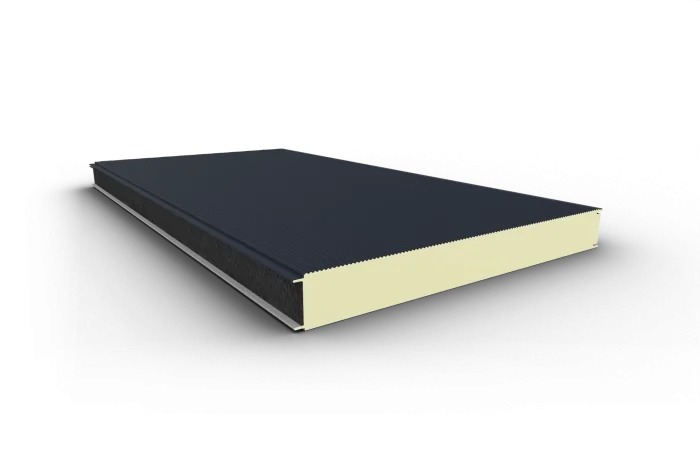
PIR wall sandwich panel with exposed fixing (standard lock) — λD 0.022, thicknesses 40–120 mm, class B-s1,d0.
λD = 0,022 W/(m·K)
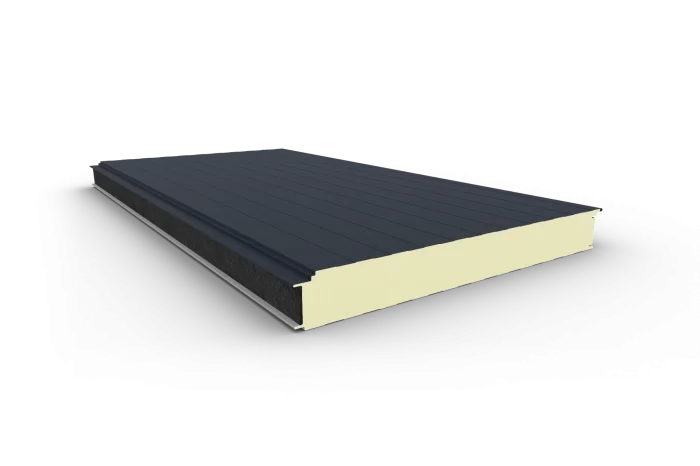
PIR wall panel with concealed fixing — module 1000 mm, λD 0.022, thicknesses 60–140 mm, EI 30.
λD = 0,022 W/(m·K)
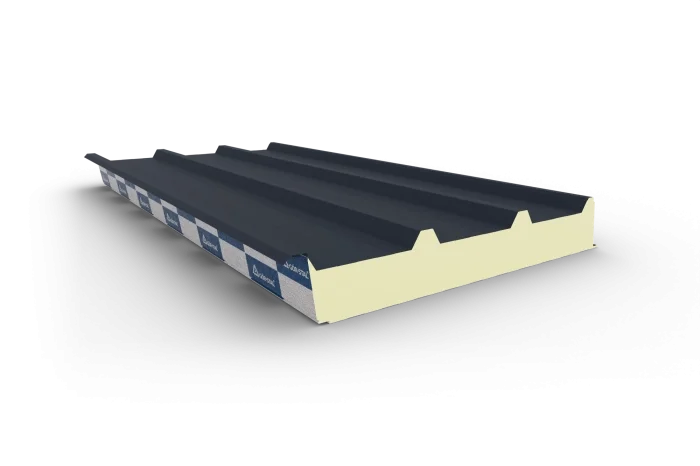
Roof PIR sandwich panel with deep external trapezoid — λD 0.022, min. pitch 3°, thicknesses 40/80–160/200 mm.
λD = 0,022 W/(m·K)
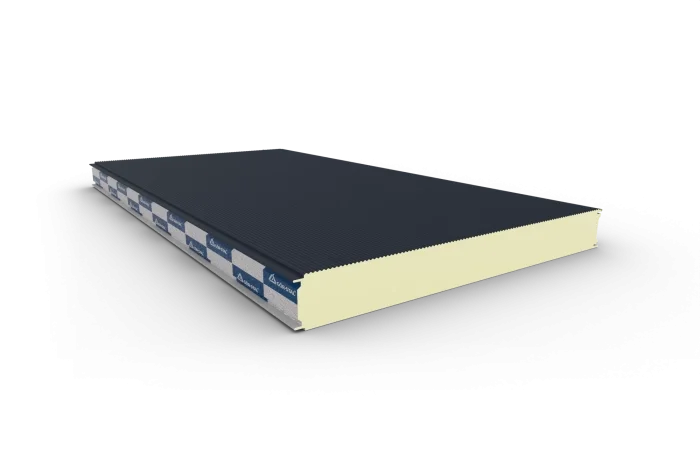
Cold storage PIR sandwich panel — λD 0.022, EI 30/EW 30, thicknesses 100–200 mm, PZH hygiene certificate.
λD = 0,022 W/(m·K)
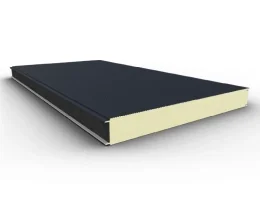
PIR wall panel with exposed fixing, MAX variant — thicknesses 80–120 mm, EI 30 (120 mm).
λD = 0,019 W/(m·K)
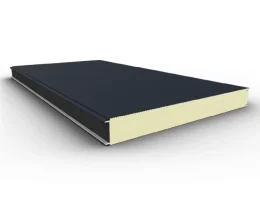
PIR wall panel with concealed fixing and modified core — λD 0.019, Ud,s 0.14 W/m²K at 140 mm.
λD = 0,019 W/(m·K)
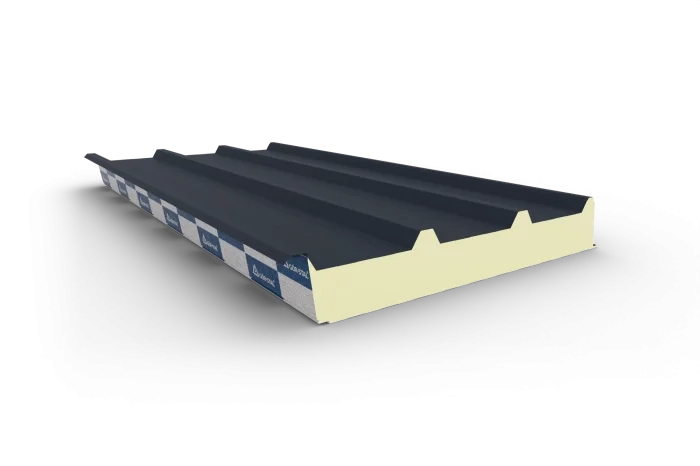
Roof PIR sandwich panel with deep trapezoid and modified core — λD 0.020, BROOF, min. pitch 3°.
λD = 0,020 W/(m·K)
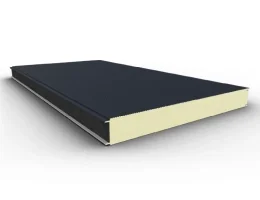
Cold storage PIR sandwich panel with modified core — λD 0.019, EI 30/EW 30, thicknesses 100–200 mm.
λD = 0,019 W/(m·K)
| Variant | Facings | Thermal conductivity (λ) | Applications |
|---|---|---|---|
| insPIRe® S | Galvanised steel sheet both sides per EN 10346, organic polyester paint 25 μm | 0,022 W/(m·K) | external cladding walls in industrial and commercial buildings, internal partition walls in skeleton construction |
| insPIRe® U | Galvanised steel sheet both sides per EN 10346, organic polyester paint 25 μm | 0,022 W/(m·K) | external cladding walls in industrial and commercial buildings, internal partition walls in skeleton construction |
| insPIRe® D | Galvanised steel sheet both sides per EN 10346, organic polyester paint 25 μm | 0,022 W/(m·K) | flat and pitched roofs of industrial halls, roofs of logistics warehouses and distribution centres |
| insPIRe® CH | Galvanised steel sheet both sides per EN 10346, organic polyester paint 25 μm | 0,022 W/(m·K) | walls and ceilings of cold stores (temperature above 0°C), walls and ceilings of freezers (temperature below 0°C) |
| insPIRe® S MAX | Galvanised steel sheet both sides per EN 10346, organic polyester paint 25 μm | 0,019 W/(m·K) | external walls in industrial and commercial construction, buildings requiring higher thermal performance than the standard S series |
| insPIRe® U MAX | Galvanised steel sheet both sides per EN 10346, organic polyester paint 25 μm | 0,019 W/(m·K) | external and internal walls with high thermal insulation requirements, low-energy and passive buildings in skeleton construction |
| insPIRe® D MAX | Galvanised steel sheet both sides per EN 10346, organic polyester paint 25 μm | 0,020 W/(m·K) | flat and pitched roofs of industrial and warehouse halls, production hall roofs with enhanced thermal insulation requirements |
| insPIRe® CH MAX | Galvanised steel sheet both sides per EN 10346, organic polyester paint 25 μm | 0,019 W/(m·K) | walls and ceilings of cold stores (temperature above 0°C), walls and ceilings of freezers (temperature below 0°C) |
An insPIRe® sandwich panel is a ready structural cladding element: two steel facings + a PIR core + the GS-Lock joint with a factory-applied gasket. It is installed directly as a hall wall or roof — without any additional cladding framework. That sets it apart from an insulation board (termPIR®), which is the insulation itself placed inside the building envelope and does not perform a load-bearing or cladding function.
Mainly industrial halls, warehouses, production facilities, cold stores and farm/utility buildings. The line has 8 variants: wall (S/U), roof (D), cold-store, and a MAX series with lower lambda. The variant is chosen for the partition type (wall/roof), thermal requirements and façade aesthetics.
PIR sandwich panels with steel facings reach a system class of B-s1,d0 / B-s2,d0 per EN 13501-1 (depending on the variant). If the project requires a non-combustible (A2) material — e.g. fire-separation walls — mineral-wool-core panels [GS MW](/en/products/plyty-warstwowe-miwo/) are used instead.
In panels with a standard joint (S) the fixing is visible on the face — an economical solution, typical for hall and warehouse façades. In panels with a hidden joint (U) the fasteners are concealed in the joint — a cleaner, linear architectural look. S and U variants should not be mixed within one partition (different fixing system).
Sandwich panels are made to order (to a specific size and colour), with a typical lead time of about 35 working days. The transport method is matched to the size and dimensions of the order — full-length panels (up to several metres) require truck transport, smaller orders can travel on a pallet. Nationwide delivery, directly to the site; unloading on the recipient's side.
Yes — we offer a complete system: sandwich-panel fasteners, flashings, tapes and gaskets, self-drilling screws. A technical advisor will prepare an accessory list matched to the project (substructure type, panel thickness, wind zone).