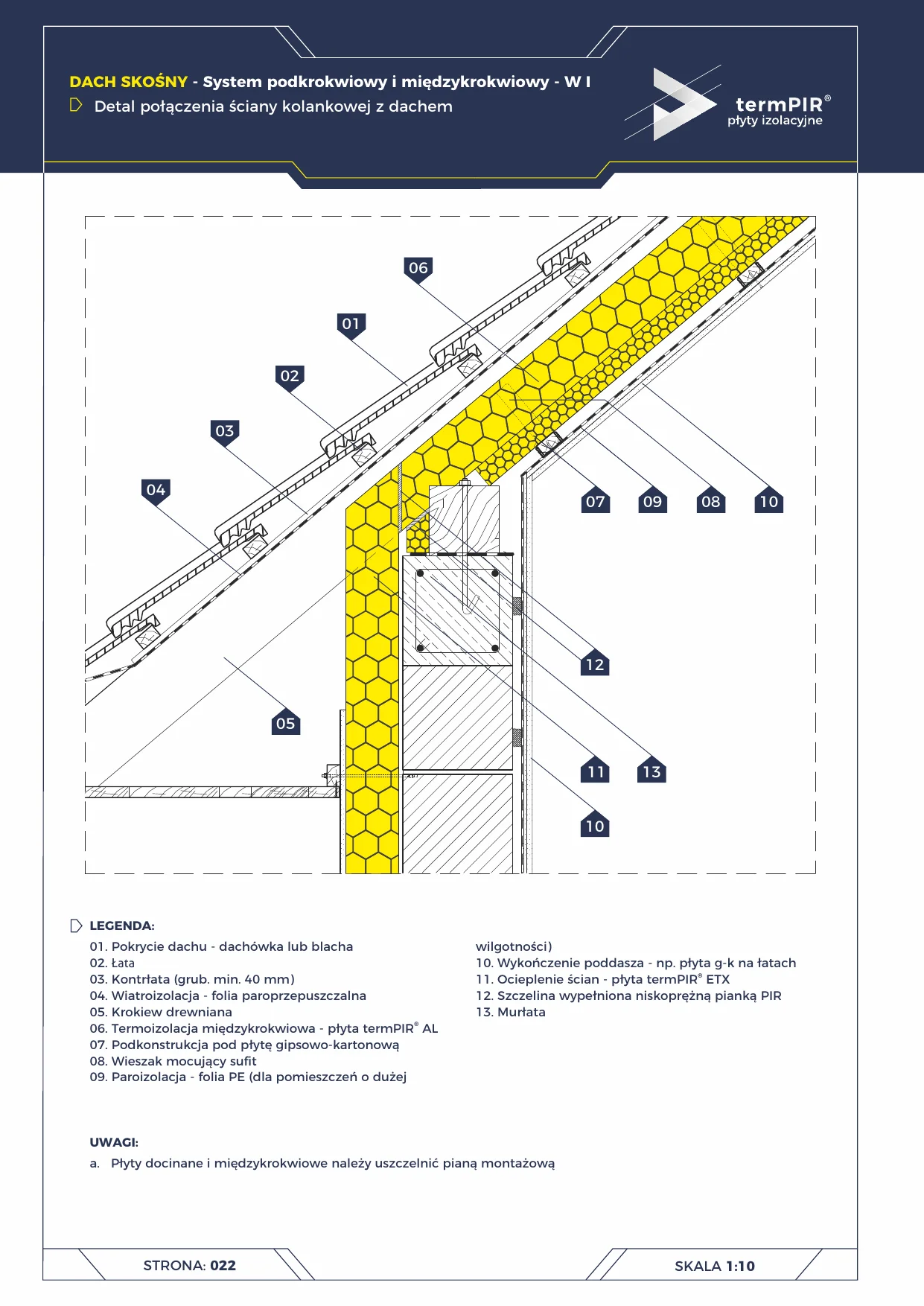
Function of the junction
The most challenging detail in a single-family house with a habitable attic — a triple-junction point:
- Pitched roof with between-rafter termPIR AL insulation (item 06).
- Knee wall insulated with ETX (item 11) on the façade side.
- Wall plate (item 13) — timber penetrating the thermal envelope.
Unlike the over-rafter system (where insulation runs above the wall plate), here the insulation is between the rafters — a geometric gap remains around the wall plate, which must be filled with low-expansion PIR foam (item 12); otherwise a thermal bridge running through the wall plate and rafters is created.
This is the most commonly observed thermographic defect in houses with habitable attics — visible as cold streaks along the rafters at the knee wall.
Critical installation aspects
- termPIR AL boards between the rafters (item 06) must be cut to ±2 mm accuracy of the rafter spacing. A fit that is too tight deforms the rafter; too loose → gap + thermal bridge.
- Geometric gap at the wall plate and the knee wall (item 12) — fill with low-expansion PIR foam (expansion ≤ 30%). Standard (PU) foam expands 200%+ → will push the boards out.
- Under-rafter insulation (a second layer beneath the rafters) eliminates the bridge running through the timber rafter itself — without it, the rafter is a thermal bridge along its entire length.
- The wall plate (item 13) must be wrapped in an insulating strip — either from above (before the wind barrier) or from below (before the vapour barrier); ideally on both sides.
- The PE vapour barrier (item 09) must run continuously from the ceiling onto the knee wall strip. Lack of continuity → vapour condensation in the insulation.
Between-rafter vs over-rafter
| Aspect | Between-rafter (this) | Over-rafter (see) |
|---|---|---|
| Insulation location | between rafters | on rafters (from above) |
| Rafter thermal bridge | present (timber lambda 0.15) | eliminated |
| Wall plate thermal bridge | requires separate insulation | eliminated |
| Roof height | unchanged | +18–25 cm |
| Cost | base | +30–40% |
| Typical use | renovations, refurbishments | new low-energy builds |
Used in the pitched roof termPIR between-rafter system.
Documentation
termPIR catalogue — Single-Family Houses, p. 22 — pitched roof W I, junction with the knee wall.
Components in this junction
Panel (2)
- 06
- 11
Fastener (1)
- 08 Ceiling hanger
Sealant (1)
- 12 Gap filled with low-expansion PIR foam
Element (9)
- 01 Roof covering — tiles or metal sheet
- 02 Battens
- 03 Counter-battens (min. 40 mm thick)
- 04 Wind barrier — vapour-permeable membrane
- 05 Timber rafter
- 07 Substructure for plasterboard
- 09 Vapour barrier — PE film (for rooms with high humidity)
- 10 Attic finish — e.g. plasterboard on battens
- 13 Wall plate