When to choose this system
A three-layer foundation is selected when:
- Premium villa with brick façade reaching ground level — the clinker does not end at the plinth but continues down to ground level. The internal foundation structure must also meet premium standards.
- Full habitable basement — when the basement is to be used as a residential or office space (not just a utility area), the three-layer structure protects the insulation from damage.
- Heritage buildings — foundation reconstruction — restoring a historic brick façade with a modern U-value.
- Public buildings — offices, archives, libraries with full basements — where the lifespan of the structure should exceed 100 years.
Three-layer construction — rationale
In contrast to a two-layer foundation (wall + insulation + dimpled membrane), here we have:
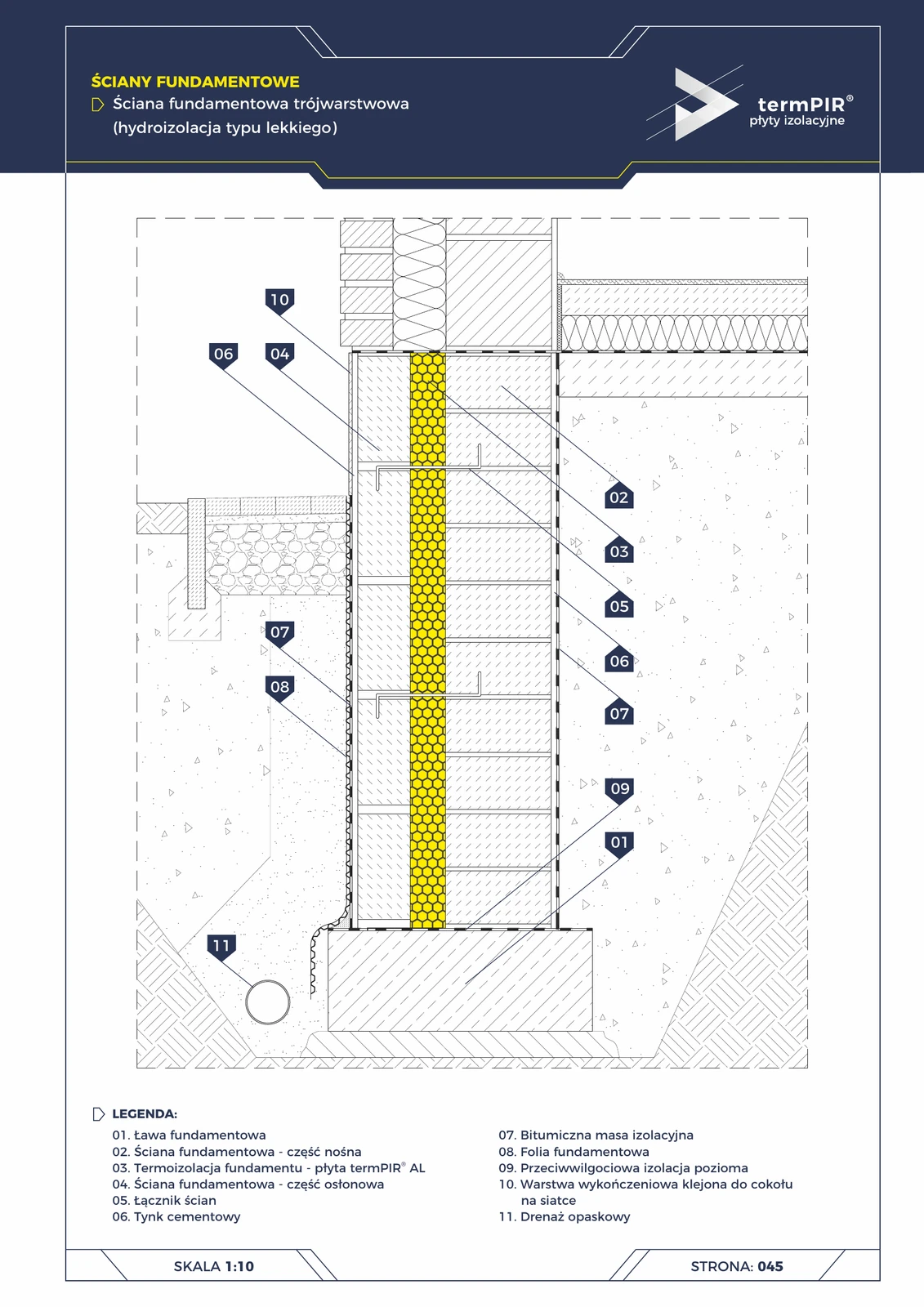
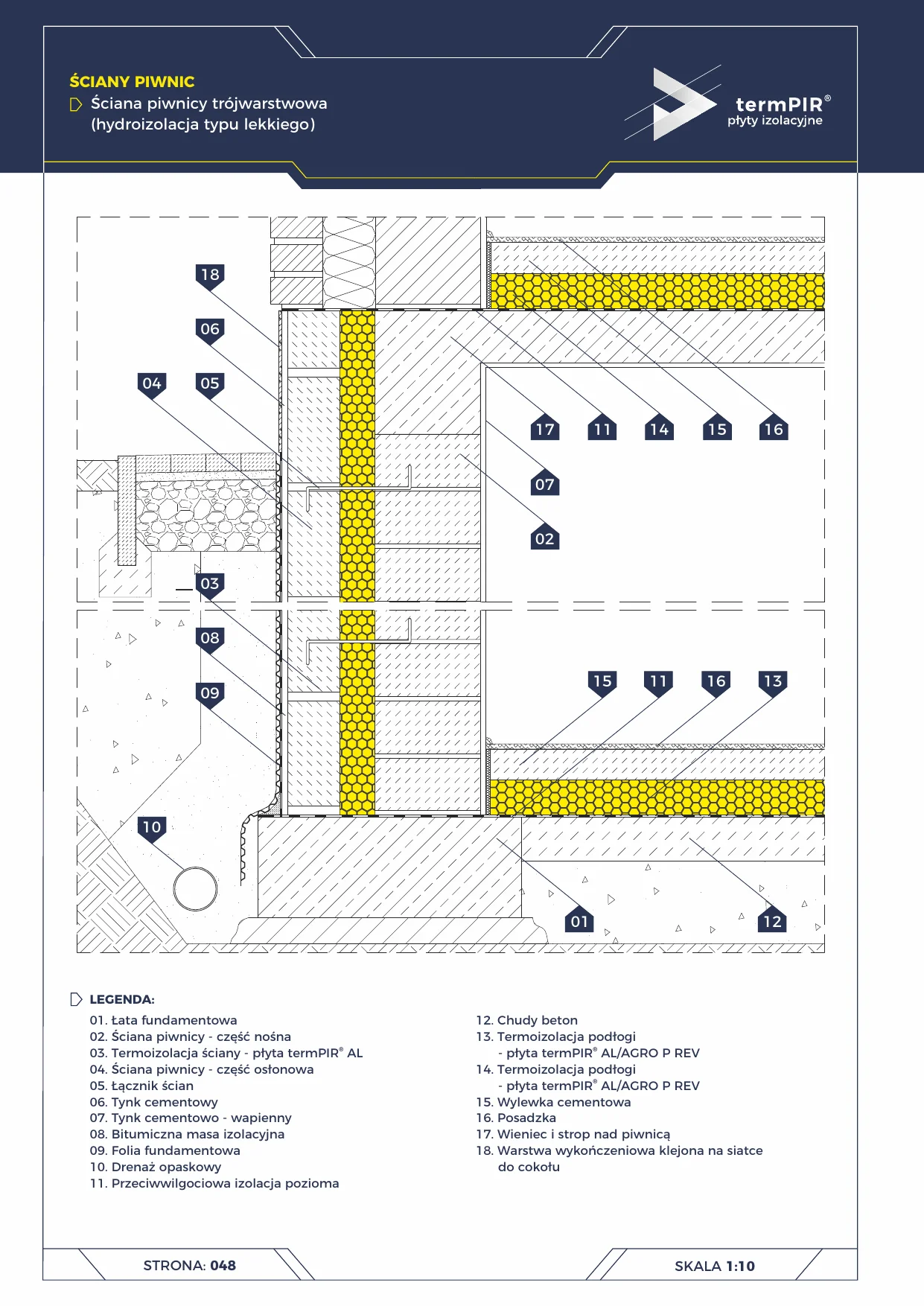
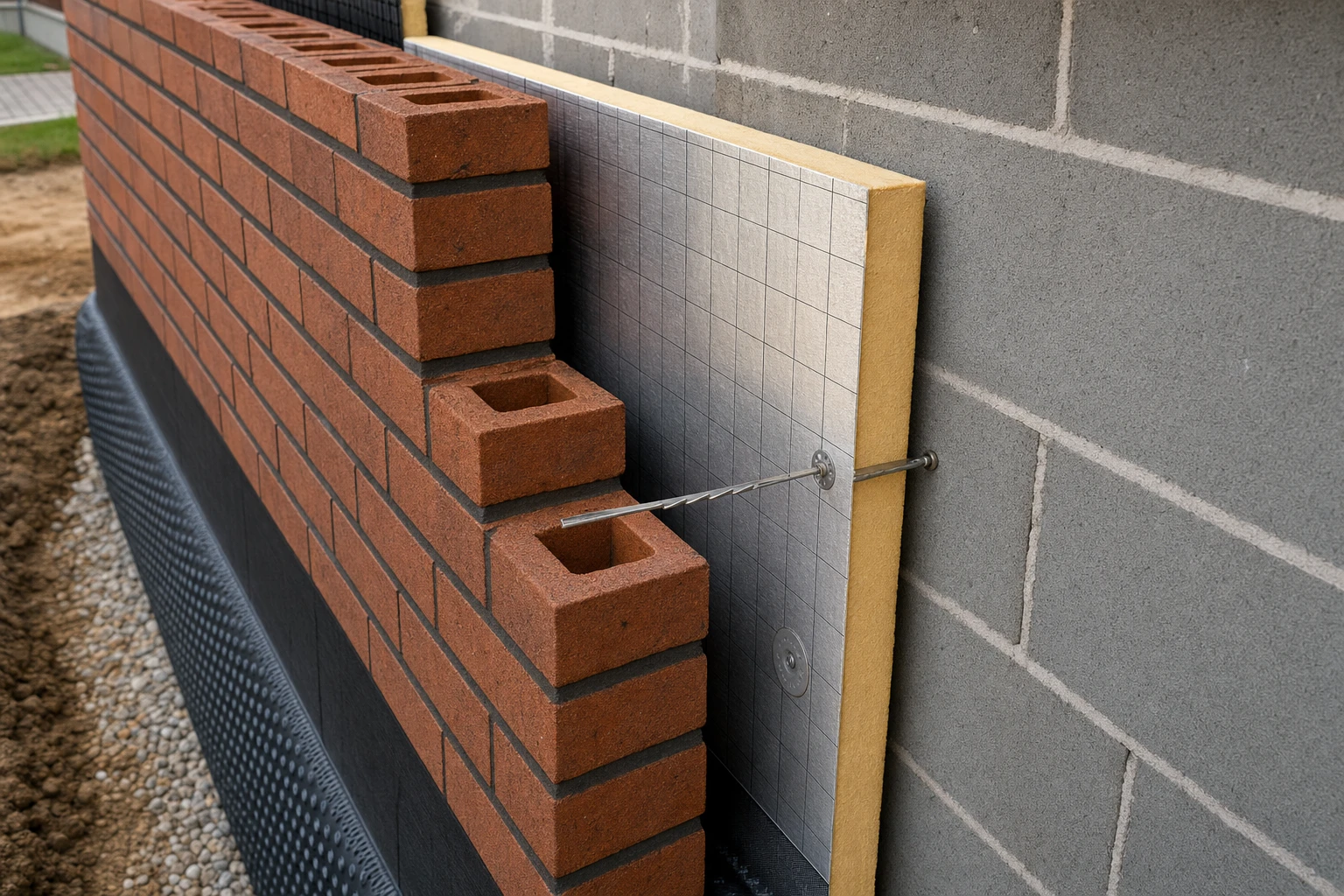
- Inner load-bearing leaf — carries the loads from the building (reinforced concrete or concrete blocks).
- Cavity with termPIR® insulation — protected on both sides, with no contact with the ground or water.
- Outer facing leaf — concrete blocks or clinker brick — providing protection and aesthetic finish.
Key advantage: the insulation is not exposed to mechanical or biological hazards. No risk of damage during backfilling, no risk of corrosion from groundwater.
Installation requirements
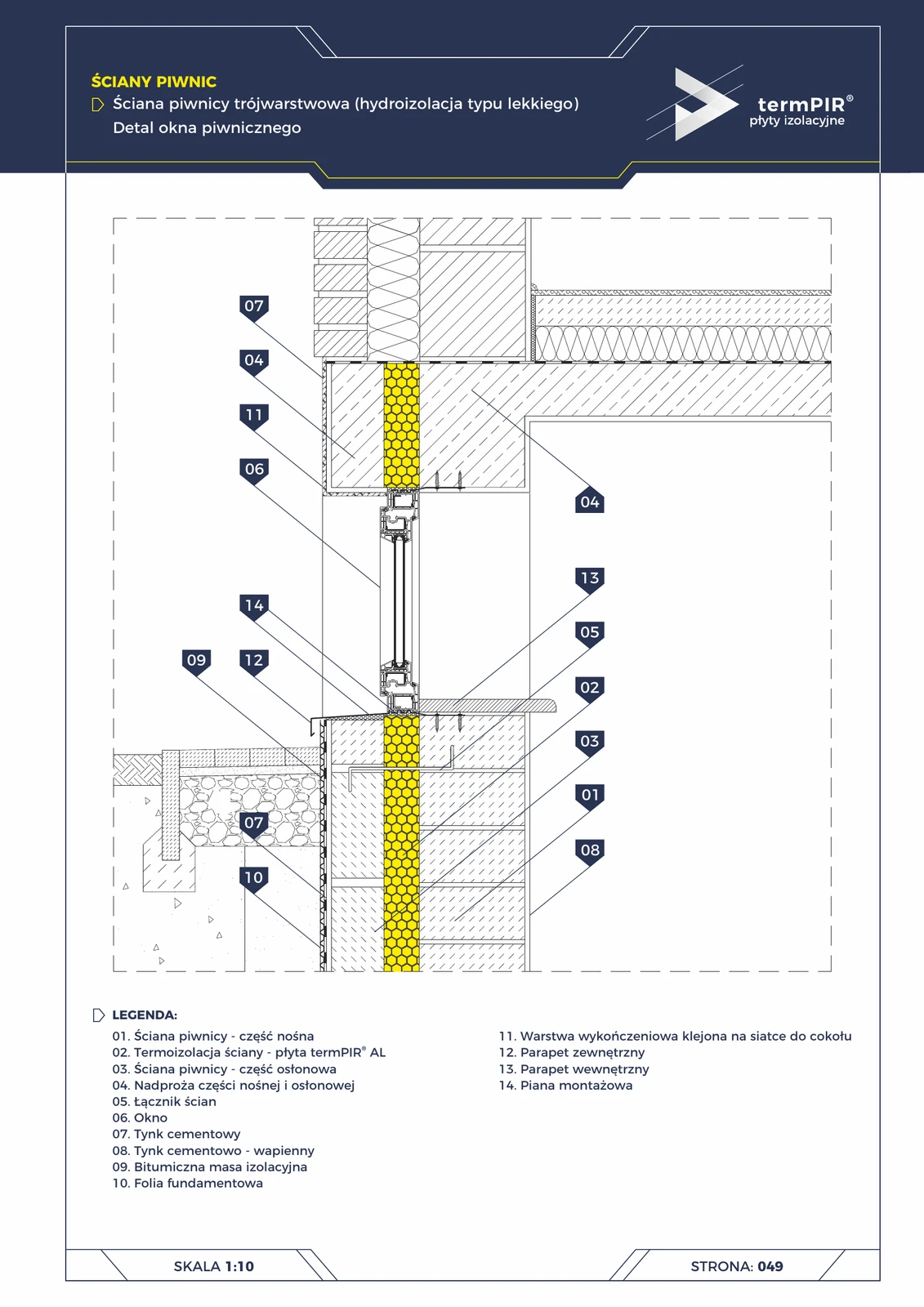
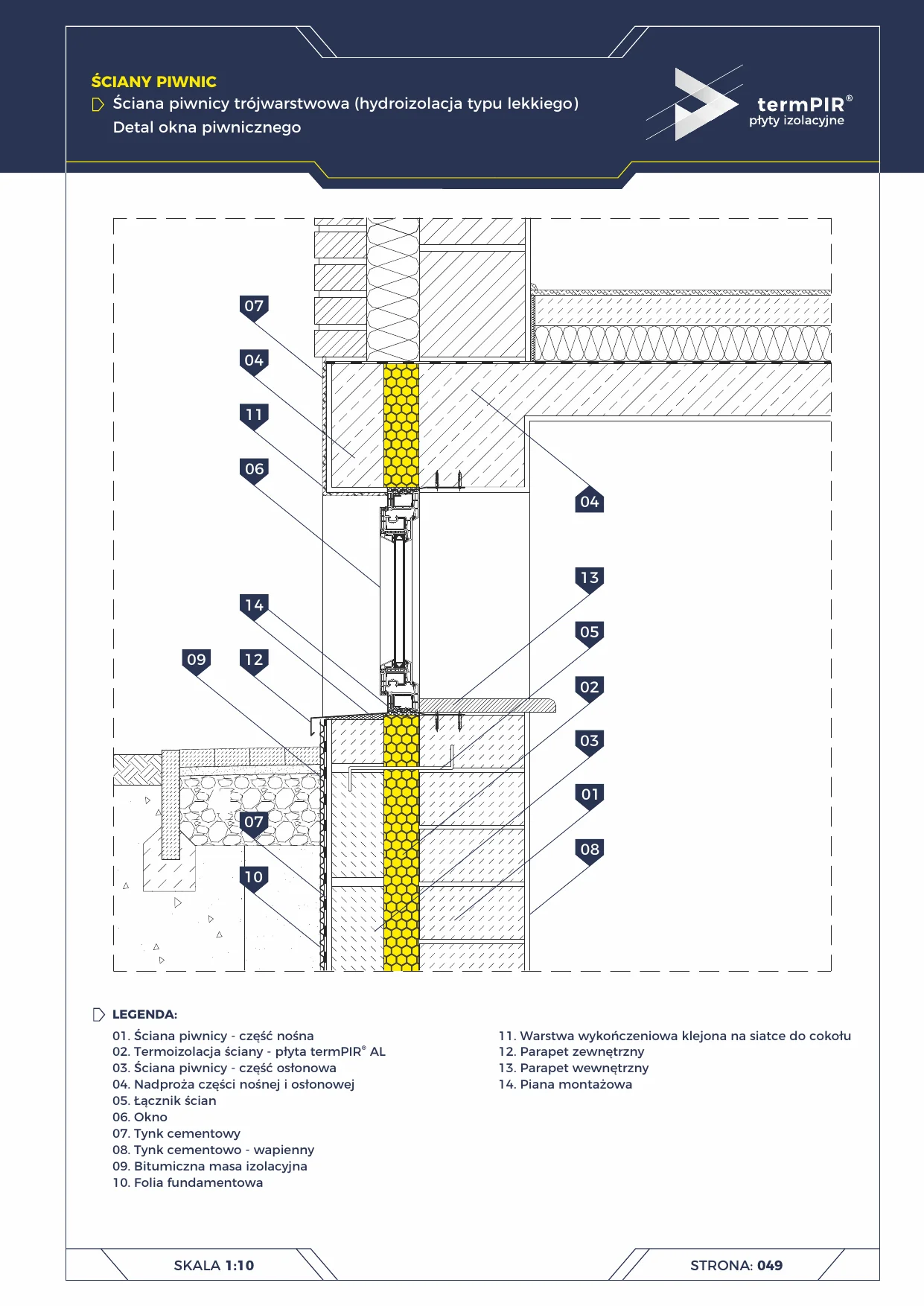
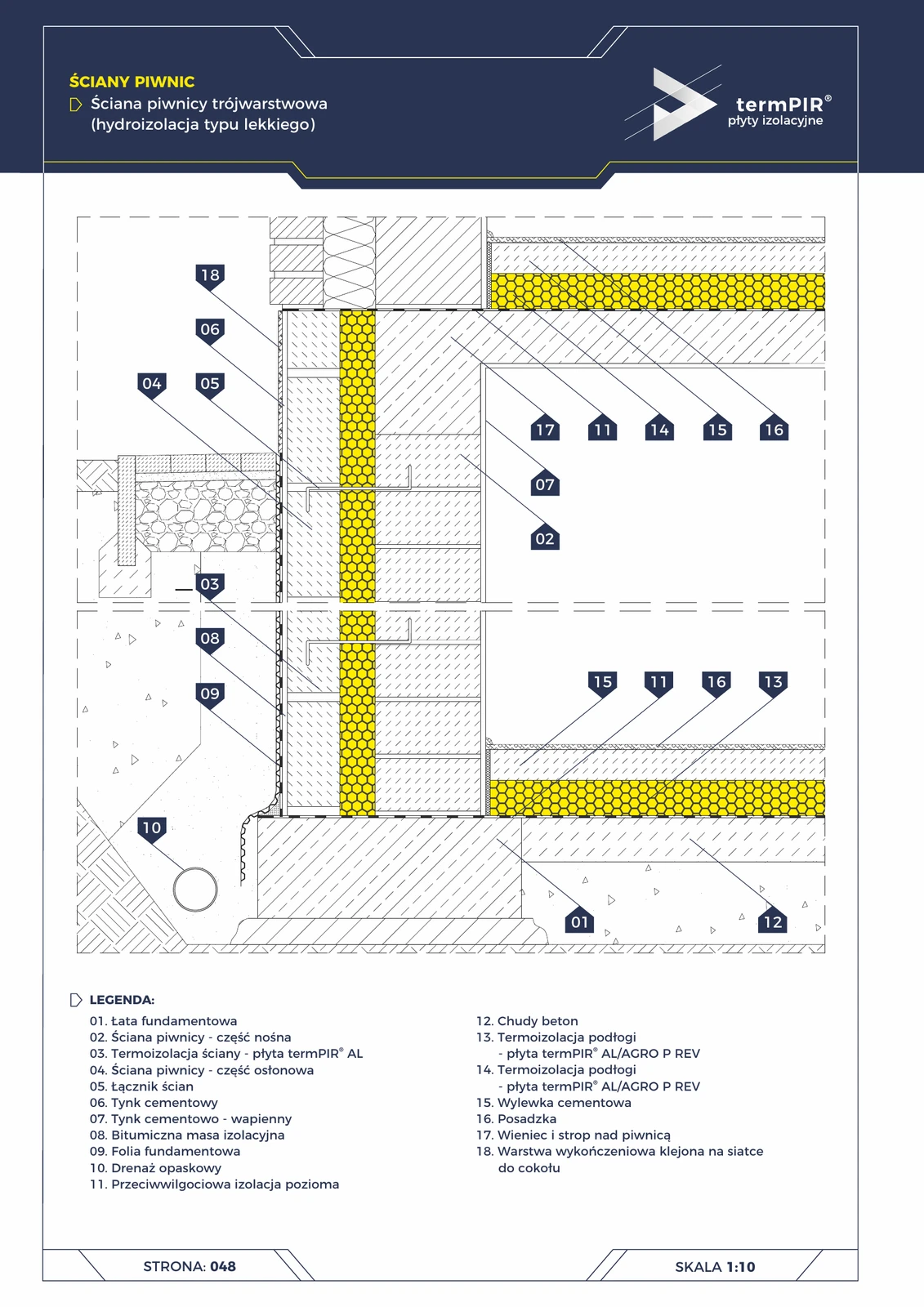
- Construction sequence: load-bearing leaf → cement render → steel ties at 0.5 m × 0.5 m spacing → termPIR® AL boards bonded to the render → facing leaf.
- Steel ties — stainless steel A2 (typically 6 mm × 200 mm), 4 pcs/m². Galvanised black steel is unsuitable (corrodes over the long service life).
- Waterproofing — applied to the external surface of the facing leaf (as in a two-layer foundation). The termPIR® insulation between the leaves forms a dry cavity.
- Horizontal damp-proof course — required at horizontal joints: foundation-to-ground boundary, connection with the foundation slab.
- Perimeter drainage — unchanged, as in the two-layer system.
Economics vs two-layer
| Aspect | Two-layer | Three-layer (this system) |
|---|---|---|
| Material cost | baseline | +30–40% (facing leaf) |
| Masonry labour | shorter (one leaf) | longer (two leaves) |
| Construction time | shorter | longer |
| Risk of insulation damage | moderate (dimpled membrane) | minimal (protective leaf) |
| System lifespan | 50–80 years | 100+ years |
| Plinth façade aesthetics | render / mosaic | continuous clinker |
Technical documentation
termPIR® Catalogue — Residential Buildings (Gór-Stal, 2022-04-26, pp. 35, 45). Three-layer construction is recommended in the premium segment and for facilities requiring a service life of more than 100 years.
Layer composition
| # | Layer | Thickness | λ | Role |
|---|---|---|---|---|
| 1 | Foundation wall — load-bearing leaf | — | — | load-bearing structure |
| 2 | Cement render | — | — | substrate levelling |
| 3 | termPIR® AL | 80–110 mm | 0,022 W/(m·K) | thermal insulation |
| 4 | Foundation wall — facing leaf (blocks / brick) | — | — | insulation protection |
| 5 | Wall ties (steel anchors) | — | — | connection between load-bearing and facing leaves |
| 6 | Bituminous waterproofing compound | — | — | external waterproofing of the facing leaf |
| 7 | Foundation membrane (dimpled) | — | — | mechanical protection of waterproofing |
| 8 | Perimeter drainage | — | — | groundwater drainage |
U-value by insulation thickness
| termPIR® thickness | U [W/m²·K] | Meets WT 2021 (roof U ≤ 0.15) |
|---|---|---|
| 80 mm | 0,26 | — no |
| 100 mm | 0,21 | — no |
| 110 mm | 0,19 | — no |
Related catalogue items
Recommended variants
Installation accessories