PIR Insulation for Ground-Bearing Floors — WT 2021 Compliance
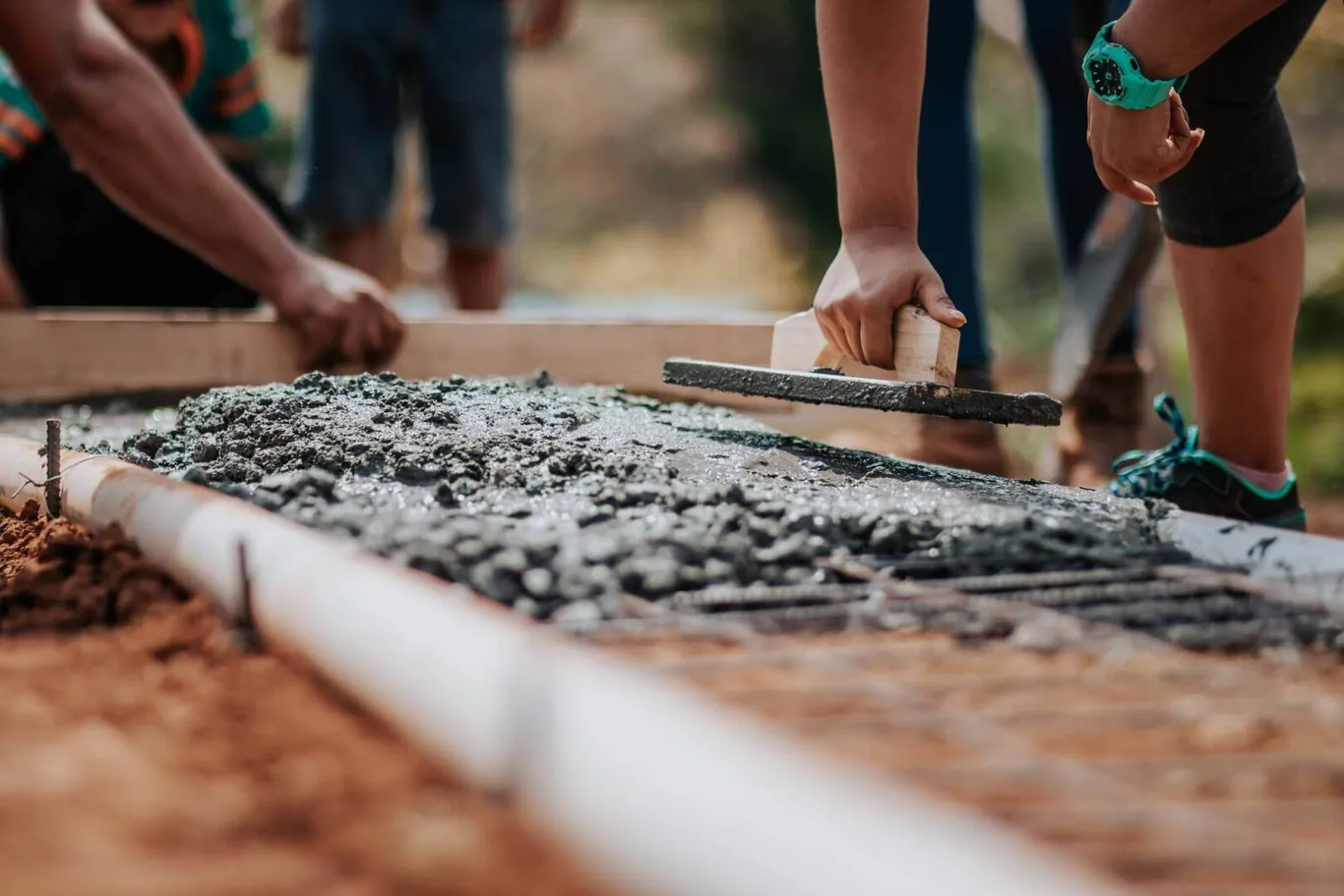
Insulating a ground-bearing floor with PIR boards — layer build-up, thicknesses and WT 2021 requirements
A ground-bearing floor is the standard solution in single-family masonry houses, warehouses, agricultural buildings and logistics facilities. It is also one of the largest surfaces through which heat escapes into the ground — its thermal insulation directly determines both occupant comfort and the building’s energy balance. In this article we show how to design and install a ground-bearing floor insulation system using PIR insulation boards that meets WT 2021 (Polish Technical Conditions 2021) requirements (U ≤ 0.30 W/m²K).
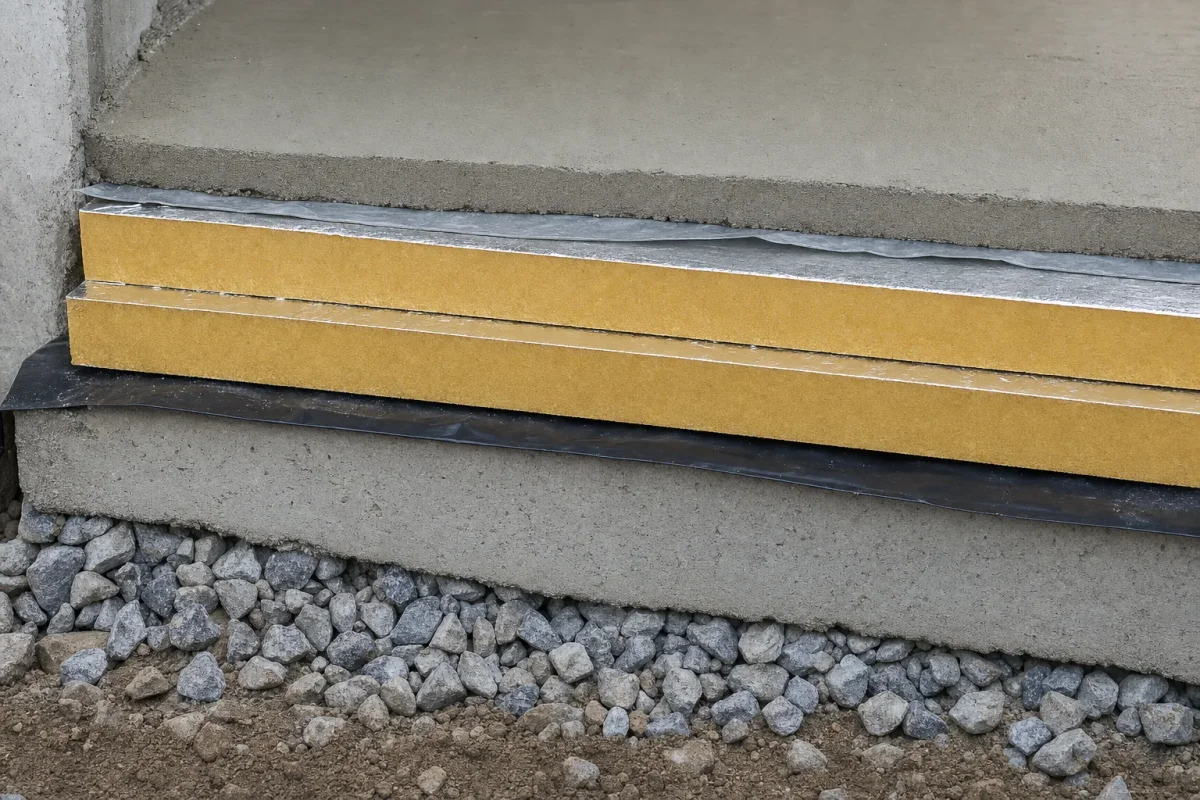
Ground-bearing floor build-up — layer sequence
A ground-bearing floor is a multi-layer assembly resting directly on a compacted sub-base within the footprint of the foundation walls. The standard build-up from the bottom up is:
- Compacted sub-base — sand-gravel mix or crushed aggregate (15–30 cm, compaction Is ≥ 0.97),
- Lean concrete — levelling slab 8–10 cm thick (C8/10 or C12/15),
- Damp-proof/waterproof membrane — heat-welded bitumen felt or 0.3 mm PE sheet in two overlapping layers,
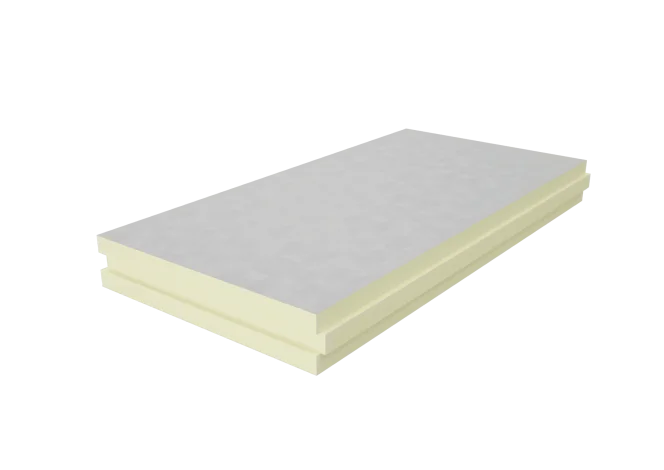
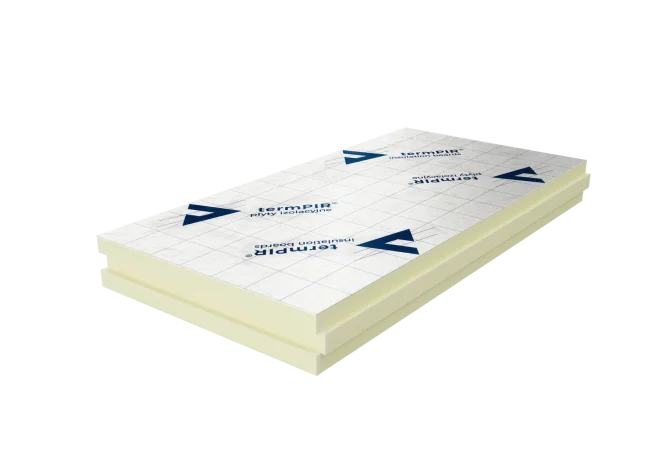
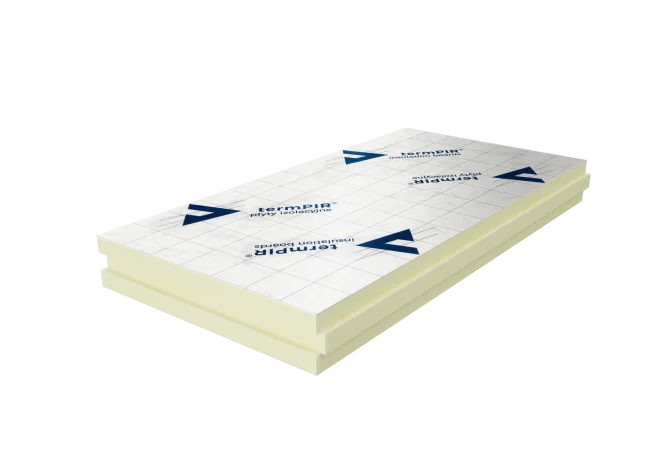
- Thermal insulation — PIR boards with low λD and adequate compressive strength,
- PE separation foil (separation from the screed),
- Cement or anhydrite screed — 4–8 cm (6–8 cm with underfloor heating),
- Finished floor — tiles, panels, resin, vinyl.
The thickness of the structural layers depends on the imposed load. In residential rooms the screed is typically 4–5 cm, in garages and utility rooms 6–10 cm. In warehouses and logistics facilities an industrial floor 15–25 cm thick is specified.
WT 2021 requirements and PIR thickness selection
Under the Polish Technical Conditions in force since 1 January 2021, the thermal transmittance U of a ground-bearing floor in a heated space must not exceed 0.30 W/m²K. For rooms with a design temperature of 8–16 °C the limit is 1.20 W/m²K, but in practice designers aim for significantly lower values to meet energy-efficiency targets and certifications (WT+, NF15, BREEAM/LEED).
PIR boards reach the required U-value at a much smaller thickness than EPS or mineral wool. The table below shows approximate thermal resistance R values and the contribution of the insulation layer alone to the overall U-value for termPIR® AL with λD = 0.022 W/(m·K):
| PIR thickness | R = d/λD [m²K/W] | U of insulation alone [W/m²K] |
|---|---|---|
| 80 mm | 3.64 | 0.275 |
| 100 mm | 4.55 | 0.220 |
| 120 mm | 5.45 | 0.183 |
| 140 mm | 6.36 | 0.157 |
| 150 mm | 6.82 | 0.147 |
| 180 mm | 8.18 | 0.122 |
| 200 mm | 9.09 | 0.110 |
In residential practice, 120–150 mm of PIR is installed in a single layer, or as a two-layer arrangement of 2×80 mm or 80+100 mm (the two-layer termPIR® AL ground-bearing floor system) with offset joints — this eliminates linear thermal bridges at board edges. For premium projects with λD = 0.019 W/(m·K) use termPIR® MAX 19 AL — 120 mm is enough to achieve U ≈ 0.135 W/m²K.
Mechanical loads — compressive strength
Insulation in a ground-bearing floor transfers static and dynamic loads from the screed and finished floor. EN 13165 defines CS(10\Y) classes — compressive stress at 10% strain. Standard termPIR® boards offer a compressive strength of CS(10\Y) ≥ 120–150 kPa, which is more than sufficient for:
- residential and office floors (imposed load 1.5–3.0 kN/m²),
- single-family garages (category F, vehicles up to 3 t),
- utility rooms and basements.
In damp conditions — high groundwater level, garages without capillary break, plinth zones — consider termPIR® WS with enhanced moisture resistance. The long-term water absorption of PIR is low (WL(T) ≤ 3% per EN 12087), but the dedicated WS variant provides additional safety margin in foundation details and transitions to the plinth system.
Underfloor heating — installation planning
A ground-bearing floor is a multifunctional layer — before construction begins, all services have to be precisely planned: underfloor heating loops (PE-Xa/PE-RT), drainage, water supply, electrical conduit. Corrections after the screed has been poured require chasing and are expensive.
With underfloor heating, PIR boards act as a reflective screen — the aluminium facing on termPIR® AL directs the heat flux upward, reducing losses into the ground by 5–8% compared with insulation without a reflective foil. Heating loops are fixed to a mesh laid on the insulation or to dedicated system mats. A separation foil between the PIR and the screed is mandatory — it prevents cement laitance from seeping into the joints and protects the aluminium facing.
Installation details — what determines durability
Joints and edge profiles. termPIR® boards are available with FIT (square edge), LAP (rebated) and TAG (tongue-and-groove) profiles. For floors, FIT in a two-layer arrangement or TAG in a single layer is the usual choice — tongue-and-groove eliminates linear thermal bridges at the joints.
Taping. Joints in the aluminium facing are sealed with aluminium tape at least 50 mm wide — this maintains the continuity of the reflective layer and limits moisture migration through the joints.
Perimeter expansion strip. A 10 mm PE or PIR strip is run along the foundation walls — it accommodates thermal expansion of the screed (particularly critical with underfloor heating).
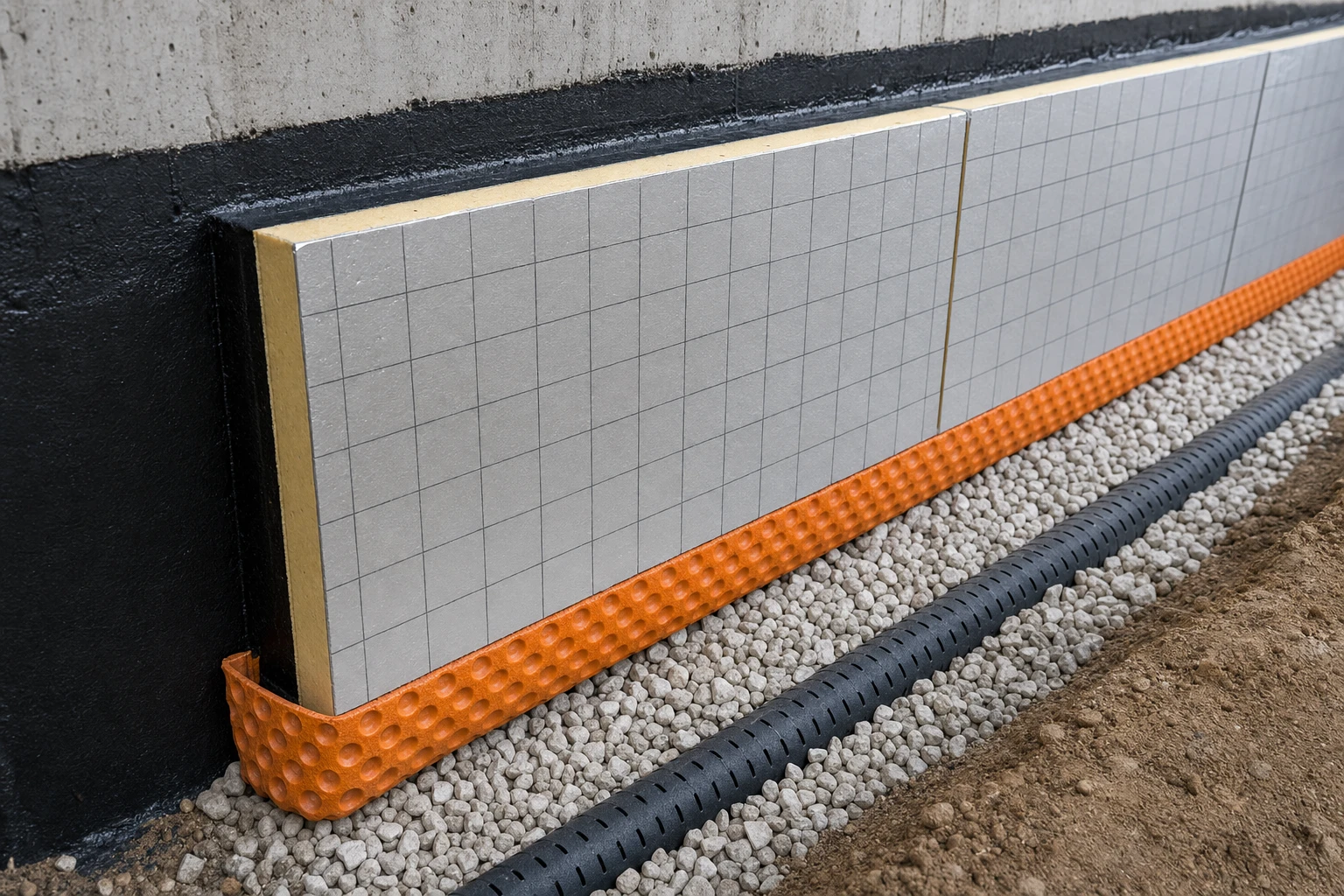
Waterproofing. PIR boards are laid dry on the waterproofing layer — full continuity of the vapour barrier on the cold side (ground) is the precondition for long-term durability of the entire assembly.
Frequently asked questions
What PIR thickness should be used under underfloor heating in a single-family house?
Will PIR boards withstand garage loads?
Is a vapour barrier needed under PIR?
PIR or EPS 100 for a ground-bearing floor?
Is termPIR® WS necessary in a ground-bearing floor?
Related products and systems
Products
Building systems
Read next

Energy Retrofit with PIR Boards and WT 2021 in Practice | BOKKA

Retrofitting Old Houses with PIR Boards — Energy Upgrade Guide
Thermal Bridges — How to Eliminate Them with PIR Boards (WT 2021)