When to use this system
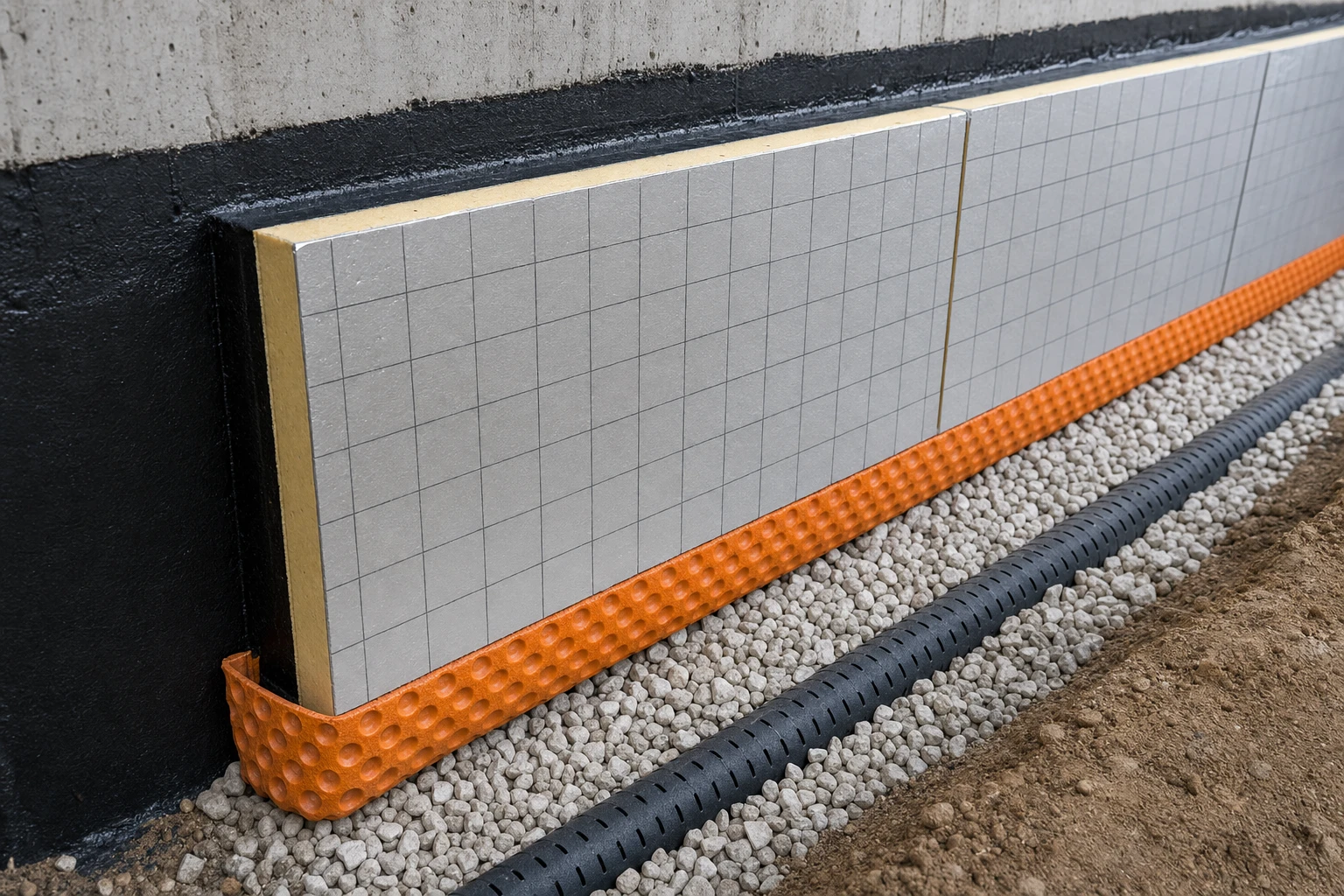
Foundation insulation with termPIR® AL on the external side (before backfilling) is the standard in modern construction for:
- Single-family house with a basement — insulating basement walls reduces heat losses from the lower storey by 40–60%.
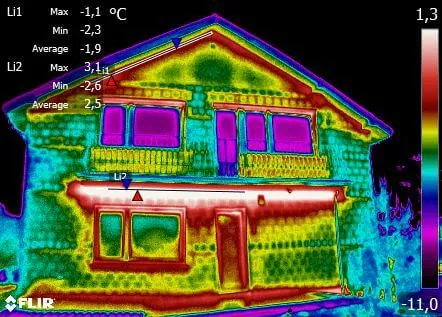
- House without a basement, with a slab on grade — plinth insulation eliminates the thermal bridge at the floor–external wall interface (typically ~10% of building losses).
- Passive and energy-efficient buildings — a continuous insulation layer without interruption at the plinth is required.
- Commercial buildings — warehouses, production halls with slab on grade heated to +12°C in winter.
Why PIR rather than XPS in the foundation
| Aspect | termPIR® AL | XPS (styrodur) |
|---|---|---|
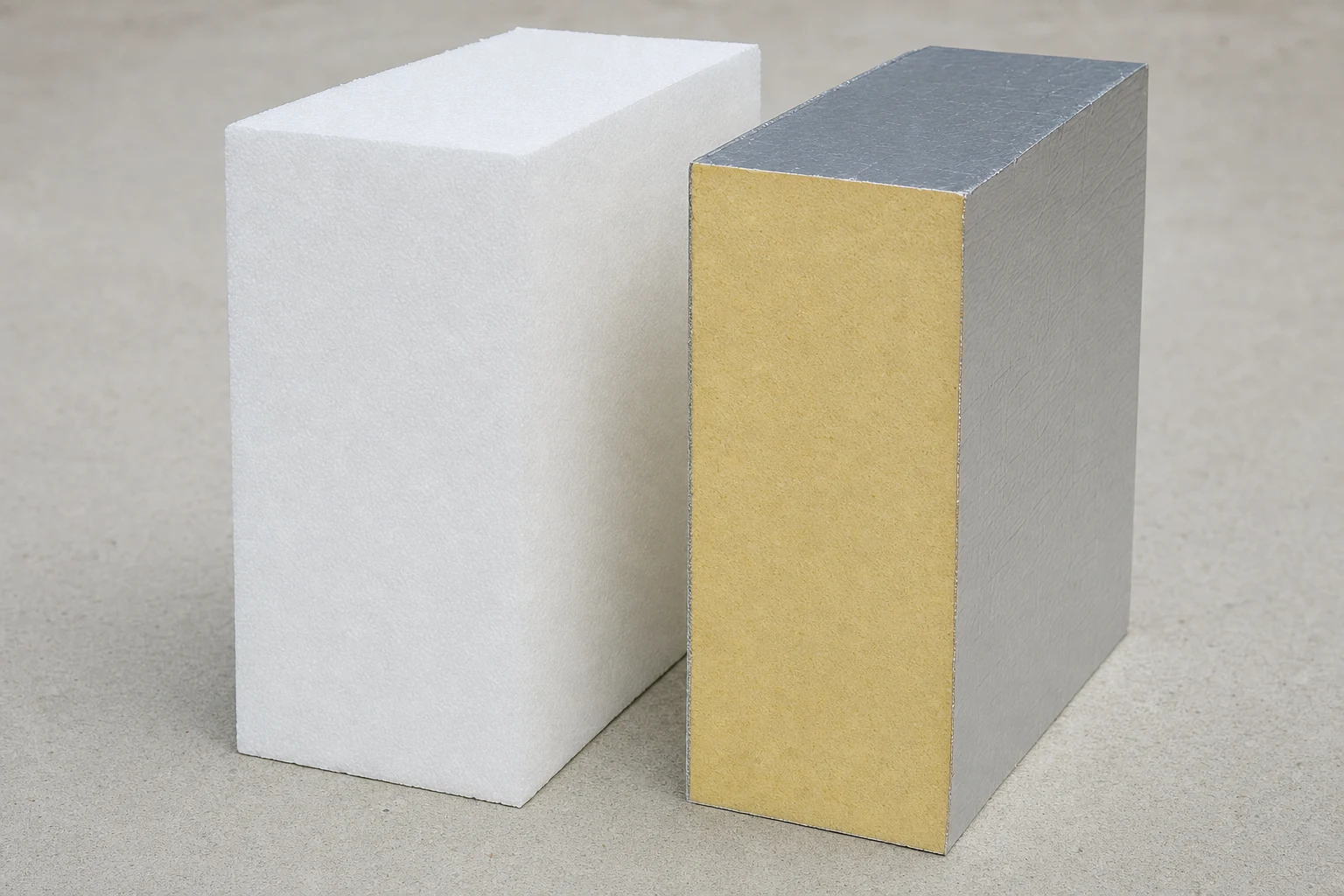
| λ | 0.022 W/(m·K) | 0.034–0.036 W/(m·K) |
| Thickness for U ≤ 0.25 | 90 mm | ~140 mm |
| Water absorption | < 2% | < 1% |
| Compressive strength | ≥120 kPa | 200–700 kPa |
| Rodent resistance | full | full |
| Price vs. efficiency | higher price/m³, lower thickness | cheaper/m³, greater thickness |
PIR is worthwhile when:
- space for the insulation layer is limited (narrow gap when backfilling the excavation)
- you want to unify the insulation material across the whole building (the same termPIR® AL in foundation, walls and roof)
- you are building to passive standard (U below 0.15 required)
Installation requirements
- Waterproofing MUST be placed beneath the insulation — cold-applied bitumen membrane (e.g. Hyperdesmo) or 2-component bituminous coating. PIR does not replace waterproofing.
- Fixing — universal PU adhesives (e.g. Foamglas Adhesive) over the entire surface, alternatively bonding with butyl tapes at corners.
- Protect the insulation from backfilling — geotextile or dimpled membrane on the side facing the soil backfill, protects against mechanical damage.
- Above-ground plinth — above ground level a transition to termPIR® ETX (ETICS) or mosaic plinth render is recommended.
Technical documentation
termPIR® 2025 folder (Gór-Stal, 2025-04-23, pp. 12–13). Waterproofness confirmed by class WL(T)2 per EN 1609 (≤ 2% by weight). Biological resistance confirmed per EN 1604 (dimensional stability).
Layer composition
| # | Layer | Thickness | λ | Role |
|---|---|---|---|---|
| 1 | termPIR® AL | 80–250 mm | 0,022 W/(m·K) | thermal insulation of foundation / plinth (external side) |
| 2 | Waterproofing layer (heat-welded bitumen membrane / bituminous coating) | — | — | foundation wall waterproofing |
| 3 | Foundation wall / foundation (concrete, concrete blocks) | — | — | load-bearing structure |
U-value by insulation thickness
| termPIR® thickness | U [W/m²·K] | Meets WT 2021 (roof U ≤ 0.15) |
|---|---|---|
| 80 mm | 0,26 | — no |
| 100 mm | 0,21 | — no |
| 120 mm | 0,18 | — no |
| 150 mm | 0,14 | ✓ yes |
| 180 mm | 0,12 | ✓ yes |
| 200 mm | 0,11 | ✓ yes |
| 250 mm | 0,08 | ✓ yes |
Related catalogue items
Recommended variants
Installation accessories