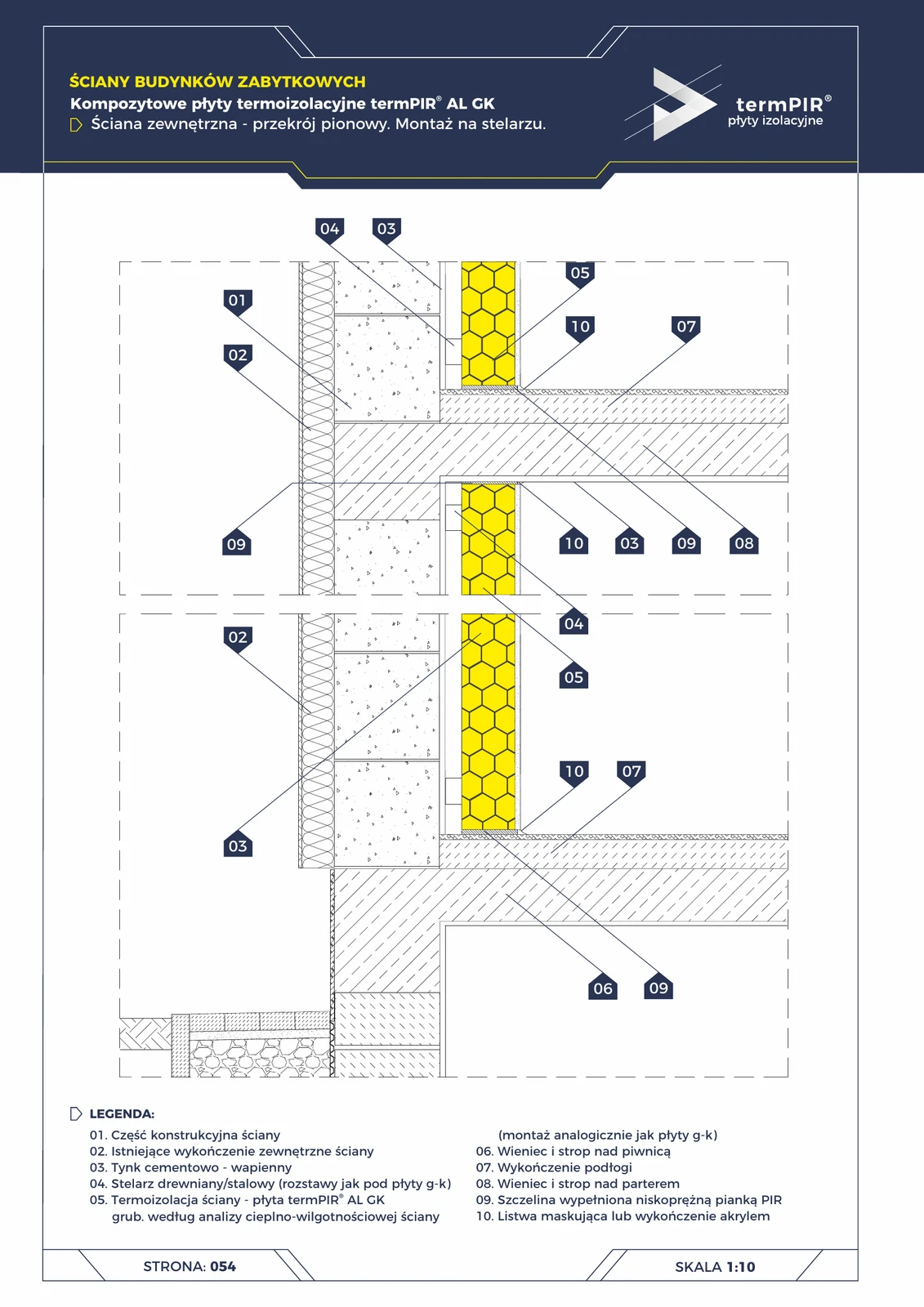
Junction function
Heritage AL GK insulation on framing = adhesive variant (p. 52) when direct bonding is not feasible:
- Uneven internal wall (deviation greater than 10 mm/m) — framing levels the plane.
- Unstable plaster — detaching, flaking, mouldy → adhesive will not hold.
- Concealed services required (cables, pipes) → space within the framing.
- High wall moisture — a 2–3 cm gap between the wall and the insulation allows the structure to ventilate.
Framing as for conventional plasterboard but thicker by the insulation thickness:
- CD60 + UD + longer hangers — for AL GK 50+12.5 mm, a profile depth of 70–80 mm is needed.
- Or timber 50×60 mm fixed to the wall with chemical anchors (heritage = chemical or mechanical anchors, NOT expansion plugs which crack the masonry).
Critical installation aspects
- Framing (item 04) — impregnated timber or steel CD60+UD profile; vertical spacing 40–60 cm (as for plasterboard); anchored to masonry with chemical anchors (Hilti HIT-RE 500 / Fischer SuperBond).
- Space between wall and AL GK board = natural ventilation of the wall structure (2–3 cm); assists with moisture balance in old walls lacking horizontal damp-proofing.
- No insulation within the framing cavity — unlike typical plasterboard with mineral wool inside, here the cavity remains empty (air acts as additional insulation).
- AL GK board (item 05) fixed to profiles with screws — analogous to plasterboard; 3 mm expansion gap between boards, joints filled with jointing compound.
- Perimeter gap (item 09) — low-expansion PIR foam; decorative cover trim (item 10).
- Thermal bridging through framing — timber (λ ≈ 0.13) or steel (λ ≈ 50!) creates point thermal bridges; steel is thermally worse — prefer timber where the building is highly energy-efficient. Steel CD60 = 5–8% loss of insulation effectiveness.
Documentation
Technical Catalogue termPIR® — Residential Buildings (Gór-Stal 2022), page 52 — Historic wall AL GK, vertical section, framing installation. Scale 1:10.
Components in this junction
Insulation (1)
- 05 Wall thermal insulation — termPIR® AL GK board (installation as for plasterboard)
Flashing (1)
- 10 Cover trim or acrylic finish
Sealant (1)
- 09 Gap filled with low-expansion PIR foam
Element (7)
- 01 Wall structural part
- 02 Existing external wall finish
- 03 Cement–lime plaster
- 04 Timber or steel framing (spacing as for plasterboard, CD60/UD)
- 06 Ring beam and floor slab above basement
- 07 Floor finish
- 08 Ring beam and floor slab above ground floor