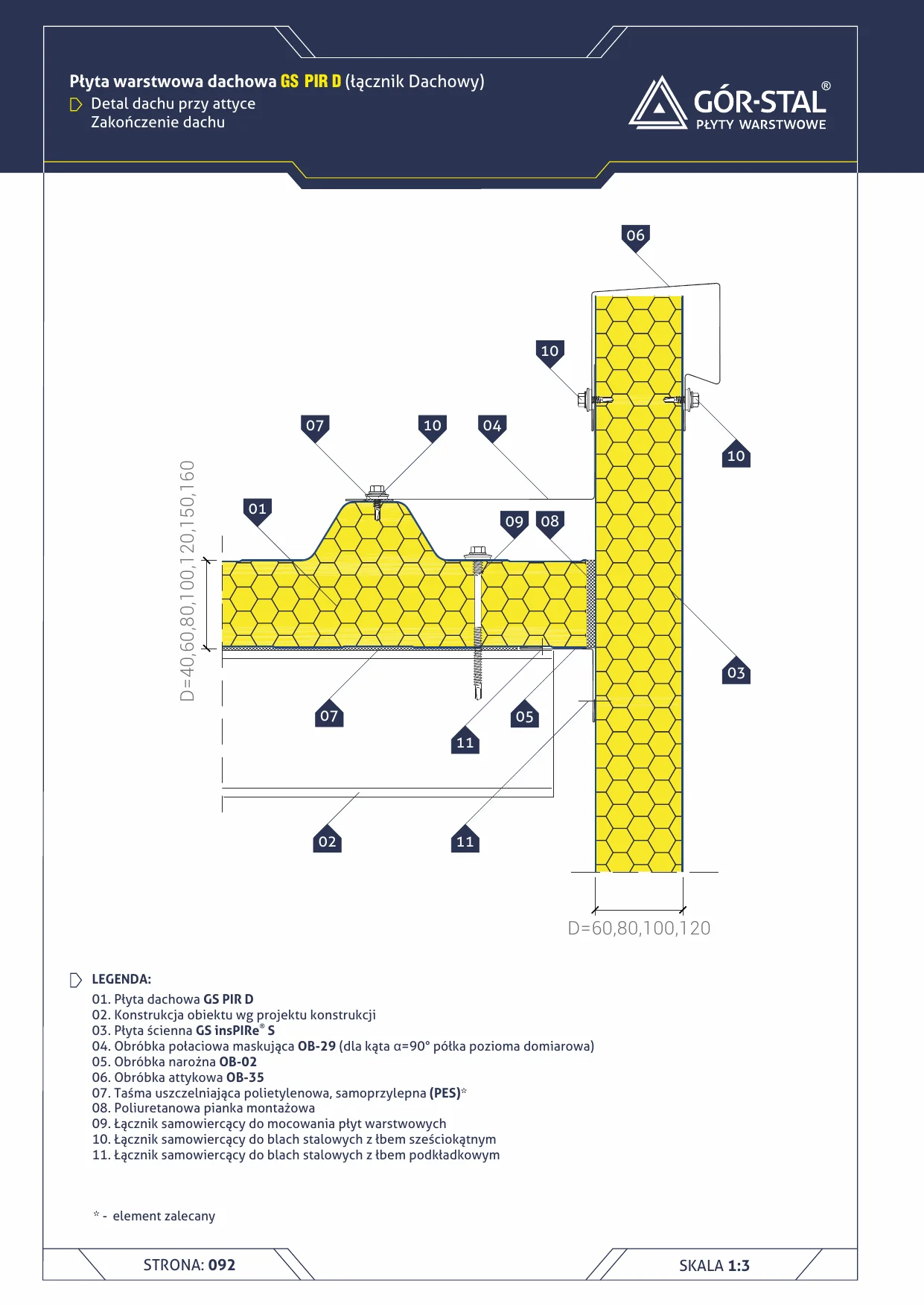
Junction function
Roof end at parapet is the “second end” of the building — a 3D corner analogous to the start, but on the opposite side of the structure. The roof ridge zone meets the upper part of the parapet here.
Difference from the roof start: here the parapet is crowned with a standard OB-35 flashing (variant II, higher profile) instead of a custom one — because the geometry is repeatable in the catalogue.
Critical installation aspects
- OB-35 vs OB-34 — OB-35 has a higher external profile (better parapet coverage) and is preferred for tall buildings (>10 m) where wind can drive rainwater inward.
- OB-29 covering roof flashing — contacts the trapezoidal corrugation of the roof panel; PES sealing tape is required.
- 5% slope of the OB-35 flashing towards the roof — water drains to the gutter, not down the wall elevation.
- PU foam (item 08) fills the interior of the 3D corner, ensuring thermal continuity.
- Double-density fasteners in the roof edge zone (1.5 m from the parapet) — PN-EN 1991-1-4 requirements for wind loads.
- OB-02 corner flashing — closes the 90° angle between the roof plane and the wall; may be omitted in low buildings where aesthetics are less important.
Used in the pitched roof insPIRe® D multi-span system.
Documentation
Gór-Stal Technical Catalogue 2025, p. 92 — detail of the roof end at the parapet.
Components in this junction
Panel (2)
- 01 insPIRe® D roof panel (GS PIR D)
- 03 insPIRe® S wall panel (insPIRe S)
Flashing (3)
- 04 OB-29 covering roof flashing (OB-29)
- 05 OB-02 corner flashing (OB-02)
- 06
Fastener (3)
- 09
- 10
- 11
Sealant (2)
- 07
- 08 Polyurethane installation foam
Element (1)
- 02 Building structure per design