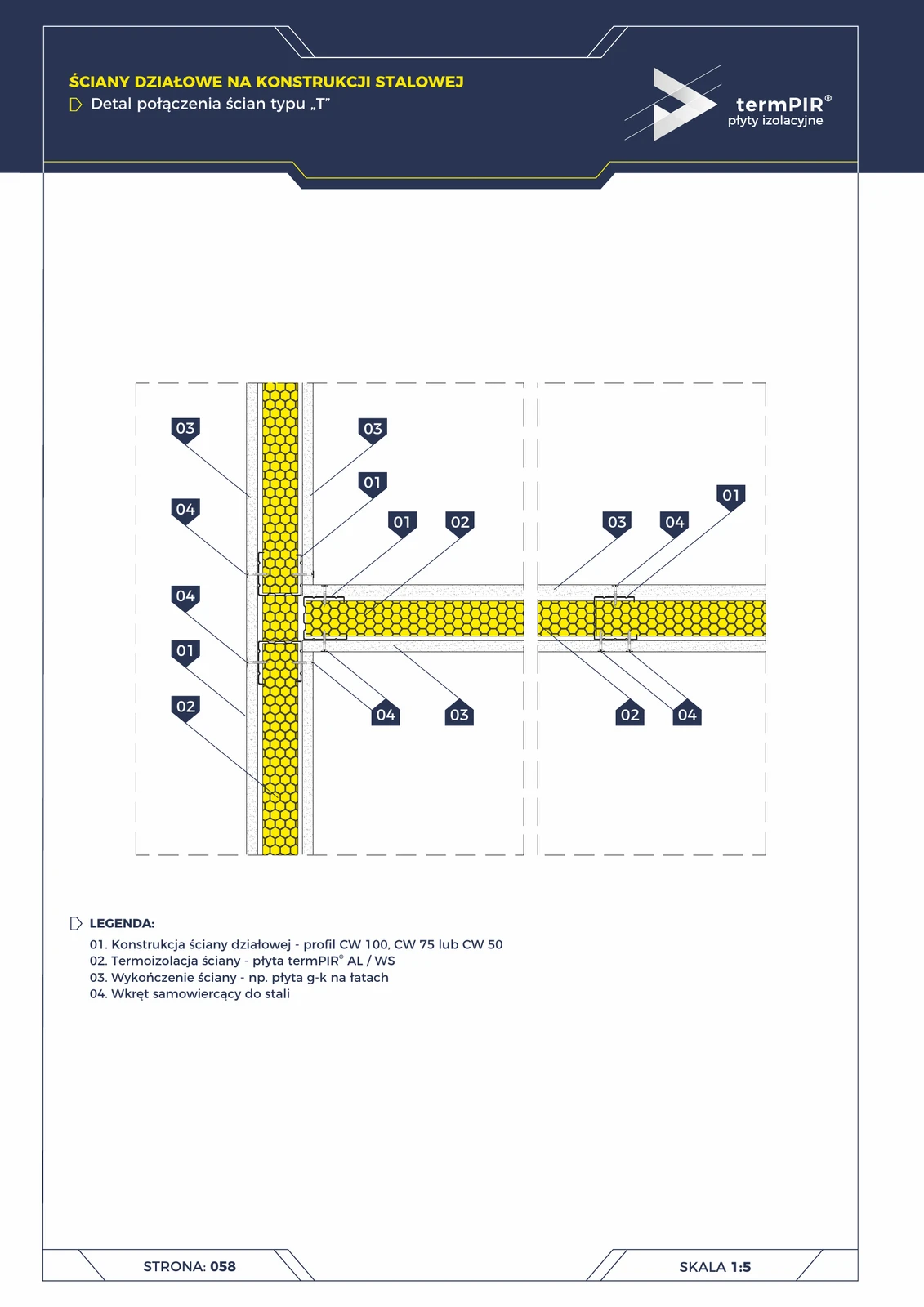
Function of the junction
T-junction = meeting of two partition walls at 90°. Typical for:
- Separating a niche / walk-in closet from a larger room.
- Separating a bathroom within a bedroom — master en suite layout.
- Open-space with light partitioning (kitchen + dining + living area).
Structurally: CW profiles of one wall are joined with CW profiles of the other wall using self-drilling screws at the 90° corner.
Critical installation aspects
- CW profiles — at the corner two vertical CW studs meet perpendicularly; connected with 6×16 mm self-drilling screws, at least 3 screws per joint (top-middle-bottom).
- termPIR® AL thermal insulation (item 02) — continued in both directions from the corner; at the corner itself a small wedge cut to size (without it, a void = acoustic bridge).
- Plasterboard finish (item 03) — external corner protected with a pre-skimmed aluminium profile (Knauf Hornleiste / Rigips Cornerflex); protects against furniture impacts.
- Internal corner (on the smaller room side) — standard joint filler + paper plasterboard corner tape.
- Acoustic performance at the corner — watch out for acoustic bridges through the metal CW; consider extending the acoustic sealing tape at the corner (as with a load-bearing wall).
Documentation
Technical Catalogue termPIR® — Residential Buildings (Gór-Stal 2022), page 58 — Partition walls, T-junction detail. Scale 1:10.
Components in this junction
Insulation (1)
- 02 Wall thermal insulation — termPIR® AL board
Fastener (1)
- 04 Self-drilling screw for steel
Element (2)
- 01 Partition wall framing — CW 100 / 75 / 50 profile
- 03 Wall finish — e.g. plasterboard on battens