When to use this system
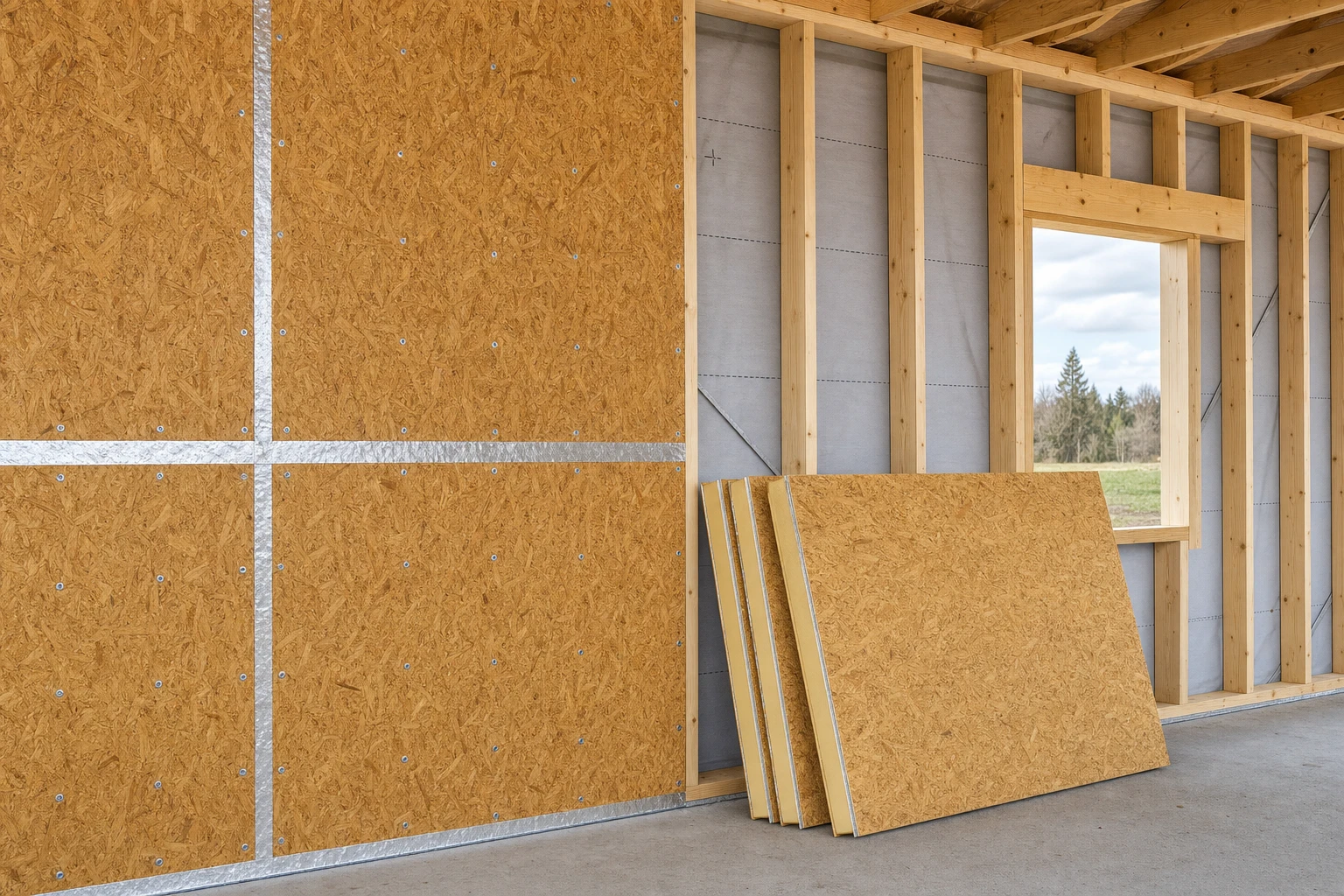
termPIR® OSB-AL-OSB is a 3-in-1 composite panel: PIR insulation + two OSB sheathings in a single element. Use when:
- Timber-frame construction — Canadian post-and-beam frame. OSB-AL-OSB replaces 3 separate elements (external OSB + PIR + internal OSB).
- Modular houses and prefabricates — factory production of wall panels, transport of finished elements to the construction site. Installation time reduction by 50–70%.
- Energy-efficient and passive houses — full 200 mm insulation layer + thin sheathing made of 12 mm OSB → thickness 224 mm vs ~280 mm for a masonry wall with ETICS.
- Renovations with extensions — when adding a light-construction storey to an existing building.
Structural characteristics
The OSB-AL-OSB panel performs a dual function: thermal insulation + structural frame sheathing:
| Function | Provided by |
|---|---|
| Thermal insulation | PIR core (λ 0.022) |
| Vapour barrier on the warmer side | internal Al foil |
| Wall structural rigidity | OSB on both sides (8–22 mm selected per structural design) |
| Substrate for façade | external OSB |
| Substrate for internal finish | internal OSB — directly plasterboard or plaster |
Frame rigidity in Canadian construction typically requires 12 mm OSB; for tall buildings exposed to wind loads — 15–18 mm.
Geometry and dimensions
- PIR core thickness: 20–250 mm (10 variants)
- OSB thickness: 8, 12, 15, 18, 22 mm (5 variants)
- Standard dimensions: 600×1200 mm / 1200×2400 mm
- Panel joints — tongue-and-groove (TAG) from 60 mm core thickness, step (LAP) from 40 mm
Installation in frame construction
- Timber frame (KVH 60×140 / 60×160) erected according to the design.
- OSB-AL-OSB panel fixed with carpentry screws into the frame studs at 200 mm spacing along studs, 300 mm in between.
- Panel joints sealed with aluminium tape on the inside (vapour-tightness) and vinyl tape on the outside (wind-tightness).
- External finish — directly on OSB: façade board, plaster or composite cladding.
- Internal finish — plasterboard directly on OSB or gypsum plaster.
Comparison with ETICS
| Aspect | termPIR® OSB-AL-OSB frame | Masonry + ETICS |
|---|---|---|
| Time to build 100 m² wall | ~1–2 days | ~10–14 days |
| Number of stages | 1 (prefab assembly) | 6+ (masonry, plaster, insulation, adhesives, mesh, render) |
| Seasonality | year-round | wet processes restricted in winter |
| Wall thickness for U=0.15 | ~220 mm | ~280 mm |
| Price per m² | higher for product | lower for product, higher for labour |
| Demountability | high (prefab) | none (bonded) |
Technical documentation
termPIR® 2025 folder (Gór-Stal, 2025-04-23, pp. 3, 11). Classification E for the core; final system class according to finish (typically NRO in wall application with internal plasterboard).
Layer composition
| # | Layer | Thickness | λ | Role |
|---|---|---|---|---|
| 1 | OSB board (8–22 mm) | 8–22 mm | — | external finish / structural sheathing |
| 2 | Adhesive layer | — | — | bonding OSB to aluminium layer |
| 3 | termPIR® OSB-AL-OSB (PIR core with AL facing on both sides) | 20–250 mm | 0,022 W/(m·K) | thermal insulation integrated with sheathing |
| 4 | Adhesive layer | — | — | bonding OSB to aluminium layer |
| 5 | OSB board (8–22 mm) | 8–22 mm | — | internal finish / structural sheathing |
U-value by insulation thickness
| termPIR® thickness | U [W/m²·K] | Meets WT 2021 (roof U ≤ 0.15) |
|---|---|---|
| 80 mm | 0,26 | — no |
| 100 mm | 0,21 | — no |
| 120 mm | 0,18 | — no |
| 150 mm | 0,14 | ✓ yes |
| 200 mm | 0,11 | ✓ yes |
| 250 mm | 0,08 | ✓ yes |
Related catalogue items
Applications
Recommended variants
Installation accessories