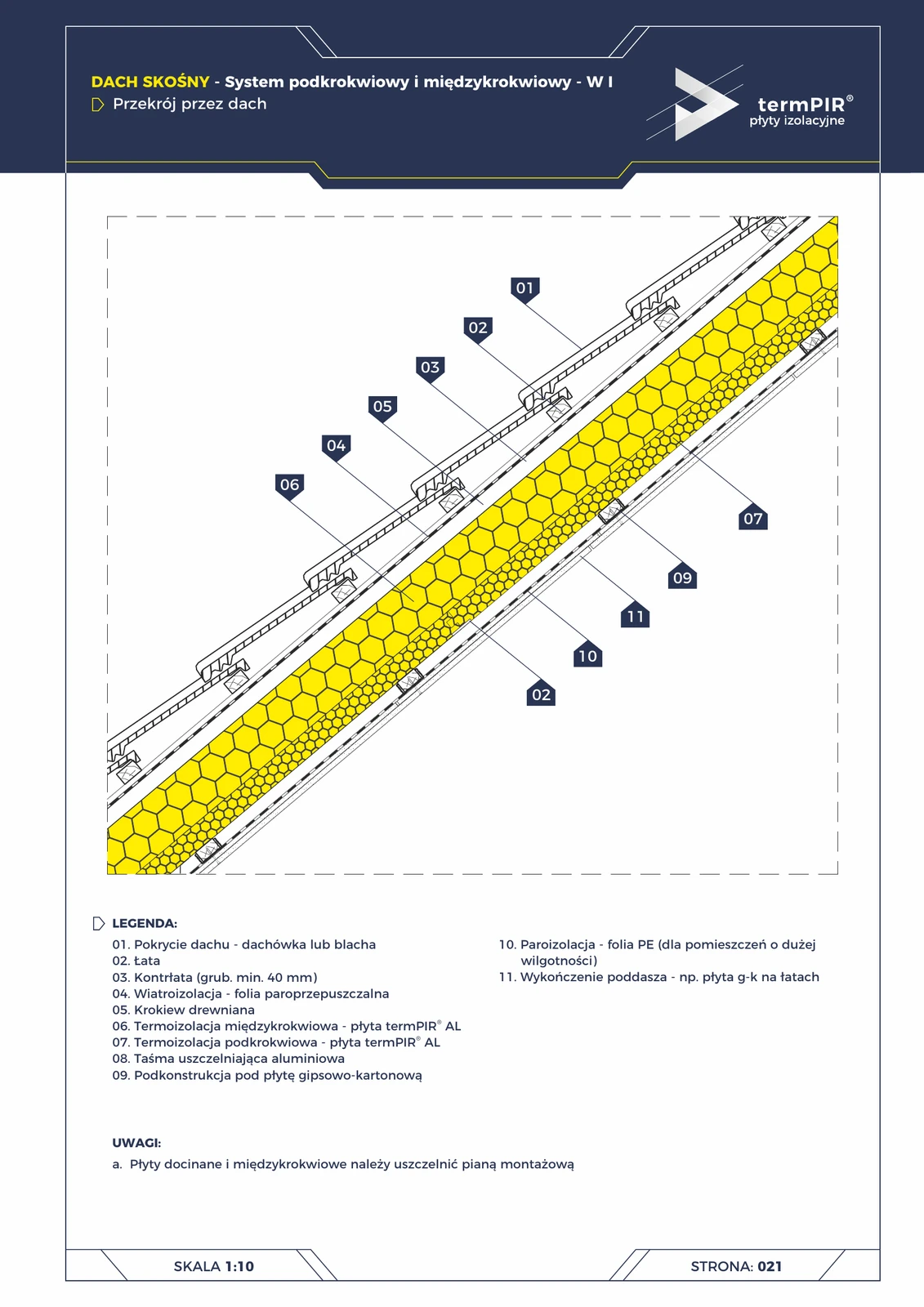
Function of the junction
The under-rafter + between-rafter W1 system is the most popular attic insulation layout in thermal upgrading — it uses two layers of insulation: between the rafters (item 06) + under the rafters (item 07).
Advantage vs the over-rafter system: it does not require removing the existing roof covering. The rafters stay as they were, and the insulation is fitted from the inside. Ideal for renovating houses built in the 1970s–1990s.
Advantage vs between-rafter insulation alone: it eliminates the thermal bridge at the rafters. A rafter (timber, λ ≈ 0.13) typically occupies 12% of the roof area — without the under-rafter layer every piece of timber is a “cold spot”.
W1 vs W2: in variant I the battens for the plasterboard are fixed directly to the rafters through the board (long screws). In variant II → via a suspension structure.
Critical installation aspects
- Between-rafter thermal insulation (item 06) — boards cut to size ±5 mm relative to the rafter spacing; gaps must absolutely be filled with installation foam (note b in the original).
- Under-rafter thermal insulation (item 07) — usually 4–6 cm; fixed to timber battens screwed to the rafters through the between-rafter layer (long self-drilling screws, every 40 cm).
- Aluminium tape (item 08) — on ALL joints of the under-rafter boards; this is the only vapour-tight layer on the interior side.
- PE vapour barrier (item 10) — required in bathrooms, gas-fired kitchens, drying rooms; in typical bedrooms it can be omitted (the termPIR® AL board already has a vapour-tight facing).
- Plasterboard substructure (item 09) — CD60 + UD profiles; the battens must be screwed to the rafters, NOT to the termPIR board (the board will not support the load).
- Thermal advantage: 18 cm between rafters + 6 cm under rafters (24 cm of termPIR® AL in total) → U ≈ 0.11 W/m²K, i.e. passive standard (WT 2021 requires U ≤ 0.15).
Used in the system pitched roof — termPIR® under-rafter.
Documentation
Technical Catalogue termPIR® — Residential Buildings (Gór-Stal 2022), page 19 — Pitched roof, under-rafter + between-rafter system W I, section through the roof. Scale 1:10.
Components in this junction
- 06 Between-rafter thermal insulation — termPIR® AL board
- 07 Under-rafter thermal insulation — termPIR® AL board
- 08 Aluminium sealing tape (tasma-aluminiowa)
- 01 Roof covering — tiles or sheet metal
- 02 Batten
- 03 Counter-batten (min. 40 mm thick)
- 04 Wind barrier — vapour-permeable membrane
- 05 Timber rafter
- 09 Substructure for plasterboard
- 10 Vapour barrier — PE foil (for rooms with high humidity)
- 11 Attic finish — e.g. plasterboard on battens