Junction function
The roof window is the most common thermal bridge in a conventionally insulated pitched roof. The timber window frame has λ ≈ 0.13, and the rafters on both sides of the window are usually doubled (for load-bearing capacity) — without insulating the frame, the temperature of the internal reveal surface in winter can drop below the dew point = water droplets on the frame + mould on the panelling.
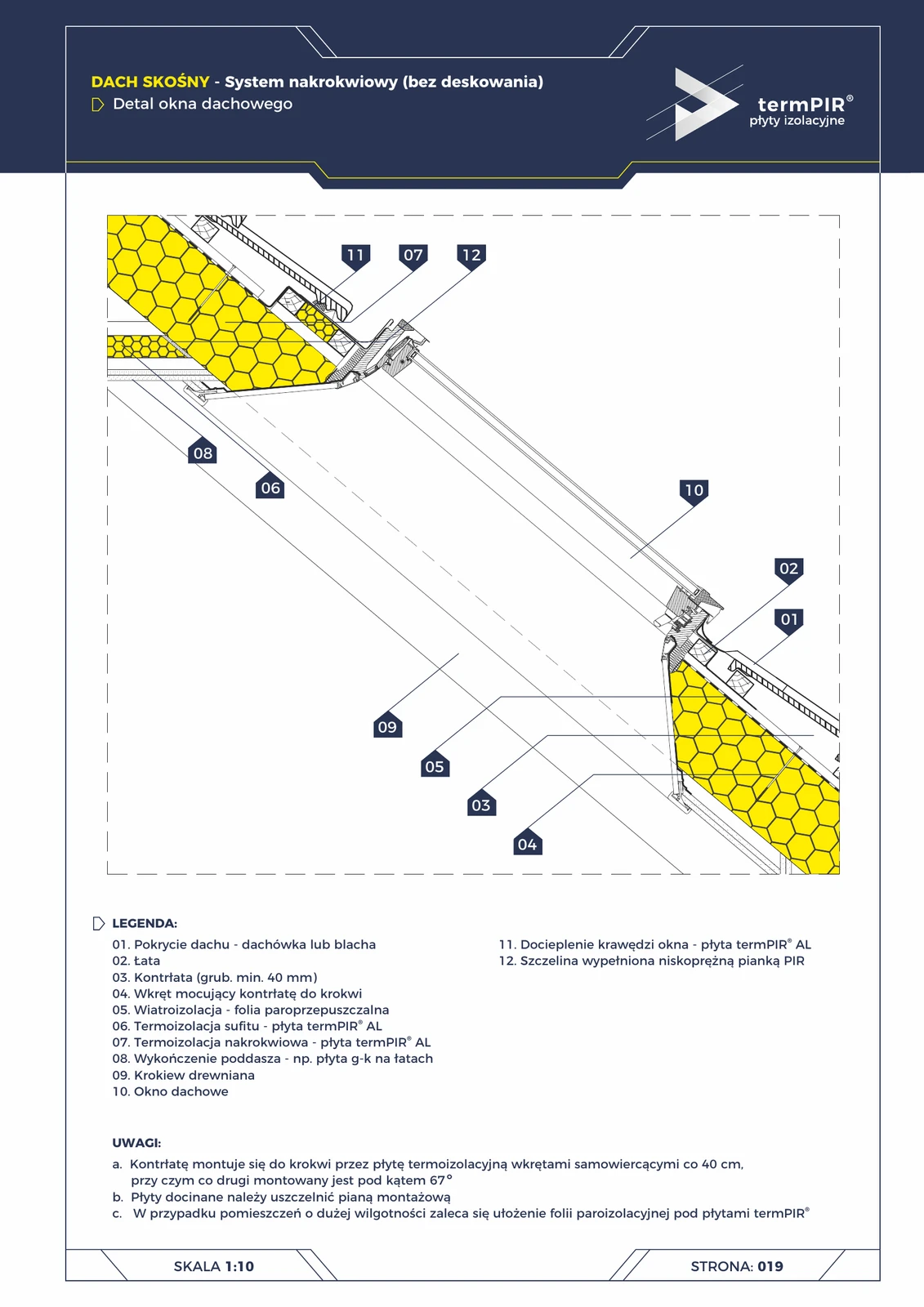
The Gór-Stal catalogue solution: insulating the window edge with a termPIR® AL board (item 11) installed around the window frame, + the gap between the frame and rafter filled with low-expansion PIR foam (item 12).
The geometry of the roof window also imposes a step in the over-rafter insulation: above the window the boards (item 07) come down to the edge of the frame, below the window the board (item 06) goes under the frame — creating a reveal recess which must be made free of thermal bridges.
Critical installation aspects
- Window edge insulation termPIR® AL (item 11) — typically 30–50 mm thick, around the entire window frame (top, sides, bottom); mechanical fixing (wood screws with 60 mm washer) + PUR foam bonding.
- Low-expansion PIR foam (item 12) — fills 5–15 mm gaps between the window frame and rafters; low expansion is critical — typical installation foam will distort the window frame.
- Wind barrier (item 05) around the window — cut along the frame outline with a 20 cm allowance, folded back and taped with butyl tape onto the frame + onto the window flashing.
- Manufacturer’s window flashing (Velux EDW/EDJ, Fakro XDP, etc.) — install according to the window manufacturer’s instructions; without it, rainwater leakage is guaranteed.
- Counter-battens around the window — interrupted along the flashing outline, the lower ones extended below the flashing (water drains to the outside of the roof).
- Internal reveal finish — most often plasterboard with an aluminium angle profile protecting the corner; for tilt-and-turn windows leave a 2 cm allowance for upholstery.
Featured in the system pitched roof — over-rafter termPIR®.
Documentation
Technical Catalogue termPIR® — Residential Buildings (Gór-Stal 2022), page 17 — Pitched roof, over-rafter system, roof window detail. Scale 1:10.
Components in this junction
- 06 Ceiling insulation — termPIR® AL board
- 07 Over-rafter insulation — termPIR® AL board
- 11 Window edge insulation — termPIR® AL board
- 04 Screw fixing counter-batten to rafter
- 12 Gap filled with low-expansion PIR foam
- 01 Roof covering — tiles or metal sheet
- 02 Batten
- 03 Counter-batten (min. 40 mm thick)
- 05 Wind barrier — vapour-permeable membrane
- 08 Attic finish — e.g. plasterboard on battens
- 09 Timber rafter
- 10 Roof window (Velux / Fakro / Roto)