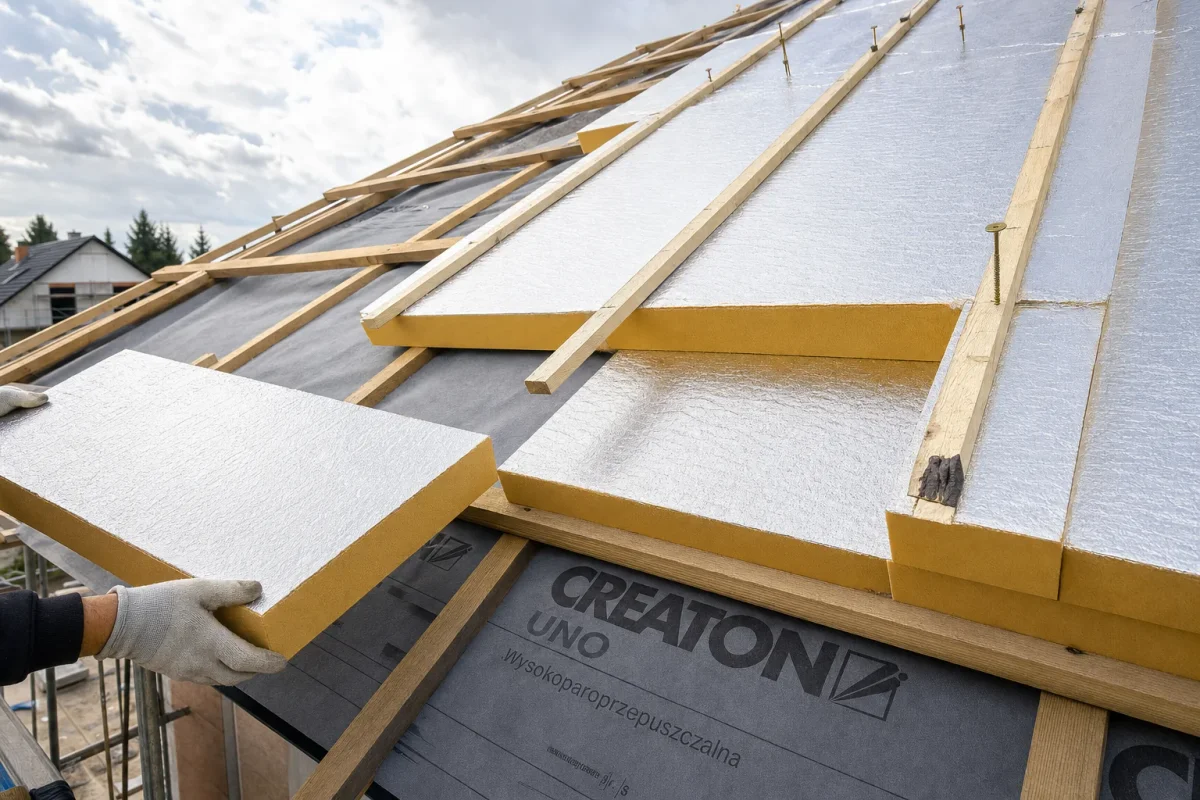
When to use this system
The over-rafter system is used when the attic space is to be utilised to the maximum while still meeting WT 2021 requirements (U ≤ 0.15 W/m²·K) without sacrificing headroom. termPIR® boards are laid above the rafters, forming a continuous insulation layer uninterrupted by structural elements — this eliminates the thermal bridges that, in a conventional between-rafter layout, can reduce insulation efficiency by 15–25%.
The solution is particularly beneficial for:
- New energy-efficient and passive buildings — allows U values below 0.10 W/m²·K at 220 mm.
- Renovations and conversions — rafters remain exposed on the inside (an architecturally attractive solution).
- Rooms with limited ceiling height — low structural thickness in relation to the thermal layer.
Installation requirements
Key technical aspects derived from the system technology (source: Technical Catalogue of termPIR® Boards — Residential Buildings, pp. 11–20):
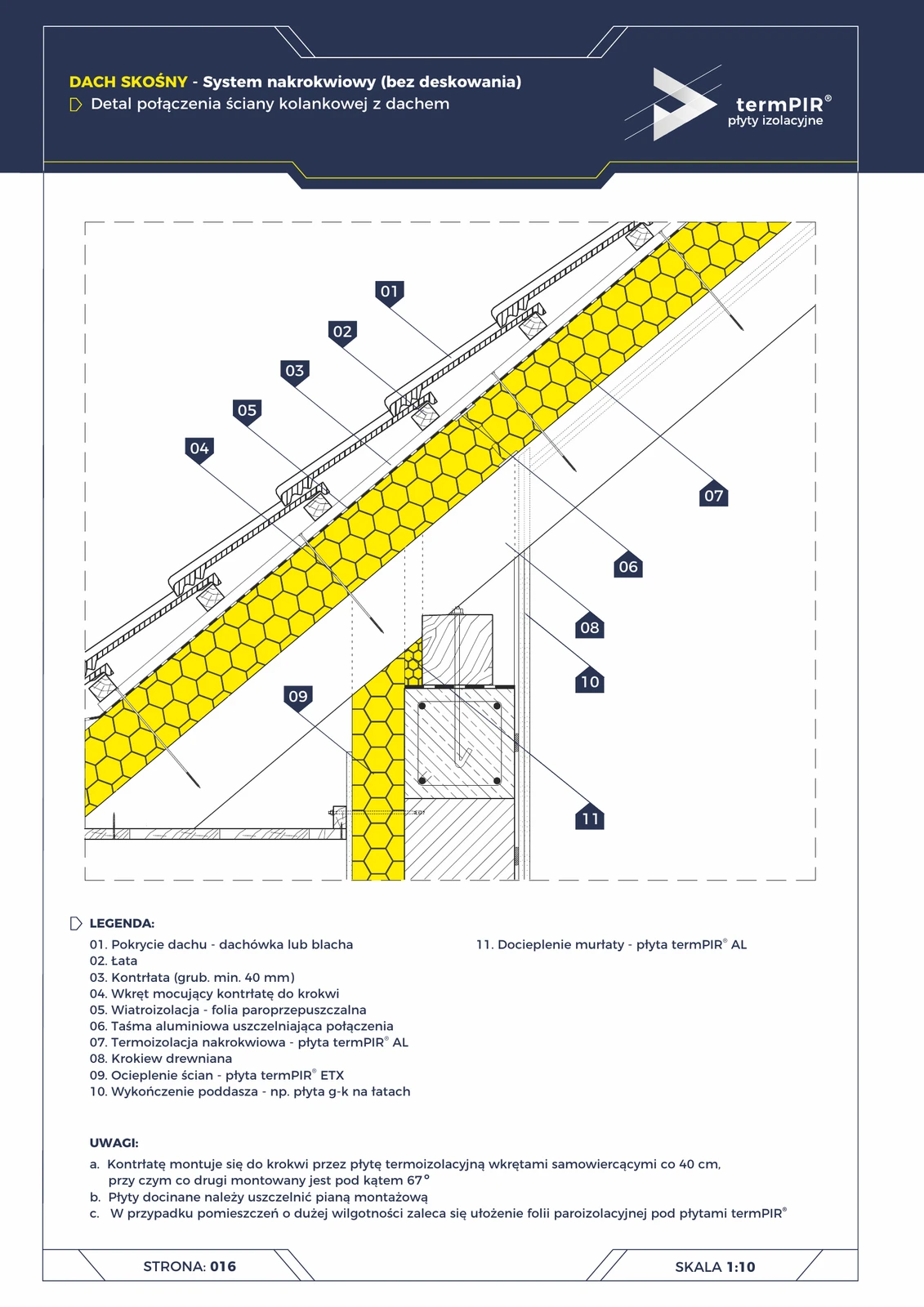
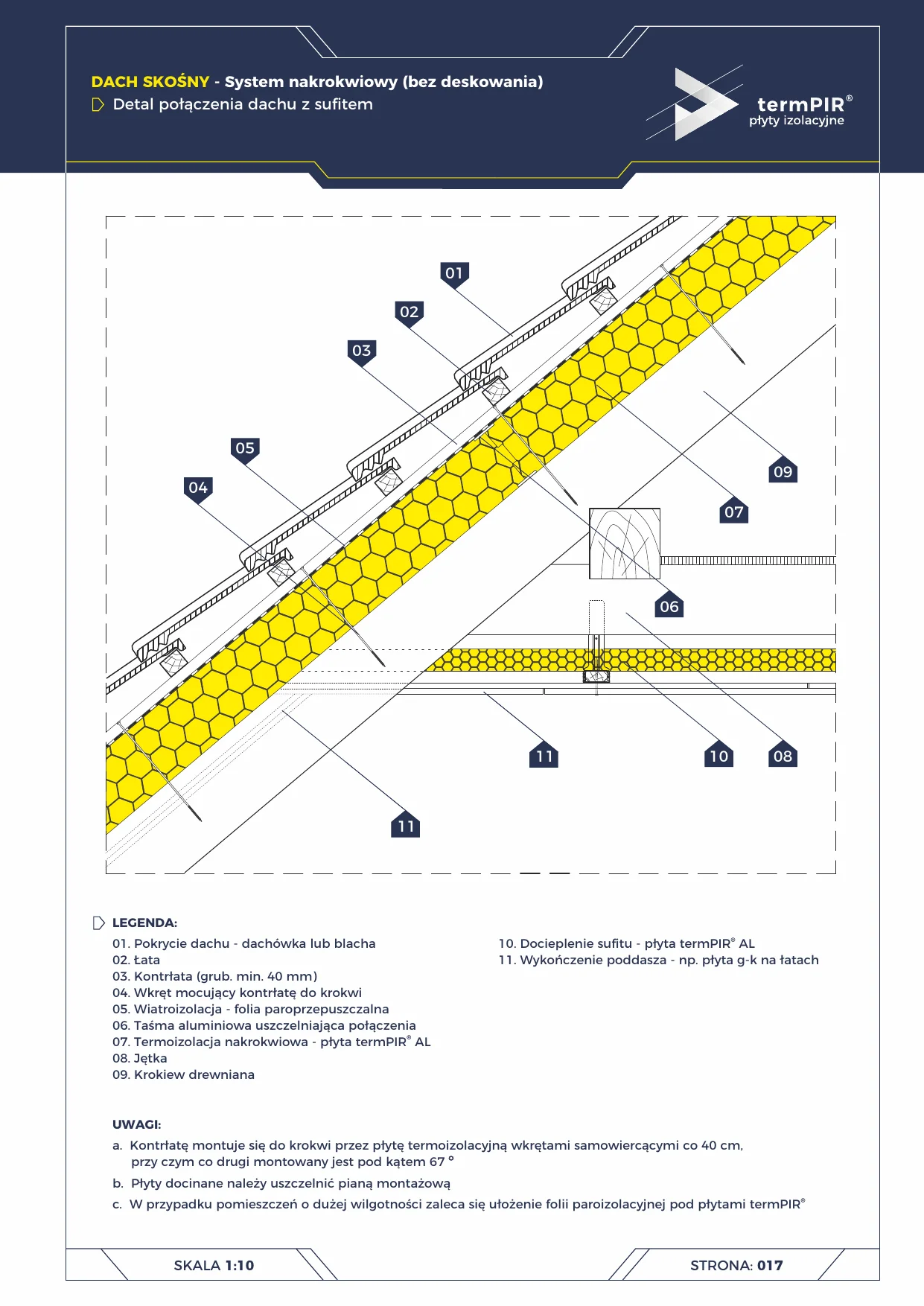
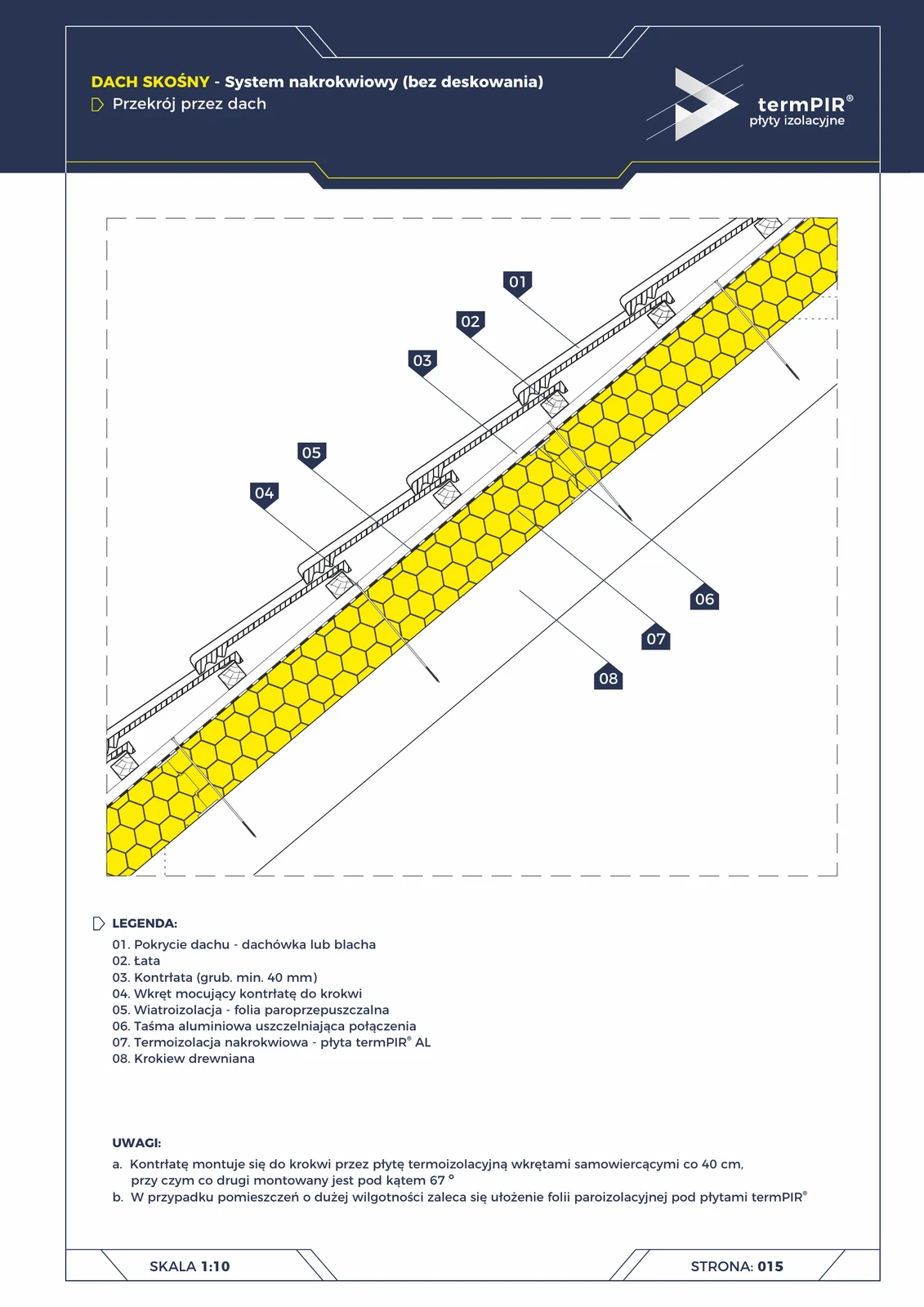
- Counter-battens fixed with self-drilling screws through the termPIR® board directly to the rafters
- Spacing approx. every 40 cm in the internal (green) roof zone
- In the edge zones (red) +1 screw per linear metre of counter-batten
- Every second screw installed at a 67° angle (for better transfer of wind loads)
- Self-drilling screws — length selected according to termPIR® thickness + counter-batten + rafter (e.g. for 150 mm termPIR® → 300 mm screw).
- Board joints sealed with aluminium tape (consumption 1.25–1.5 lm/m²) or low-expansion PIR foam.
- Wind barrier laid directly on the termPIR® boards on the external side.
- In rooms with elevated humidity (bathroom, sauna) — an additional PE vapour barrier foil is required under the boards on the internal side.
Advantages of the over-rafter system
| Aspect | termPIR® over rafters | Conventional between-rafter mineral wool |
|---|---|---|
| Thermal bridges at rafters | none | present, reduce efficiency by 15–25% |
| Visibility of structure from inside | rafters exposed (aesthetics) | rafters hidden in insulation |
| Insulation thickness required for U ≤ 0.15 | 150 mm | ~280 mm of mineral wool |
| Existing roof retrofit | requires removing the covering | installed from inside, no need to strip the covering |
| Workmanship | quick, dry, single contractor | longer, multi-stage |
Recommended termPIR® variants
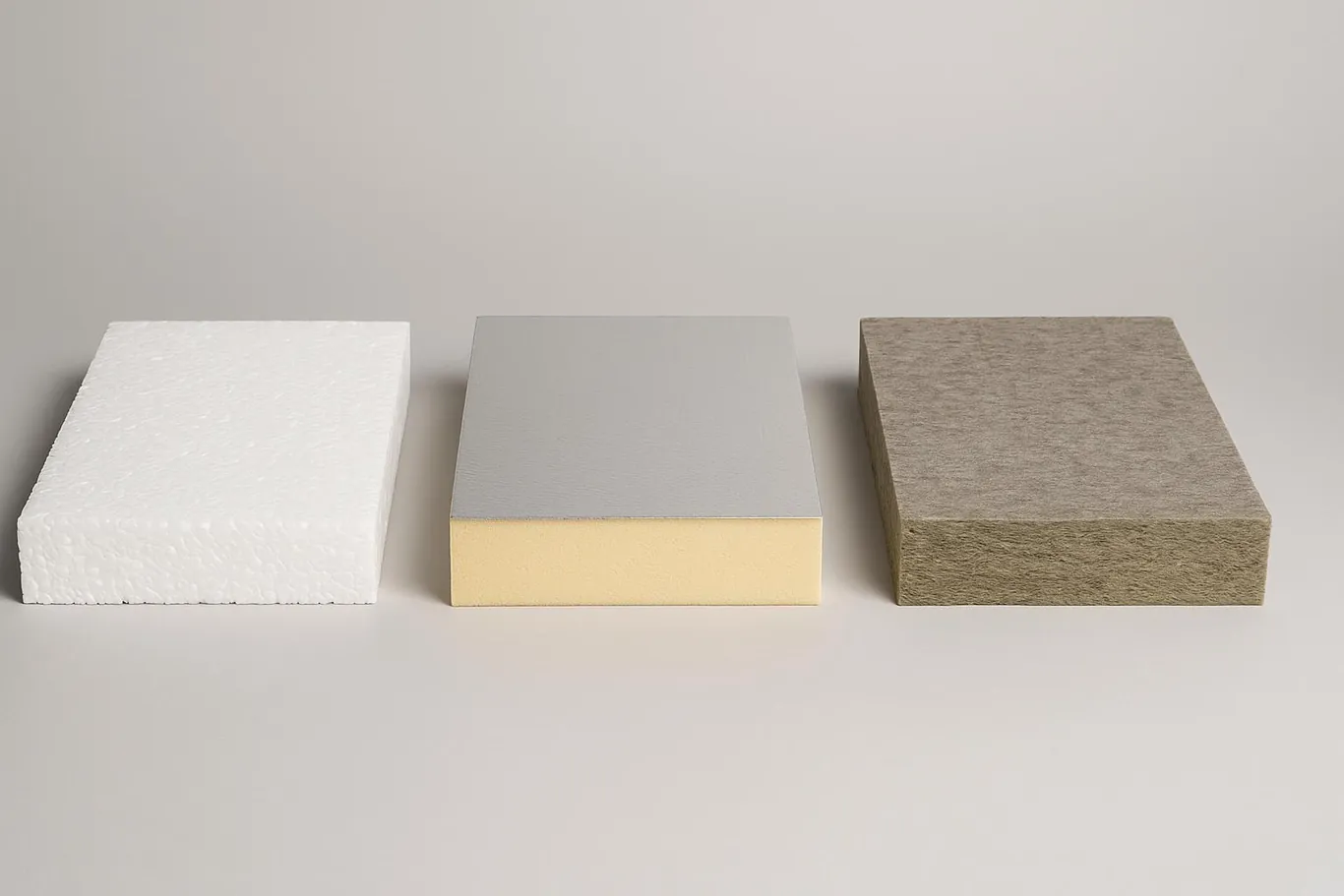
- termPIR® AL — universal 50 µm aluminium foil on both sides, gas-tight. Default choice for over-rafter roofs.
- termPIR® AL R-eco — variant with recycled content, for orders with environmental requirements (LEED, BREEAM, CAM criteria for public procurement).
- termPIR® MAX 19 AL — λ reduced to 0.019 W/(m·K). Achieves U ≤ 0.15 at just 130 mm where structural height is limited.
Installation components from the BOKKA range
Apart from the termPIR® boards, the system requires standard roofing elements (covering, battens, counter-battens, wind barrier). From our range, directly for this system:
- Timber-frame screws — for fixing counter-battens to rafters through the termPIR® layer, length selected according to board thickness (e.g. 300 mm screw for 150 mm termPIR®)
- Aluminium tape — sealing of all board joints and cuts (consumption 1.25–1.5 lm/m²)
Flashings OB-XX are used in sandwich panels (insPIRe®, GS MW). In a pitched termPIR® roof, the external finish is the roof covering (tile/sheet metal) on battens and counter-battens.
Technical documentation
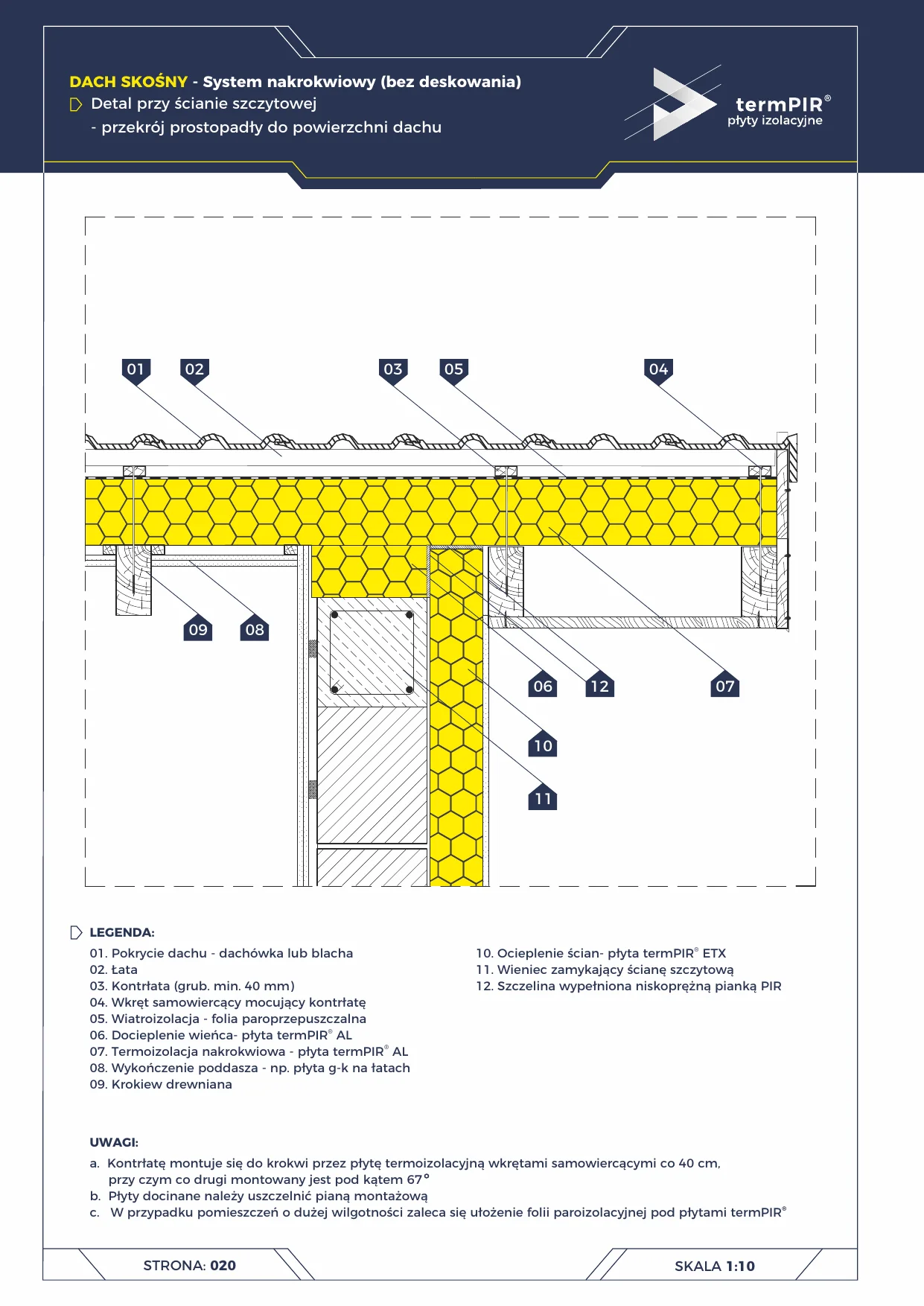
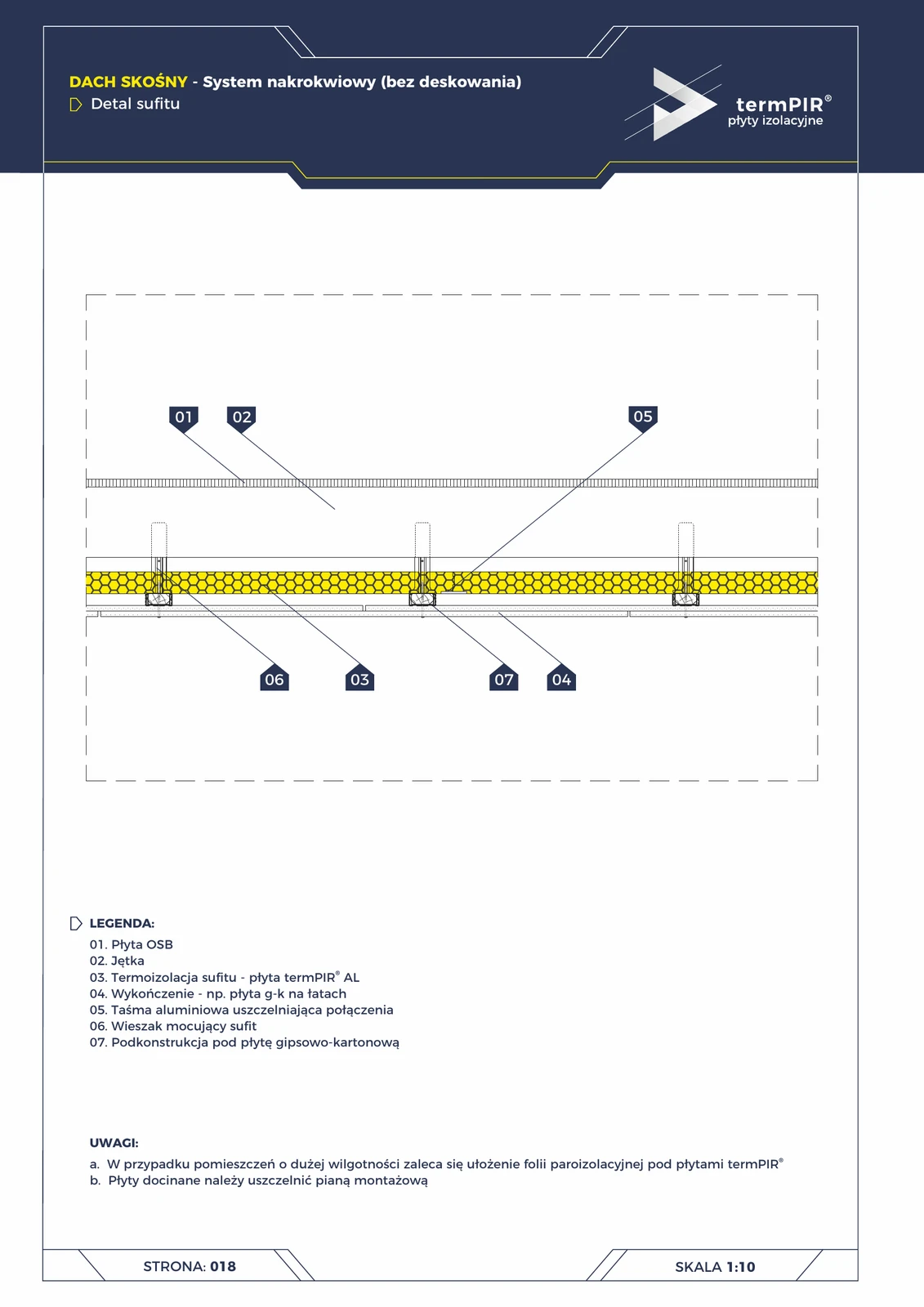
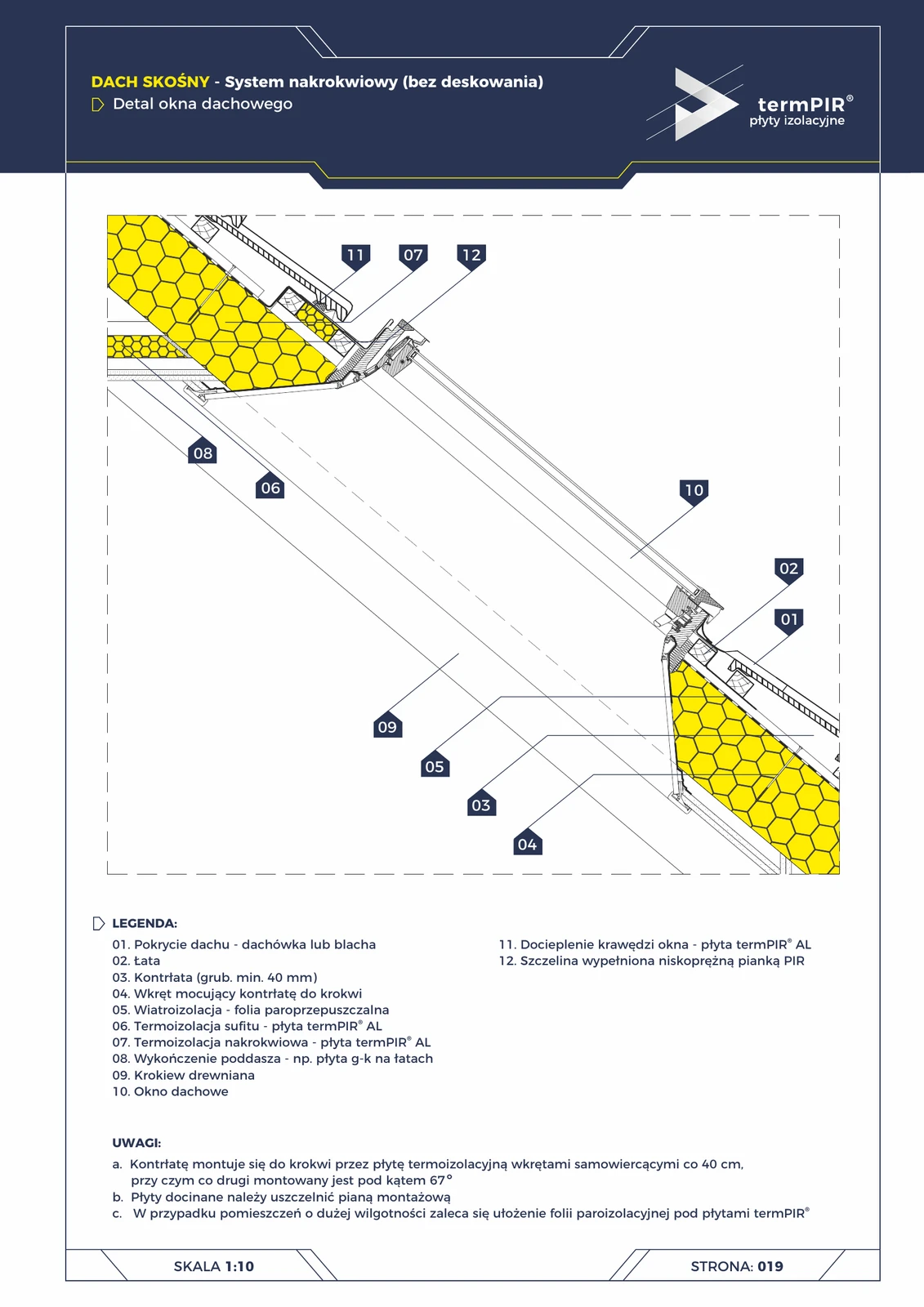
The system is described in the manufacturer’s catalogue “Technical Catalogue of termPIR® Insulation Boards — Residential Buildings” (Gór-Stal, 2022-04-26, pp. 11–20). Detailed connection drawings are available in the Construction Junctions section (counter-batten fixing, ridge junction, gable wall junction, roof window detail, eaves detail).
Layer composition
| # | Layer | Thickness | λ | Role |
|---|---|---|---|---|
| 1 | Roof covering — tile or sheet metal | — | — | external covering |
| 2 | Batten | — | — | covering support |
| 3 | Timber counter-batten | 40 mm | — | roof ventilation / fixing |
| 4 | Wind barrier (vapour-permeable membrane) | — | — | wind barrier |
| 5 | termPIR® AL | 120–220 mm | 0,022 W/(m·K) | primary over-rafter insulation |
| 6 | Timber rafter | — | — | load-bearing roof structure |
U-value by insulation thickness
| termPIR® thickness | U [W/m²·K] | Meets WT 2021 (roof U ≤ 0.15) |
|---|---|---|
| 120 mm | 0,17 | — no |
| 130 mm | 0,16 | — no |
| 140 mm | 0,15 | ✓ yes |
| 150 mm | 0,14 | ✓ yes |
| 160 mm | 0,13 | ✓ yes |
| 170 mm | 0,12 | ✓ yes |
| 180 mm | 0,12 | ✓ yes |
| 190 mm | 0,11 | ✓ yes |
| 200 mm | 0,11 | ✓ yes |
| 210 mm | 0,10 | ✓ yes |
| 220 mm | 0,10 | ✓ yes |