PIR vs EPS/XPS vs Mineral Wool: ROI Analysis for Designers | BOKKA
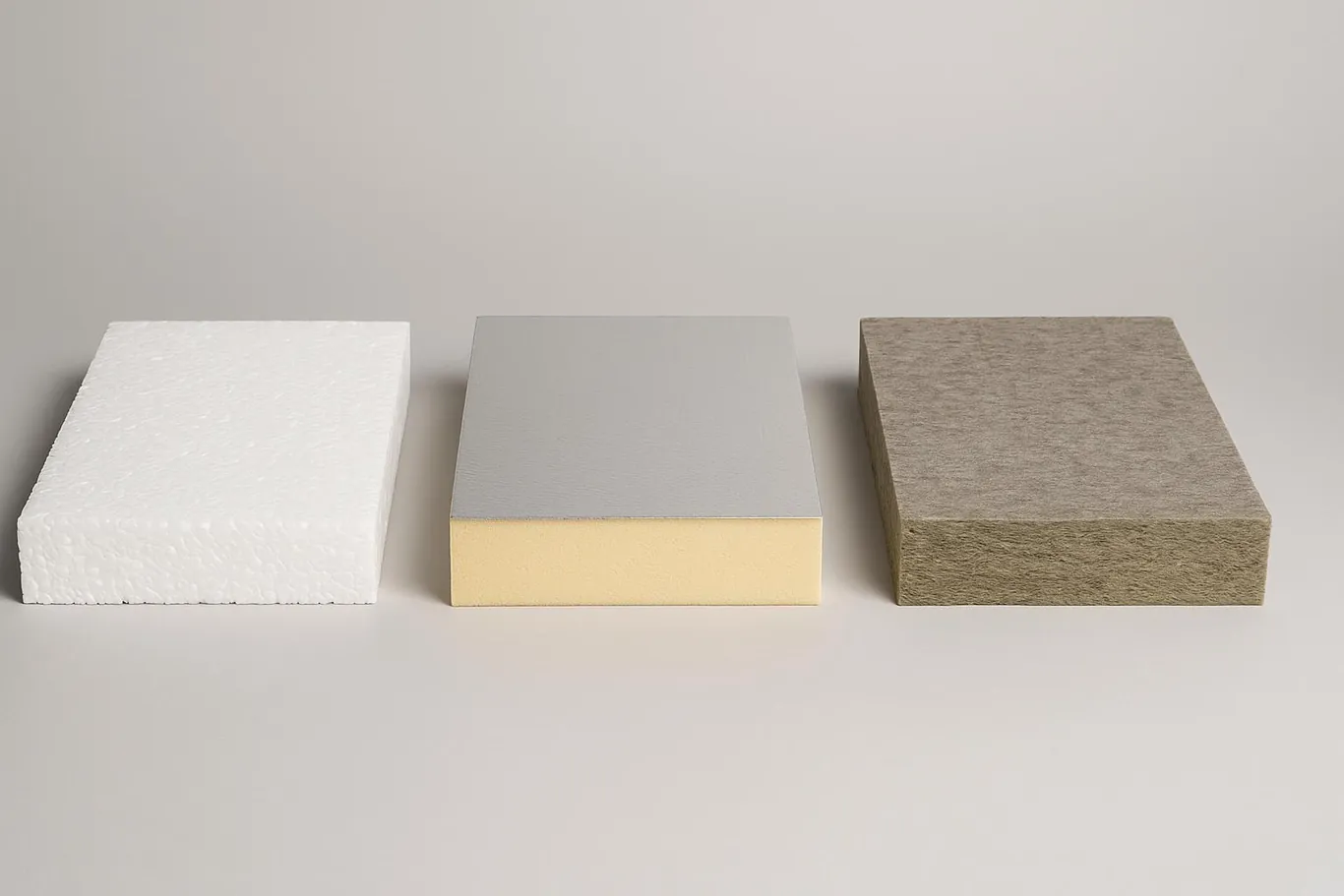
The question we hear at BOKKA almost daily from architects and investors: “do PIR boards really pay off more than EPS, despite their visibly higher purchase price?” The answer requires nuance — in some applications EPS remains the economic benchmark, in others PIR wins decisively over the life-cycle horizon (TCO), and in yet others the only acceptable choice is mineral wool. Below is a complete analysis with 2026 figures — for designers who need to justify their decision to the investor while meeting WT 2021 (Polish Technical Conditions 2021), fire classes, EPBD 2030 and acoustic requirements.
The key difference: λD and thickness under WT 2021
WT 2021 requirements (roof U ≤ 0.15 W/m²·K, external wall U ≤ 0.20 W/m²·K) define the minimum insulation thickness for each material. The lower the λD, the thinner the layer required.
| Material | λD [W/(m·K)] | Thickness for roof U ≤ 0.15 | Thickness for wall U ≤ 0.20 |
|---|---|---|---|
| Glass mineral wool (structural) | 0.036–0.040 | ≈ 24–27 cm | ≈ 18–20 cm |
| Stone mineral wool (rigid) | 0.037–0.041 | ≈ 25–27 cm | ≈ 19–20 cm |
| EPS 040 (standard) | 0.040 | ≈ 27 cm | ≈ 20 cm |
| EPS 031 (graphite) | 0.031 | ≈ 21 cm | ≈ 15 cm |
| XPS | 0.033 | ≈ 22 cm | ≈ 16 cm |
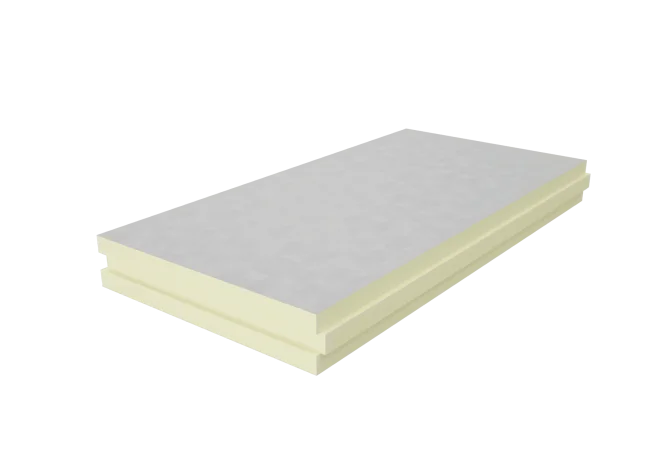
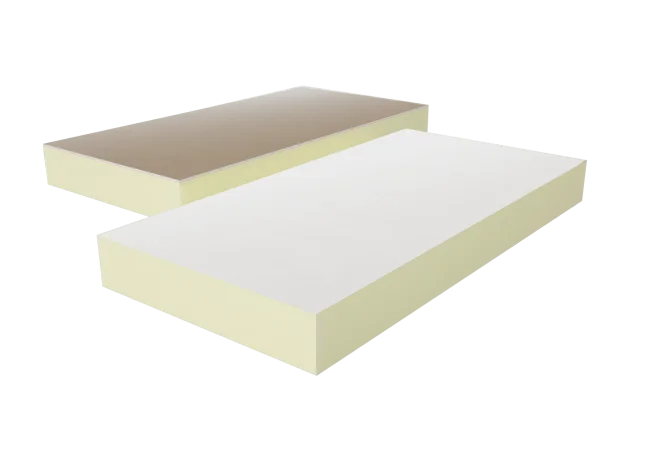
| termPIR® AL | 0.022 | ≈ 15 cm | ≈ 11 cm |
| termPIR® MAX 19 AL | 0.019 | ≈ 13 cm | ≈ 10 cm |
PIR insulation boards deliver the same thermal performance at 30–40% lower thickness than EPS 040 or mineral wool. The number alone says nothing yet about economics or fire class — price, installation, fire class, acoustics, carbon footprint and the space the insulation occupies all come into play.
Material price per m² (indicative, Q2 2026)
Market prices change rapidly — the values below are indicative. For current prices and wholesale discounts contact your BOKKA sales representative.
| Material | Thickness for roof U ≤ 0.15 | Indicative price |
|---|---|---|
| EPS 040 | 27 cm | ≈ PLN 45–55/m² |
| EPS 031 graphite | 21 cm | ≈ PLN 55–65/m² |
| Façade mineral wool | 25 cm | ≈ PLN 90–120/m² |
| XPS | 22 cm | ≈ PLN 80–95/m² |
| termPIR® AL | 15 cm | ≈ PLN 75–90/m² |
| termPIR® MAX 19 AL | 13 cm | ≈ PLN 95–115/m² |
PIR carries a material premium of 40–70% versus EPS 040, but is comparable in price to mineral wool at the same U-value. Rigid façade wool (e.g. 165 kg/m³) is additionally heavier and requires more expensive fastening — which becomes a significant difference on a warehouse flat roof.
TCO — what decides over a 15–25 year horizon
The material purchase price accounts for 30–45% of the life-cycle cost of the insulation layer. The other factors:
1. Lower thickness → recovered space
In a pitched roof insulated above the rafters, 12 cm of thickness difference equals an extra 12 cm of usable attic height. For a 100 m² apartment that translates into a valuation difference of ≈ PLN 6,000–12,000 (at PLN 6–12k per floor m²). For an industrial warehouse a thinner layer = lower parapet structure → savings on flashing sheet metal, roofing materials, and on flat roofs also on chimney and ventilation flashings.
2. Installation pace and crew load
Thinner, stiffer PIR insulation boards install faster and lighter. For a 2,000 m² warehouse flat roof:
- EPS 040 27 cm in 2 layers (bonded and anchored) — ≈ 4 days × 4-person crew
- Mineral wool 25 cm in 2 layers (bonded + anchored, heavy) — ≈ 4.5 days × 4-person crew, additionally heavier, requires higher OHS measures
- termPIR® WS 15 cm in 1 layer — ≈ 2.5 days × 4-person crew
Labour and logistics difference: PLN 6,000–14,000 in favour of PIR.
3. Durability and dimensional stability
- Closed-cell PIR: dimensional stability of 25–50 years, λD drops in the first 6 months (pentane blowing-agent diffusion process) and then stabilises. After 25 years German FIW München studies show λ drift of around 5–8%.
- Mineral wool: the longest failure-free period (40+ years), but sensitive to moisture — permissible in-service humidity ≤ 1%, above which λ deteriorates drastically.
- EPS: 30+ year stability under typical conditions, but sensitive to UV (styrene degradation) and organic solvents. Critical in ETICS — render protection is mandatory.
- XPS: the most durable of the synthetic insulations, hydrophobic (absorption 0.2–0.7%), the first choice for plinths and foundations exposed to water.
4. Moisture and water absorption
- termPIR®: absorption < 2% (closed-cell)
- termPIR® WS: dedicated to layers below the waterproofing, at the ground interface
- Mineral wool: absorption 0.5–1.5% (after hydrophobisation), but a 1% moisture increase reduces λ by 5–10% — critical in roofs with vapour bridges
- White EPS: 2–5%
- XPS: 0.2–0.7% (best)
For flat roofs (where standing water is a real concern) PIR is more tolerant than EPS and wool, but XPS remains the benchmark for the plinth section.
5. Fire class
- termPIR® (Al/Al foil): B-s1,d0 (fire-retardant, self-extinguishing)
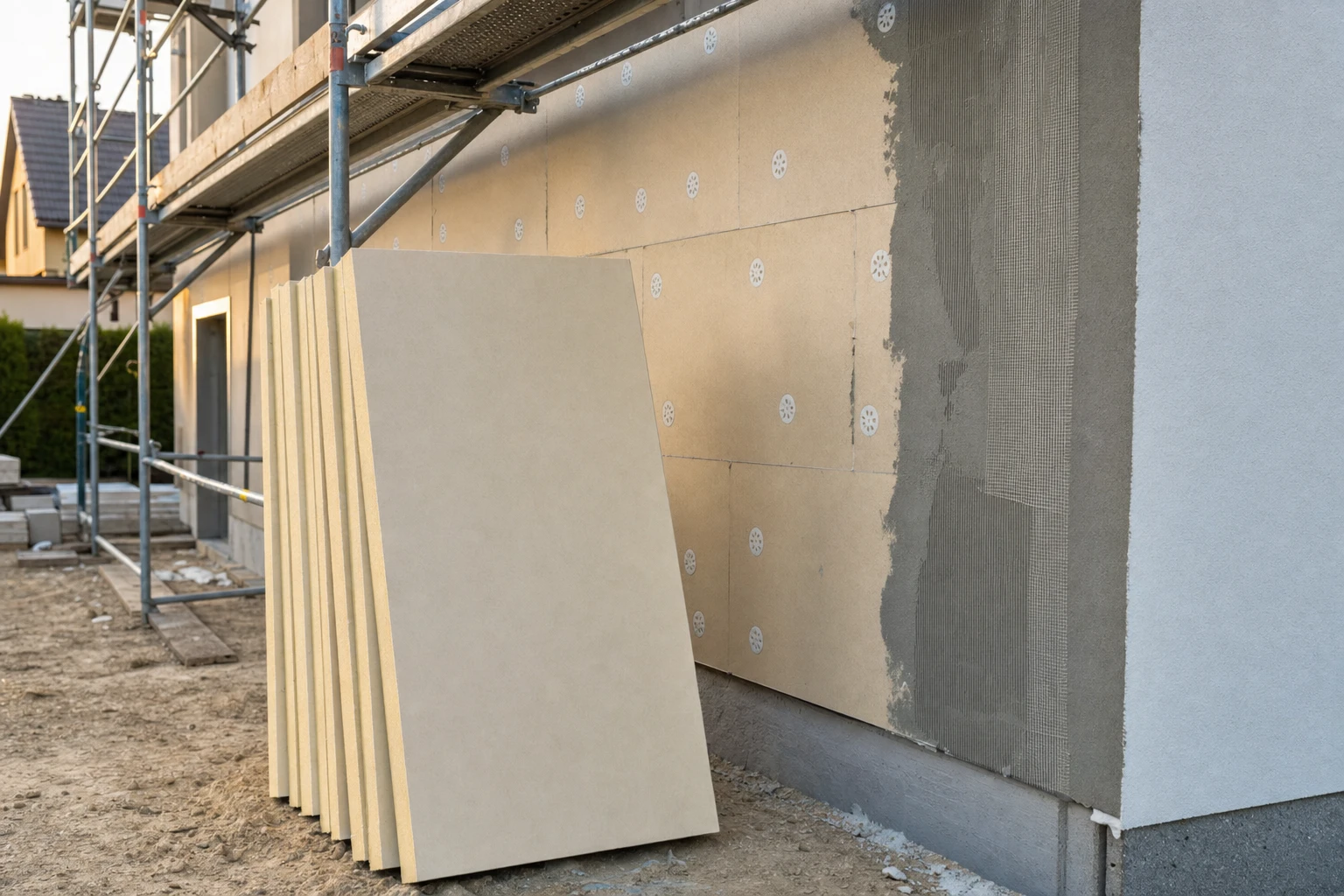
- termPIR® ETX with glass fleece: B-s1,d0 + ETA 17/0066 (dedicated for ETICS)
- Mineral wool: A1 or A2-s1,d0 (non-combustible)
- EPS: E (combustible, requires protection by a class B layer)
- XPS: E
In public buildings, industrial halls and warehouses, the B-s1,d0 class of PIR satisfies requirements without additional layers. In buildings requiring A2 class (e.g. evacuation routes, warehouses above a certain height, underground garages) — neither PIR nor EPS is an option. Only mineral wool.
Fire class — when A2 is mandatory
This is the most frequently overlooked aspect of the analysis. Fire class is not a designer’s preference — it is dictated by regulations for the given building type and fire compartment. The main A2 situations:
| Building type / zone | Required class | Optimal material |
|---|---|---|
| Evacuation routes, staircases of buildings above 25 m | A1/A2-s1,d0 | Mineral wool |
| Underground garages (especially multi-stall) | A1/A2 | Mineral wool |
| Warehouses, ZL III/IV category and above | A2 or B-s1,d0 depending on zone | termPIR® ETX (B-s1,d0) or wool |
| Fire-separation walls, fire-resistant parapets | A1 mandatory | Mineral wool |
| ETICS on buildings >12 m in some cases | B-s1,d0 minimum | termPIR® ETX with ETA |
| Freezers, chillers adjacent to retail areas | B-s1,d0 or A2 | insPIRe® CH or GS MW |
| Single-family houses (standard ETICS) | No A-class requirement | EPS or termPIR® |
| Standard industrial halls, ZL I/II category | B-s1,d0 sufficient | termPIR® or insPIRe® |
A full fire-requirements analysis requires a project review — and this is where the BOKKA advisor helps verify whether the designer is over-specifying A2 where B-s1,d0 would suffice (which substantially reduces cost), or conversely, has not overlooked an A2 requirement (which would result in a failed acceptance).
Acoustics — when mineral wool beats PIR and EPS
Acoustic insulation of walls and floor slabs is the second aspect where mineral wool holds a fundamental advantage over PIR and EPS. The Rw value (weighted sound reduction index) depends not only on partition mass, but on vibration damping in the insulation layer:
| Material | Vibration damping | Typical Rw gain in standard partition |
|---|---|---|
| Façade mineral wool | very good (resonator nature of fibres) | +5–10 dB vs wall without insulation |
| Glass mineral wool | very good | +5–10 dB |
| EPS / XPS | poor (closed-cell, continuous structure) | +1–3 dB |
| termPIR® | poor (closed-cell, rigid structure) | +1–3 dB |
For this reason, in partition walls between apartments, inter-storey floor slabs, hotel and office walls, the acoustic design typically requires mineral wool. PIR and EPS are insufficient in these applications — regardless of thickness.
For sandwich-panel systems: GS MW panels (mineral-wool core) offer Rw 26–30 dB, while insPIRe® with a PIR core — typically 24–25 dB. A small numerical difference, but in acoustic specifications for industrial halls adjacent to residential developments it can be decisive.
Embodied energy and carbon footprint — what EPBD 2030 will bring
The EPBD recast Directive (2024) requires, from 2030, a whole-life CO₂ balance of the building — not only operational emissions but also embodied energy in materials. Manufacturers are increasingly publishing EPDs (Environmental Product Declarations) in accordance with EN 15804.
Indicative GWP values (Global Warming Potential, kg CO₂-eq per 1 m² at U ≤ 0.15):
| Material | GWP A1-A3 [kg CO₂-eq/m²] | Embodied energy [MJ/m²] |
|---|---|---|
| Glass mineral wool | ≈ 35–50 | ≈ 350–500 |
| Stone mineral wool | ≈ 50–70 | ≈ 500–700 |
| EPS 040 | ≈ 18–25 | ≈ 250–400 |
| EPS 031 graphite | ≈ 25–35 | ≈ 350–500 |
| XPS | ≈ 75–110 (HFC) or 30–50 (CO₂-blown) | ≈ 600–900 |
| termPIR® AL | ≈ 30–45 | ≈ 350–550 |
PIR has a moderate CO₂ footprint — higher than standard EPS, but lower than HFC-blown XPS. On the 2030 horizon, public investors (and increasingly private ESG-driven investors) will require EPDs and a CO₂ balance — a factor worth incorporating already in 2026 for projects delivered after 2028.
Read more in our article on EPBD 2030 and PIR boards.
When EPS remains optimal
PIR is not “always better”. The choice must be per building element:
| Building element | Optimal material | Why |
|---|---|---|
| Single-family house façade (standard ETICS) | EPS 040/031 graphite | Low price, ETICS well-developed by system manufacturers, no thickness limit |
| Plinth exposed to water / foundation | XPS or termPIR® WS | XPS is hydrophobic; termPIR® WS dedicated to moisture interfaces |
| Ground-bearing floor with large thickness | EPS 100/200 + PIR layer | Combination of economical EPS in the bottom + thin PIR as a finishing layer under underfloor heating |
| Detached garage wall | EPS 040 | No fire-class requirement, low material cost |
When mineral wool is the only choice
| Building element | Optimal material | Why |
|---|---|---|
| Evacuation routes, staircases | A1 wool | Legal A1 class requirement |
| Multi-stall underground garages | A1/A2 wool | Fire requirement |
| Fire-separation walls (REI 60, REI 120) | A1 wool + fire-resistant facings | No certification without wool |
| Inter-storey floors (acoustics Rw ≥ 50 dB) | Wool | Acoustics — PIR is insufficient |
| Partition walls between apartments | Wool inside CW profile cavity | Rw ≥ 50 dB requirement |
| Warehouses requiring A2 class | GS MW (sandwich panel with MW core) | Fire requirement + no alternative |
| Suspended ceilings in public spaces with Rw | Wool in ceilings | Acoustics + A class |
When PIR wins decisively
| Building element | Optimal material | Why |
|---|---|---|
| Warehouse/storage flat roof (B-s1,d0 sufficient) | termPIR® WS / termPIR® AL | Thinner layer, B class, lightweight, fast installation |
| Pitched roof, above rafters | termPIR® AL | Elimination of the timber thermal bridge, board stiffness, possibility of fully exposed rafters from below |
| Usable attic with limited height | termPIR® MAX 19 AL | Highest parameters → smallest thickness → retained height |
| Premium ETICS / historic building | termPIR® ETX | Thin layer, vapour permeability, B-s1,d0 class |
| Industrial hall, freezer, chiller (sandwich panels) | insPIRe® or GS MW | EPS is simply not manufactured as a sandwich-panel core in class B; PIR and MW are the only options |
| Thermal upgrade with limited thickness | termPIR® AL/GK | Combination of insulation + plasterboard in one, final internal layer |
| Floor under underfloor heating (top layer) | termPIR® AL | Stiffness + load resistance + thin layer under screed |
A concrete example: 2,000 m² warehouse flat roof, U ≤ 0.15
Variant A: EPS 040, 27 cm
| Item | Cost |
|---|---|
| Material (27 cm × 2,000 m² × ≈ PLN 50/m²) | ≈ PLN 100,000 |
| Waterproofing (heavier-duty required due to thickness) | ≈ PLN 30,000 |
| Labour (4 days × 4-person crew) | ≈ PLN 14,000 |
| Parapet — 12 cm higher (sheet metal, flashing, chimneys) | ≈ PLN 6,000 |
| Total | ≈ PLN 150,000 |
Variant B: termPIR® WS, 15 cm
| Item | Cost |
|---|---|
| Material (15 cm × 2,000 m² × ≈ PLN 85/m²) | ≈ PLN 170,000 |
| Waterproofing (standard, lower thickness) | ≈ PLN 22,000 |
| Labour (2.5 days × 4-person crew) | ≈ PLN 9,000 |
| Standard parapet | PLN 0 (vs A) |
| Total | ≈ PLN 201,000 |
Variant C: rigid façade mineral wool 25 cm
| Item | Cost |
|---|---|
| Material (25 cm × 2,000 m² × ≈ PLN 105/m²) | ≈ PLN 210,000 |
| Standard waterproofing | ≈ PLN 25,000 |
| Labour (4.5 days + additional OHS) | ≈ PLN 17,000 |
| Parapet — 10 cm higher | ≈ PLN 4,000 |
| Total | ≈ PLN 256,000 |
Net comparison:
- A (EPS): PLN 150,000 — cheapest, but class E (additional facing required in some zones)
- B (PIR): PLN 201,000 — +34% vs EPS, class B-s1,d0, fastest installation
- C (wool): PLN 256,000 — +70% vs EPS, class A2/A1, acoustics
The decision depends on the fire zone:
- Zone not requiring A2 → A vs B → B justified by TCO (payback through installation time and lower parapet)
- Zone requiring A2 → only C (wool) — A and B are excluded by law
In a typical 5–10 year investment scenario, the PIR premium pays back through no insulation replacement, lower heating bills (5–8% lower heat loss thanks to a smaller share of thermal bridges in the thinner layer) and ROI from earlier hall delivery.
7 common designer mistakes
In day-to-day advisory work at BOKKA we encounter recurring errors in material specifications. The most common:
Mistake 1: PIR with Al foil under ETICS
PIR boards with a gas-tight aluminium facing (e.g. termPIR® AL) are not suitable for traditional ETICS with thin-coat render — the Al foil prevents water-vapour diffusion. Result: condensation under the render, system delamination after 1–3 winters. Correctly: for ETICS use termPIR® ETX with glass fleece and ETA 17/0066. This is the only PIR version with ETICS system certification.
Mistake 2: EPS in a chiller or freezer
EPS is not approved as a sandwich-panel core in class B — which in refrigerated facilities adjacent to retail space is a requirement. Attempts to use EPS in a freezer end in a failed fire acceptance. Correctly: insPIRe® CH (PIR core, B-s1,d0) or GS MW CH (wool core, A2) — both options certified for refrigeration.
Mistake 3: Mineral wool on a flat roof without moisture control
Mineral wool on a flat roof requires rigorous vapour-barrier control — without a sealed vapour barrier, indoor moisture accumulates in the wool, reducing λ by 30–50% over a few winters. Closed-cell PIR is tolerant to such conditions. Correctly: if wool on a flat roof — a Sd ≥ 100 m class vapour barrier is mandatory, along with continuous installation quality control.
Mistake 4: XPS in ETICS
XPS has a smooth surface and low adhesion to adhesives and renders — most ETICS systems do not certify it. Nonetheless it is sometimes specified for its hydrophobicity. Correctly: in ETICS use EPS 031/040 or termPIR® ETX. Reserve XPS for plinths and foundations.
Mistake 5: Failure to account for linear thermal bridges
A good insulation material in the main layer will not help if, at the interface with the structure (e.g. window jamb, parapet, plinth), the designer omits the linear bridge. Bridges can reduce the effective U of an entire partition by 10–25%. Correctly: for every architectural junction check BOKKA structural junctions with manufacturer drawings — they show correct solutions for insulation continuity.
Mistake 6: Mixing insulations with different λ without recalculating resistance
Sometimes a designer adds a bottom EPS 100 mm layer + a top termPIR® 80 mm layer for “quick insulation”. They then fail to sum the R resistances correctly — effective U may be worse than single-layer 150 mm PIR. Correctly: use BOKKA’s U-value calculator — enter the layers and you get exact U and a comparison of variants.
Mistake 7: A “λ ≤ 0.030” specification without a specific material
A specification like “PIR insulation with λ ≤ 0.030 W/m·K” is unfeasible — no manufacturer declares such λD for standard boards (real PIR: 0.022–0.028). Result: the contractor delivers any material and challenges the specification. Correctly: specify concretely — “termPIR® AL 150 mm thick, λD 0.022 W/(m·K), class B-s1,d0” — or an equivalent material with documented λD.
Calculator for your own numbers
Instead of believing our examples, check your own
Frequently asked questions
Is PIR insulation better than EPS (styrofoam)?
How much EPS equals a PIR board?
PIR board or mineral wool?
When should you NOT choose PIR?
Do sandwich panels have PIR or EPS inside?
Related products and systems
Products
Read next

Energy Retrofit with PIR Boards and WT 2021 in Practice | BOKKA
Smog and Allergies — How PIR Thermal Upgrades Cut Emissions | BOKKA
Retrofitting Old Houses with PIR Boards — Energy Upgrade Guide