When to use this system
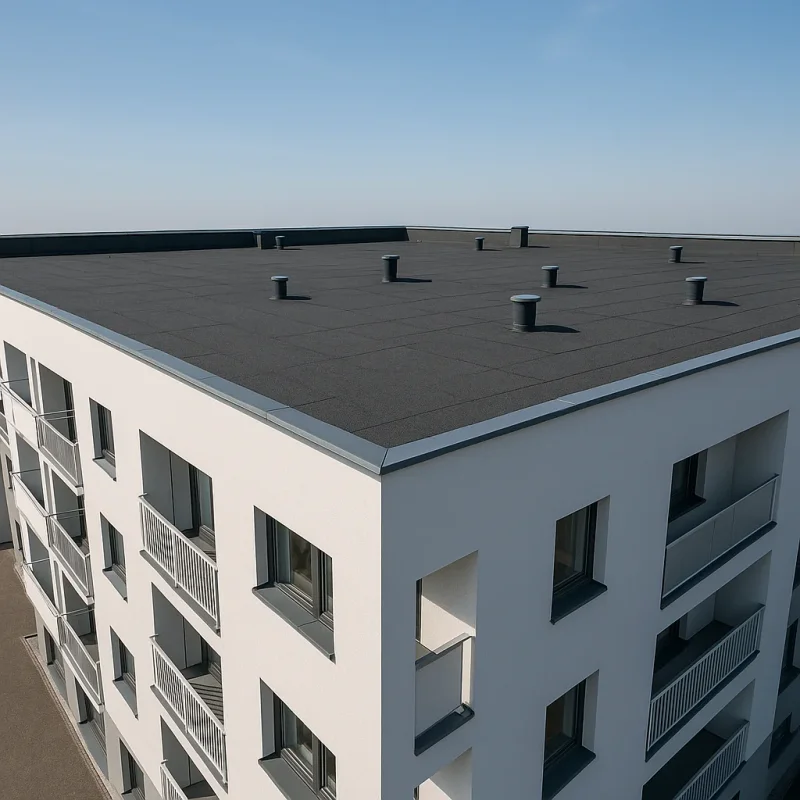
Standard insulation of a flat roof on a reinforced concrete slab — the most common build-up in Polish multi-family residential, public-use and industrial construction with reinforced concrete structure:
- Low U-value at minimum thickness — termPIR® AL has the best λ in the industry (0.022 W/(m·K)). At 200 mm we achieve U = 0.11 W/m²·K (well below WT 2021 for roofs = 0.15).
- Compatible with any waterproofing — two-layer torch-on bitumen membrane or synthetic membranes (PVC, EPDM, FPO, TPO). Selection per design and client requirements.
- Slope formed with izoGRASS® wedges — when the slab has no structural fall. Reduces roof mass by 80–90% vs a sloping concrete screed.
Waterproofing — technology choice
| Waterproofing | Characteristics | Typical application |
|---|---|---|
| SBS torch-on bitumen two-layer (underlayer + cap sheet) | Classic. Torch-welded with gas burner. Overlap at each seam. | Multi-family buildings, public-use, standard industrial halls. |
| PVC membrane (PVC-P) single-layer | Lightweight (1.2–2.0 mm), hot-air welded. Colour-stable. Requires separation layer (geotextile) from PIR. | Visible roofs, residential, retail halls. |
| EPDM membrane (rubber) single-layer | Highest durability (40–50 years). Adhered or mechanically fixed. Very flexible. | Premium projects, active use. |
| FPO / TPO membrane | Thermoplastic polyolefins. Hot-air welded. High UV resistance without plasticisers. | Newer projects requiring chemical resistance. |
Important: for PVC and FPO/TPO membranes a separation layer (300 g/m² synthetic geotextile) between PIR and membrane is required — protects against plasticiser migration or chemical incompatibility.
Roof slope — izoGRASS® wedges (add-on)
termPIR® does not produce tapered boards. When the reinforced concrete flat roof has no structural fall, we use izoGRASS® tapered wedges laid on top of termPIR® AL before waterproofing:
- 3 layout types: unidirectional, valley, hip (selection per roof geometry and drain locations).
- Slope 1.5–8% — dimensions and angle determined individually per project.
- Variable thickness 0–220 mm — from a thin wedge at the drain line to a “valley” at the outlets.
- Wedges are laid on termPIR® AL, joints sealed with aluminium tape, then waterproofing.
izoGRASS® wedges are a structural add-on providing slope for water drainage — they are NOT an insulation layer included in the system U-value calculation. The variable thickness of the wedges prevents unambiguous point U-value calculation. The designer calculates the system U-value using only termPIR® AL (constant-thickness layer); the wedges are a thermal bonus (adding thermal resistance especially in thicker zones — near the drains).
Required termPIR® AL thickness per WT 2021
WT 2021 for roofs over heated rooms: U ≤ 0.15 W/m²·K:
- 150 mm termPIR® AL → U = 0.14 W/m²·K ✓ minimum meeting WT
- 180–200 mm → U = 0.12–0.11 W/m²·K (energy-efficient standard)
- 220–250 mm → U = 0.10–0.08 W/m²·K (passive standard)
Installation variants
- Adhered — PU adhesive or bitumen adhesive for bitumen membrane. Full airtightness, no perforation of the vapour barrier. Requires even substrate and dry weather.
- Mechanically fixed — telescopic (tube-washer) fasteners through the insulation layers into the concrete slab. 4–6 pcs/m² in the interior zone, 6–8 pcs/m² in edge and corner zones (wind uplift). Standard: ETA-approved anchors for C20/25 concrete.
- Ballasted (rare) — loose-laid on the slab, weighted with washed gravel or concrete pavers (inverted roof system when ballasted).
System fire rating — REI 30 (ITB 01120.4/20/R97NZP)
The roof system with termPIR® AL insulation on reinforced concrete elements has been awarded fire resistance class REI 30 by the Building Research Institute (ITB Classification No. 01120.4/20/R97NZP, Warsaw, 2020-04-08):
| Variant | Insulation configuration | Fire class of RC load-bearing part | Roof fire resistance class |
|---|---|---|---|
| 1 | 1 layer termPIR® AL ≥ 70 mm | REI 30 | REI 30 |
| 2 | 2 layers termPIR® AL totalling ≥ 100 mm (each ≥ 40 mm) | REI 30 | REI 30 |
Classification scope of application:
- Roof pitch: 0°–15° acc. to PN-EN 1365-2.
- Load-bearing part: solid, hollow-core (multi-void), ribbed (trough, channel) reinforced concrete elements designed per Polish Standards and Eurocode 2 (PN-EN 1992-1-2:2008).
- Waterproofing: PVC/EPDM/TPO membrane ≥ 1.2 mm or bitumen membrane 1–2 layers or sheet metal (steel/aluminium/titanium-zinc).
- Insulation: termPIR® AL (or IzoProof), core density min. 30 kg/m³, tongue-and-groove min. 12 mm, facing AL / Agro AL / WS / PK.
- Vapour barrier: bitumen or PE film ≥ 0.2 mm or none.
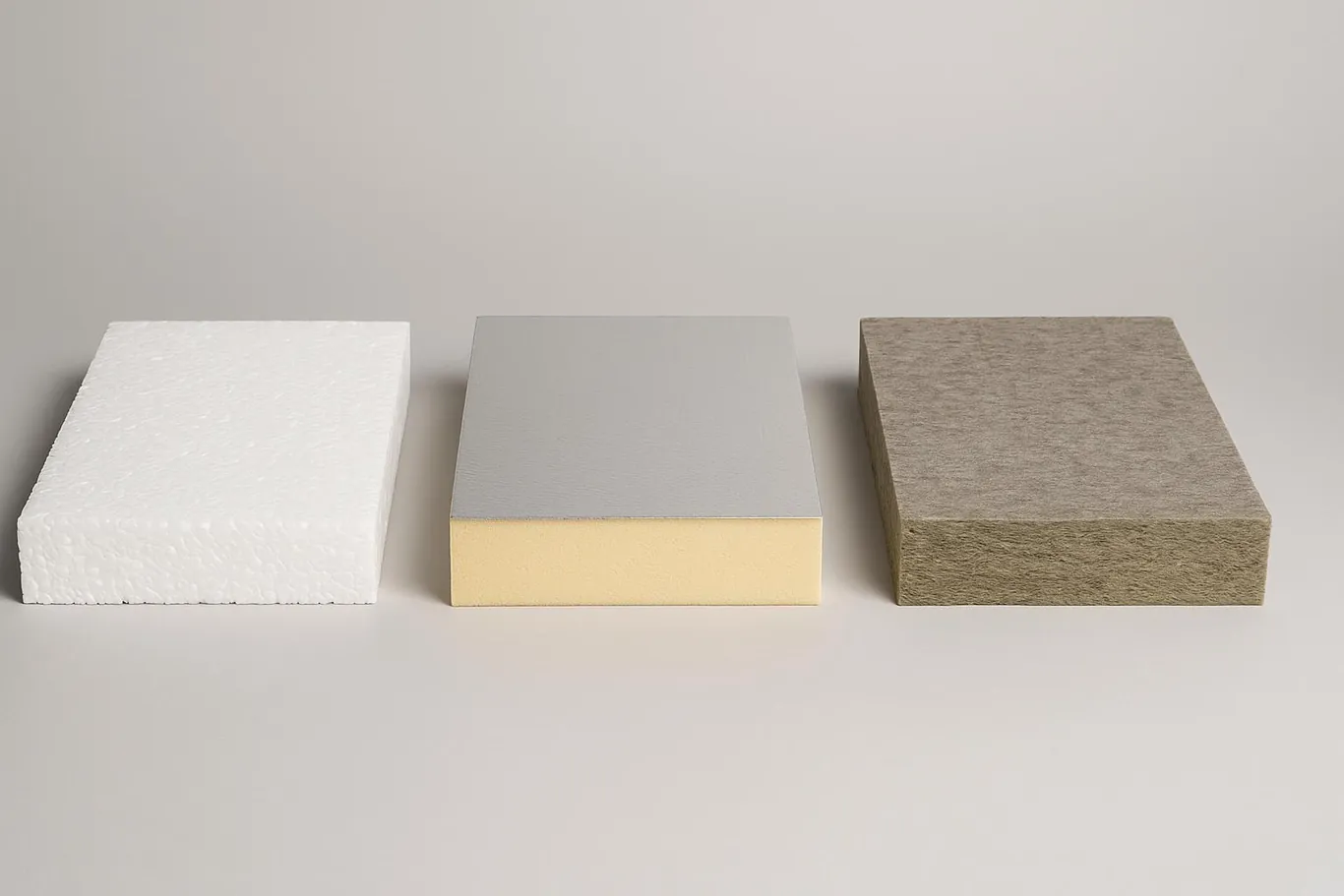
- Tapered wedges: EPS, PIR, mineral wool or none (do not affect REI classification).
Meaning of the REI class:
- R = load-bearing capacity (Resistance).
- E = fire integrity (Etanchéité).
- I = fire insulation (Insulation) — temperature on the cold side does not rise by more than 140°C on average.
The final REI 30 class is valid provided all conditions of the classification scope are met (termPIR thickness, layer arrangement, certified facings, approved waterproofing systems). A higher class than REI 30 requires individual classification for the specific project.
Vapour barrier — critical
Below the termPIR® AL layer, an obligatory vapour barrier is required on the interior (warm) side:
- Vapour-tight bitumen sheet (with Al foil or polyester carrier) — most often in industrial halls.
- PE film with SD ≥ 100 m — in residential buildings.
- Joints with 100 mm overlap + butyl tape — airtightness is critical; without a vapour barrier interior water vapour condenses in the insulation = loss of efficiency within 2–5 years.
Technical documentation
System described in termPIR® Folder 2025 (Gór-Stal, 2025-04-23, p. 13). Holds CE certificates (EN 13165), PZH hygiene certificate for termPIR® AL board.
Waterproofing — choice of bitumen / membrane manufacturer remains with the designer and contractor. BOKKA supplies only PIR boards (termPIR® AL + izoGRASS® wedges); waterproofing is purchased from the membrane manufacturer or by the contractor.
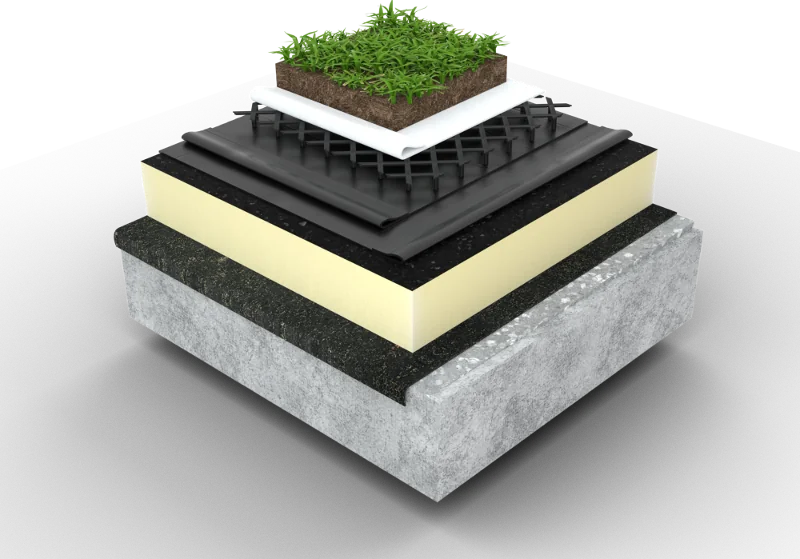
Layer composition
| # | Layer | Thickness | λ | Role |
|---|---|---|---|---|
| 1 | Waterproofing — torch-on bitumen membrane (two-layer: underlayer + cap sheet) OR synthetic PVC / EPDM / FPO / TPO membrane | — | — | external waterproofing |
| 2 | termPIR® AL — 50 µm aluminium facing on both sides | 80–250 mm | 0,022 W/(m·K) | main insulation (gas-tight) |
| 3 | Vapour barrier — vapour-tight bitumen sheet or PE film with SD ≥ 100 m | — | — | vapour barrier on the interior side |
| 4 | Load-bearing layer — reinforced concrete slab | — | — | load-bearing structure |
U-value by insulation thickness
| termPIR® thickness | U [W/m²·K] | Meets WT 2021 (roof U ≤ 0.15) |
|---|---|---|
| 80 mm | 0,26 | — no |
| 100 mm | 0,21 | — no |
| 120 mm | 0,18 | — no |
| 150 mm | 0,14 | ✓ yes |
| 180 mm | 0,12 | ✓ yes |
| 200 mm | 0,11 | ✓ yes |
| 220 mm | 0,10 | ✓ yes |
| 250 mm | 0,08 | ✓ yes |