EPBD 2030 & Zero-Emission Buildings — Role of PIR Boards | BOKKA
EPBD recast 2024 — a new era of zero-emission buildings
The European Union is tightening building energy performance requirements in ways that will reshape design practice over the next decade. The recast EPBD (Energy Performance of Buildings Directive) 2024/1275, in force since 28 May 2024, requires that all new buildings be zero-emission from 2030, and that the existing building stock be fully decarbonised by 2050. For investors, designers and contractors, this means working with thermal insulation materials of the highest possible performance — such as PIR insulation boards with λD 0.019–0.022 W/(m·K).
Key EPBD recast dates and their consequences
The recast EPBD sets out a schedule that Member States — including Poland — must transpose into national law. The most important deadlines are:
- 2028 — all new public buildings must meet the ZEB (Zero-Emission Building) standard,
- 2030 — the zero-emission requirement covers all new buildings (residential, commercial, industrial, warehouse and logistics),
- 2033 — the worst-performing residential buildings (EPC class G) must be upgraded to class D,
- 2050 — full decarbonisation of the existing building stock.
A zero-emission building under the EPBD is a facility with very high energy efficiency, whose small residual energy demand is covered 100% by low-emission sources: photovoltaics, district heating from renewables, or heat pumps. Without extremely efficient thermal insulation, hitting these values economically is impossible — even the best heat pump cannot offset large losses through the building envelope.
WT 2021 is only a starting point
The current WT 2021 (Polish Technical Conditions 2021) define the minimum thermal transmittance values:
| Element | WT 2021 U [W/m²K] | ZEB standard (indicative) |
|---|---|---|
| Roof / flat roof | ≤ 0.15 | ≤ 0.10–0.12 |
| External wall | ≤ 0.20 | ≤ 0.13–0.15 |
| Floor above unheated space | ≤ 0.25 | ≤ 0.15 |
| Ground-bearing floor | ≤ 0.30 | ≤ 0.18–0.20 |
ZEB standards demand U-values 30–40% lower than WT 2021. Achieving these levels with high-lambda materials (glass wool λD 0.038, EPS 100 λD 0.036) means thicker layers — which translates into greater building volume, additional structural load and loss of usable floor area. This is where PIR holds the advantage.
Why PIR boards are the natural choice under EPBD 2030
PIR polyurethane remains the material with the lowest lambda available on the market among commonly used structural thermal insulations. A comparison of the thickness required to reach U = 0.10 W/m²K (a level close to ZEB for a roof):
| Material | λD [W/(m·K)] | Thickness for U=0.10 |
|---|---|---|
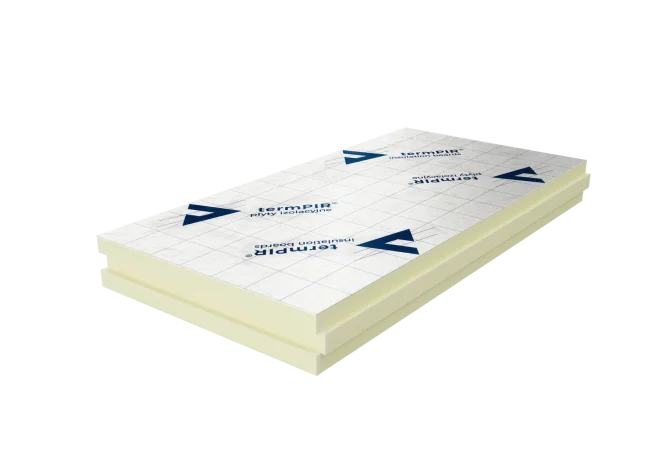
| termPIR® MAX 19 AL | 0.019 | ~19 cm |
| termPIR® AL | 0.022 | ~22 cm |
| Stone mineral wool | 0.036 | ~36 cm |
| EPS 100 polystyrene | 0.036 | ~36 cm |
| Glass wool | 0.038 | ~38 cm |
Practical consequences for an EPBD-compliant project:
- Thinner envelope — for over-rafter roof insulation, a saving of 15–20 cm of structural height, which means lower roof-truss cost, shorter metal flashing and lower parapet loads,
- Greater usable area — in a single-family house with two-leaf walls, a gain of 4–8 m² of net floor area within the same outer footprint,
- Long-term stability of parameters — PIR does not lose λD over decades of service, unlike mineral wool, which is exposed to moisture and settling,
- Fire reaction class B-s2,d0 (system) under EN 13501-1 — meets fire-safety requirements for residential and most commercial buildings,
- Compliance with EN 13165 — product standard for rigid PIR/PUR foams in construction.
PIR applications in zero-emission buildings
Pitched roof — over-rafter
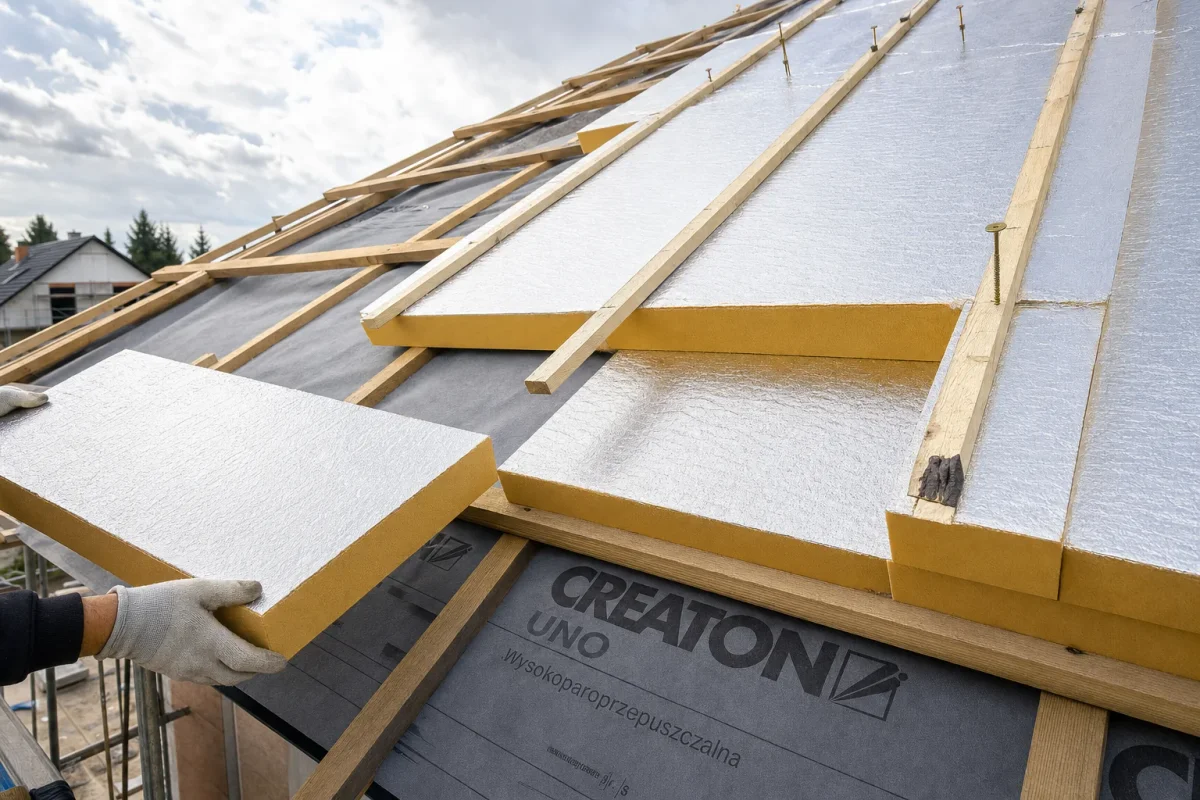
Installing termPIR® over rafters eliminates thermal bridges at the timber structural members. An 18–22 cm board with a TAG tongue-and-groove edge ensures a continuous insulation layer and a U-value below 0.11 W/m²K.
Flat roof
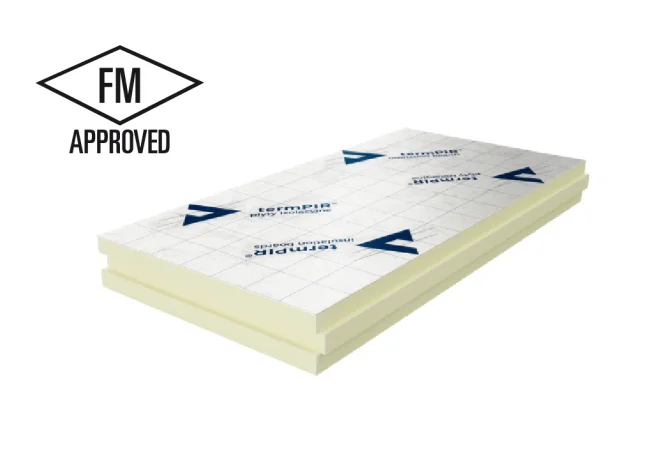
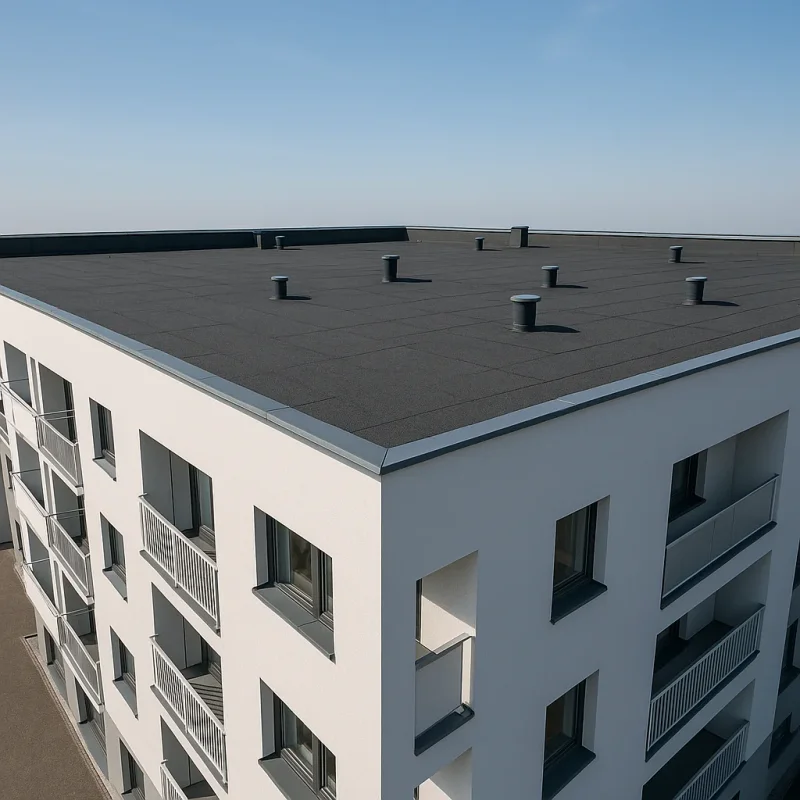
For commercial and logistics facilities, termPIR® Pro-F with glass fleece for PVC/TPO membranes, together with izoGRASS® tapered insulation, allows the designed falls of 1.5–2% to be achieved without additional structural layers. The system holds FM Approved certification.
External wall — ETICS
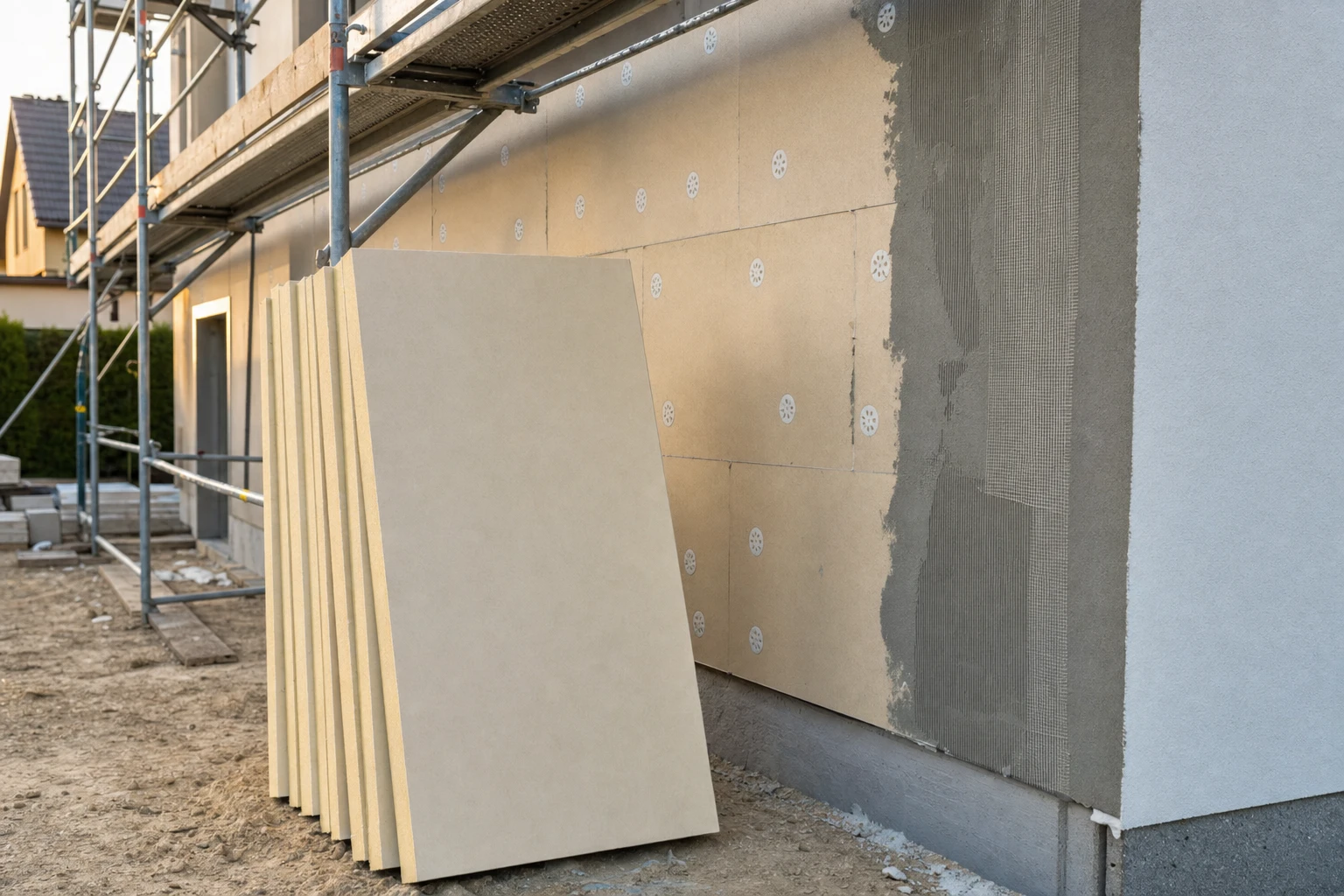
For masonry walls with a thin-coat render system, termPIR® ETX is used, featuring glass fleece and European Technical Assessment ETA 17/0066. With λD 0.025 W/(m·K), the board is vapour-permeable — crucial for the moisture safety of the wall assembly. Note: standard aluminium-faced boards (termPIR® AL) must not be used in ETICS — the gas-tight foil would block water-vapour diffusion and lead to degradation of the render system.
Energy retrofit of existing buildings
The EPBD introduces a mandatory renovation passport — a document guiding the building owner through a phased upgrade plan towards the zero-emission standard. Insulation installed in 2026 must be compatible with a heat-source replacement and PV installation planned for 2030. Using PIR from the first stage means there is no need to add insulation later — which eliminates duplicated labour costs.
What you can do today
The EPBD will not take full effect tomorrow, but design decisions made today will govern 30–50 years of building service life:
- Investor building in 2026–2028 — design straight to the ZEB standard, even if it does not formally apply yet. The insulation premium is 3–7% of construction cost, and pays back through lower energy bills and higher residual property value.
- Owner upgrading a building — carry out the thermal retrofit “to EPBD 2050”, not to the minimum WT in force at the time of original construction. Repeating the same work in 10 years makes no economic sense.
- Designer and developer — factor in the renovation passport and coordinate insulation layers with planned PV and heat-pump installations already at the building design stage.
Frequently asked questions
Are WT 2021 requirements compliant with EPBD 2030?
Do PIR boards meet fire requirements for multi-family residential buildings?
Is aluminium-faced PIR board suitable for ETICS?
What PIR thickness delivers U = 0.10 W/m²K for a roof?
Is a building renovation passport already mandatory in Poland?
Related products and systems
Products
Read next
Smog and Allergies — How PIR Thermal Upgrades Cut Emissions | BOKKA
Thermal Imaging Survey: Detecting Thermal Bridges | BOKKA
WHO 2021 Air Quality Guidelines and Thermal Retrofit in Poland