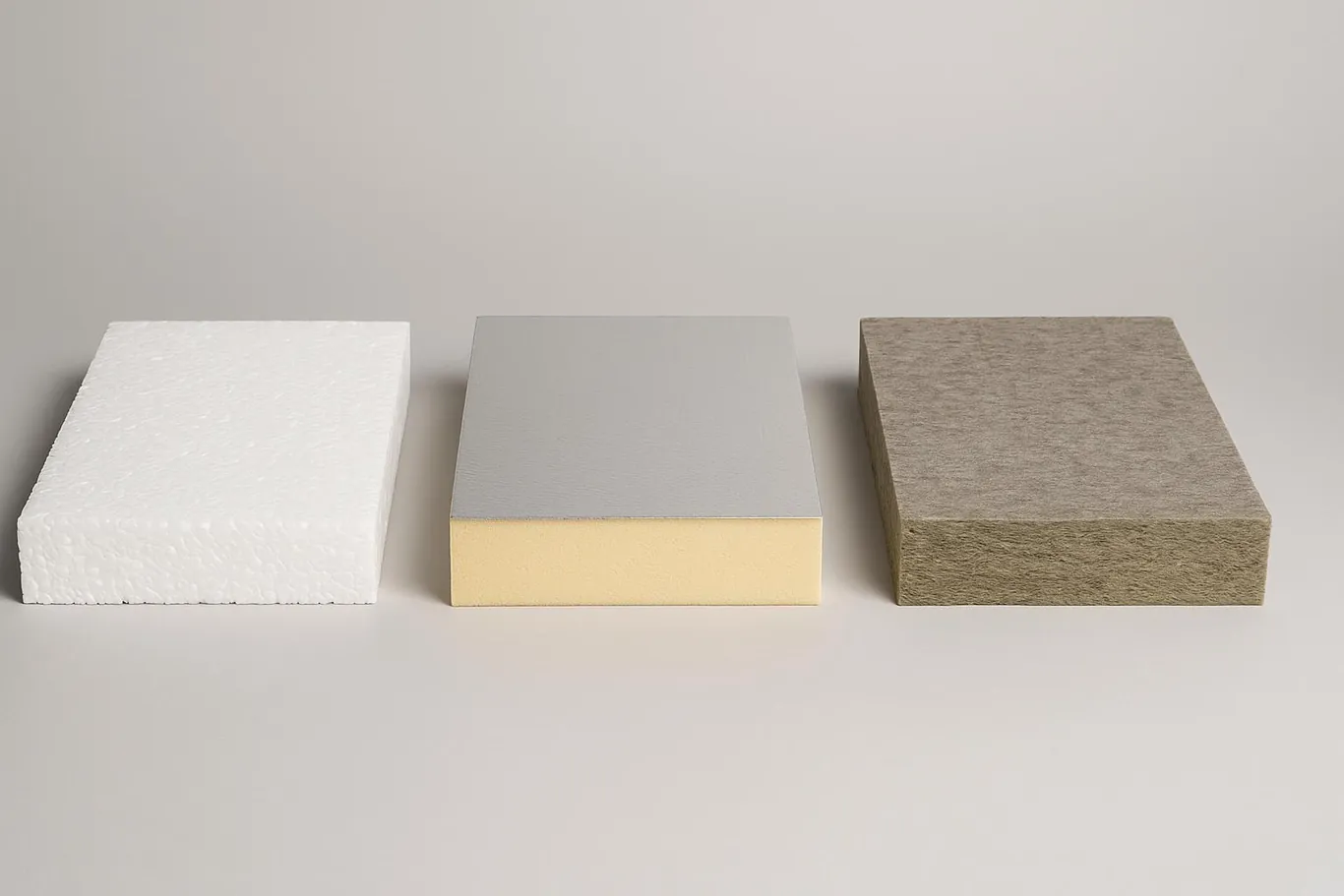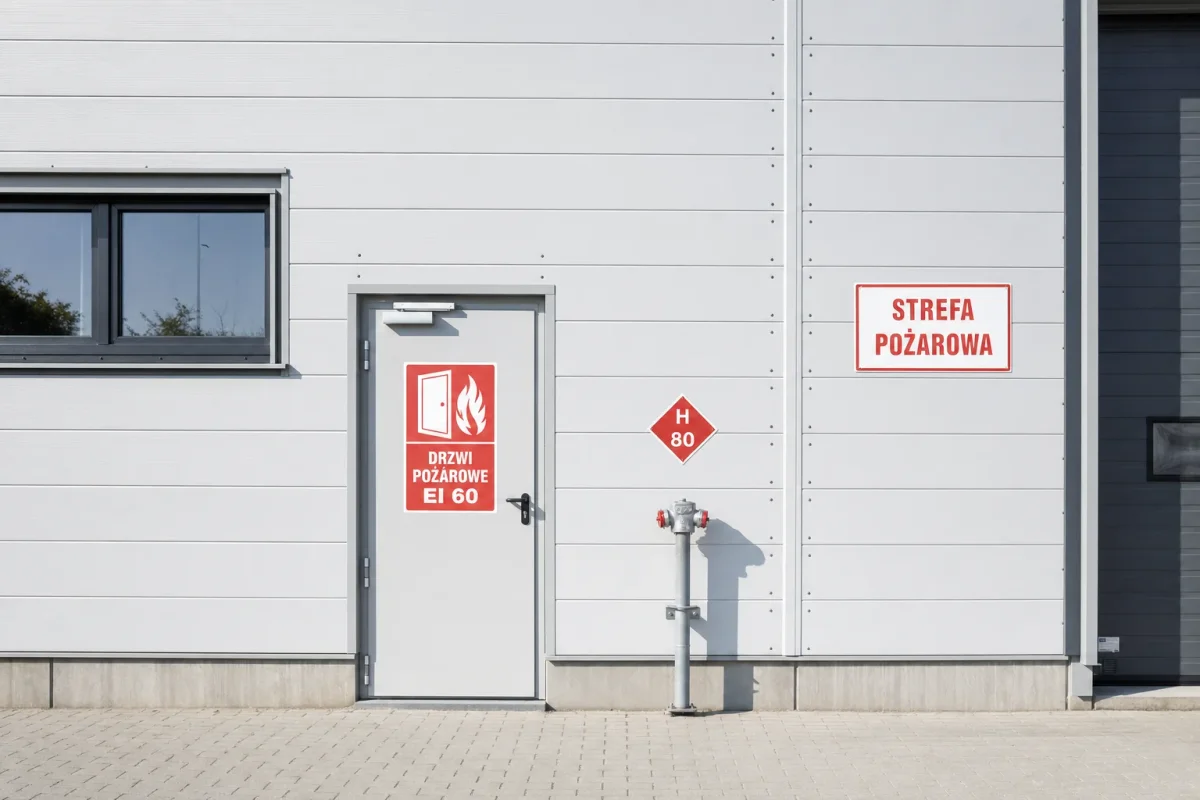
When to use this system
The GS MW CH system is used when A2-s1,d0 (non-combustible) reaction-to-fire class is a design requirement, an insurer’s stipulation or a regulation:
- Warehouse halls with combustible goods — storage of paper, timber, plastics, tyres. The insurer often requires non-combustible walls to limit fire spread.
- Fire compartment separation walls — boundary walls between zones defined by the fire safety design (e.g. production vs office, production vs warehouse).
- High-rise buildings >12 m — building regulations require NRO (non-fire-spreading) or non-combustible classification for façades.
- Cold stores and freezers with combustible goods — where CO² is used as the refrigerant (PIR would react with ammonia in case of damage).
- Public buildings — hospitals, schools, hotels — where A2 is the standard due to evacuation requirements.
Fire performance parameters
The system stands out with the highest fire safety class among sandwich panels:
| Parameter | GS MW CH | insPIRe® CH (PIR) |
|---|---|---|
| Reaction to fire | A2-s1,d0 (non-combustible) | B-s1,d0 (combustible, non-fire-spreading) |
| EI resistance | EI 120 / EI 180 / EI 240 | EI 30 / EI 60 (depending) |
| Smoke density | s1 (lowest) | s1 |
| Flaming droplets | d0 (none) | d0 (none) |
| Core λ | 0.044 W/(m·K) | 0.022 W/(m·K) |
The choice between GS MW vs insPIRe® is a trade-off: fire safety vs thermal performance. To achieve the same U-value, a mineral wool panel must be 2× thicker than PIR — e.g. for U = 0.22 W/m²·K we need 200 mm MW vs 100 mm PIR.
QA variant — premium for refrigeration
GS MW QA-CH is the Quality Assurance version:
- Improved joint profile with an additional PUS gasket — better air-tightness
- Core λ 0.040 W/(m·K) (vs 0.044 in the standard) — 10% better thermal performance
- PZH hygienic approval — approved for food industry facilities
Installation requirements
- Supporting structure — designed to account for the heavier panel (wool density 105 kg/m³ vs 40 kg/m³ PIR = approx. 2.5× heavier panel).
- Module length standard 2.0–16.0 m. Maximum length limited due to weight.
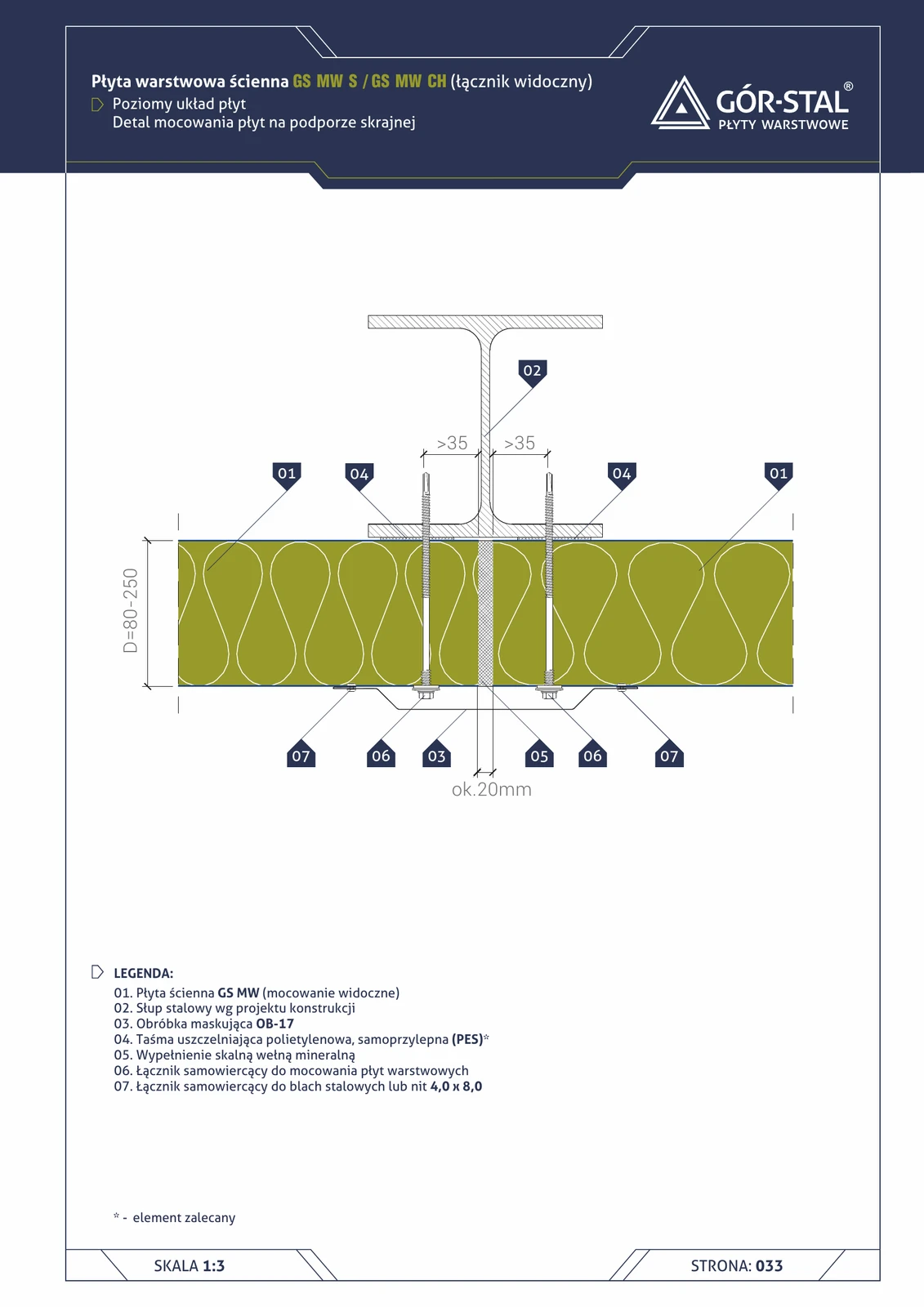
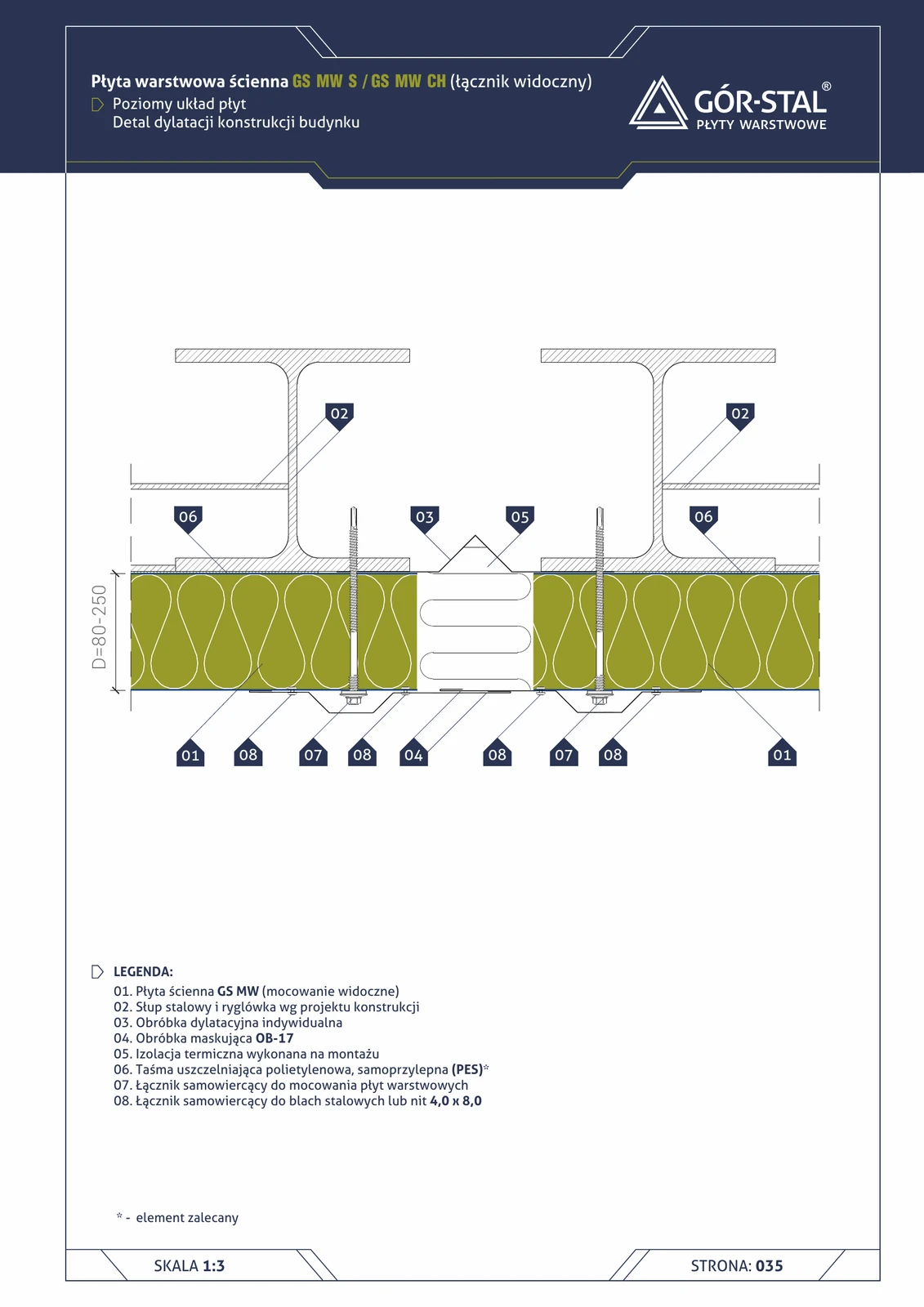
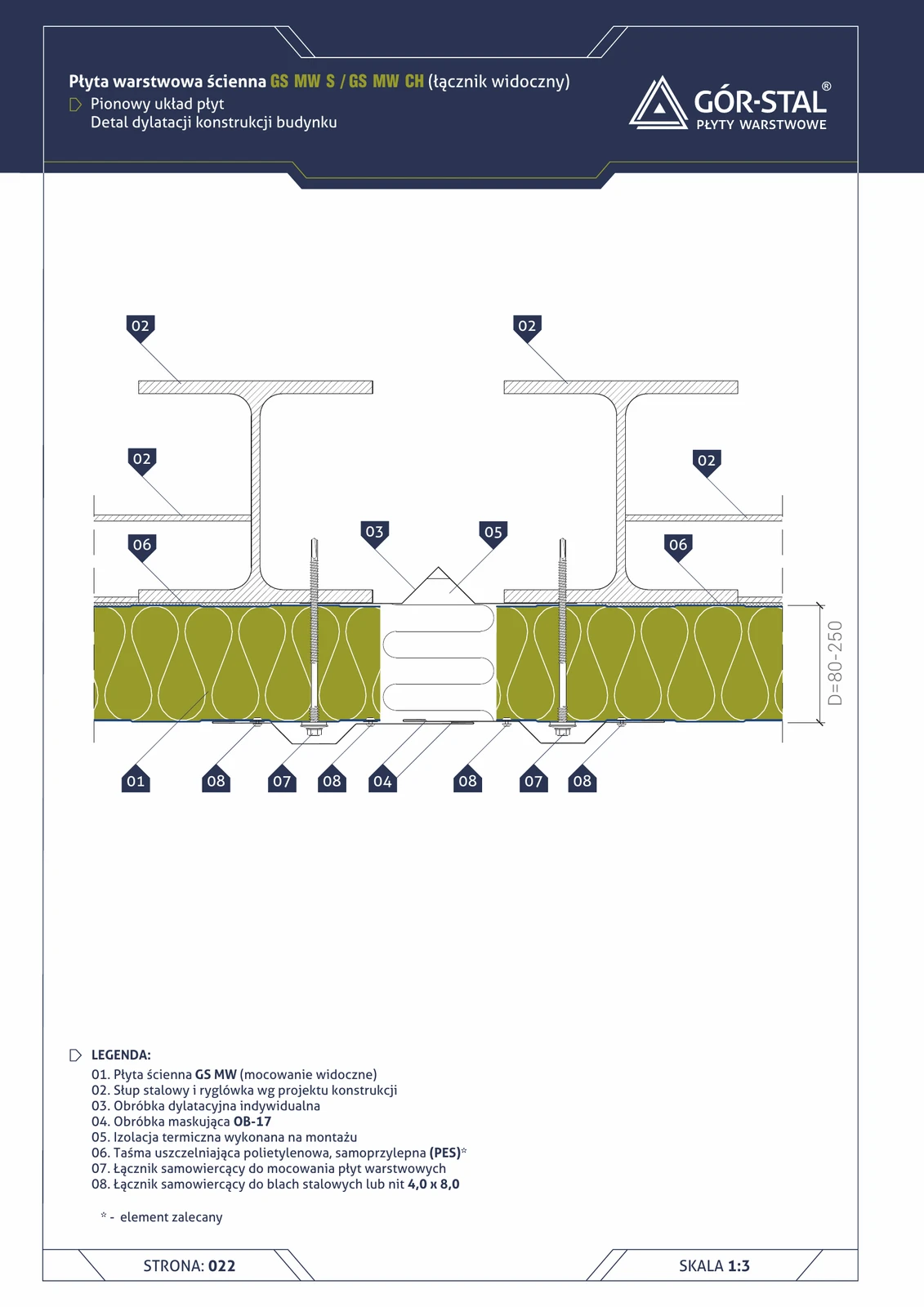
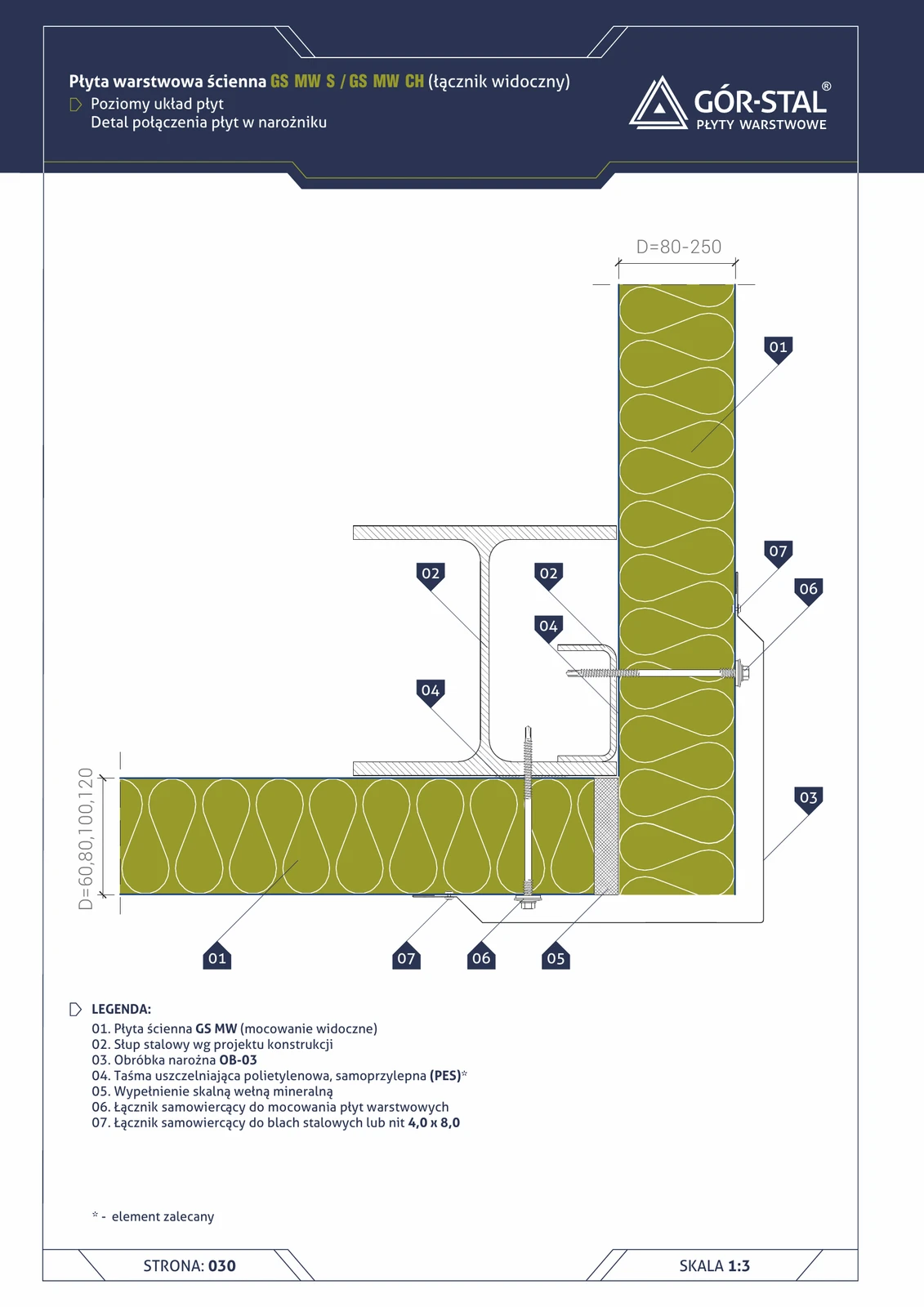
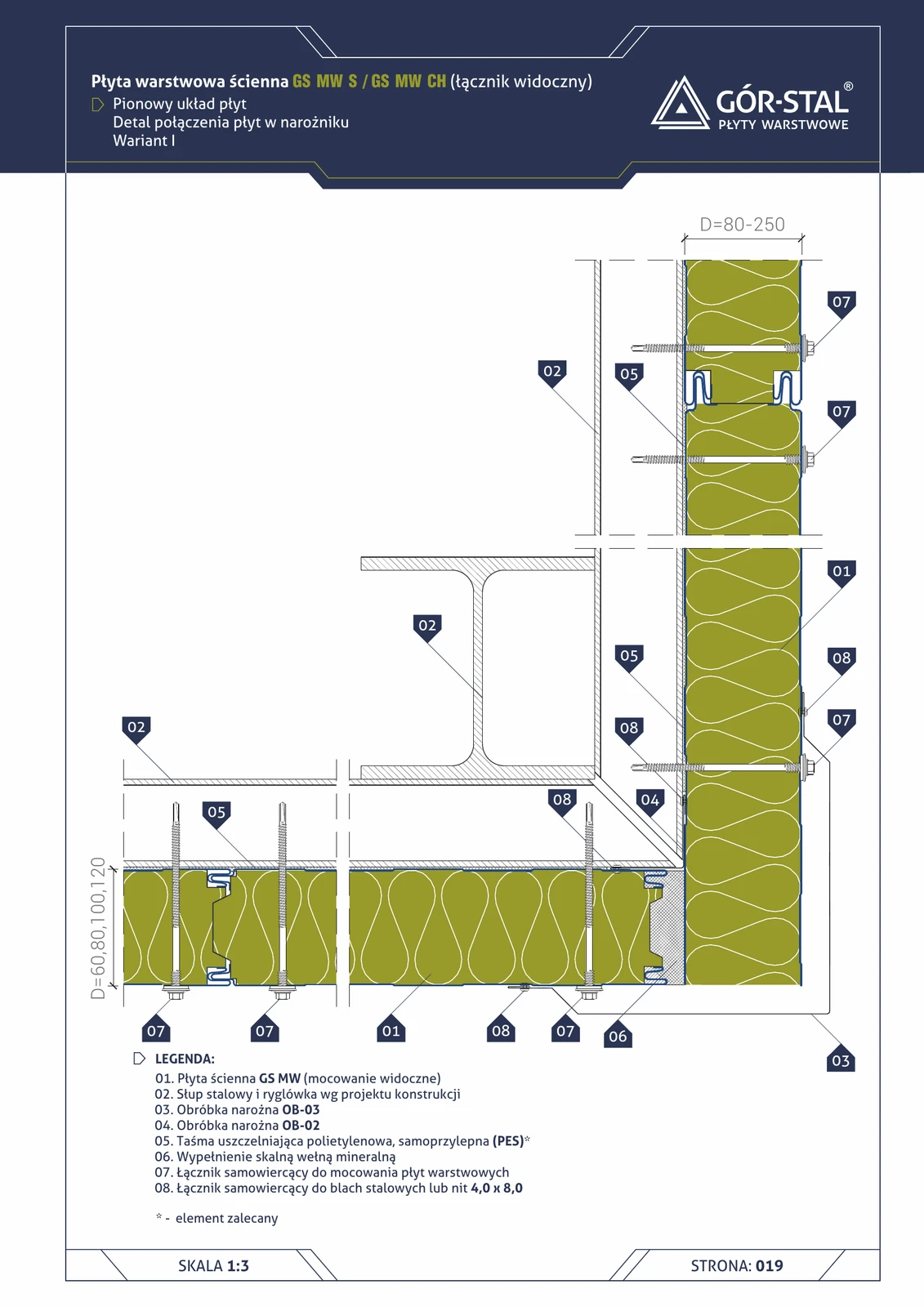
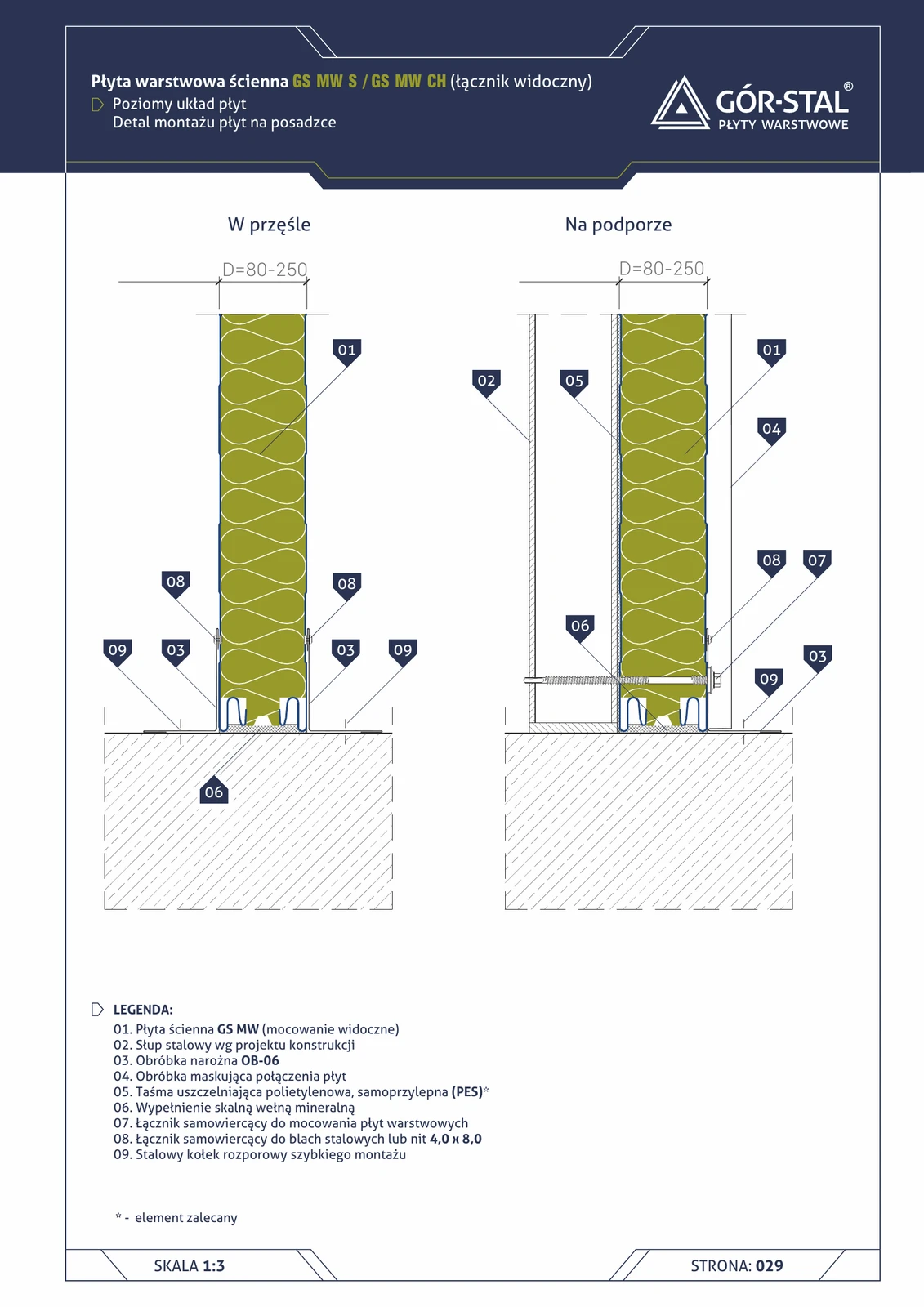
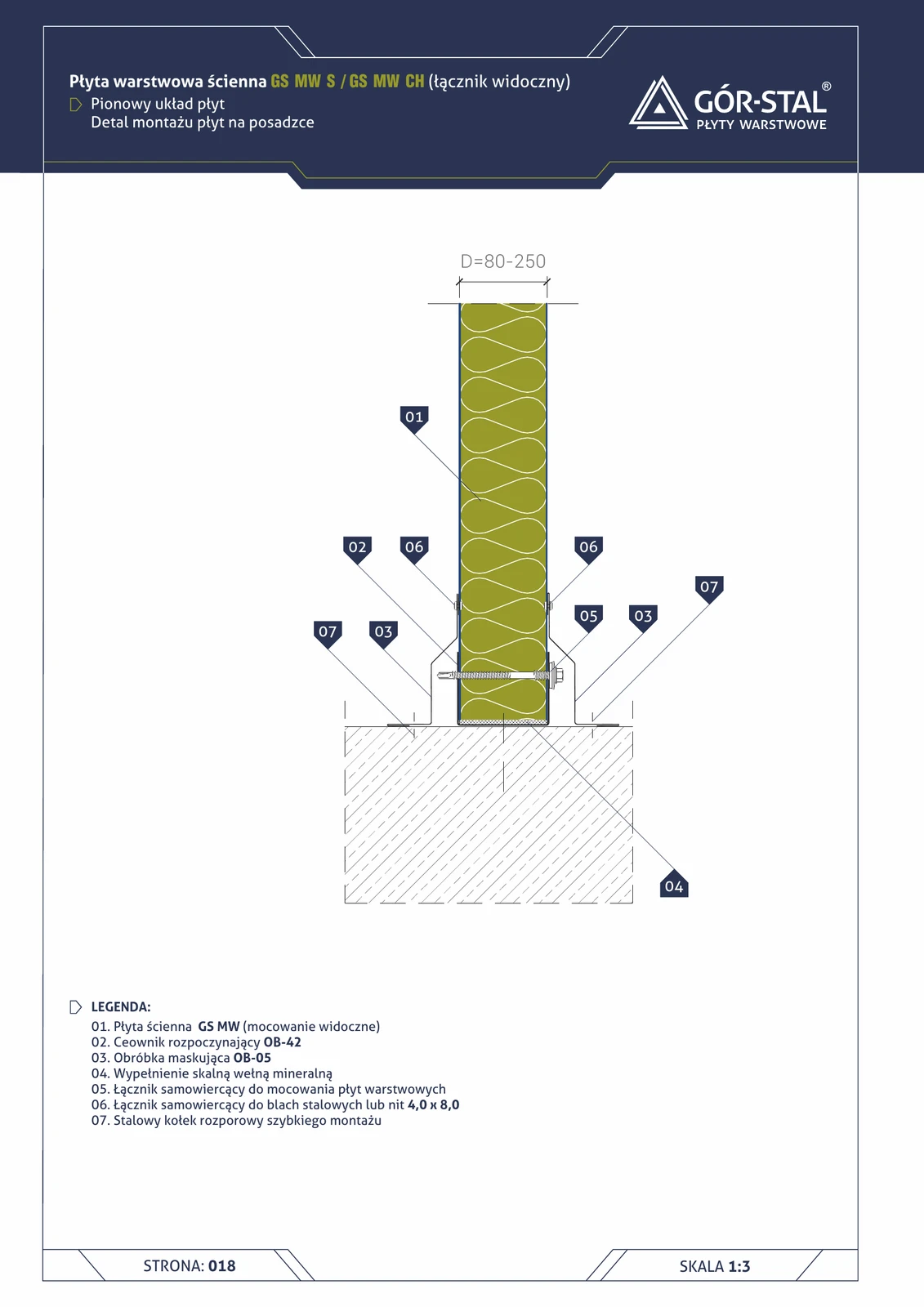
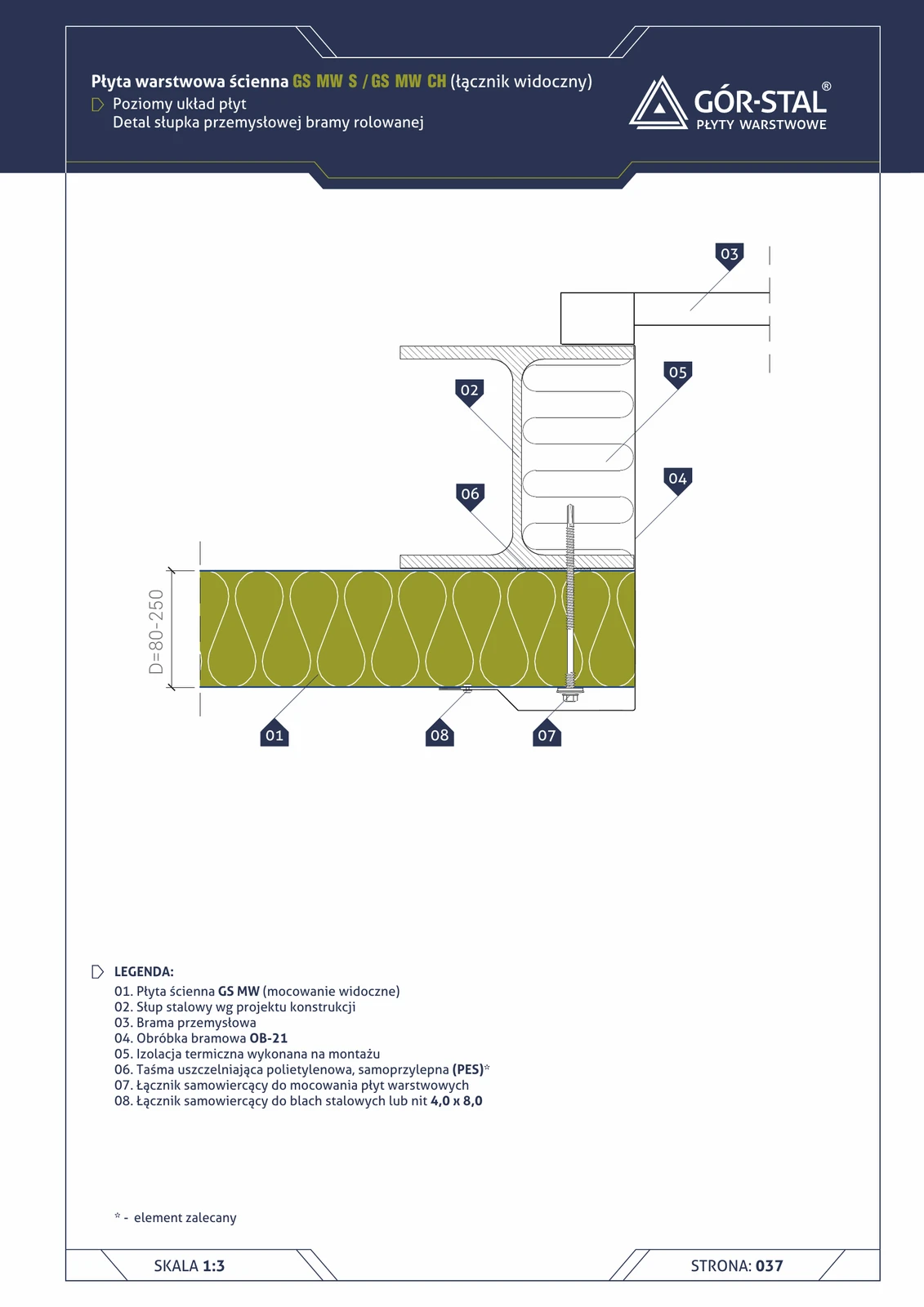
- Sandwich panel fasteners — typically visible (vertical joint), length selected for panel thickness.
- Joint compatibility — GS MW can be mixed with insPIRe® CH (PIR) within a single facility — e.g. fire separation walls in MW, the rest in PIR. Confirmation with the manufacturer is required.
Required flashings
The sandwich panel system uses a complete set of roof and wall flashings:
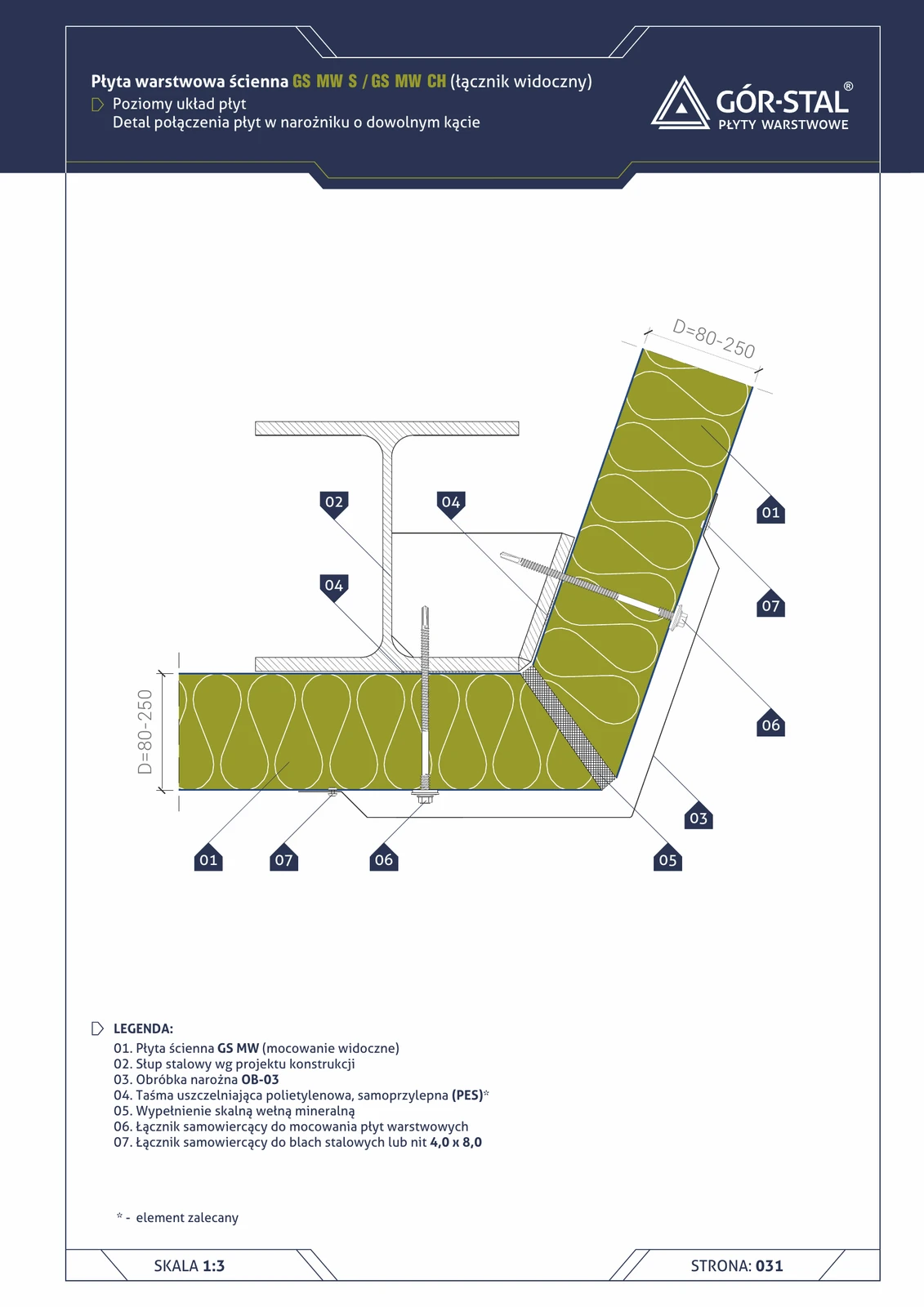
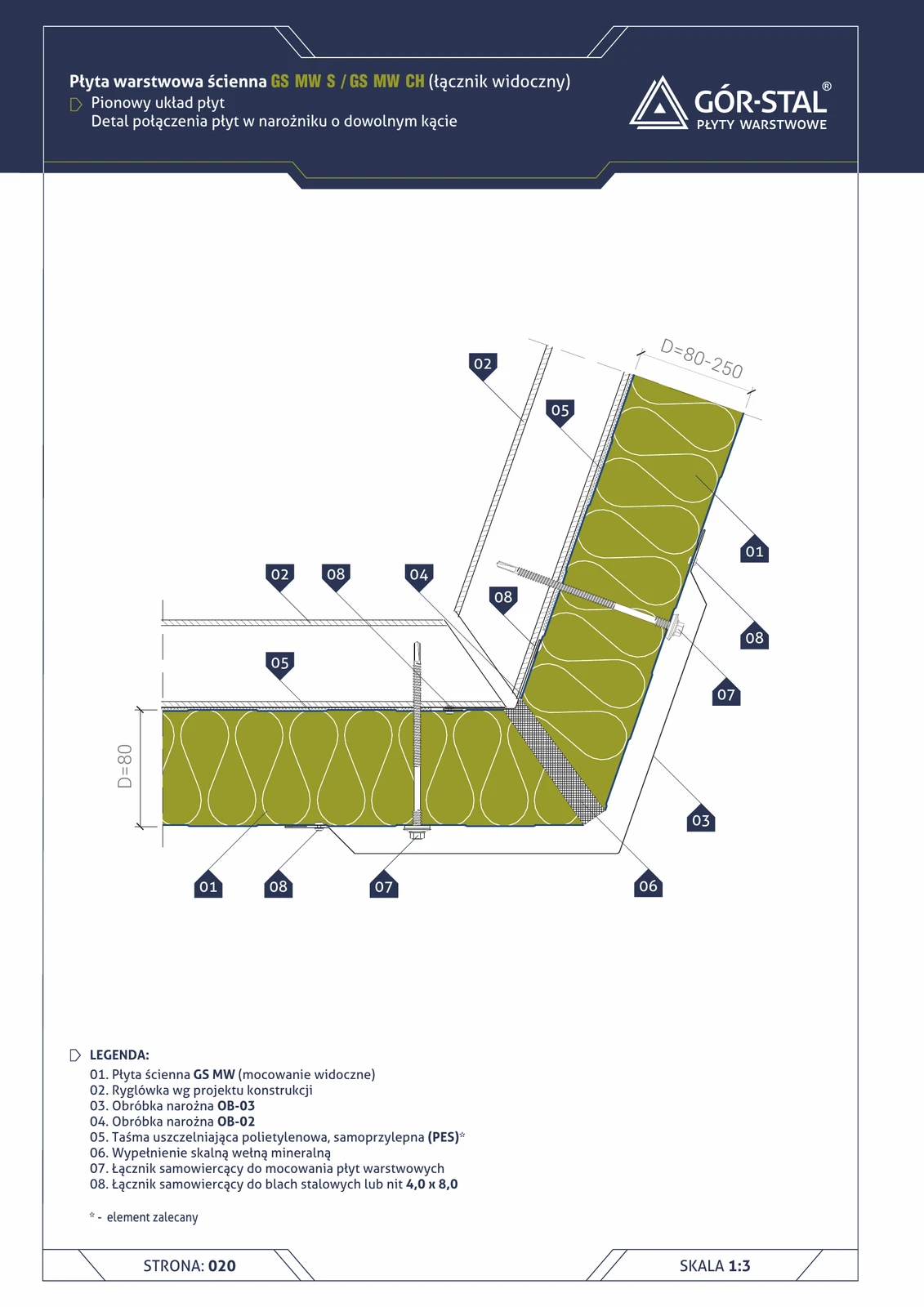
- OB-01 / OB-02 — external / internal corner
- OB-17 — panel joint cover
- OB-22 — ridge (when used as a roof wall)
- OB-36 — panel closure
Technical documentation
The system is described in the GS MW Mineral Wool Panel Catalogue (Gór-Stal, 2025-04-23, pp. 8–12). Classification A2-s1,d0 per PN-EN 13501-1; fire resistance classifications EI 120 / 180 / 240 per PN-EN 1364-1 (non-loadbearing walls) and PN-EN 1365-2 (floors).
Layer composition
| # | Layer | Thickness | λ | Role |
|---|---|---|---|---|
| 1 | Galvanised steel sheet + 25 µm polyester coating | 0.5–0.7 mm | — | external facing |
| 2 | Core — lamella rock mineral wool | 100–250 mm | 0,044 W/(m·K) | thermal insulation and non-combustible structure (105 kg/m³) |
| 3 | Galvanised steel sheet + 25 µm polyester coating | 0.5–0.6 mm | — | internal facing |
U-value by insulation thickness
| termPIR® thickness | U [W/m²·K] | Meets WT 2021 (roof U ≤ 0.15) |
|---|---|---|
| 100 mm | 0,43 | — no |
| 120 mm | 0,36 | — no |
| 160 mm | 0,27 | — no |
| 200 mm | 0,22 | — no |
| 250 mm | 0,17 | — no |