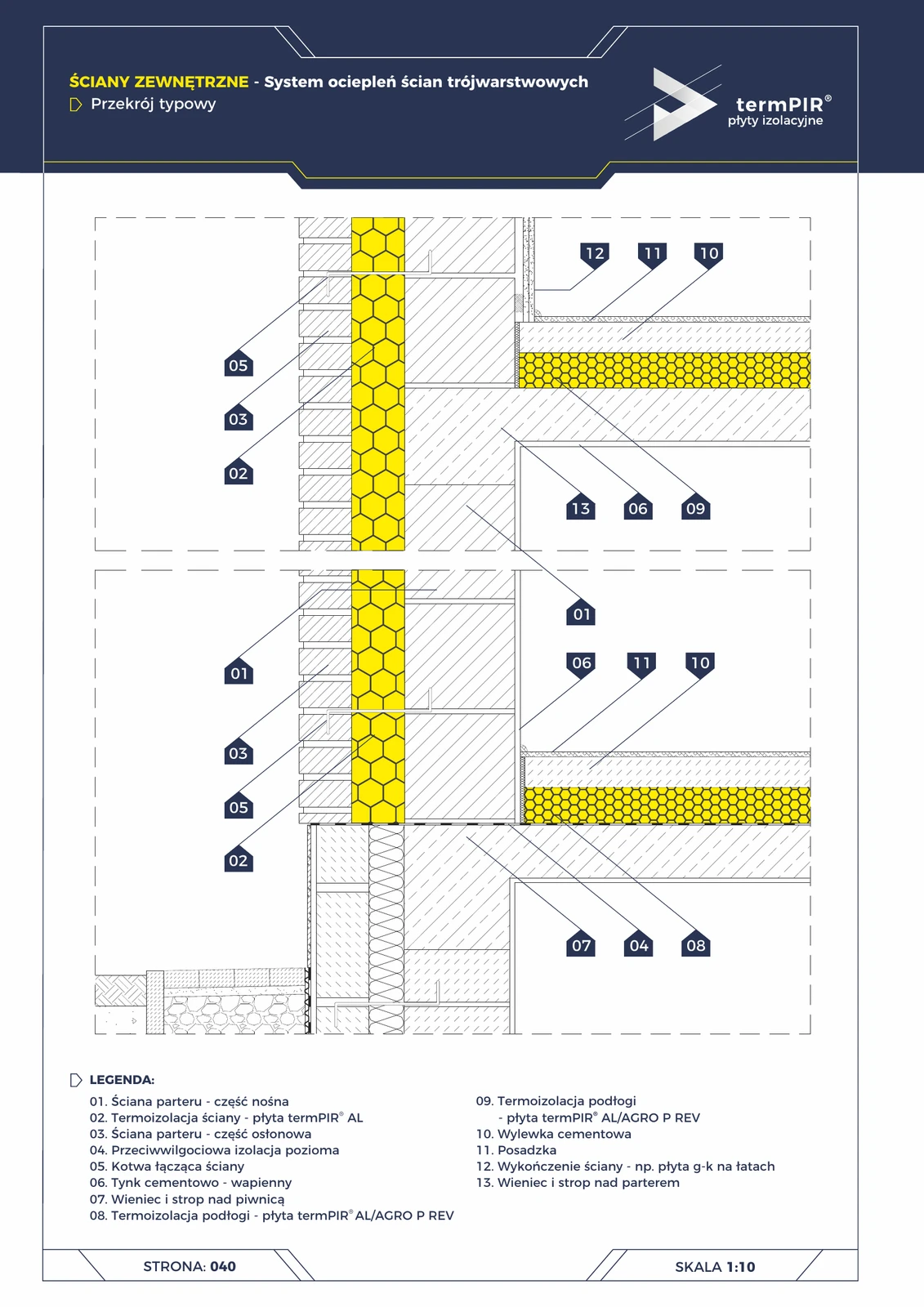
Junction function
Three-layer wall = the Polish single-family house standard of the 1990s: load-bearing leaf + insulation layer + outer leaf. Vs ETICS (p. 36):
- Durability: 80+ years (clinker requires no renovation), vs ETICS 25–30 years (render + decorative trim).
- No painting work on the facade — clinker / silicate is a maintenance-free facade.
- Better acoustics — masonry mass ~400 kg/m² (vs ETICS ~100 kg/m²).
- Required footprint — wider by 6–12 cm (the full outer leaf is added).
- Initial cost — 30–50% higher than ETICS, but over a 30-year period equivalent (zero renovation).
With termPIR® AL (item 02) as insulation:
- λD = 0.022 W/m·K = a thinner layer than EPS/MW at the same U-value.
- Aluminium facing on both sides = vapour tightness + resistance to installation damage.
- No fire issues — in a three-layer wall PIR is enclosed within the masonry (no air contact), so the reaction-to-fire class is secondary.
Critical installation aspects
- Wall ties (item 05) — stainless steel (NOT galvanised!) with a thermal break such as Thermomaß / Halfen MBA; spacing 50 cm vertically, 75 cm horizontally + additional at corners every 30 cm.
- termPIR® AL board (item 02) in the cavity: bonded to the load-bearing leaf with PUR foam adhesive full-surface or fixed with spacers (50×50 cm spacing) so as not to block the thermal performance of the structure.
- Slope towards the interior of the cavity — for clinker outer leaves, weep holes in the joints every 50 cm are recommended (ventilation of condensation in the cavity).
- Horizontal damp-proof course (item 04) MUST BE at floor level — torch-on bitumen membrane; without it capillary rise of water from the foundations occurs = salt efflorescence on clinker (white patches).
- Floor ring beam (items 07, 13) — thermal break required; a termPIR® AL strip 30–50 mm or a Schöck Isokorb beam in Filigran slabs.
- Thermal bridge at the slab/balcony interface — in single-family houses the balcony slab is typically a thermal bridge; a termPIR® AL strip in the lintel zone of the ring beam reduces ψ from 0.5 to <0.1 W/m·K.
Documentation
Technical Catalogue termPIR® — Residential Buildings (Gór-Stal 2022), page 38 — External three-layer wall, typical section. Scale 1:10.
Components in this junction
Insulation (3)
- 02 Wall insulation — termPIR® AL board
- 08 Floor insulation — termPIR® AL board
- 09 Floor insulation — continuation
Fastener (1)
- 05 Wall tie (stainless steel)
Element (9)
- 01 Ground-floor load-bearing wall (inner leaf)
- 03 Ground-floor outer leaf (clinker / silicate)
- 04 Horizontal damp-proof course
- 06 Cement-lime plaster (interior)
- 07 Ring beam and slab above basement
- 10 Cement screed
- 11 Floor finish
- 12 Interior wall finish — e.g. plaster or plasterboard on battens
- 13 Ring beam and slab above ground floor