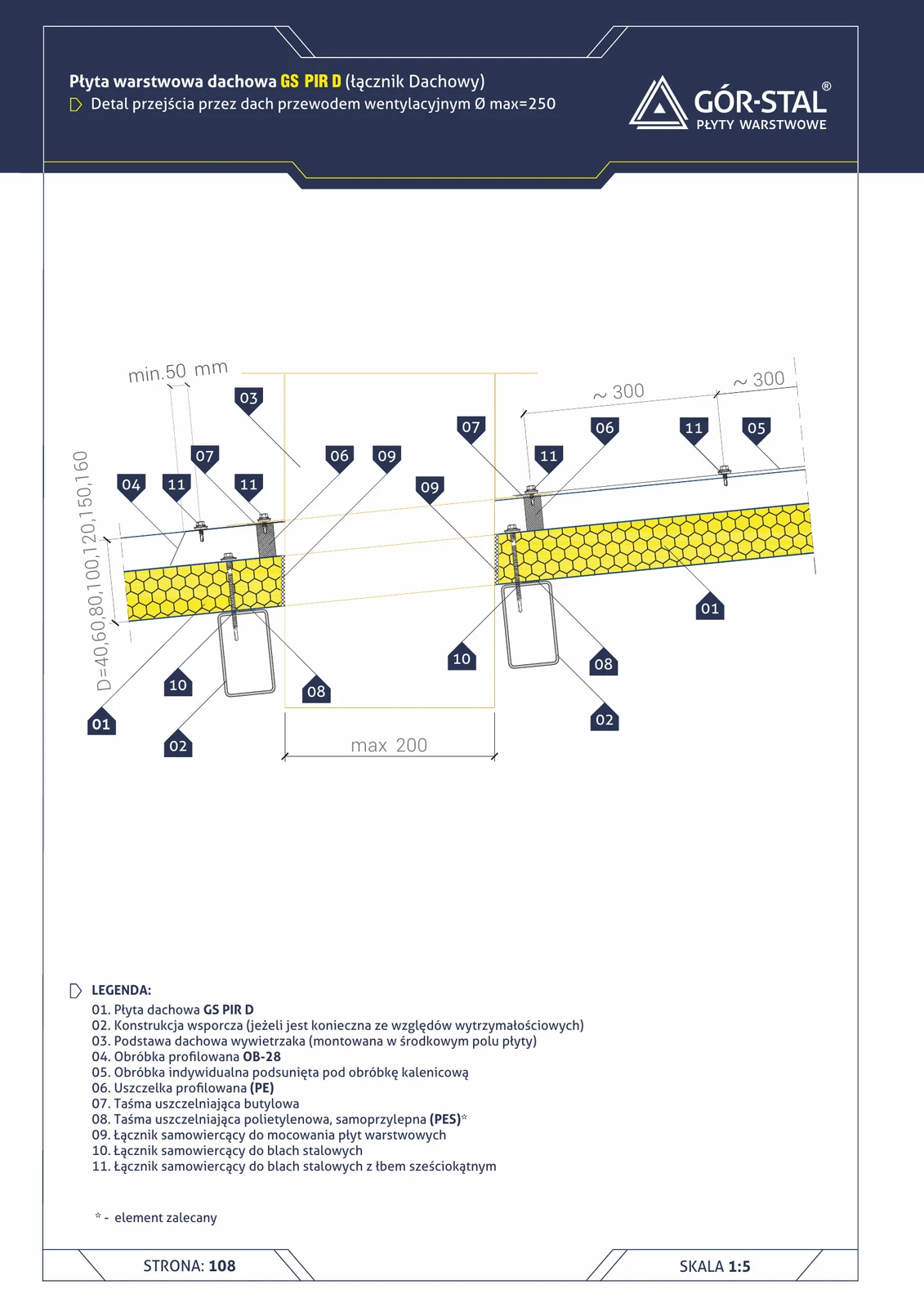
Junction function
Ventilation duct through roof = penetration of a vent stack / HVAC duct / process duct through the roof panel. A critical detail for:
- Rainwater tightness — water must not penetrate through the duct collar.
- Structural stability — the duct may be heavy (HVAC counterweight) and must be securely fastened.
Critical installation aspects
- Location in the central field of the panel — min. 300 mm from the panel edge; placement closer to the edge compromises the joint and causes leaks.
- Vent stack roof base = a prefabricated unit matched to the trapezoidal profile; its flange is sealed with butyl tape around the entire perimeter.
- OB-28 + custom flashing surround the base.
- Opening in the panel = cut with a diamond saw; protect edges with PUR foam to prevent water ingress into the PIR core.
- Ventilation compensation — the vent stack requires airflow; install a backdraft damper if required.
- Thermal bridge = steel vent stack ψ ≈ 0.3 W/K — cover with external insulation (insulating jacket).
Documentation
Technical Catalogue insPIRe S/U + GS PIR D (Gór-Stal 2025), page 106 — Ventilation duct — roof penetration. Scale 1:5.
Components in this junction
Panel (1)
- 01 GS PIR D roof panel (GS PIR D)
Flashing (2)
- 04 OB-28 profiled flashing (OB-28)
- 05 Custom flashing tucked under the ridge flashing
Fastener (3)
- 09
- 10 Self-drilling fastener for steel sheets
- 11
Sealant (3)
- 06 PE profiled gasket
- 07 Butyl sealing tape
- 08
Element (2)
- 02 Support structure (if required)
- 03 Vent stack roof base (in the central field of the panel)