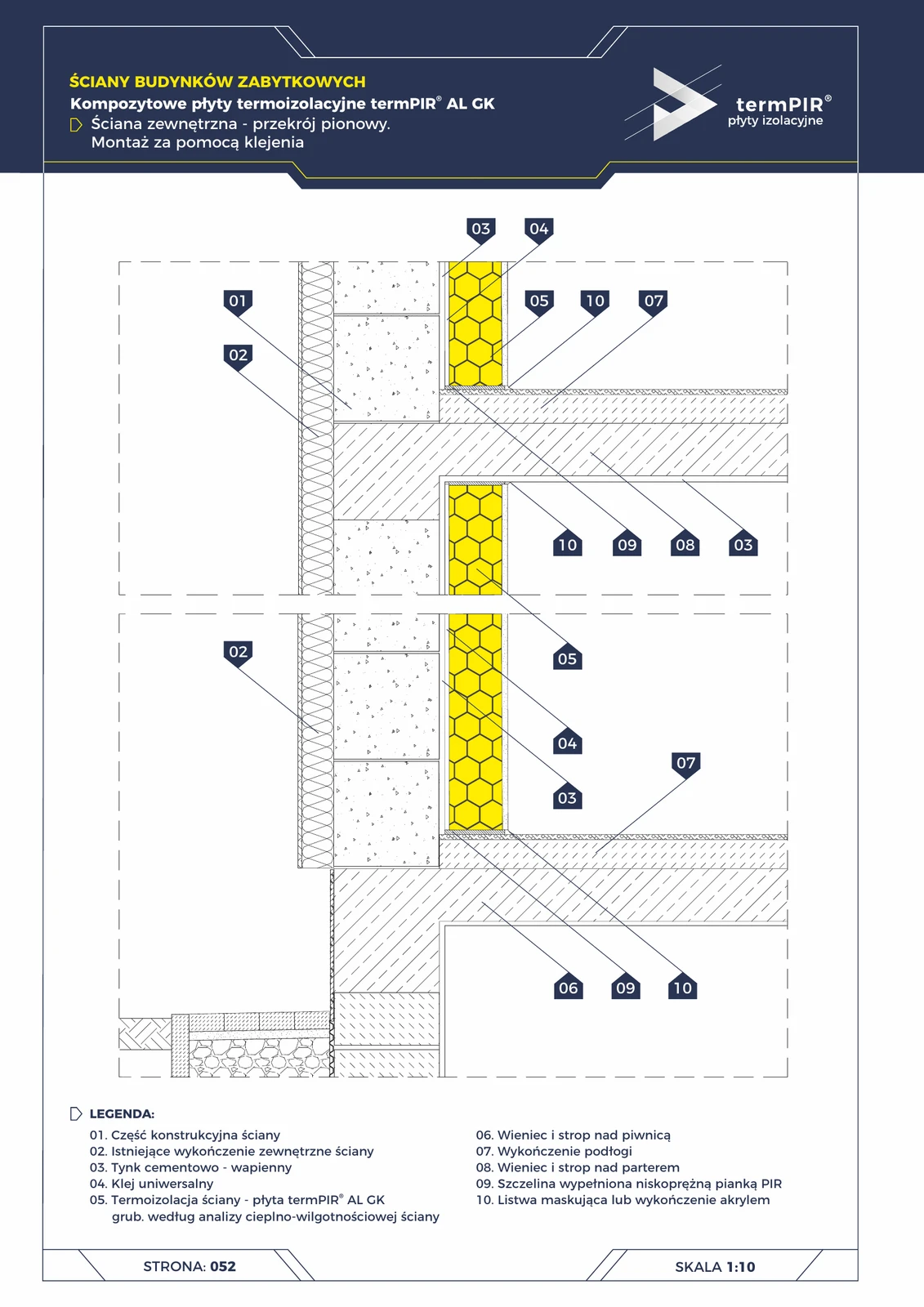
Junction function
Internal insulation of heritage buildings = the only option when the conservation officer does not allow the façade to be altered. Challenges:
- Moisture in the wall — existing historic walls often carry moisture from the foundation (no damp-proof course); internal insulation SHIFTS the dew point deeper into the wall = risk of condensation within the structure.
- Hygrothermal analysis per PN-EN ISO 13788 (Glaser method) or WUFI (dynamic) is mandatory before design; it determines the maximum permissible insulation thickness.
- Internal thermal bridges (slabs, cross walls) are harder to eliminate than in external insulation.
termPIR® AL GK = ideal material for heritage buildings:
- Low vapour permeability of the AL facing → lower risk of condensation deep within the wall than with mineral wool.
- Thinner layer than EPS/MW for the same U-value → less loss of living space (important in small tenement flats).
- Ready plasterboard on the room side → no additional finishing layer required.
Critical installation aspects
- Hygrothermal analysis (Glaser method / WUFI) is MANDATORY before selecting thickness. Typical values for a 38 cm brick tenement wall: max 6–8 cm AL GK (for interior humidity 50–60% RH). Above this → condensation deep within the masonry.
- Universal adhesive (item 04) — full-surface (NOT spot bonding!); Ceresit CT 84 PUR foam adhesive or PCI Pecimörtel; before gluing, remove old plaster, sand down, prime for adhesion.
- Substrate plaster (item 03) — cement-lime or Ceresit CN 73 (self-levelling) — levels the wall prior to gluing.
- Perimeter gap (item 09) — low-expansion PIR foam fills 5–15 mm gaps at the slab and floor; high-expansion foam will distort the geometry + damage adjacent historic stucco.
- Masking trim (item 10) — timber (consistent with the heritage interior character) or acrylic skim at corners.
- Slabs (items 06, 08) — the ring beam is often uninsulated → linear thermal bridge = the only location of condensation within the insulation layer. Accept + monitor with thermography after the first winter.
- Warm side (interior) — continuity of AL GK vapour-tightness across all joints: aluminium tape on seams + plasterboard tape and filler on the board.
Documentation
Technical Catalogue termPIR® — Residential Buildings (Gór-Stal 2022), page 52 — Historic wall AL GK, vertical section, glued installation. Scale 1:10.
Components in this junction
Insulation (1)
- 05 Wall thermal insulation — termPIR® AL GK board (thickness per hygrothermal analysis)
Flashing (1)
- 10 Masking trim or acrylic finish
Accessory (1)
- 04 Universal adhesive (PCI Pecimörtel / Ceresit CT 85 / PUR foam adhesive)
Sealant (1)
- 09 Gap filled with low-expansion PIR foam
Element (6)
- 01 Structural part of the wall (brick / stone / half-timbered masonry)
- 02 Existing external wall finish (historic plaster + any stucco)
- 03 Cement-lime plaster (interior, as substrate for gluing)
- 06 Ring beam and slab above basement
- 07 Floor finish
- 08 Ring beam and slab above ground floor