When to use this system
A ceiling beneath an unheated attic is a classic configuration in single-family construction — it applies to:
- Single-family houses with an open attic — a non-usable loft used as storage or left completely empty.
- Multi-family buildings with an attic — the topmost storey is heated, and the attic above it serves as a thermal buffer.
- Buildings with an uninsulated roof — where the roof is not insulated (e.g. energy-efficient houses with an insulated ceiling but an uninsulated roof — the attic acts as a thermal buffer).
- Renovations of older houses — when an old attic has a timber floor and no insulation was provided between the loft and the residential storey below.
WT 2021 requirement: U-value of the ceiling above unheated space ≤ 0.25 W/m²·K (ti ≥ 16°C). Already met by 80 mm of termPIR® AL.
Top-floor ceiling vs interstorey ceiling
| Aspect | Top-floor ceiling (this system) | Interstorey ceiling |
|---|---|---|
| Temperature above the ceiling | atmospheric (attic) | internal room temperature (≥ 16°C) |
| WT 2021 requirement | U ≤ 0.25 | U ≤ 1.00 (Δti ≥ 8°C) |
| Typical termPIR® thickness | 100–150 mm | 20–50 mm |
| Waterproofing | not required | not required |
| Walkway over insulation | OSB walkway boards | concrete screed |
Installation requirements
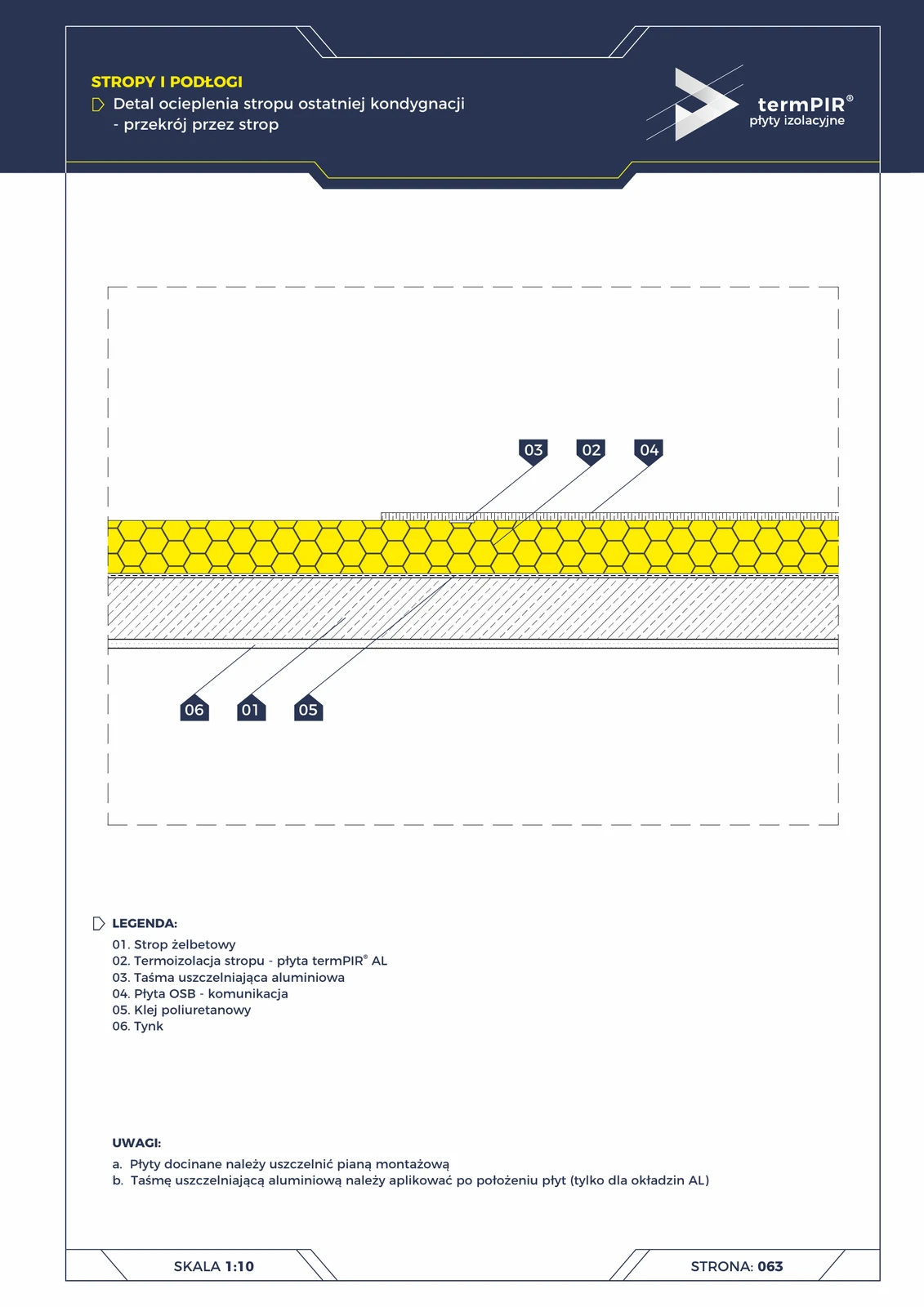
- termPIR® AL boards are to be laid in a staggered pattern on the reinforced concrete slab, with no need for bonding (their own weight keeps them in place).
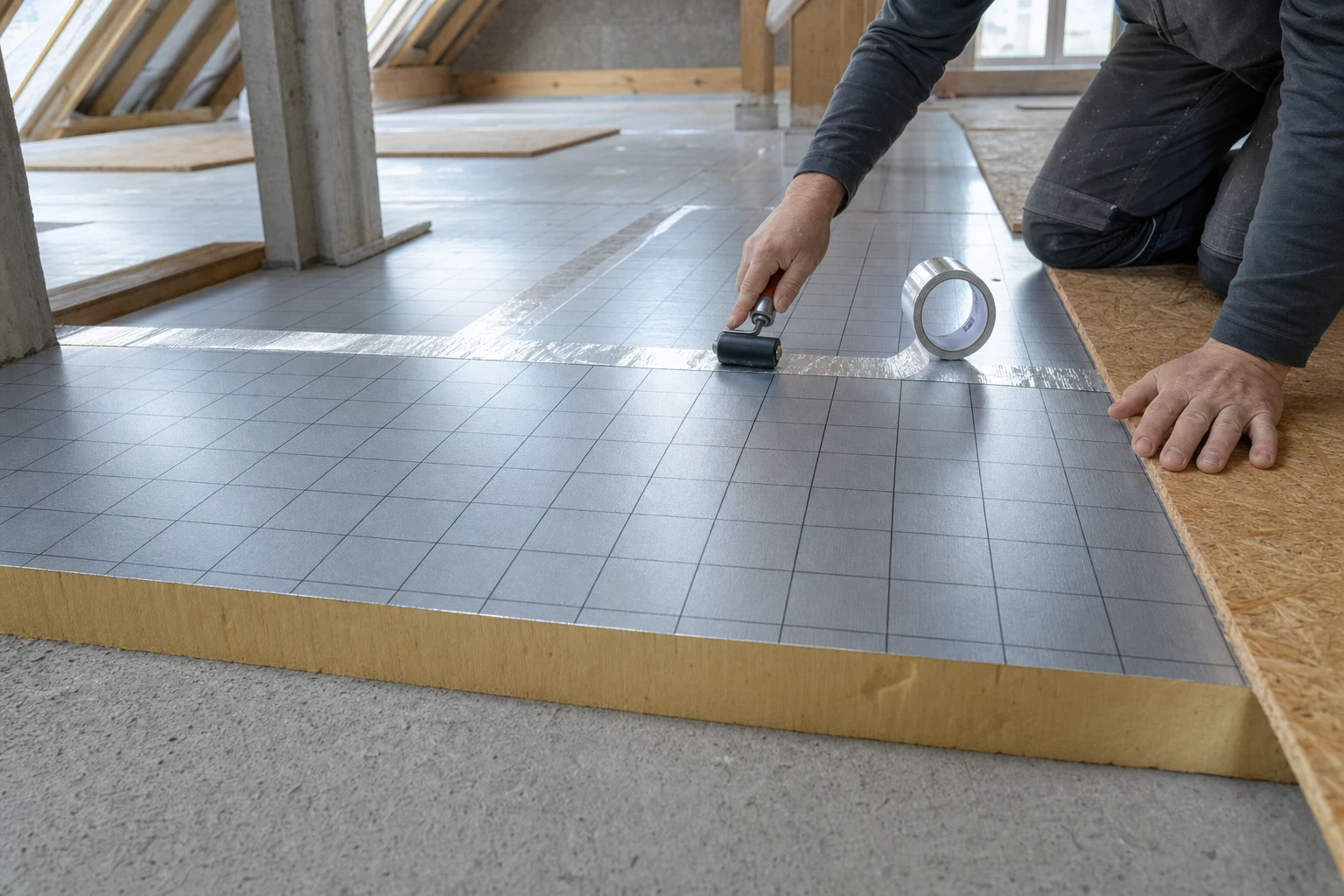
- Board joints must be sealed with aluminium tape on the upper side (vapour tightness) — essential when the rooms below have elevated humidity.
- Cut boards should be sealed with PIR foam (chemical compatibility with the core).
- Adhesive fixing (optional) — polyurethane adhesive in spots, where there is a risk of board displacement (e.g. strong winds through attic ventilation openings).
- OSB walkway boards — laid on top of the insulation along the attic’s communication axis (for services and maintenance), at least 60 cm wide. Screwed together at joints.
Knee-wall zone
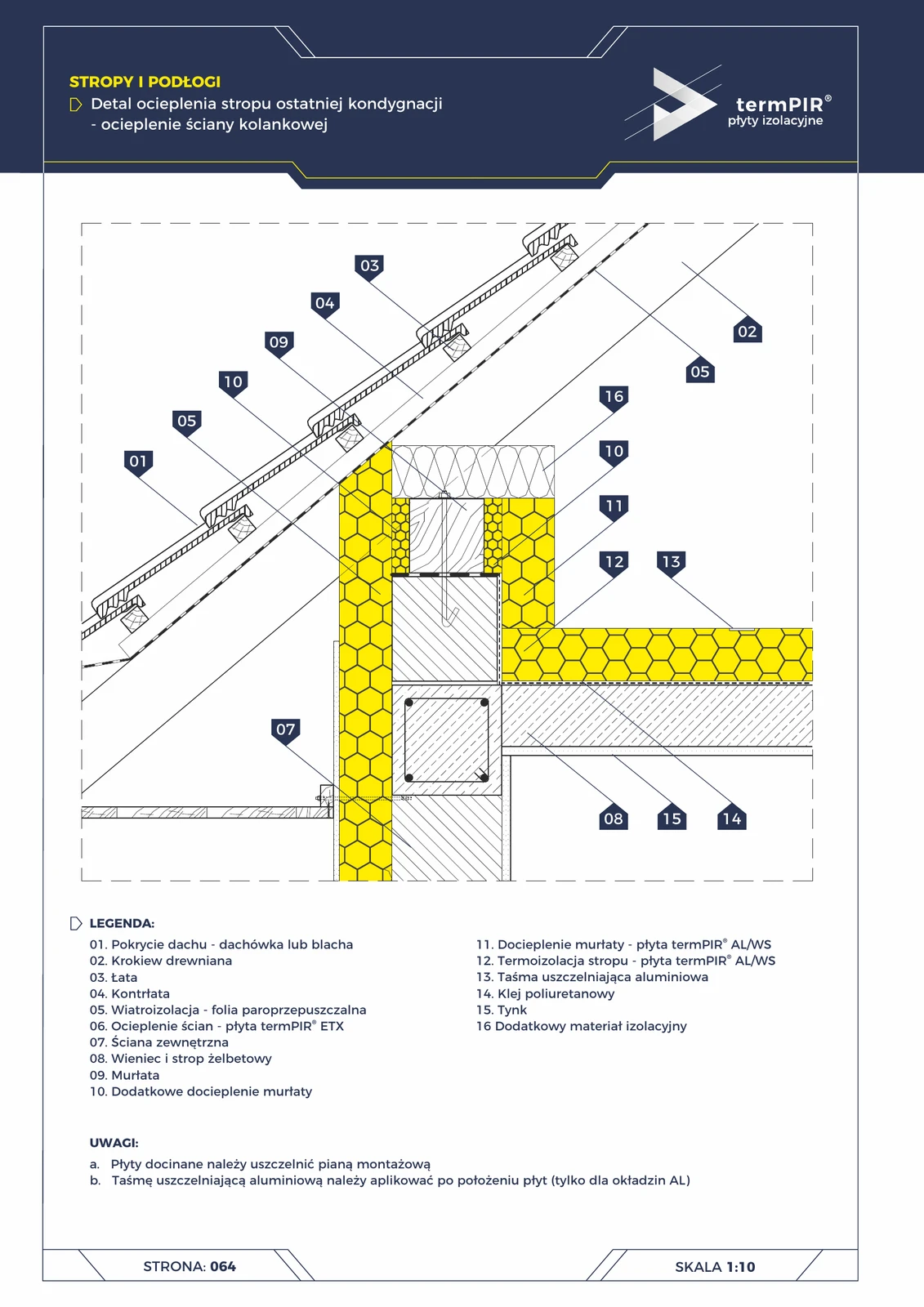
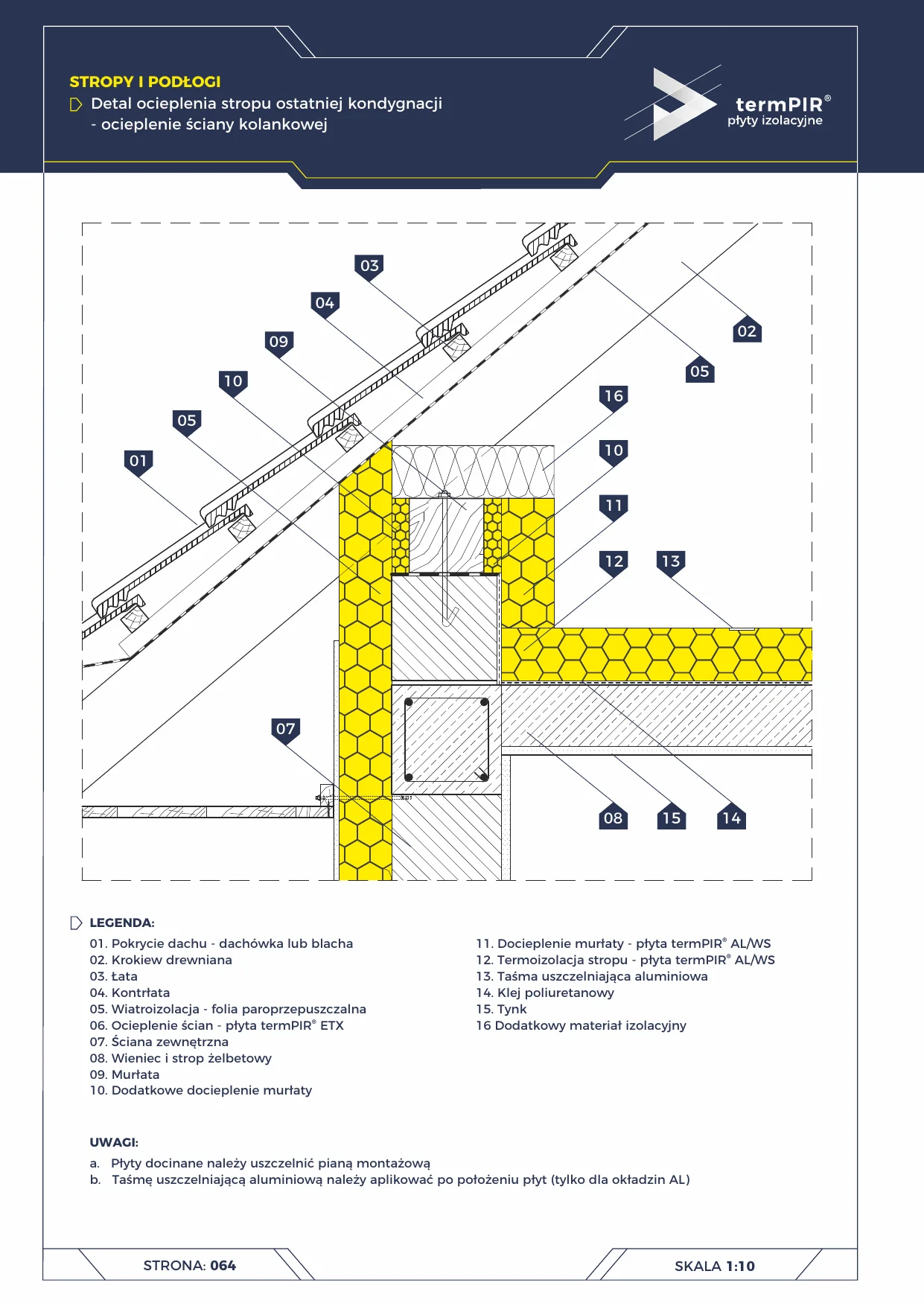
CRITICAL: at the junction of the ceiling with the knee wall (at the roof eaves), additional insulation is required — without it, the thermal bridge reduces the system’s effectiveness by 15–20%:
- termPIR® ETX (glass veil) — installed vertically on the knee wall, compatible with foamed-concrete blocks
- termPIR® AL on the knee wall + additional insulation of the wall plate (the roof’s load-bearing beam)
Technical documentation
termPIR® Catalogue — Residential Buildings (Gór-Stal, 2022-04-26, pp. 61, 63–64). The system is described as a simple variant (without an additional vapour barrier) for typical single-family construction with a non-usable attic.
Layer composition
| # | Layer | Thickness | λ | Role |
|---|---|---|---|---|
| 1 | OSB board (on top of insulation — optional) | — | — | walkway surface in the attic |
| 2 | Polyurethane adhesive (optional bonding to slab) | — | — | fixing insulation to the slab |
| 3 | Aluminium sealing tape | — | — | sealing of panel joints (vapour tightness) |
| 4 | termPIR® AL | 80–170 mm | 0,022 W/(m·K) | thermal insulation of the ceiling |
| 5 | Reinforced concrete slab | — | — | load-bearing structure |
U-value by insulation thickness
| termPIR® thickness | U [W/m²·K] | Meets WT 2021 (roof U ≤ 0.15) |
|---|---|---|
| 80 mm | 0,26 | — no |
| 100 mm | 0,21 | — no |
| 120 mm | 0,17 | — no |
| 150 mm | 0,14 | ✓ yes |
| 170 mm | 0,12 | ✓ yes |
Related catalogue items
Recommended variants
Installation accessories