Attic Insulation with PIR Boards — WT 2021 Compliance | BOKKA
Attic insulation — why it determines the comfort of the entire building
The attic is the building envelope component subjected to the greatest thermal stress — in summer it heats up from solar radiation, in winter it loses heat through the roof, which has the lowest thermal mass. Poorly designed insulation means rooms overheating above 30°C during summer, water vapour condensing on thermal bridges, mould growth, and heating bills up to 25–30% higher. In this article, we show how to design attic insulation compliant with WT 2021 (Polish Technical Conditions 2021) using termPIR® boards with low lambda, without losing usable headroom.
WT 2021 requirements for the roof and ceiling above the attic
In force since 1 January 2021, the Polish Technical Conditions impose strict requirements on roof envelope components:
| Envelope component | Umax per WT 2021 |
|---|---|
| Roof, flat roof, ceiling below unheated attic | 0.15 W/m²K |
| Ceiling above the top heated storey | 0.15 W/m²K |
| External wall | 0.20 W/m²K |
To achieve U ≤ 0.15 W/m²K using mineral wool with λD = 0.038 W/(m·K), a layer about 26–28 cm thick is required. Using PIR boards with λD = 0.022 W/(m·K), about 15 cm is enough — a difference that determines the room height and the geometry of the truss.
PIR boards — technical parameters for attic insulation
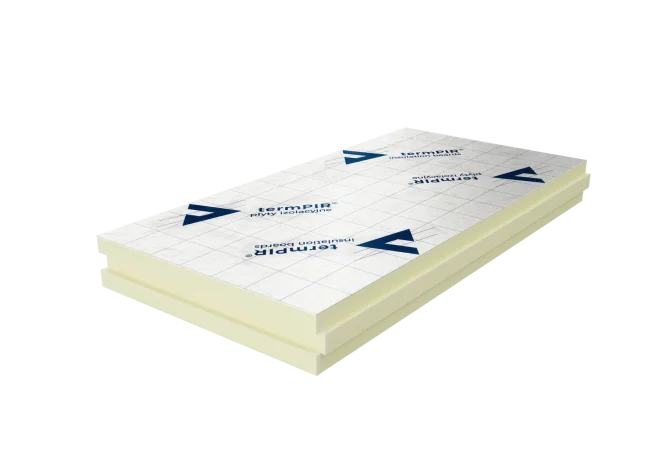
PIR boards are rigid polyisocyanurate foam thermal insulation compliant with EN 13165, faced on both sides with aluminium foil (gas-tight) or glass fleece. Key parameters:
- λD = 0.022 W/(m·K) for termPIR® AL and the eco variant termPIR® AL R-eco
- λD = 0.019 W/(m·K) for premium termPIR® MAX 19 AL — the lowest lambda on the market
- Fire reaction class (system): B-s2,d0
- Compressive strength ≥ 150 kPa (CS(10\Y)150) — load-bearing capacity during installation
- Dimensional stability, no dusting, resistance to fungi and mould
- Standard dimensions: 1200×2400 mm and 1200×600 mm; thicknesses from 20 to 250 mm
- Edge profiles: TAG (tongue-and-groove) — eliminate linear thermal bridges at joints
Minimum PIR thickness needed to meet WT 2021 (U ≤ 0.15 W/m²K) — indicative, for full coverage of the roof slope:
| Board | λD | Minimum thickness |
|---|---|---|
| termPIR® AL | 0.022 | ~150 mm |
| termPIR® MAX 19 AL | 0.019 | ~130 mm |
| Mineral wool λ=0.038 | 0.038 | ~260 mm |
Over-rafter method — eliminating thermal bridges
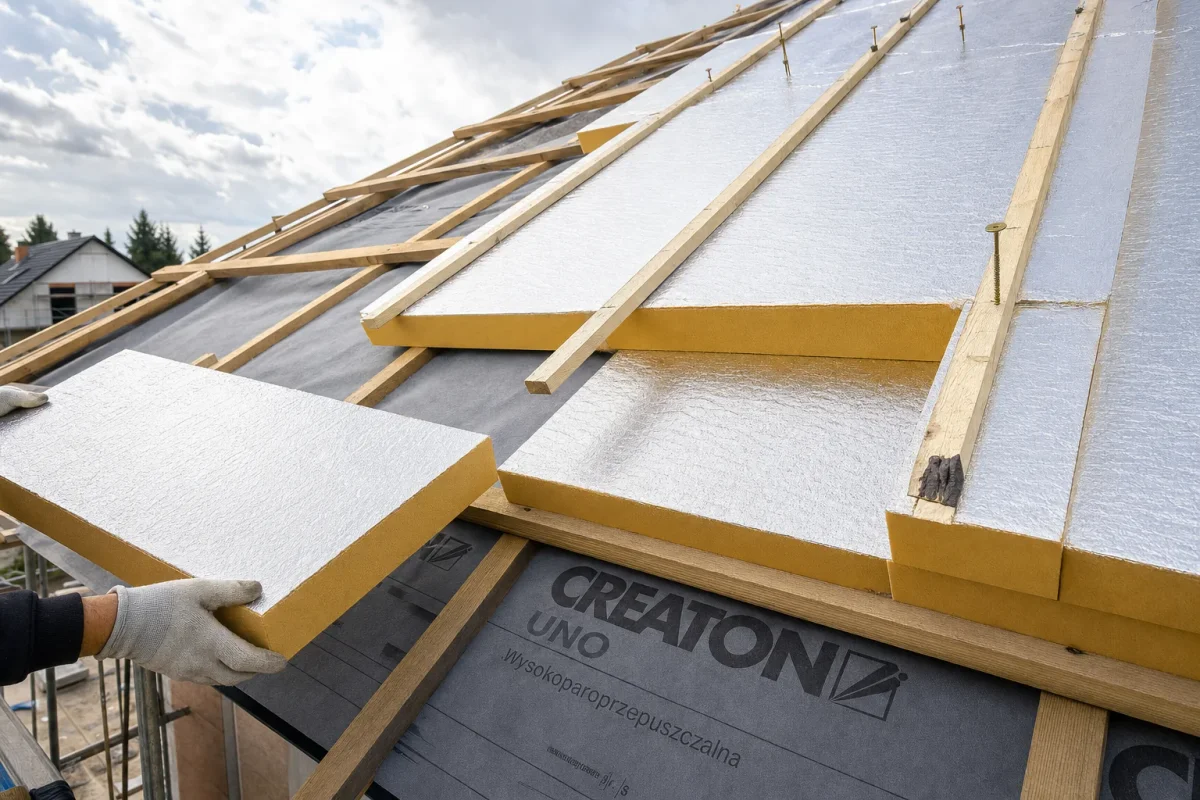
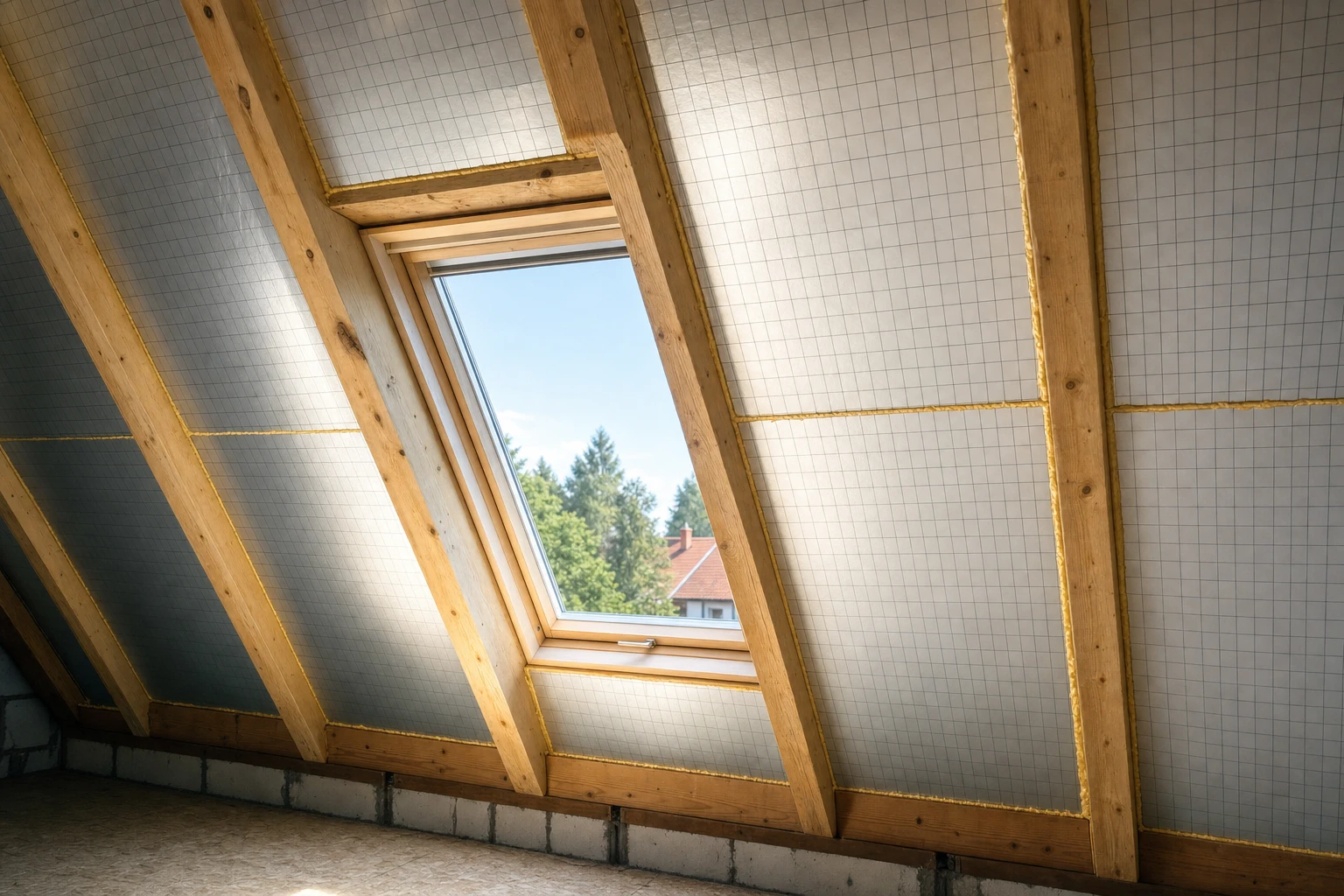
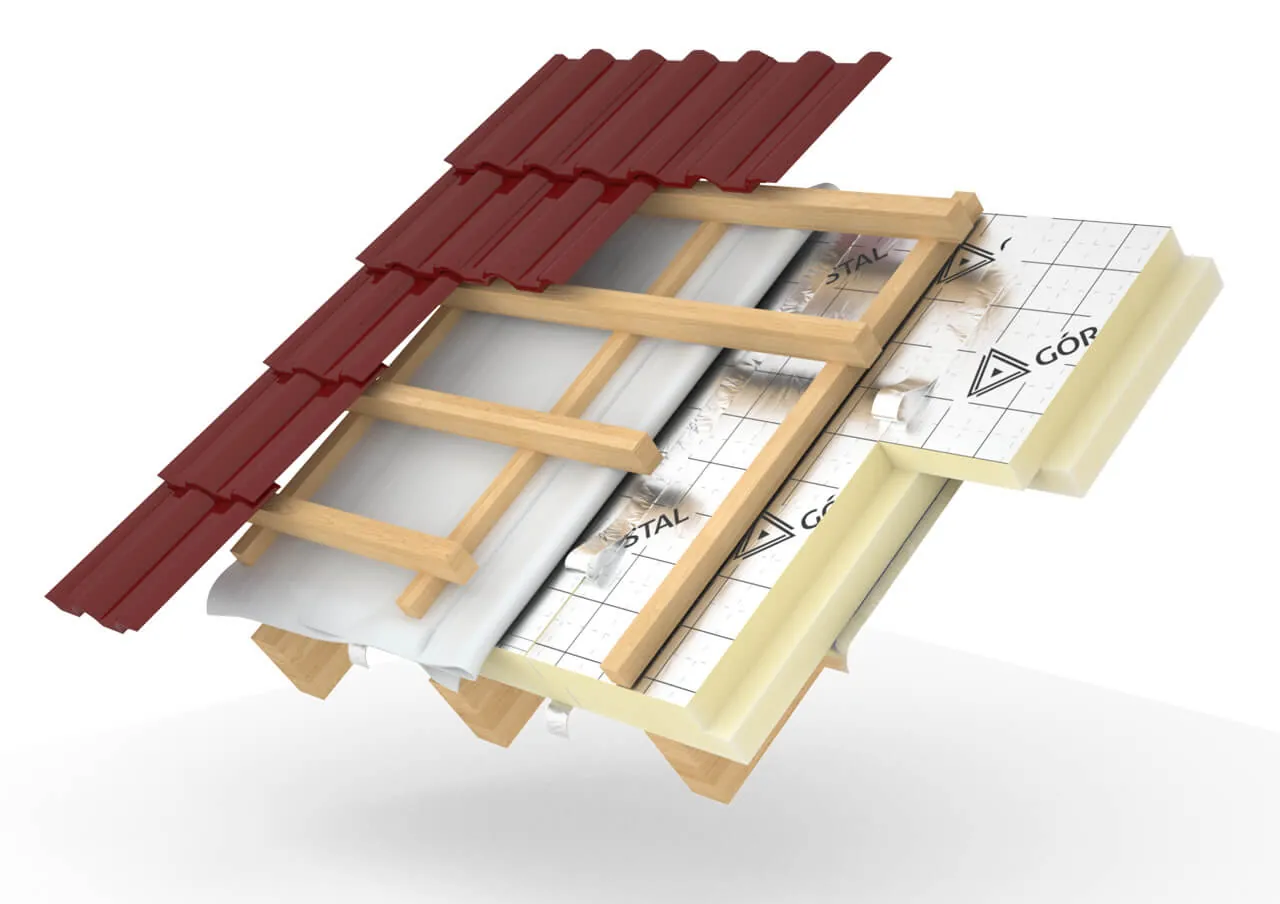
The termPIR® over-rafter layout consists of laying PIR boards on top of the rafters, beneath the battens and counter-battens. This is the reference solution for new buildings and for renovations combined with replacement of the roof covering, because it:
- eliminates thermal bridges in the rafter zone (timber has λ approx. 0.16 W/(m·K) — 7× higher than PIR)
- allows the roof truss to remain visible in the interior design
- does not reduce headroom in the room
- ensures continuity of insulation at the junction with the knee wall
The boards are laid on blind boarding or directly on the rafters with a vapour barrier on the room side. Joints are sealed with aluminium tape, and counter-battens are fixed with long carpentry screws penetrating the PIR layer into the rafters.
Under-rafter and between-rafter methods — fast renovation without removing the roof covering
When the roof covering is in good condition, the most effective approach is under-rafter or between-rafter termPIR® insulation. Thin boards (e.g. 100–120 mm) are fitted between the rafters with a 20–40 mm gap for ventilation beneath the underlay membrane, and a second layer (40–60 mm) is mounted below the rafters in a cross-layout. The resulting W I configuration (Layer I between-rafter + Layer II under-rafter) almost completely eliminates rafter thermal bridges.
Advantages of the method in renovation:
- requires no removal of roof tiles or sheet metal
- minimal loss of headroom (thinner layer than mineral wool)
- dry installation — no curing breaks
- immediate finishing with gypsum plasterboard on a frame is possible
For multi-layer assemblies, we recommend boards with the TAG profile and aluminium facing, which acts as a vapour barrier — eliminating the need for a separate PE film (provided all joints are carefully sealed with aluminium tape).
ECO and premium variants — when to choose which
- termPIR® AL — the universal standard, suitable for 90% of residential projects
- termPIR® AL R-eco — the same λD 0.022, lower carbon footprint (glass fleece inside, less Al) — the choice for buildings certified to BREEAM/LEED
- termPIR® MAX 19 AL — λD 0.019 — when limited structural space (low rafters, dormers, swallow-tail dormers) demands maximum performance per cm of thickness