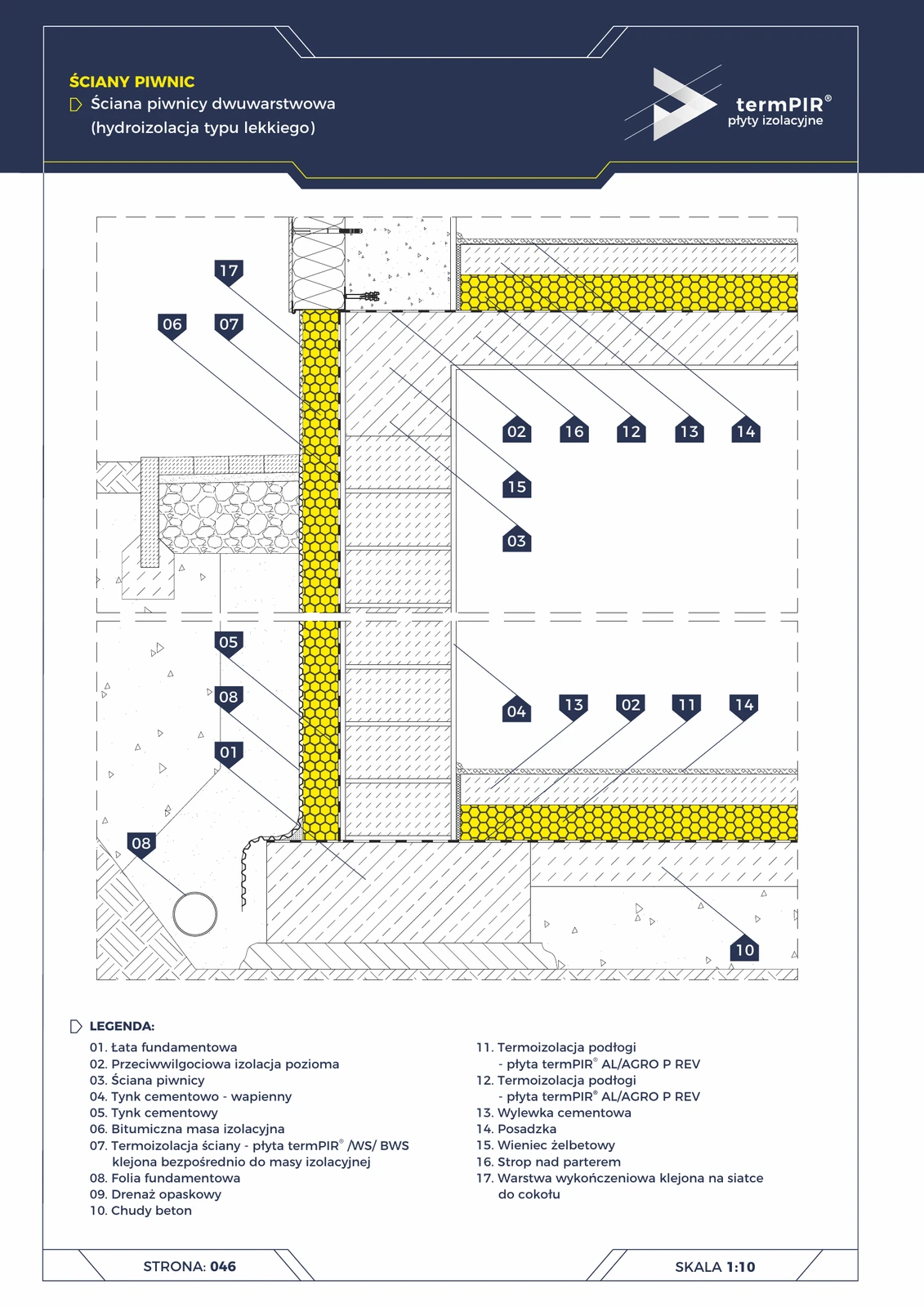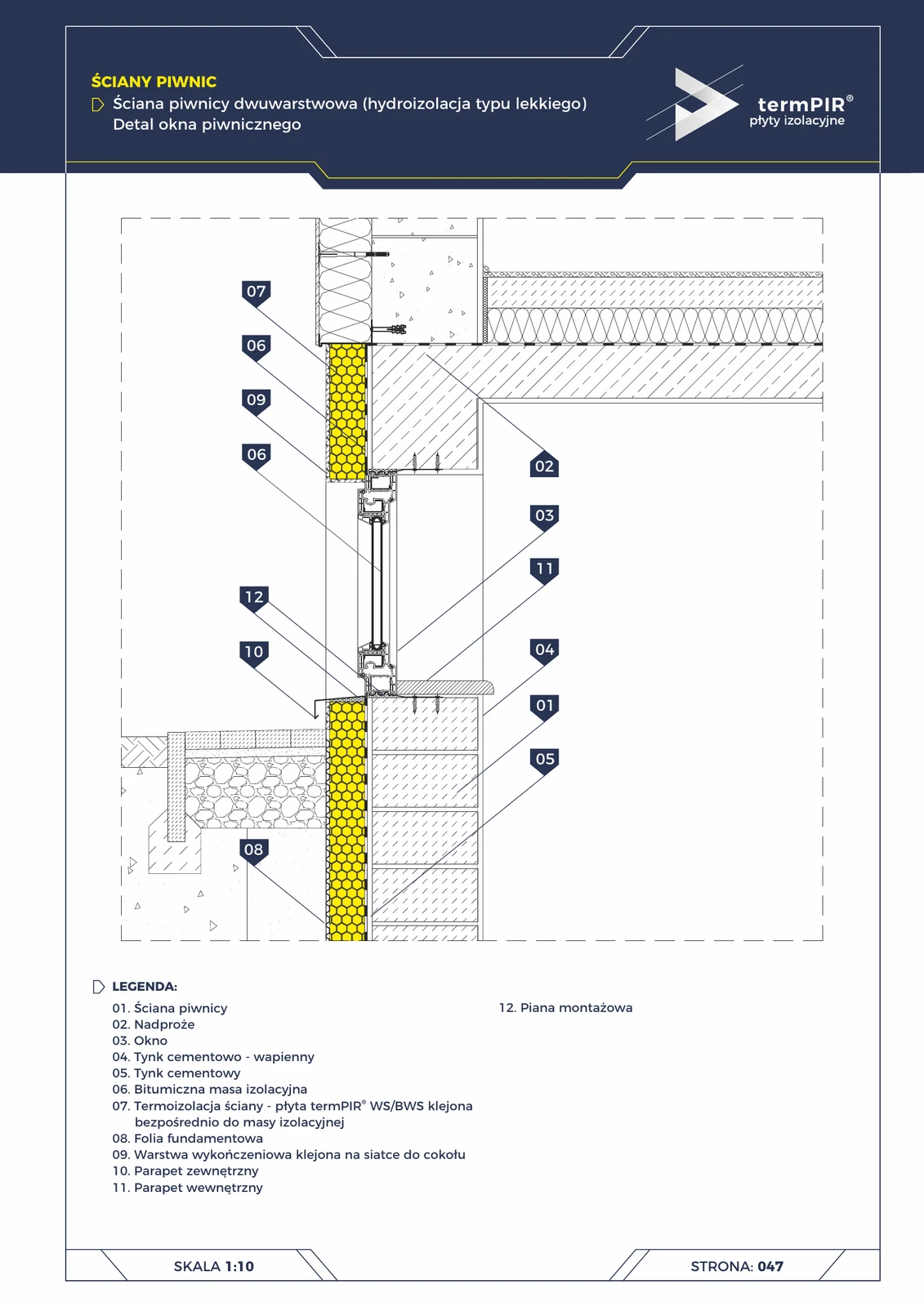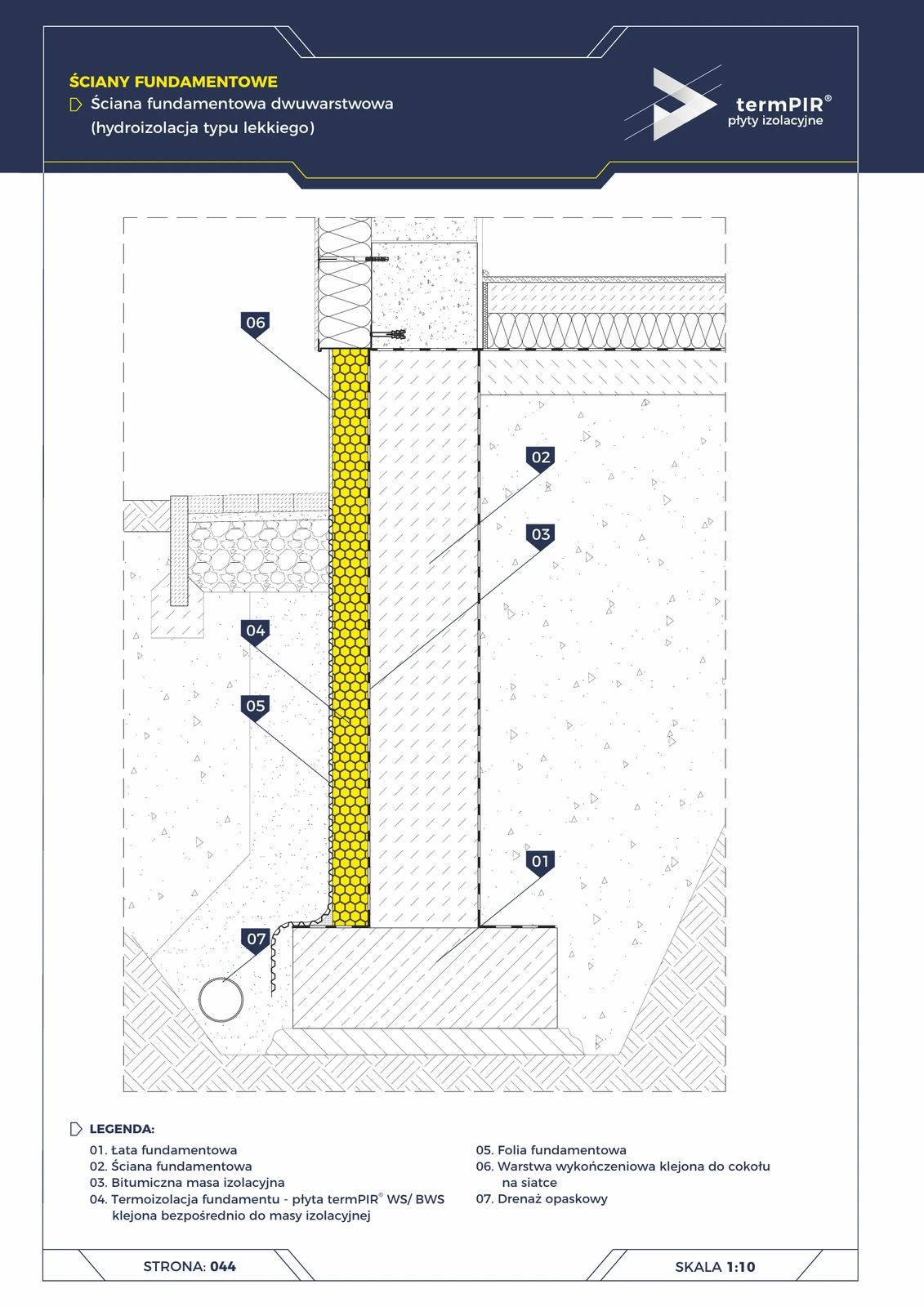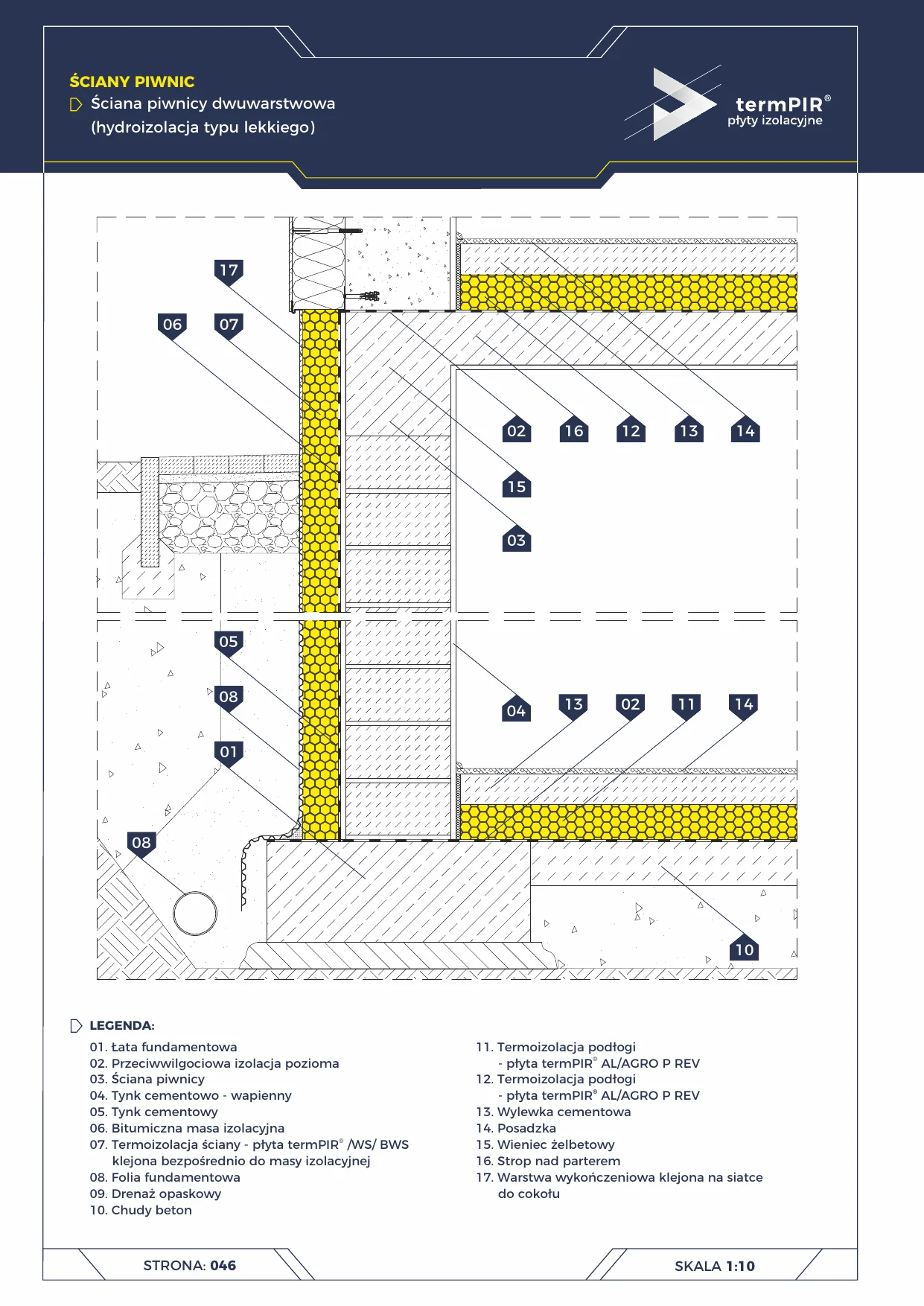
When to use this system
The two-layer system (wall + termPIR + drainage) is the economical standard for:
- New single-family houses with a basement — a typical cost-effective solution.
- Refurbishment of existing foundations — external thermal upgrade of older buildings without structural rework.
- Low-rise multi-family buildings (up to 4 storeys) with basement garages.
- Service buildings with a technical basement / archive.
Not suitable for buildings with pressurised groundwater (water table above the bottom edge of the foundation) — in such cases medium- or heavy-duty waterproofing is required, with PIR insulation placed outside the waterproofing envelope.
termPIR® WS characteristics
| Parameter | Value |
|---|---|
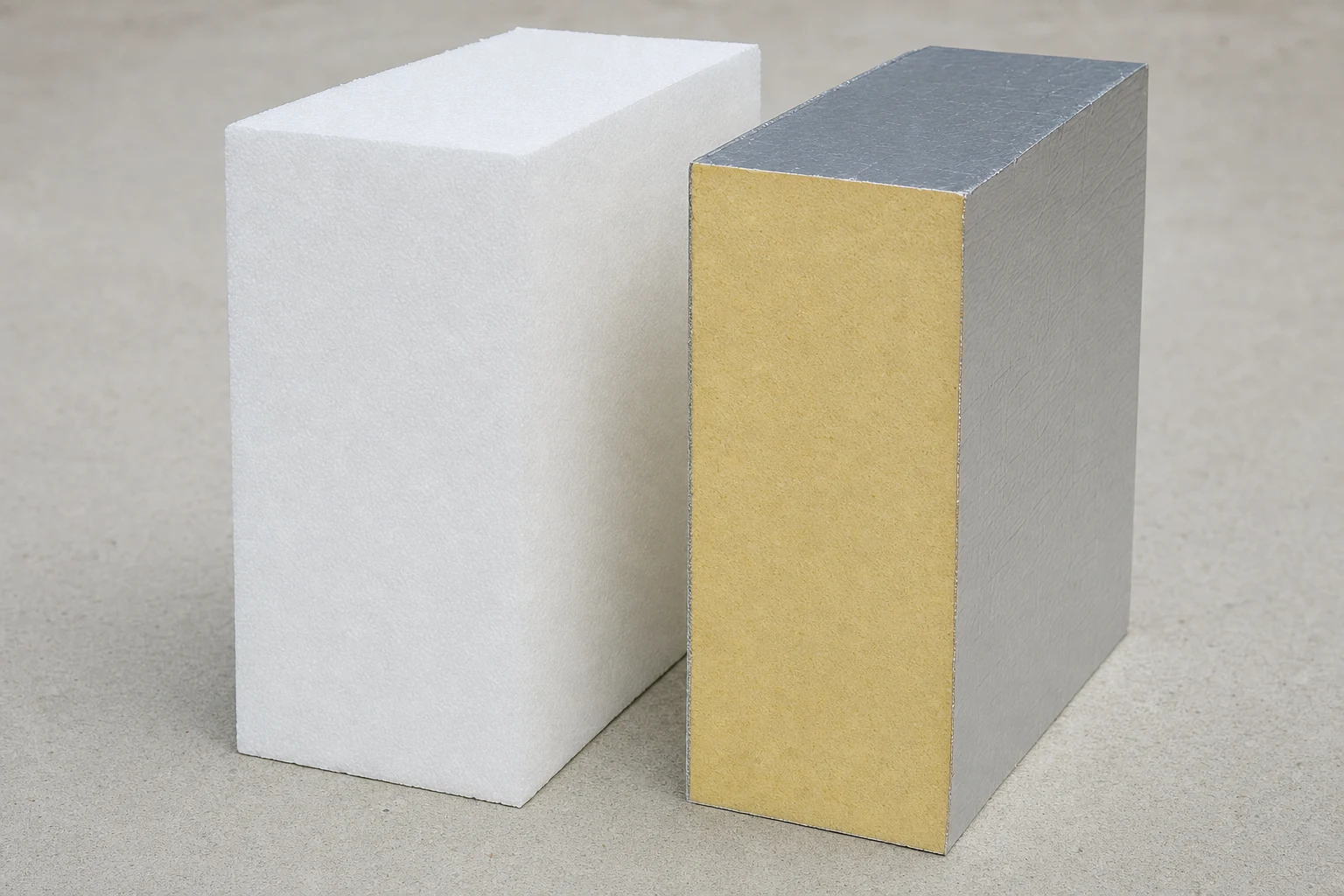
| Facing | glass veil on both sides (vapour-permeable, grey) |
| Thicknesses | 20-250 mm (typically 60-150 mm for foundations) |
| Reaction-to-fire class | E (50-250 mm) / F (20-49 mm) |
| Bonding to bituminous compound | direct — glass veil is chemically compatible |
| Plinth zone for mesh | yes — glass veil acts as a base for plinth render |
λD coefficient by thickness (as declared in the product data sheet):
| Thickness | λD [W/(m·K)] |
|---|---|
| < 80 mm | 0.027 |
| 80-120 mm | 0.026 |
| ≥ 120 mm | 0.025 |
The improved λ at greater thicknesses results from the foaming technology — density inside a thicker board is more uniform, with less “skin” of poorer performance. The U-value in the table above takes this variability into account.
Installation requirements
- Applied waterproofing — 2-component bituminous compound (e.g. Hyperdesmo, Botament) applied to the foundation wall in 2 coats, total dry thickness ≥ 3 mm.
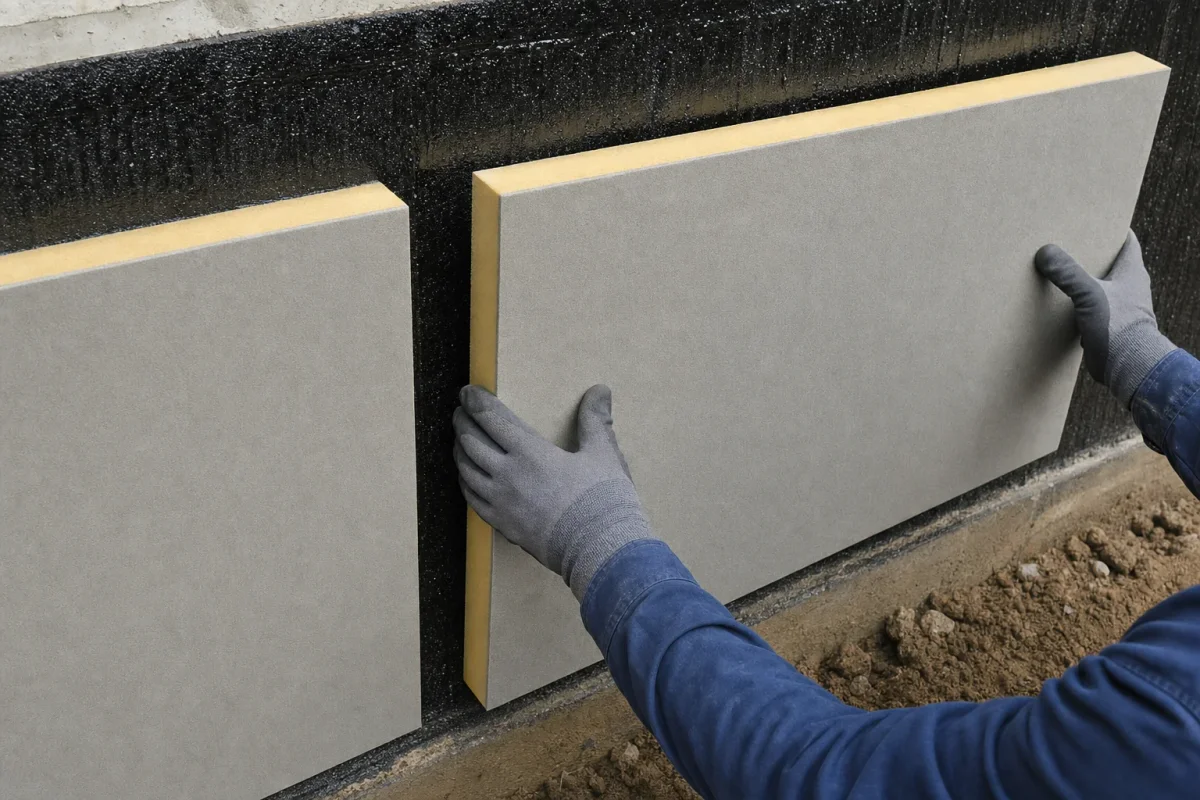
- termPIR® bonding — applied directly to the fresh bituminous compound and pressed with a trowel. Open time of the adhesive: per the compound manufacturer’s TDS (typically 30–60 min).
- Dimple membrane laid on the termPIR® with dimples facing the insulation (gravity drainage towards the perimeter drain). The top edge is mechanically fixed with a profile.
- Perimeter drainage — PVC drainage pipe Ø100 mm in a gravel bed, with a 0.5–1% fall towards the inspection chamber.
- Plinth zone (above ground) — transition to termPIR® ETX or mosaic plinth render with reinforcing mesh.
Waterproofing — critical notes
The system is described as light-duty waterproofing (bituminous compound only). Use only where:
- No permanent water pressure — groundwater table below the foundation base (difference > 30 cm).
- Permeable soil — sands, gravels, loess with drainage. NOT for clays or silts.
- Perimeter drainage is present — without drainage, standing water will force its way into the insulation regardless of the quality of the waterproofing.
For permanent water pressure, medium-duty waterproofing (2× torch-on felt + bituminous compound) or heavy-duty (bentonite membrane, watertight concrete) is required.
Comparison with the three-layer foundation
| Aspect | Two-layer (this system) | Three-layer with protective skin |
|---|---|---|
| Construction | wall + insulation + drainage | wall + insulation + protective skin + drainage |
| Insulation durability | sufficient (with dimple membrane) | excellent (protective skin) |
| Price per m² | baseline | +30–40% |
| Typical use | single-family houses | premium villa with clinker façade down to ground level |
Technical documentation
termPIR® catalogue — Residential Buildings (Gór-Stal, 2022-04-26, pp. 35, 44). The two-layer system is described as the standard variant for typical single-family construction.
Layer composition
| # | Layer | Thickness | λ | Role |
|---|---|---|---|---|
| 1 | Foundation wall (concrete, concrete blocks) | — | — | load-bearing structure |
| 2 | Bituminous waterproofing compound | — | — | applied waterproofing membrane |
| 3 | termPIR® WS — glass veil facing on both sides (grey) | 30–250 mm | 0,026 W/(m·K) | thermal insulation bonded to bituminous compound (λD 0.025-0.027 depending on thickness) |
| 4 | Foundation dimple membrane | — | — | mechanical protection + drainage |
| 5 | Perimeter drainage | — | — | groundwater removal |
| 6 | Mesh-reinforced finishing layer (plinth) | — | — | above-ground finish |
U-value by insulation thickness
| termPIR® thickness | U [W/m²·K] | Meets WT 2021 (roof U ≤ 0.15) |
|---|---|---|
| 30 mm | 0,79 | — no |
| 40 mm | 0,61 | — no |
| 50 mm | 0,50 | — no |
| 60 mm | 0,42 | — no |
| 80 mm | 0,31 | — no |
| 100 mm | 0,25 | — no |
| 120 mm | 0,20 | — no |
| 150 mm | 0,16 | — no |
| 200 mm | 0,12 | ✓ yes |
| 250 mm | 0,10 | ✓ yes |