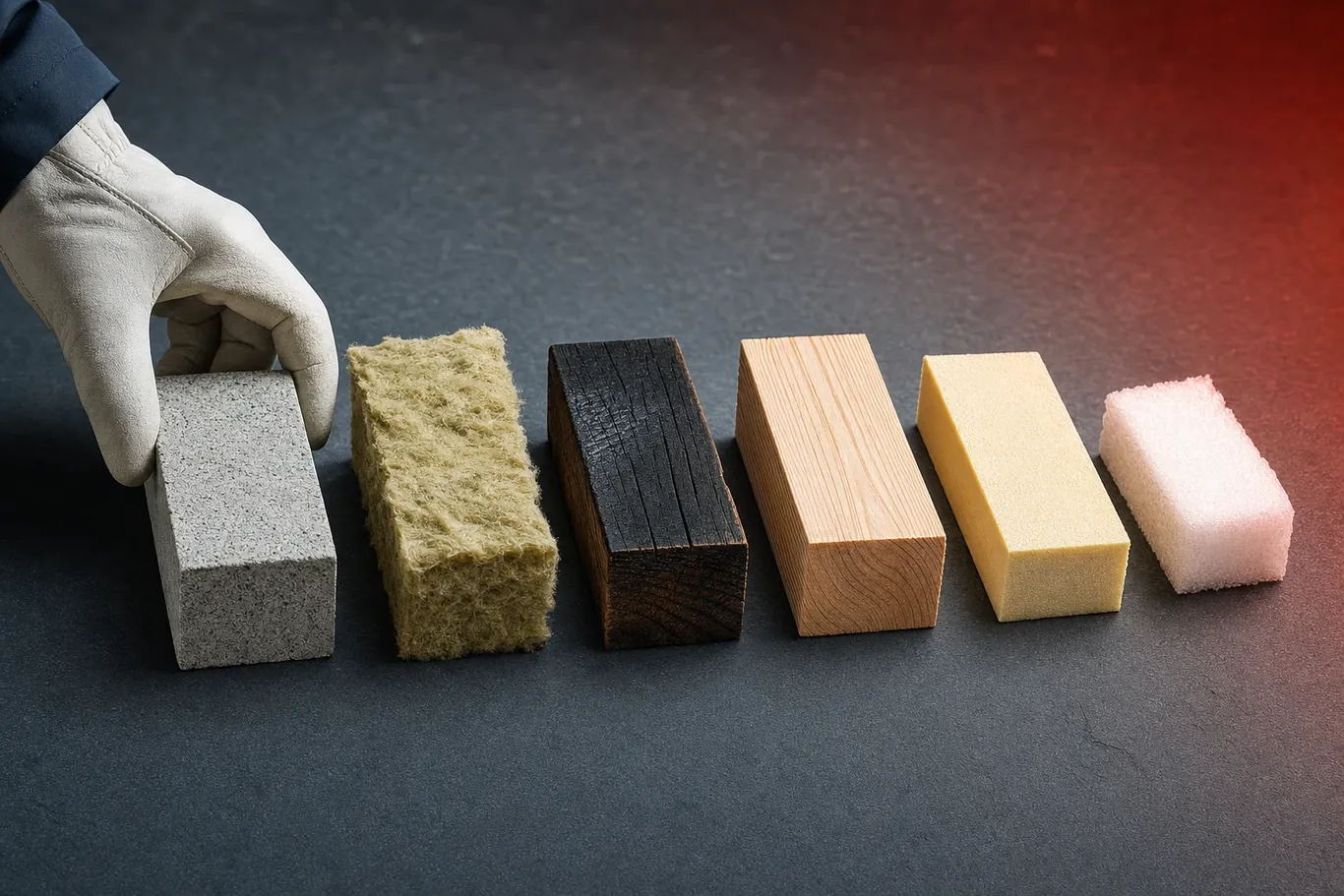
Acoustics R'w 30/35/40 dB in Sandwich Panel Halls
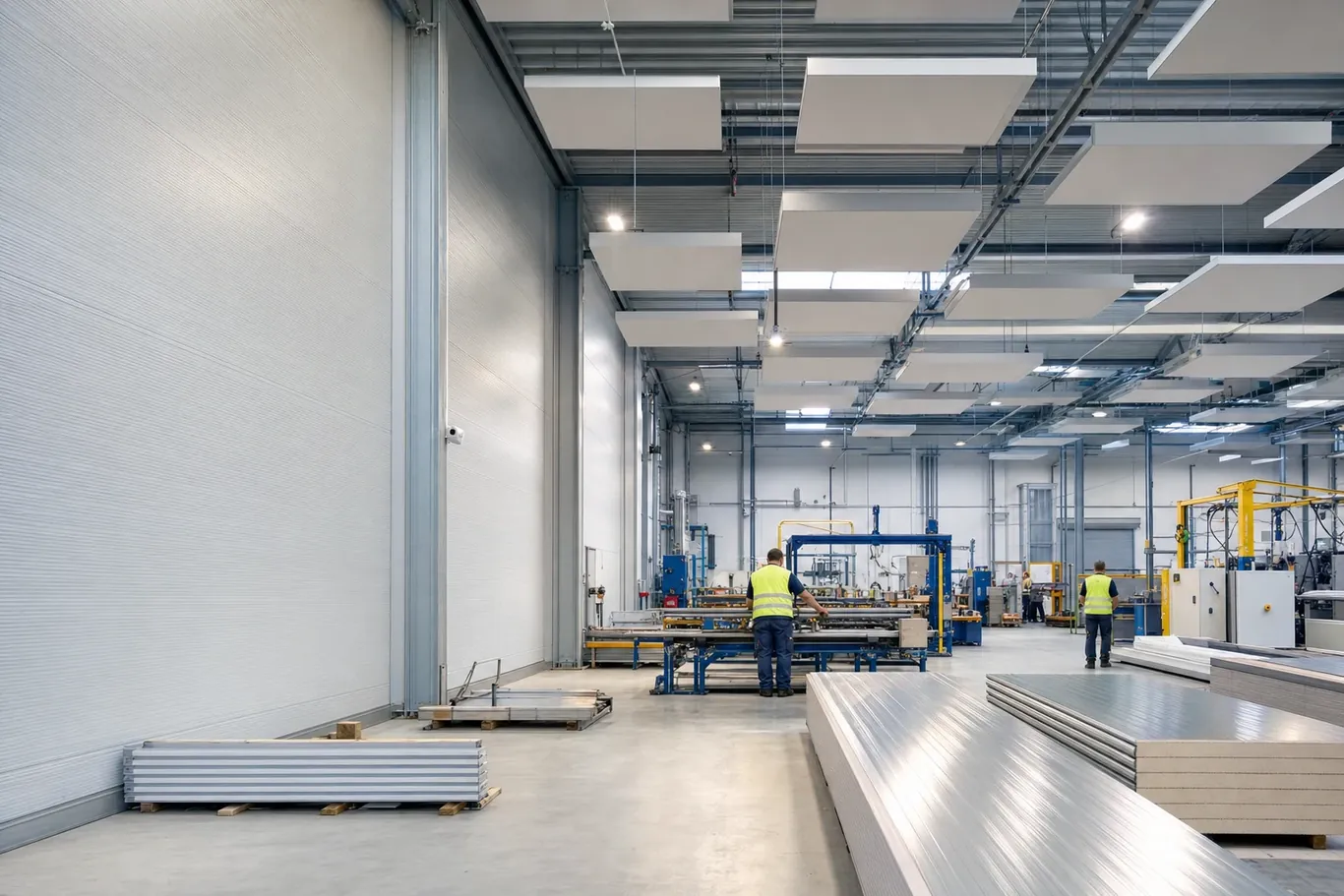
“Is it loud inside a sandwich panel hall?”
The short answer: it depends on the panel core + thickness + system configuration.
- PIR 100 mm: R’w ~22–25 dB (poor)
- Mineral wool 100 mm: R’w ~32–35 dB (moderate)
- Mineral wool 150 mm + absorptive ceiling: R’w 40+ dB (good)
In practice: PIR provides poor sound insulation, mineral wool is markedly better. For production halls with people for 8 hours a day this matters.
In this article we present concrete acoustic data from laboratory testing of GS MW QA + how to select insulation against an acoustic requirement.
What R’w means in decibels
R’w (with the prime) = weighted sound reduction index of a building element for airborne sound. Measured in dB (decibels). The higher it is, the better it suppresses noise.
R'w = 30 dB  → "a whispered conversation through the wall is audible"
R'w = 35 dB  → "a normal conversation is faintly audible"
R'w = 40 dB  → "a loud conversation is faintly audible, a shout is audible"
R'w = 50 dB  → "rock music is faintly audible"
R'w = 60 dB  → "loud music is audible as a hum"
A difference of +10 dB = 2× quieter (perceptually). So R’w 40 vs R’w 30 is not 33% better — it is 2× quieter in perception.
The R vs R’ (prime) standard
- R = laboratory measurement without bridges (an ideal element with no joints)
- R’ (R prime) = measurement under real conditions (accounts for sound bridges through floors, ceilings, connections with walls)
R’ is usually 5–10 dB lower than R. For a design, always look at R’w (with the prime) — that is the real sound insulation on site.
Acoustic requirements for halls in Poland
| Hall type | R’w requirement, external wall | R’w requirement, partition wall |
|---|---|---|
| Standard warehouse | no requirement (no people) | none |
| Warehouse with office | 35 dB (towards the office) | 45 dB (office separation) |
| Quiet production hall (assembly, sorting) | 35–40 dB | 45 dB |
| Loud production hall (machining, rolling) | 45 dB | 55 dB (separation of quiet workstations) |
| Special hall (studio, concert hall) | 50+ dB | 60+ dB |
Legal basis: PN-B-02151-3:2015 (building acoustics — requirements) + occupational health and safety (worker noise exposure — Dz.U. 2018 poz. 1991).
Important: OH&S rules — a worker must not be exposed to >85 dB for 8 hours. Above that level hearing protection is required. A production hall with a machine tool inside may reach 95–105 dB near the machine. A worker 10 m away with a suitable acoustic wall → 70 dB → OK without ear protectors.
Concrete GS MW QA data (mineral wool)
From test report LZF00-01120/20/R99NZF issued by the ITB Laboratory of Building Physics, Acoustics and Environment (accreditation AB 023):
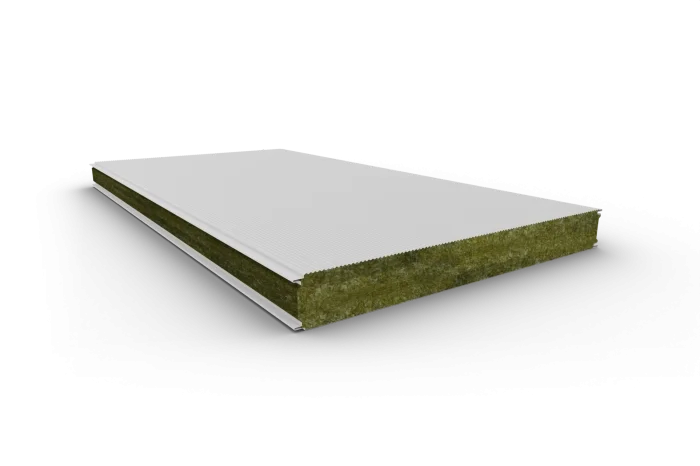
Testing was carried out on sandwich panels GS MW with a core of Stanrock M mineral wool (Rockwool, 108 kg/m³) + 0.5 mm steel facings.
| Variant | Thickness | R’w (ITB test) | Acoustic class |
|---|---|---|---|
| GS MW S 80 (wall) | 80 mm | 32 dB | A1 (typical) |
| GS MW CH 120 (cold-store wall) | 120 mm | 35 dB | A2 |
| GS MW CH 160 (cold-store wall) | 160 mm | 38 dB | A2 |
| GS MW U 120 (ceiling) | 120 mm | 36 dB | A2 |
So mineral wool in a sandwich panel delivers 32–38 dB for thicknesses of 80–160 mm. Good values for typical halls.
termPIR® AL data (for comparison)
From ICiMB Kraków testing (report 062.W.20.B):
| Variant | Thickness | R’w |
|---|---|---|
| termPIR® AL 60 mm | 60 mm | 22 dB |
| termPIR® AL 120 mm | 120 mm | 25 dB |
In practice: PIR has 10–13 dB worse sound insulation than mineral wool of the same thickness. That is a significant difference for halls with people.
Why mineral wool is 10–13 dB better than PIR
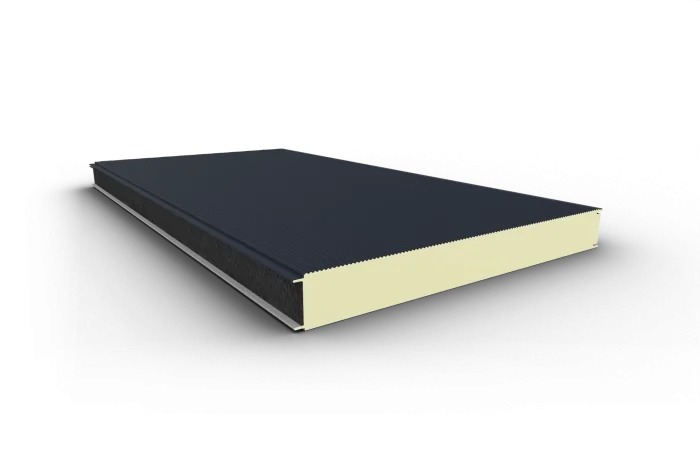
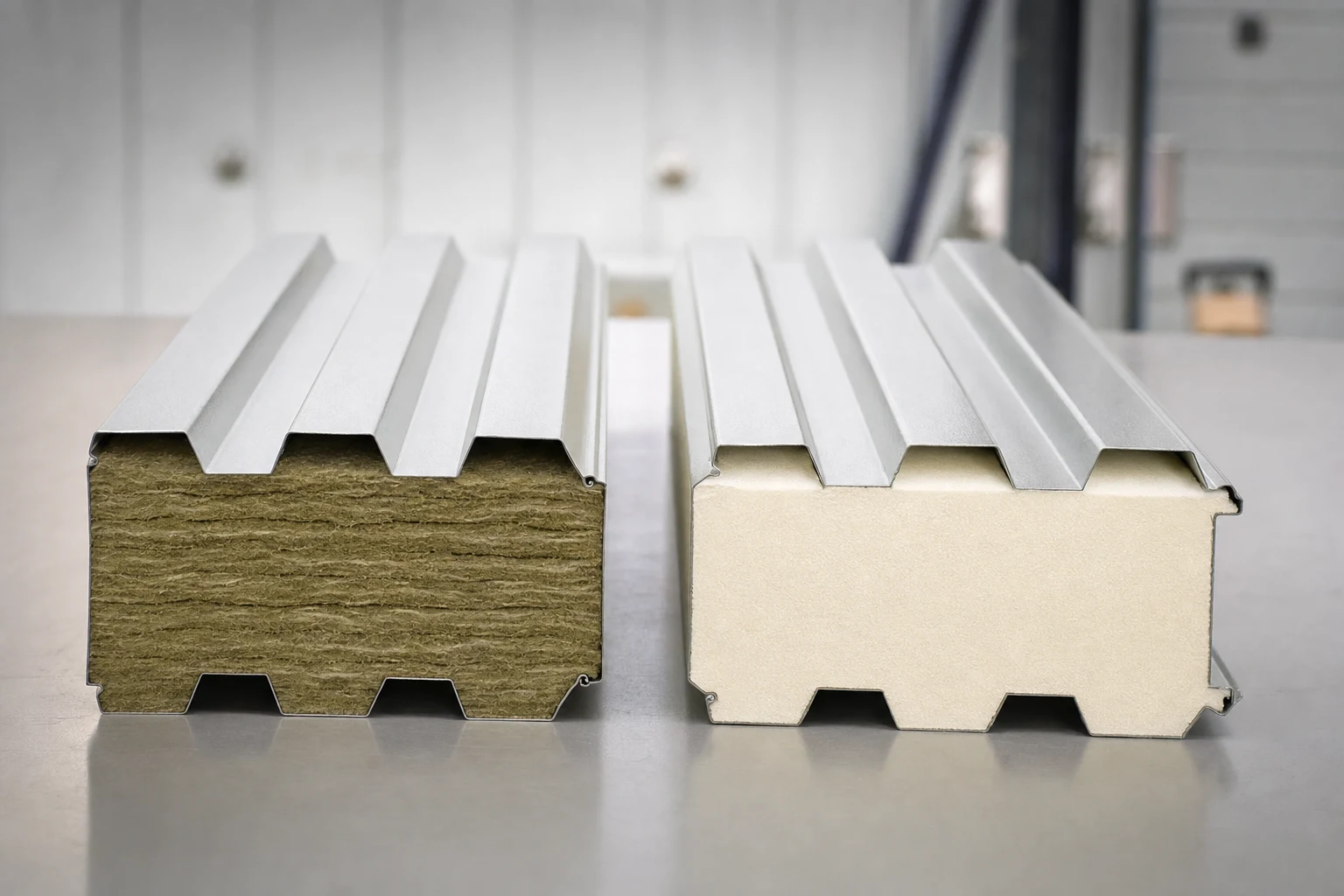
PIR is a rigid cellular foam — a dense structure that strongly suppresses heat conduction but poorly damps acoustic waves. A rigid surface → acoustic waves reflect off it and pass through.
Mineral wool is loose fibres (density 60–160 kg/m³). Acoustic waves dissipate in the hundreds of microscopic spaces between the fibres. A better sound absorber by the very nature of the material.
On top of that, mineral wool has 5× higher density than PIR (~108 kg/m³ vs ~30 kg/m³). The mass law states: sound insulation grows in proportion to mass/m². A heavier panel = better insulation.
Combinations for higher requirements
For a requirement of R’w 45 dB (partition wall of a production hall with an office):
Variant A — double GS MW QA
[GS MW QA S 120 mm] + [cavity 50 mm] + [GS MW QA S 120 mm]
                  ↓
            R'w ≈ 46-48 dB
Two elements + an air resonator. Total thickness 290 mm. Excellent sound insulation + EI 120+ fire resistance.
Variant B — GS MW QA + internal gypsum board
[GS MW QA S 120 mm] + [steel CD60 framing] + [GK board 12.5 mm]
                  ↓
            R'w ≈ 45 dB
Cheaper than Variant A. Total thickness 200 mm.
Variant C — full hybrid wall
[silicate masonry 25 cm] + [GS MW QA insulation 100 mm] + [render]
                  ↓
            R'w ≈ 55-60 dB
The most expensive and thickest, but it delivers the highest insulation for very demanding applications (recording studios, concert halls).
Absorptive ceiling — reducing reverberation inside the hall
R’w describes insulation between spaces. But inside the hall there is a second problem: reverberation (the persistence of sound after the source is switched off). The longer the reverberation, the “louder” the hall feels — waves reflect off the walls many times.
Reverberation is measured in seconds (the time over which sound loses 60 dB of intensity).
- Hall without absorbers: reverberation 3–5 s = very loud
- Hall with an absorptive ceiling: reverberation 1.5–2 s = comfortable to work in
- A standard office: reverberation 0.5–0.8 s
For production halls, OH&S rules require reverberation ≤ 2 s (for continuous work). The solution: a suspended ceiling of acoustic panels (perforated gypsum or mineral wool). The GS MW QA U sandwich panel already provides some absorptive effect (the wool core absorbs part of the reflected waves).
The practical decision: PIR or mineral wool in a hall?
| Your hall | Suggested insulation |
|---|---|
| Standard warehouse (no people for long) | PIR (GS insPIRe) — cheaper, better U |
| Warehouse with 1-2 people (forklifts, no office) | PIR + possibly 1 acoustic wall to the office zone |
| Warehouse with an office inside | Office partition wall: mineral wool 120 mm + GK (R’w 45+) |
| Quiet production hall (assembly) | Mineral wool 100 mm for the whole walls |
| Loud production hall (machining) | Wool 150–200 mm + absorptive ceiling |
| Hall with a laboratory / precision rooms | Masonry + ETICS + wool (R’w 55+) |
Acoustic pitfalls on site
Pitfall 1 — Overlooking sound bridges
Mineral wool 200 mm delivers R’w 38 dB without bridges. But if a structural steel profile passes directly through the wall (not acoustically isolated) → a sound bridge → R’w drops by 5–8 dB.
Remedy: isolate steel profiles in the wall with acoustic pads (EPDM rubber) or cut them at the wall junction.
Pitfall 2 — Doors and windows in an acoustic wall
A wall of R’w 45 dB + standard door (R’w 20 dB) → the combined R’w of the wall ~28 dB. The door is the weakest link.
Remedy: for acoustic requirements use special doors (R’w 35–40 dB) or even acoustic doors (R’w 45+ dB). Check the door’s sound insulation in the specification.
Pitfall 3 — Wall-to-ceiling / floor junction
The worst bridge — the wall-to-floor-slab junction. There the sound wave “goes around” the wall over the top or under the bottom. For rooms requiring high insulation, the floor slab must also be acoustically isolated or the wall must reach the roof (not stop at a suspended ceiling).
Remedy: for walls of R’w 45+, the wall reaches the roof, not only the suspended ceiling.
Pitfall 4 — Machine vibration through the structure
A machine on the floor emits noise in two ways: through the air (R’w measured) and through the structure (vibration transmitted through the foundation).
If the problem is vibration → the wall’s sound insulation will not help. Anti-vibration foundations for the machine are needed (rubber bases, springs, isolated frames).
What BOKKA offers
For projects requiring acoustics:
- GS MW QA S/U/CH across the full range of thicknesses (80–250 mm)
- ITB acoustic reports (LZF00-01120/20/R99NZF for the Stanrock M core)
- Advisory support in selecting thickness against a specific R’w required in the project
- Acoustic accessory specification (rubber pads, acoustic tapes for junctions)
🤝 Free BOKKA technical consultation — we’ll help select the product and complete documentation for your project.
FAQ
Is R’w 35 dB a lot? Moderate. It is the level of a standard office partition wall (gypsum on framing). It is sufficient for office work, but through such a wall you will hear a loud conversation from the adjacent room.
Can PIR sandwich panels be used at all in halls with people? YES, for warehouse halls or quiet production (no machine tools, no steam blasts, etc.) they suffice. For loud production or with offices inside the hall, mineral wool or a combination is preferred.
Do double walls give a better R’w than a single thick one? YES — the resonator law. Two 100 mm walls + a 50 mm cavity give R’w 45 dB. A single 250 mm wall gives R’w 38 dB. The same material insulates better when divided.
Does sound insulation affect wall durability? Not significantly. The same materials serve both thermal and acoustic insulation in parallel. Mineral wool has a durability of 30+ years (as insulation).
What about noise from the roof (rain, hail)? The GS insPIRe D PIR roof sandwich panel has R’w ~25 dB → rain on the roof is audible inside (as a hum). GS MW QA D (wool) → R’w ~35 dB, rain is faintly audible.
Is mineral wool 100 mm = R’w 35 dB ALWAYS? No. R’w depends on core density + facing mass + fixing method + junction sealing. The values in the text refer to specific tests for GS MW QA with a Stanrock M core (108 kg/m³). For other manufacturers it may be 30–40 dB at this thickness.
Summary
| Required R’w | Suggested insulation |
|---|---|
| 25 dB (warehouse, no requirement) | PIR 80–100 mm |
| 30 dB | mineral wool 80 mm |
| 35 dB | wool 120 mm |
| 40 dB | wool 160 mm + care over the junctions |
| 45 dB | wool 120 mm + a sandwich wall (2 elements + cavity) or 25 cm masonry |
| 50 dB+ | 25 cm masonry + ETICS wool + acoustic doors |
PIR provides poor sound insulation — mineral wool is 10–13 dB better. For halls with people for long periods (production, office, laboratory), there is only one choice: mineral wool.
🤝 Free BOKKA technical consultation — we’ll help select the product and complete documentation for your project.
Sources:
- PN-B-02151-3:2015 — Building acoustics — Protection against noise in buildings
- PN-EN ISO 717-1:2013 — Acoustics — Rating of sound insulation in buildings
- ITB report LZF00-01120/20/R99NZF — Sound insulation of GS MW
- Regulation of the Minister of Family and Social Policy of 27 September 2018 on maximum permissible concentrations and intensities (Dz.U. 2018 poz. 1991)
Related products and systems
Read next
Mineral wool sandwich panels — when to choose them instead of a PIR core
EI 120 for sandwich panels — under what conditions? 10 pitfalls of fire classification
Sandwich panels second grade — what it exactly means and when it makes sense