EI 120 for sandwich panels — under what conditions? 10 pitfalls of fire classification
A situation no investor wants
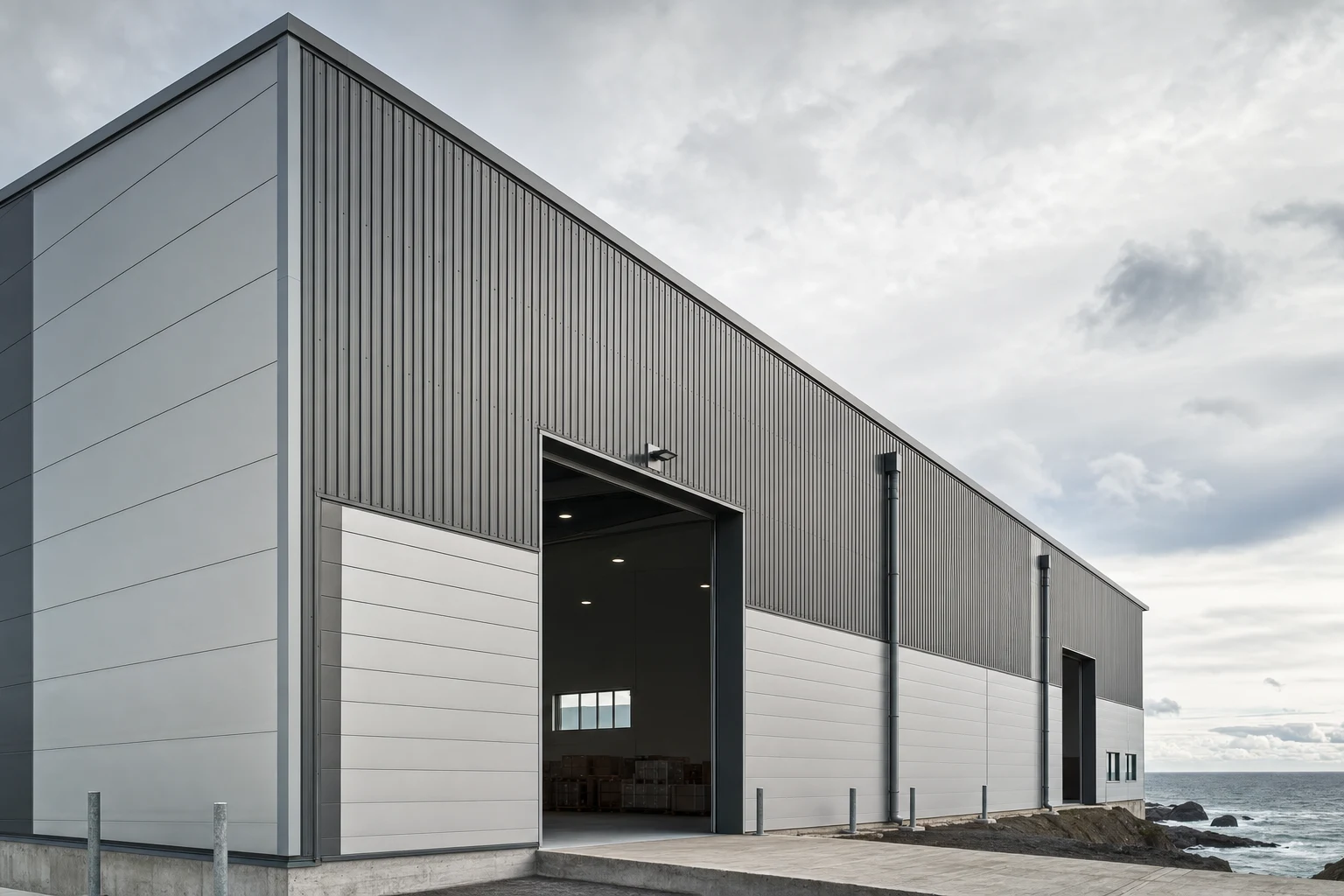
An 8-metre-high warehouse hall, partition walls between fire zones. The designer specified EI 120. The contractor purchased sandwich panels with a mineral wool core — the manufacturer’s data sheet states “EI 120”, so everything seems compliant. The panels were installed horizontally, with a 7-metre span between supports.
Eighteen months later, during handover, the fire brigade will ask for the fire classification document, not just the product data sheet. Within one afternoon it becomes clear that a panel declared as “EI 120” — under test conditions — provides EI 120 only up to a 4 m span, and at 7 m, at most EI 90. The class declared in the project does not apply. The question stands: who will cover the cost of the technical expertise, additional plasterboard cladding, or new internal columns?
This is not a hypothetical scenario. This is everyday life on Polish construction sites. The fire classification of a sandwich panel is not a property of the material — it is an agreement made under specific test conditions. Change one parameter and the class loses its validity.
In this guide we show 10 conditions that determine whether the declared EI/REI class actually protects the building — and how not to fall into the “catalogue card” trap.
Fire classification is an agreement, not a material property
Sandwich panel manufacturers list fire resistance classes in their catalogue sheets in shorthand — “EI 60”, “REI 120”, “BROOF(t1)”. This looks like a physical parameter, just like λD or density. It is not at all.
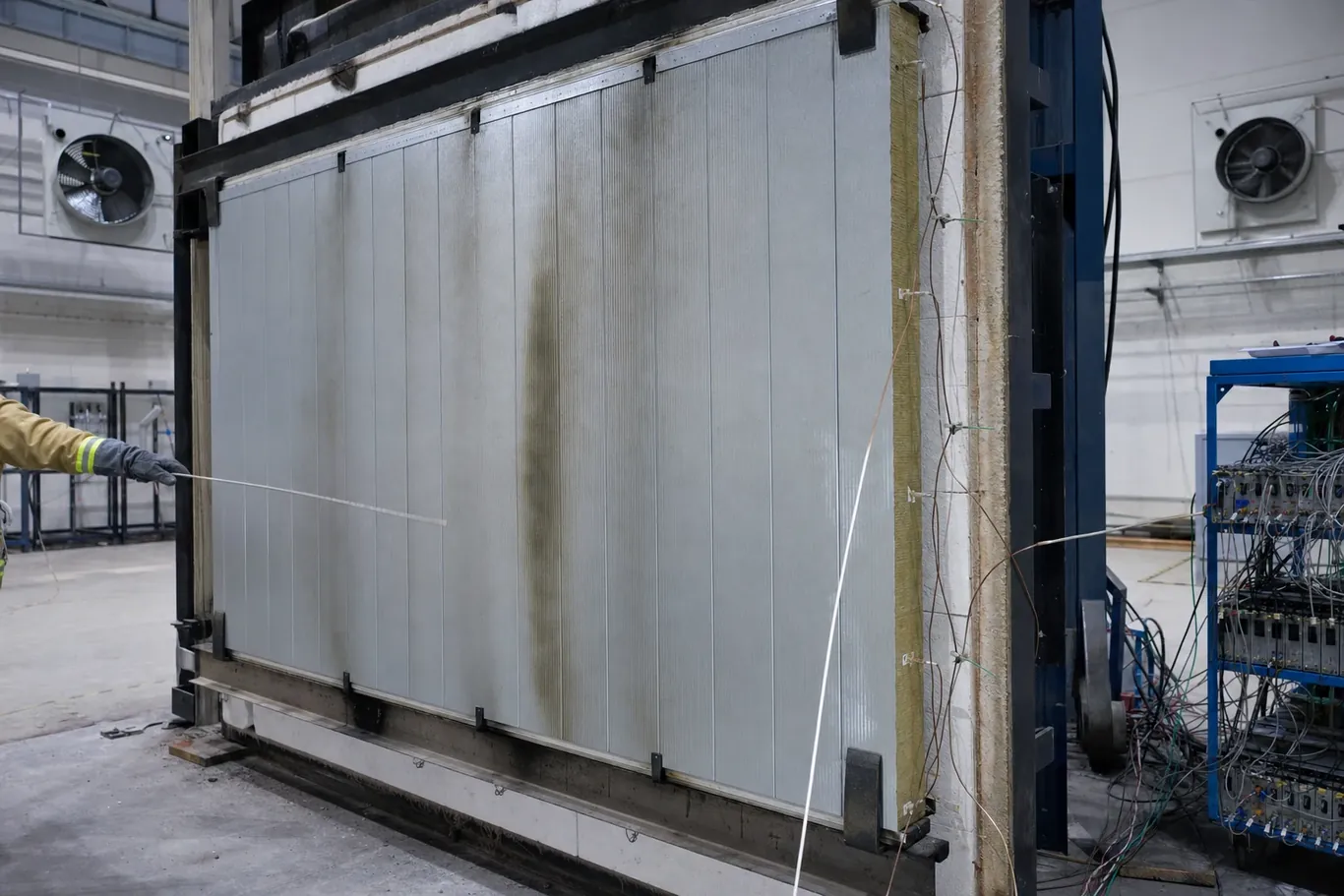
A fire resistance class under PN-EN 13501-2 is the result of a specific test in a notified laboratory — according to PN-EN 1364-1 for non-loadbearing walls, PN-EN 1364-2 for ceilings, or PN-EN 1365-2 for roofs and floors. Each test has a clearly defined direct field of application and optionally an extended field of application.
What does this mean in practice? A quote from the classification report for a partition wall made of sandwich panels with a mineral wool core (notified body, test 2022):
Classification EI 120 for a maximum span of 6.0 m in a single-span configuration with fixing to steel supports using L 100×50×3 mm profiles and self-drilling screws ø5.5/6.3×150 mm with EPDM-sealed washers, at a distance of 50 mm from the longitudinal panel edges and at half panel width. Without fire-resistant sealant inside the panel joints.
This single paragraph contains nine separate parameters that together define “EI 120” for this specific panel. Change any of them — and the class may drop or cease to apply.
10 conditions that determine the validity of classification
1. Support span
This is the most common design trap. The EI/REI class for the same panel changes with the span of the bay. The larger the span, the lower the class.
A concrete example from tests of a sandwich panel with a mineral wool core, 120 mm thick:
| Support span | Fire resistance class |
|---|---|
| up to 4.0 m | EI 180 |
| up to 7.5 m | EI 120 |
The same panel. Just a change in span. The class drops from 180 minutes to 120 minutes — that is the difference between meeting the requirements for building class “B” PM and the need to add additional protection.
For panels with a PIR core the drop is more dramatic:
| PIR ceiling panel, 120 mm | Class |
|---|---|
| span up to 4.0 m | EI 30 |
| span up to 6.0 m | EI 20 |
| span up to 7.5 m | EI 15 |
A designer who sees “EI 30” in the product data sheet and does not check the maximum span will, in a hall with supports arranged every 7 m, actually receive EI 15 — that is, half as much.
2. Number of bays and support arrangement
Classification is usually issued for a single-span configuration (panel between two supports) or two-span (with an intermediate support). These are not the same.
In a single-span test the panel bends freely under the influence of temperature. In a continuous (two-span) arrangement it behaves differently — the bending moment is distributed, but the joints above the middle support become a new critical point.
Practical implications:
- An EI 120 class from a single-span test does not automatically apply in a two-span application.
- A two-span test usually allows for a larger application span (e.g. up to 7.5 m vs 6.0 m), but for a lower class.
- Any multi-span application (3+ supports) requires separate verification — often a technical expert opinion.
3. Installation direction (orientation)
Vertical or horizontal? For many sandwich panels the class depends on orientation, because the behaviour under temperature is different:
- Vertical — heat transfers from top to bottom by convection inside the core
- Horizontal — temperature is distributed evenly, but the panel’s own weight acts along a different axis
Manufacturers often test both configurations. The classification specifies: “EI 120 for horizontal orientation” or “for vertical orientation” — or “for both”, if separate tests have been carried out.
Designing a vertical panel arrangement based on a horizontal test (or vice versa) without verification is a classic design error.
4. Fixings — type, diameter, quantity, washer
Fixing is not an installation detail — it is an integral part of the test. The classification specifies:
- Screw diameter: ø5.5 vs ø6.3 mm
- Length: typically 100–200 mm depending on panel thickness
- Type: self-drilling, self-tapping, with rubber or EPDM washer
- Layout: number of screws per support (typically 4–5), distance from the edge (usually 50 mm)
- Supporting structure material: whether the test was on a steel L 100×50 profile, HEA, wooden batten, or reinforced concrete
A quote from international industry guidelines:
Improper fixing with metal fasteners through a sandwich panel may cause early panel collapse under fire exposure, even though the same structure behaves correctly under standard conditions — the facings lose connection with the supporting structure.
In practice: a contractor who swaps the screws for “cheaper” 4.8 mm ones without consulting the designer invalidates the class even if everything else matches.
5. Joint seal
Sandwich panel joints — tongue-and-groove, labyrinth lock, straight edge — are channels through which heat and gases flow during a fire. The test specifies:
- Without fire-resistant sealant inside the joints (typical for quick tests, MW)
- With intumescent tape (e.g. TermPaint) in the joints (for higher EI classes)
- With fire-resistant silicone FIRE-ACRYL for special applications
- With butyl or EPDM tape for gas-tightness
If the test was carried out without sealant inside the joints, and the contractor on site applies ordinary (combustible) silicone “to be safe” — paradoxically the class is lowered, because material that was not in the test has been added.
The most common errors:
- No sealant where the test required it
- Use of combustible sealant instead of fire-resistant
- Omission of intumescent tape in main joints for EI 60+
6. Metal facing thickness
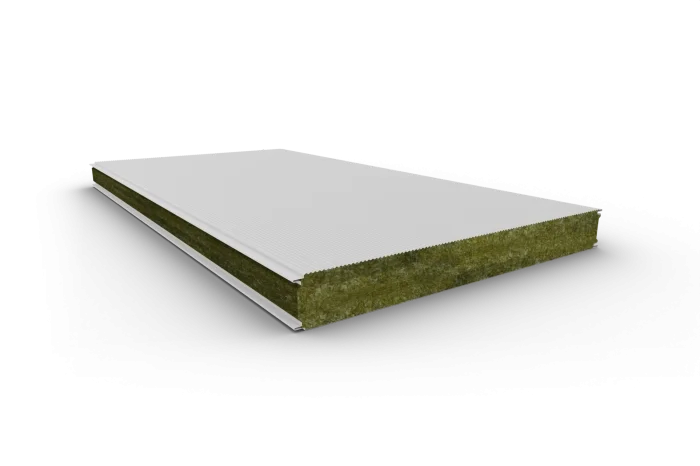
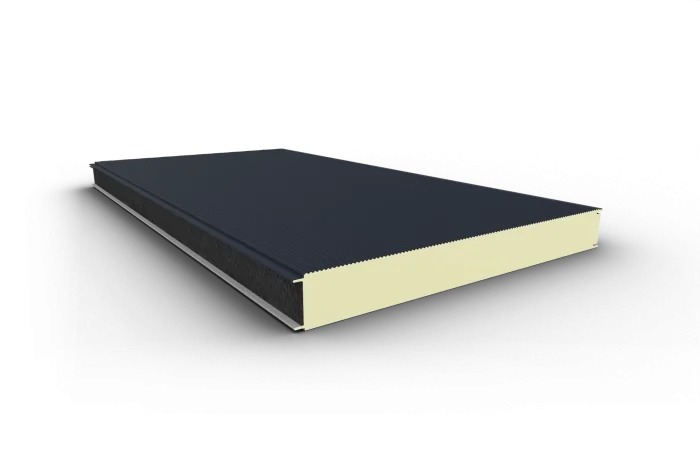
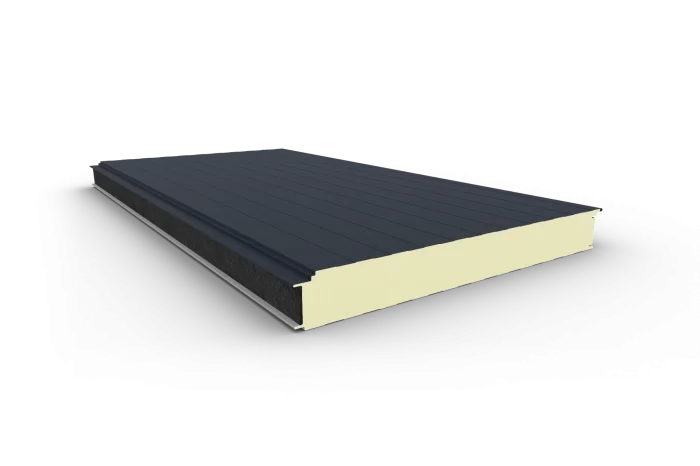
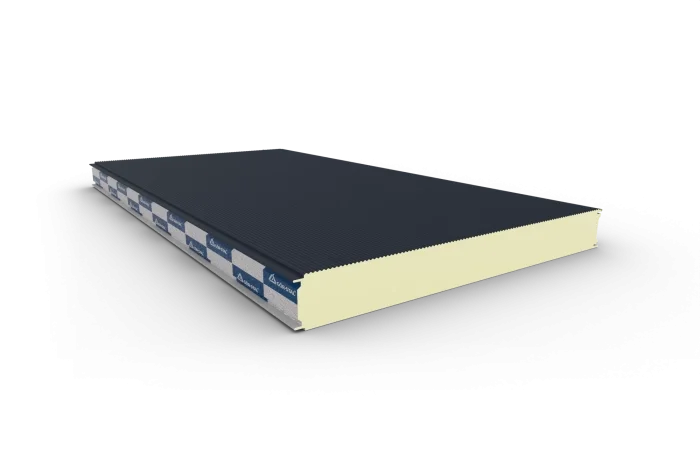
A sandwich panel is an insulating core (PIR, MW, EPS) between two steel facings — usually 0.4–0.7 mm sheet. The thickness of the facings is a test parameter:
- Inner facing 0.5 mm, outer 0.5 mm — typical MW configuration
- Inner facing 0.6 mm, outer 0.5 mm — reinforced version
A manufacturer may offer the same panel variant with different facing thicknesses. A class issued for 0.5/0.5 does not apply for 0.4/0.5. Some tests have a “min. 0.5 mm” clause in the field of application — then thinner facings lose the class.
7. Supporting structure
The structure on which the panel is mounted is part of the test:
- Steel L profiles (e.g. 100×50×3 mm) — typical for partition walls
- HEA, IPE profiles — supporting structures of halls
- Timber structure (battens, rafters) — pitched roofs
- Steel rods, hat profiles, single-layer/cross grid
An application on a different structure is a different test. The manufacturer may have separate classifications for typical configurations — the designer must check which structure was used in the test on which the declared class is based.
8. Roof covering (BROOF t1)
For flat roofs, the BROOF(t1) class is crucial — the roof’s resistance to external fire. This test ALWAYS requires defining the whole system:
- Covering: PVC membrane, TPO, EPDM, bituminous felt (each separately!)
- Method of fixing the covering: adhesive, mechanical, ballast
- Substrate: chipboard, planks, concrete, trapezoidal sheet
- Roof slope: usually 15° in the test
- Test conditions: air temperature, wind speed
A PIR panel + PVC membrane may have BROOF(t1). The same panel + TPO membrane requires a separate test. Core density is additionally conditioned — for example, for polyurethane cores: PUR min. 35 kg/m³ for BROOF(t1), for mineral wool MW lamella min. 80 kg/m³ or MW slabs min. 110 kg/m³.
A contractor who swaps the designed “PVC covering” for “TPO because it was cheaper” — invalidates BROOF.
9. Core reaction class per thickness
This is a trap for designers sizing the insulation thickness. The reaction-to-fire class of the core (EN 13501-1) changes with thickness. Example for PIR cores:
- 20–49 mm — class F
- 50–250 mm — class E
Some projects require at least class E for the core. A designer copying “class E” from the product card without checking the thickness may propose a PIR panel of 30 mm in an application requiring class E — which is formally inadmissible according to the test document.
For sandwich panels with a mineral wool core (class A2-s1 d0) this problem is smaller — wool is non-combustible at all thicknesses.
10. Test temperature curve
Standard fire resistance tests use the ETK curve (Eurocode, standard curve). This is a curve representing an indoor residential/office fire.
For special facilities, other curves apply:
- HC (hydrocarbon) — hydrocarbon fire, e.g. petrochemical, fuel storage
- RWS (Rijkswaterstaat) — road and rail tunnels
- External curve — facades, elevations
An EI 120 classification according to ETK does not apply for a facility covered by an HC testing requirement. For most typical PM/ZL facilities, ETK is sufficient — but for special projects (tunnels, petrochemical, airport terminals) it must be verified.
The reality of numbers — table from specific tests
We show directly how the class changes as a function of span and thickness — based on classification tests for our sandwich panels with mineral wool core (GS MW QA) and PIR core (GS insPIRe).
MW sandwich panels (mineral wool), single-span configuration
| Panel | Thickness | Span ≤ 4.0 m | Span ≤ 6.0 m | Span ≤ 7.5 m |
|---|---|---|---|---|
| GS MW QA S/U/CH (wall) | 100 mm | EI 120 | EI 90 | EI 90 |
| GS MW QA S/U/CH (wall) | 120 mm | EI 180 | EI 120 | EI 120 |
| GS MW QA S/U/CH (wall) | 200 mm | EI 240 | EI 180 | EI 120 |
PIR sandwich panels, single-span configuration
| Panel | Thickness | Span ≤ 4.0 m | Span ≤ 6.0 m | Span ≤ 7.5 m |
|---|---|---|---|---|
| GS insPIRe S/U/CH (PIR) | 100 mm | EI 30 | EI 20 | EI 15 |
| GS insPIRe S/U/CH (PIR) | 120 mm | EI 30 | EI 20 | EI 15 |
| GS insPIRe S/U/CH (PIR) | 140 mm | EI 30 | EI 30 | EI 20 |
Practical conclusions:
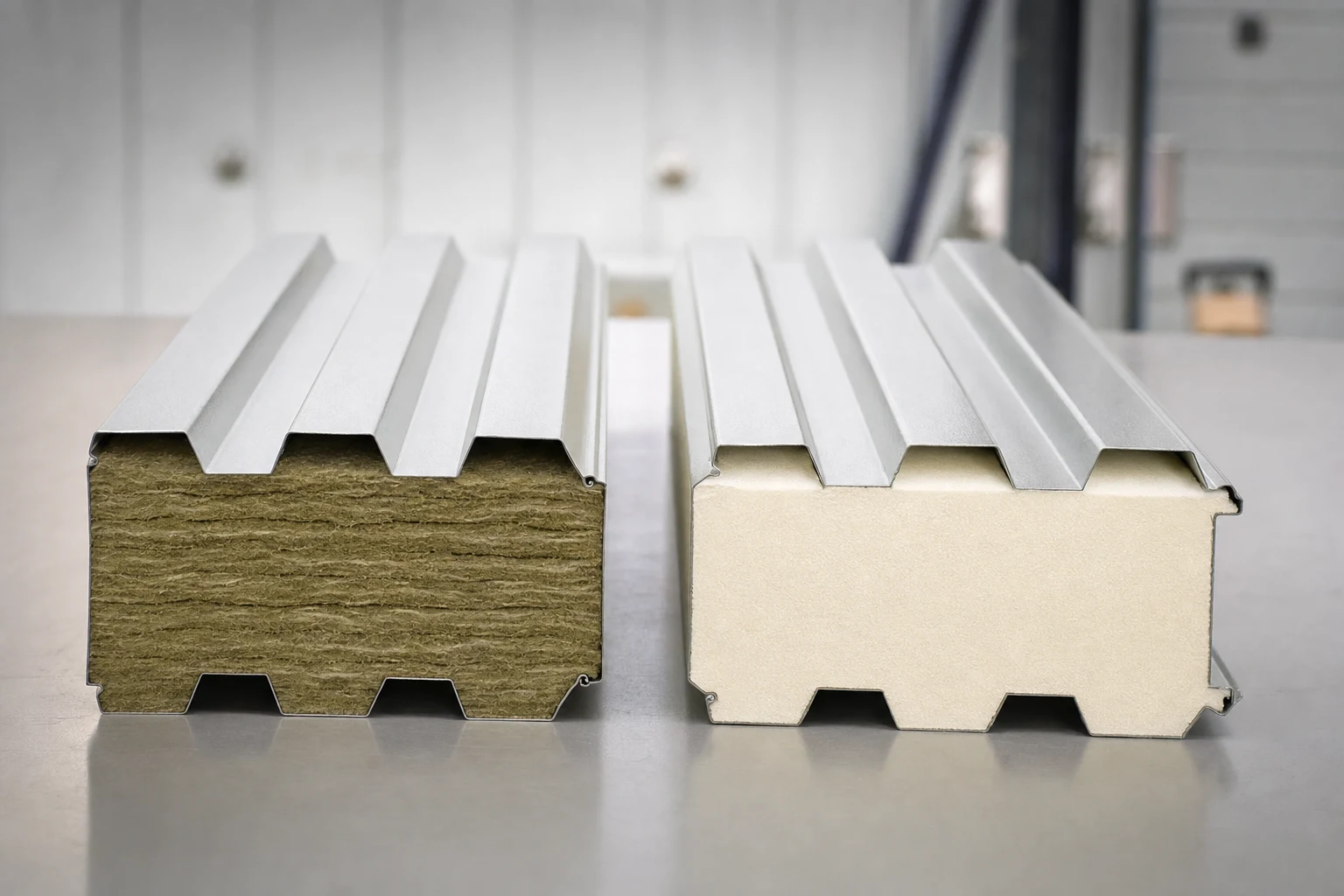
- MW panels provide higher classes than PIR — this is obvious, but the difference is greater than designers think. 120 mm MW = EI 180 vs 120 mm PIR = EI 30.
- PIR works where EI 15–30 is required (most partition walls in PM buildings of class “C/D/E”).
- MW is essential where EI 60+ is required (building classes “A/B”, fire zone separations).
- Span has a greater impact than thickness — switching from 7.5 m to 4 m raises the class by 1–2 steps. Sometimes it is worth adding an intermediate support instead of increasing the insulation thickness.
Note: the tables above are an illustration of the principle — the specific values for your project depend on the exact configuration (fixings, joints, supporting structure). Always verify with the classification document for the chosen variant.
5 most common pitfalls on the construction site
From our experience in investment projects:
Pitfall 1 — “REI/EI from the catalogue card in the project”
The designer writes in the technical description: “partition wall EI 60” and chooses a panel based on the manufacturer’s declaration. They do not check for which span, fixings and orientation the declaration applies. After handover, the State Fire Service inspector asks for the classification document (not the product card) and it turns out that the configuration in the project does not fit within the test’s field of application.
Cure: write in the technical description the test configuration — span, fixings, orientation — in accordance with the manufacturer’s classification document.
Pitfall 2 — Screw substitution
The contractor receives panels with an installation booklet specifying ø5.5×150 mm screws in the appropriate number. “For savings” they switch to 4.8×130, “because they hold anyway”. Under normal conditions — they hold. In a fire, the panel loses connection with the structure earlier and the EI class is not achieved.
Cure: the fixing specification is part of the classification, not an installation suggestion. There is no negotiation.
Pitfall 3 — Joint seal “just to be safe”
The contractor sees gaps between panels and, just to be safe, injects ordinary silicone. There was no silicone in the test — or it was fire-resistant FIRE-ACRYL. Ordinary silicone is a combustible material that changes the boundary condition of the test. The class formally loses validity.
Cure: use only sealants in accordance with the classification document. “Better nothing” than “anything”.
Pitfall 4 — Horizontal vs vertical orientation
The designer draws a wall vertically; the installer (due to panel length or hall geometry) installs horizontally. The classification was for vertical. The class loses validity until a separate horizontal orientation test is performed.
Cure: the installation direction must be indicated in the project and confirmed by the manufacturer’s classification before purchase.
Pitfall 5 — Additional perforations and installations
The classification is for a full, non-perforated wall or floor. Each additional perforation — ventilation passage, socket, cable ladder, installation screw — is a potential invalidation of the class at the perforation location.
Cure: installation passages require a separate, certified fire-rated penetration seal (e.g. Hilti collars, CP compounds). The panel classification covers the panel, not the penetrations.
What to do — designer’s and contractor’s checklist
For the designer
- Determine the class required by the Building Regulations (WT) (e.g. EI 60 for a wall separating zones in PM class “B”)
- Collect the classification document from the chosen manufacturer (not the product card — the classification document issued by a notified body)
- Check the field of application: maximum span, support arrangement, orientation, fixings, supporting structure
- Write in the technical description the configuration from the document: “EI 60, max span 6.0 m, single-span configuration, fixings ø5.5×150 mm at 50 mm from the edge”
- Specify the joint seal in accordance with the test
- Check the core reaction class per thickness (PIR: F for 20–49 mm, E for 50+)
- For roofs: select a covering that forms a BROOF(t1) system with the panel
For the contractor
- Obtain from the designer the classification document along with the project
- Verify whether the ordered variant matches the configuration in the document (variant, facing thickness, profiles)
- Do not change screws, washers, sealants without the designer’s consent and confirmation of compatibility with the test
- Install in the direction indicated in the document
- Document: site photos showing fixings, joints, seals — in the event of a State Fire Service inspection these are proof of compliance
- Installation penetrations to be addressed with certified penetration seals, not improvisation
How BOKKA helps
We are a direct distributor of sandwich panels with PIR core (GS insPIRe) and with mineral wool core (GS MW QA). We have a database of 539 manufacturer classification documents — DoP, ETA, AVCP1 certificates and full classification reports from notified bodies (ICiMB 1487, ITB 1488, IMBiGS 1454, CERTBUD 2310, FIRES 1396 and others).
What this means for your project:
- We check the configuration — before issuing an offer we confirm whether the chosen variant in your conditions (span, orientation, fixings) actually meets the declared EI/REI class.
- We match the product to the class — do you require EI 120 for an 8 m wall? We indicate the specific variant + thickness that will provide it at your span.
- We supply the documentation — the classification document from the notified body is delivered together with your order. It is evidence for the State Fire Service.
- We advise on pitfalls — fixings, joints, orientation — before the contractor makes a mistake.
Your technical contact for sandwich panel projects:
🤝 Free technical consultation with BOKKA — we will help you select the product and complete documentation for your project.
Summary
An EI 120 class from a catalogue card is a promise. An EI 120 class from a classification document, with a field of application covering your configuration — is proof. The difference between these two documents can be as much as several dozen minutes of real fire resistance for your building.
Designing fire safety with sandwich panels is not complicated — it only requires understanding that a fire resistance class is an agreement made under test conditions, not a property of the material. Check the span, fixings, orientation, joints, supporting structure. Verify the reaction class per thickness. Stick to the manufacturer’s specification.
In case of doubt — get in touch. A free consultation before ordering saves weeks of expert opinions after handover.
Sources and legal basis:
- Regulation of the Minister of Infrastructure on the technical conditions to be met by buildings and their location (Polish Building Code) — Chapter 2, §§ 212–219
- PN-EN 13501-1:2018 — Fire classification of construction products and building elements — Reaction to fire
- PN-EN 13501-2:2023-09 — Fire classification of construction products and building elements — Fire resistance
- PN-EN 1364-1:2015 — Fire resistance tests for non-loadbearing elements — Walls
- PN-EN 1365-2:2014 — Fire resistance tests for loadbearing elements — Floors and roofs
- PN-EN 14509:2013 — Self-supporting double-skin metal-faced insulating sandwich panels
Frequently asked questions
Does the EI class from the catalogue card always apply?
What is the "extended field of application"?
Can a PIR panel have EI 60?
Which is more important: reaction-to-fire class or fire resistance?
Is a test from 2018 still valid?
Can I change the fixings manufacturer on site?
Related products and systems
Products
Read next
Sandwich panels second grade — what it exactly means and when it makes sense
Mineral wool sandwich panels — when to choose them instead of a PIR core
Acoustics R'w 30/35/40 dB in Sandwich Panel Halls