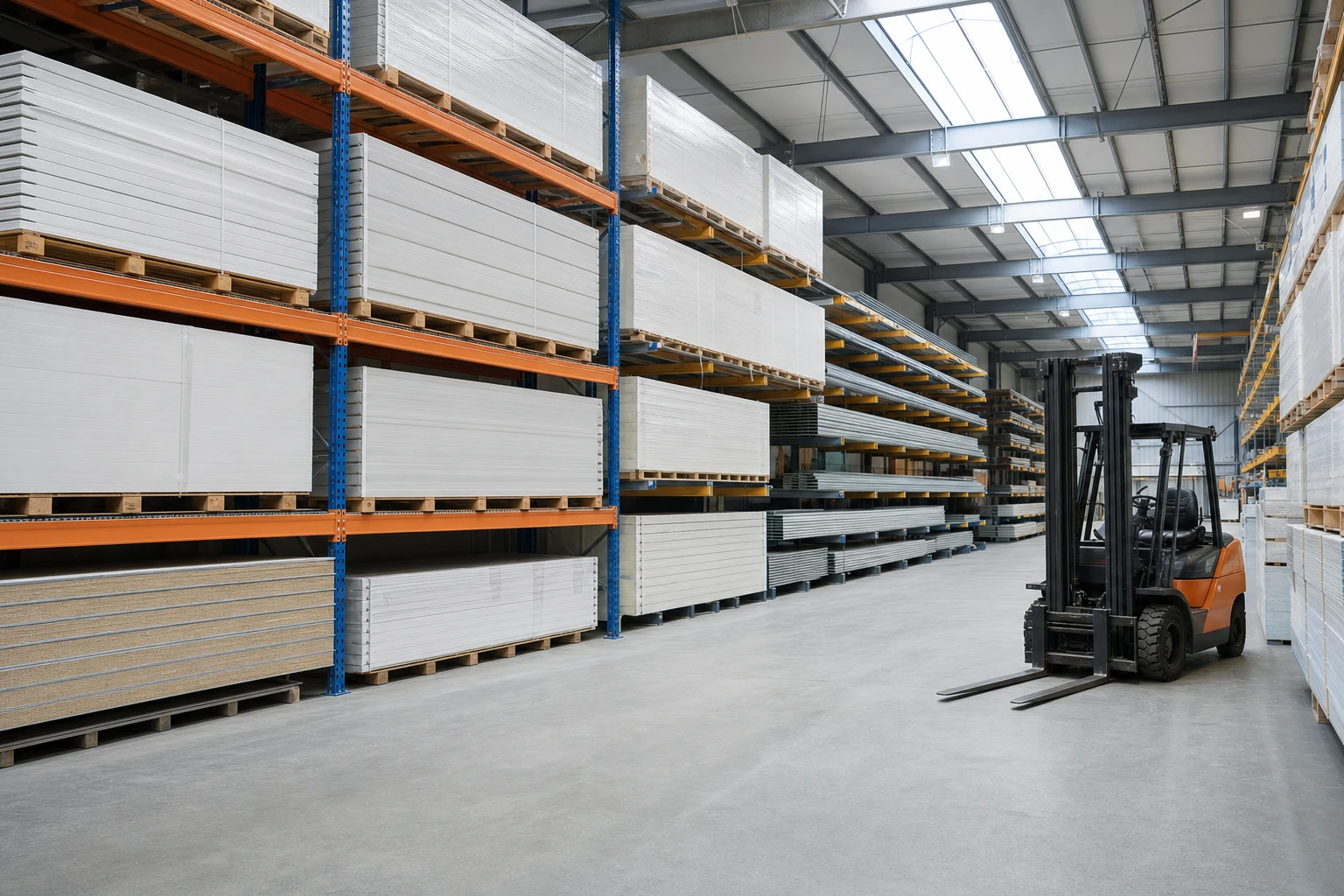
1000 m² Warehouse — termPIR® or Sandwich Panels? Cost, Time, Operation Comparison
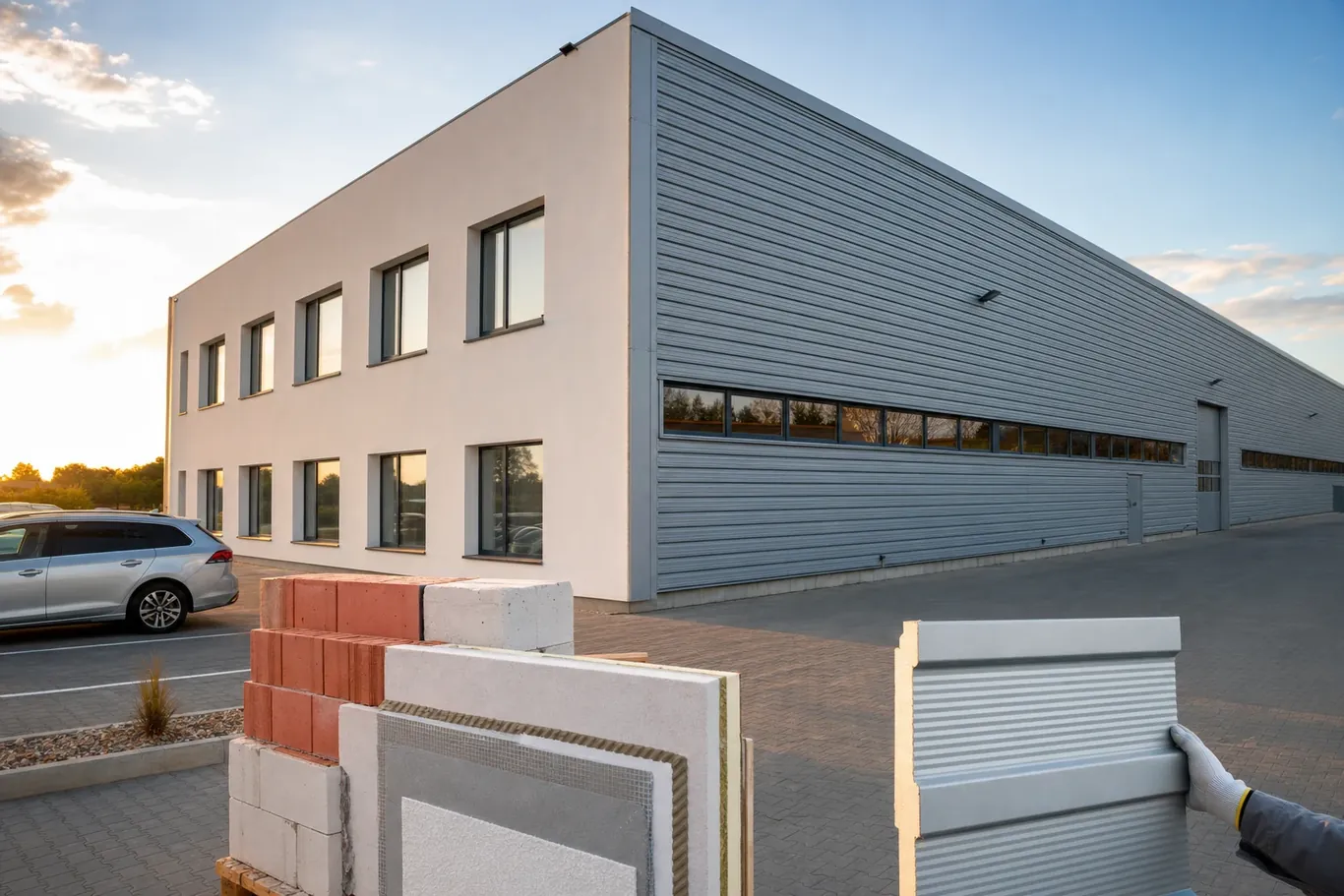
“I’m building a 1000 m² warehouse. What should I choose?”
Every logistics investor in Poland asks this question. Two schools of thought:
- Traditional — steel or reinforced concrete structure + double-leaf masonry wall or frame + termPIR® insulation + finishes
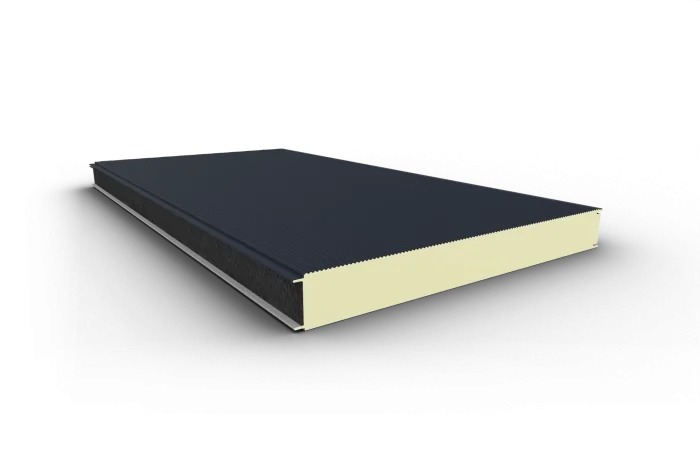
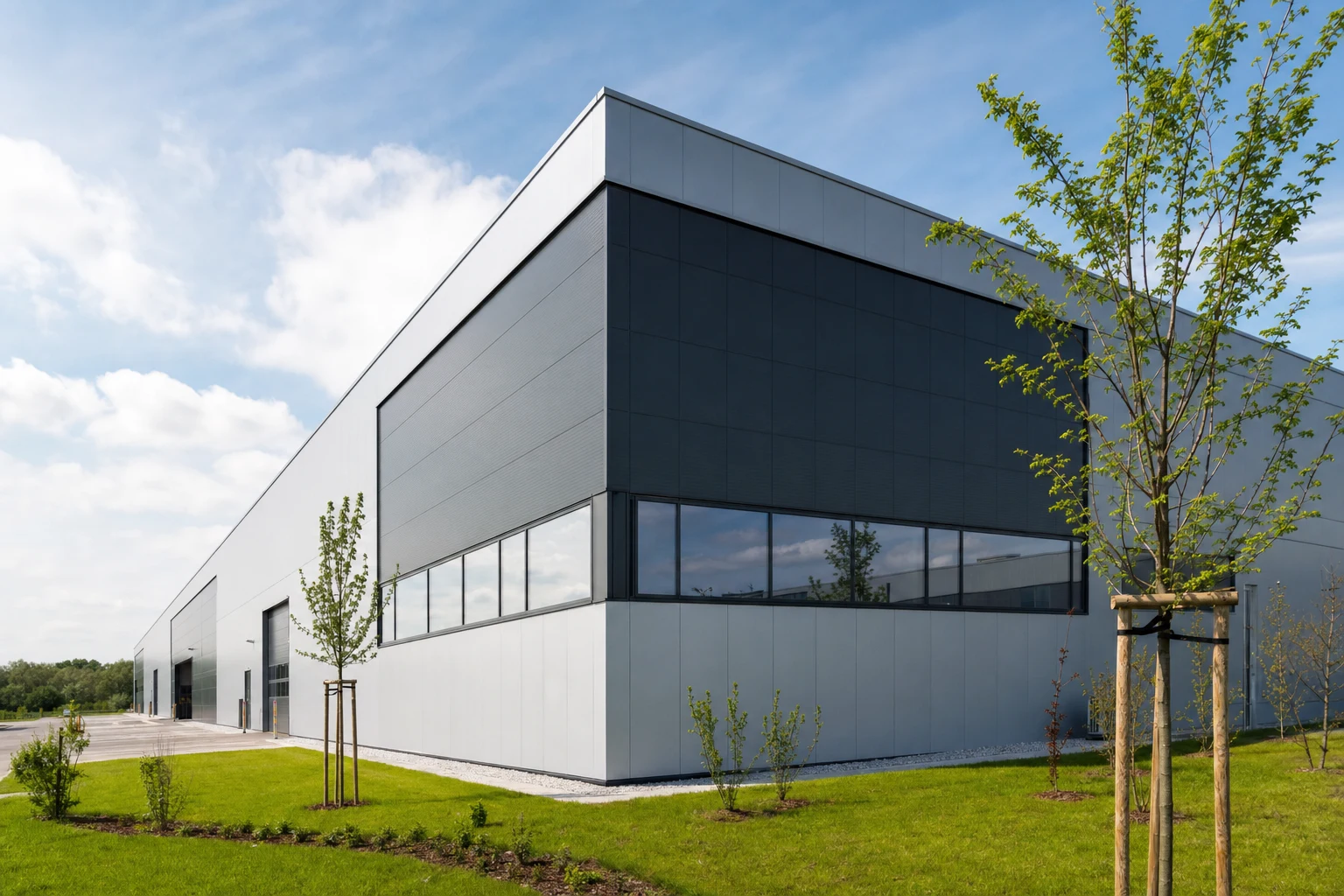
- Lightweight — steel structure + sandwich panels (PIR or mineral wool) as simultaneous envelope + insulation
Both work. Both will meet WT 2021. Both will let your warehouse serve 30+ years. But the differences in cost, time, and operation are dramatic.
In this article we show concrete calculations for a 1000 m² warehouse (typical). No marketing, with numbers for 2026.
In short: how the two schools differ
| termPIR® + masonry/frame | Sandwich panels | |
|---|---|---|
| Structure | Steel load-bearing + masonry from blocks/keramzit/silicate | Steel load-bearing (lighter) |
| Envelope | Masonry 24–30 cm + insulation 14–20 cm + exterior render | Sandwich panel 80–200 mm = envelope + insulation in one |
| Build time | 6–9 months | 5–6 months (including ~35 days of factory production of sandwich panels) |
| Price (per m² of warehouse) | 1,400–2,200 PLN | 1,100–1,700 PLN |
| Wall weight per m² | 350–500 kg | 18–25 kg |
| Extension / rebuild | Complicated (masonry) | Easy (demountable) |
| Durability | 50+ years | 30–40 years |
| Insulation replacement | Practically impossible | Possible (panel demounting) |
| Fire resistance classes | Easy REI 60+ (fire-resistant masonry) | Requires selection (EI 30–EI 240 depending on configuration) |
In practice:
- Traditional wins on durability and fire class
- Sandwich panels win on cost and time
The choice depends on what matters more to you.
Concrete calculation — 1000 m² warehouse
Assumptions:
- Usable area: 1000 m² (e.g. 50×20 m)
- Usable height: 8 m to ridge
- Location: central Poland, standard material availability
- Building fire resistance class: D (typical for PM)
- Requirement: WT 2021 + REI 30 for partition wall between zones
Variant 1 — Steel structure + silicate masonry + termPIR® ETX (ETICS)
Steel structure:             ~280 PLN/m² warehouse  =  280,000 PLN
Silicate masonry 24 cm:      ~180 PLN/m² walls × 350 m² walls = 63,000 PLN
termPIR® ETX 160 mm (ETICS): 110 PLN/m² × 350 m² = 38,500 PLN
Render + mesh + adhesive (ETICS): 95 PLN/m² × 350 m² = 33,250 PLN
Roof (trapezoidal sheet + termPIR AL 140 mm + felt): 200 PLN/m² × 1100 m² = 220,000 PLN
Joinery (gates, doors, windows): ~80,000 PLN
Reinforced concrete floor:   ~120 PLN/m² × 1000 = 120,000 PLN
Installations (water, power, heating): ~200,000 PLN
Labour and other:            ~350,000 PLN

TOTAL: ~1,380,000 PLN = 1,380 PLN/m² of warehouse
Build time: 7–9 months
Variant 2 — Steel structure + GS insPIRe (PIR) sandwich panels walls + GS insPIRe D roof
Steel structure (lighter, smaller foundations):
                              ~220 PLN/m² warehouse  =  220,000 PLN
GS insPIRe S 100 mm (wall):   140 PLN/m² × 350 m² = 49,000 PLN
Sandwich wall installation:   50 PLN/m² × 350 = 17,500 PLN
GS insPIRe D 120 mm (roof):   165 PLN/m² × 1100 m² = 181,500 PLN
Sandwich roof installation:   60 PLN/m² × 1100 = 66,000 PLN
Joinery:                       ~75,000 PLN
Reinforced concrete floor:    ~120,000 PLN
Installations:                 ~180,000 PLN
Labour and other:             ~220,000 PLN

TOTAL: ~1,128,000 PLN = 1,128 PLN/m² of warehouse
Build time: 5–6 months
Variant 3 — Steel structure + GS MW QA sandwich panels (mineral wool) — for higher fire class
Steel structure:               220 PLN/m² × 1000 = 220,000 PLN
GS MW QA S 120 mm (wall):      180 PLN/m² × 350 = 63,000 PLN
Installation:                  50 PLN/m² × 350 = 17,500 PLN
GS MW QA D 150 mm (roof):      210 PLN/m² × 1100 = 231,000 PLN
Roof installation:             60 × 1100 = 66,000 PLN
Other (as Variant 2):          ~595,000 PLN

TOTAL: ~1,192,000 PLN = 1,192 PLN/m² of warehouse
Advantage of Variant 3: EI 60–EI 180 for walls (mineral wool), full BROOF, better fire classes for a PM class facility. Price ~6% higher than Variant 2.
Synthetic comparison
| Variant | Total cost | Price/m² | Build time | Wall fire class | Durability |
|---|---|---|---|---|---|
| 1 — Masonry + termPIR® ETX | 1,380,000 PLN | 1,380 PLN/m² | 7–9 months | REI 60+ | 50 years |
| 2 — GS insPIRe (PIR) | 1,128,000 PLN | 1,128 PLN/m² | 5–6 months | EI 15–30 | 30 years |
| 3 — GS MW QA (wool) | 1,192,000 PLN | 1,192 PLN/m² | 5–6 months | EI 60–EI 180 | 35 years |
Difference between 1 and 2: 252,000 PLN against masonry (+ 4 months longer). That’s a lot.
Operating cost — 10-year perspective
The building itself is half the story. The other half is operation.
Energy (heating + cooling)
Assumption: warehouse heated in winter to 12°C, cooled in summer to 25°C. Air conditioning 50 kW, air source heat pump.
| Variant | Roof U-value | Wall U-value | Annual demand kWh/m² | Cost 10 years (energy 0.8 PLN/kWh) |
|---|---|---|---|---|
| 1 — Masonry + ETICS PIR | 0.15 | 0.18 | 110 kWh/m² | 880,000 PLN |
| 2 — GS insPIRe 120 mm | 0.18 | 0.22 | 135 kWh/m² | 1,080,000 PLN |
| 3 — GS MW QA 150 mm | 0.17 | 0.19 | 122 kWh/m² | 976,000 PLN |
Variant 1 saves 200,000 PLN on energy over 10 years vs Variant 2 — because better insulated (thicker PIR layer + thermal mass of masonry).
Maintenance and repairs
| Variant | Every 5 years | Every 10 years |
|---|---|---|
| Masonry + ETICS | Minor render cracks (~5,000 PLN) | ETICS inspection, possible touch-up (~15,000 PLN) |
| Sandwich panels | Joint inspection, sealing tapes (~3,000 PLN) | Possible replacement of damaged panels (~10,000 PLN) |
Maintenance similar, sandwich panels advantage in ease of repair (demountable).
Total Cost of Ownership (TCO) — 10 years
| Variant | Investment | Energy 10 years | Maintenance | TCO 10 years |
|---|---|---|---|---|
| 1 — Masonry + ETICS PIR | 1,380,000 | 880,000 | 20,000 | 2,280,000 PLN |
| 2 — GS insPIRe (PIR) | 1,128,000 | 1,080,000 | 13,000 | 2,221,000 PLN |
| 3 — GS MW QA (wool) | 1,192,000 | 976,000 | 13,000 | 2,181,000 PLN |
10-year verdict:
- GS MW QA (wool) — cheapest over 10 years (2.18 mln) + best fire classes
- GS insPIRe (PIR) — very close (2.22 mln), faster build
- Masonry + ETICS — most expensive (2.28 mln), but longest durability (50+ years)
In a 20-year perspective: masonry catches up with sandwich panels and overtakes them (fewer costly repairs, better insulation = lower bills). Plus masonry has higher market value upon potential sale.
In a 5-year perspective (if you plan to sell or lease the warehouse short-term): sandwich panels DEFINITELY win.
What to choose — decision in 4 questions
1. How long do you plan to keep this warehouse?
- 5–10 years → sandwich panels (PIR or MW)
- 15+ years → masonry + ETICS seriously considered
2. Do you need high fire resistance class?
- REI 30 is enough (typical PM warehouse class “D”–“E”) → sandwich PIR OK
- REI 60+ needed (hazardous materials, adjacent warehouse, classes “A”–“C”) → mineral wool or masonry + ETICS
3. How important is delivery time?
- Urgently needed (5–6 months) → sandwich panels — faster than masonry, but factor in 35 days of factory production
- Can wait 7–9 months → masonry + ETICS
4. What are your acoustic and climate preferences inside?
- Standard warehouse (no people for long) → sandwich panels suffice
- Hall with people 8h daily / cold store / freezer / production hall → masonry (better thermal mass, better acoustics) or GS MW (wool has better acoustics than PIR)
Most common investor mistakes
Mistake 1 — Choosing based on envelope price alone
Investor asks “how much per m² of sandwich panel?” → buys the cheapest. Missed opportunity: steel structure (the main cost) differs by 20–30% depending on the static requirements of the panel. TCO matters, not the envelope price.
Mistake 2 — Ignoring fire class
PIR sandwich panels have EI 15–30 (wall). The fire inspector during acceptance requires EI 60 → you need to add gypsum partition walls → 80,000 PLN extra. Check building class requirements before choosing.
Mistake 3 — Wrong thickness selection for the climate
PIR 80 mm in a warehouse heated to 18°C in winter = high power bill. Every heated warehouse starts at min. 100 mm PIR wall, 120 mm roof. Investment in insulation pays back in 5–7 years.
Mistake 4 — Omitting ETICS for masonry
A 25 cm silicate wall alone has U ~0.7 W/(m²·K) — far from WT 2021. Without ETICS with PIR/MW (15–20 cm additional) → illegal, the authority will not approve it.
What BOKKA offers
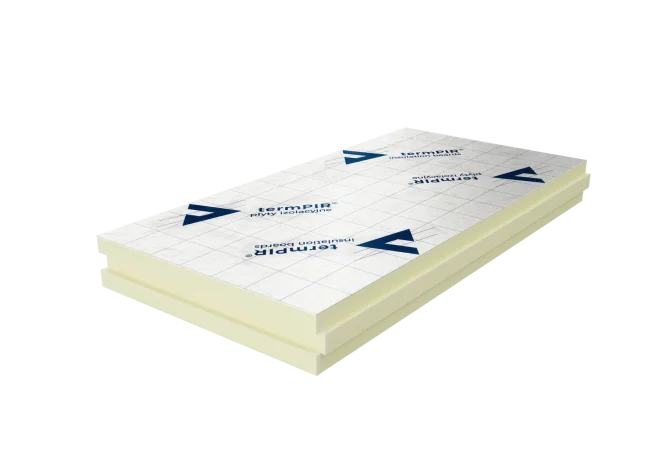
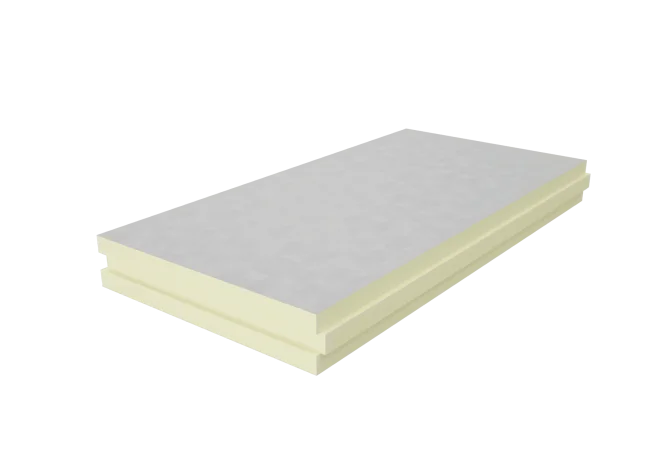
We sell both schools — termPIR® + GS insPIRe / GS MW sandwich panels. Without pushing one option. We advise objectively:
- TCO calculation for your warehouse (with concrete numbers for your climate, requirements, location)
- Nationwide delivery — termPIR® pallets in 7 days, sandwich panels made to order at the Gór-Stal factory (typically ~35 days — production starts after order confirmation + transport)
- Full documentation — DoP, REI/EI classifications, BROOF for every configuration
🤝 Free BOKKA technical consultation — we’ll help select the product and complete documentation for your project.
Summary
| Your situation | Choice |
|---|---|
| Urgent build, standard warehouse, 5–10 years | PIR sandwich panels (GS insPIRe) |
| Warehouse with hazardous materials or REI 60+ requirement | MW sandwich panels (GS MW QA) |
| Production hall with people, long-term investment, acoustics | Masonry + ETICS termPIR ETX |
| Cold store / freezer warehouse | GS insPIRe CH (PIR) 150–200 mm |
| Mixed requirements | Masonry up to 3 m + sandwich panels above |
🤝 Free BOKKA technical consultation — we’ll help select the product and complete documentation for your project.
Frequently asked questions
Can I combine both schools (masonry + sandwich panels)?
What about cold storage / freezer warehouses?
Can sandwich panels be demounted?
What about acoustics of sandwich panel halls?
How much does the steel structure for a sandwich panel warehouse weigh?
Are sandwich panel halls cheaper to insure?
Related products and systems
Read next
Reaction-to-Fire Euroclasses A1/A2/B/C/D/E/F — What They Mean in Design Practice
How to read DoP, ETA and AVCP certificate — a guide for designers and buyers
EPD and carbon footprint of sandwich panels and PIR — ESG in construction