How to calculate the U-value of a sandwich panel and PIR assembly (step by step)

Every assembly design — wall, roof, floor — ends with the same question: does it meet the WT 2021 requirements. This is answered by the thermal transmittance, the U-value, not by thickness alone or a “good lambda” of the material. In this article we show, step by step, how λ differs from U, how the U formula is built, how to pick the surface heat-transfer resistances, and how to calculate U for an assembly of sandwich panels and PIR — with reference to the public WT 2021 limit values. We do not quote a product’s specific λ from memory: calculations always use the declared value from the technical data sheet of the given product.
λ vs U — two different quantities
This distinction is the foundation and the source of the most common errors.
Lambda (λ) — thermal conductivity, unit W/(m·K). It is a property of the material itself, independent of thickness. It says how intensely heat flows through the material: the lower the λ, the better the insulator. We explain it in detail in the article on the thermal conductivity coefficient. λ alone is not enough to assess an assembly — it knows nothing about thickness or the neighbouring layers.
U-value — thermal transmittance, unit W/(m²·K). It is a property of the whole assembly: it accounts for all layers, their thicknesses, their λ and the surface heat-transfer resistances on both faces. It is U that we compare against the legal requirements.
In the simplest terms: λ describes the brick, U describes the whole wall with plaster, insulation and air on both sides. A low λ is a necessary condition for a good U, but not a sufficient one — thickness and the full set of layers also count.
The formula that organises everything
The U-value is simply the reciprocal of the total thermal resistance of the assembly:
U = 1 / RT
where RT [m²·K/W] is the sum of all resistances along the heat path:
RT = Rsi + R1 + R2 + … + Rse
The resistance of a single material layer is calculated as:
R = d / λ
where d is the layer thickness in metres and λ its declared thermal conductivity. The most common arithmetic mistake is entering the thickness in centimetres or millimetres — d must be in metres.
Rsi and Rse are the surface heat-transfer resistances on the inner and outer face — they account for the heat exchange between the assembly and the air. They are taken from the EN ISO 6946 tables depending on the direction of heat flow:
| Surface | Horizontal flow (wall) | Upward flow (roof) | Downward flow (floor) |
|---|---|---|---|
| Rsi (internal) | 0.13 | 0.10 | 0.17 |
| Rse (external) | 0.04 | 0.04 | 0.04 |
(values in m²·K/W). For a wall, typically Rsi = 0.13 and Rse = 0.04; for a roof Rsi = 0.10.
A worked example — a wall from a sandwich panel / PIR
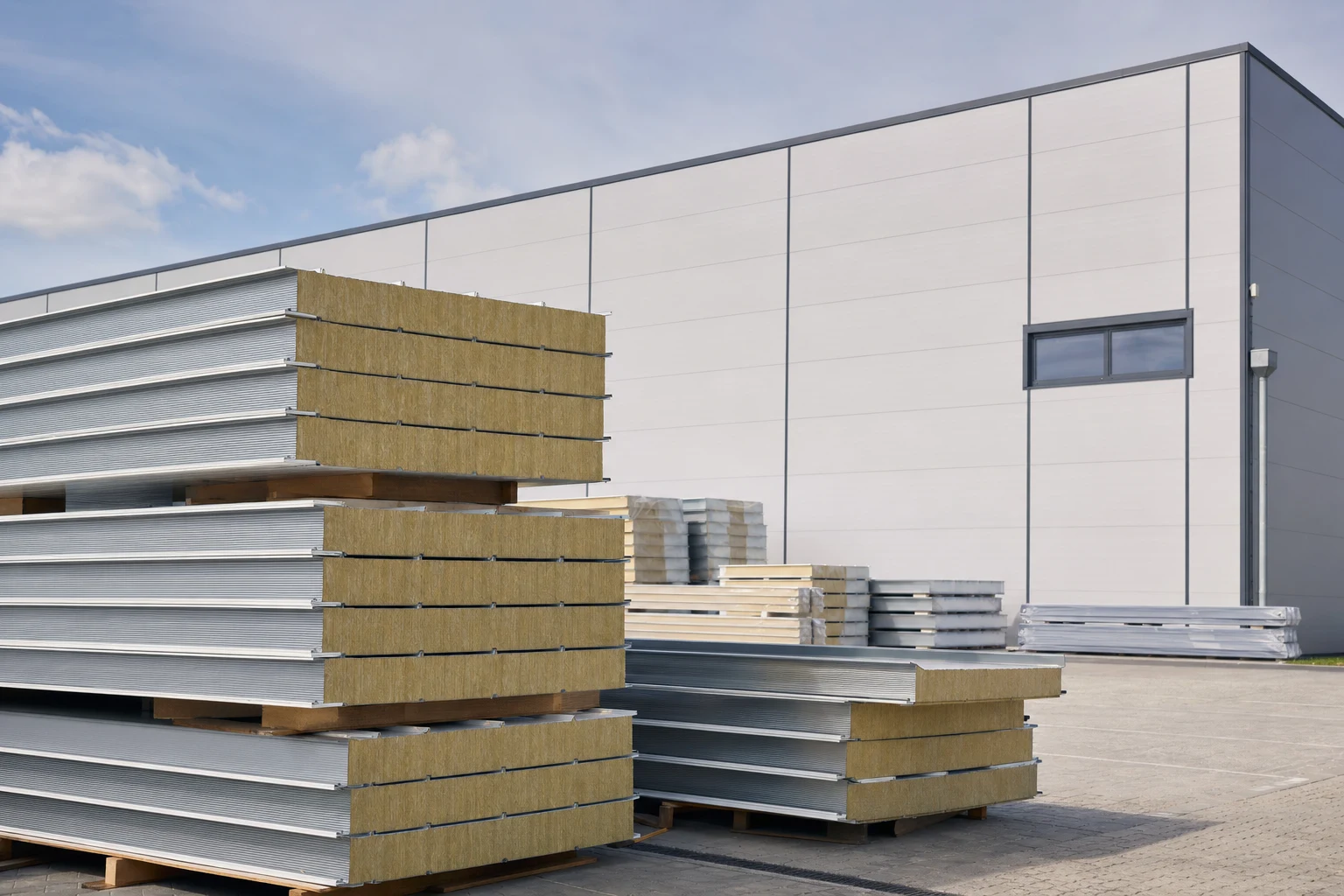
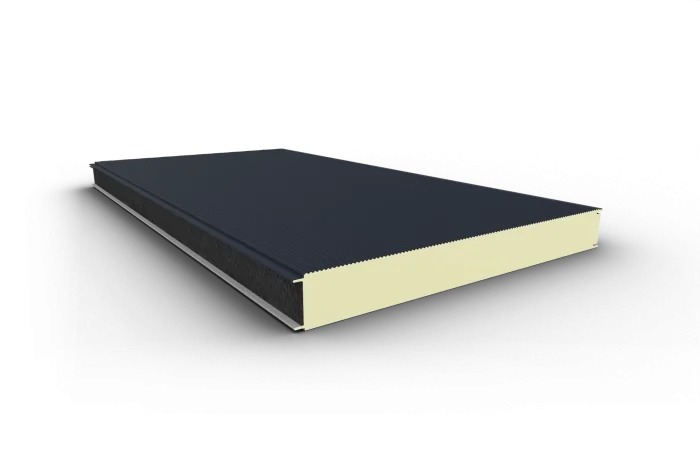
Let us show the calculation flow on an external wall made of a PIR sandwich panel. The λ values used below are symbolic — in a real project you insert the λ declared in the product data sheet.
Assume a wall: indoor air → sandwich panel (PIR core of thickness d, in steel facings) → outdoor air. Step by step:
- Surface resistances (wall, horizontal flow): Rsi = 0.13; Rse = 0.04 → together 0.17 m²·K/W.
- PIR core resistance: R = d / λ. The steel facings have a very high λ (they conduct heat) and a thickness of the order of tenths of a millimetre — their resistance is negligibly small, so the assembly’s R is governed by the core.
- Total resistance: RT = 0.17 + (d / λPIR).
- U-value: U = 1 / RT.
A clear qualitative conclusion: because the surface resistances are constant and small, the U result is governed above all by the ratio of core thickness to its λ. The thicker the core and the lower the declared λ, the lower (better) the U. That is why low-λ materials such as PIR achieve the required U at a smaller thickness than higher-λ materials — which translates into a thinner assembly and less floor area lost. We analyse this relationship between λ and insulation economics in the text PIR panels vs polystyrene — an ROI analysis.
For sandwich panels the manufacturer often declares the U-value directly for a given core thickness — then there is no need to calculate from λ, it is enough to read U from the data sheet and compare it with WT 2021. For multi-layer assemblies (e.g. a roof with over-rafter insulation) each layer is calculated separately and the resistances are summed.
WT 2021 requirements — what we compare U against
The calculated U is compared with the maximum limit values set out in the Technical Conditions (WT 2021). For buildings with a room temperature of at least 16°C, the limits include:
| Assembly | Umax per WT 2021 [W/(m²·K)] |
|---|---|
| External wall | 0.20 |
| Roof, flat roof | 0.15 |
| Floor on ground | 0.30 |
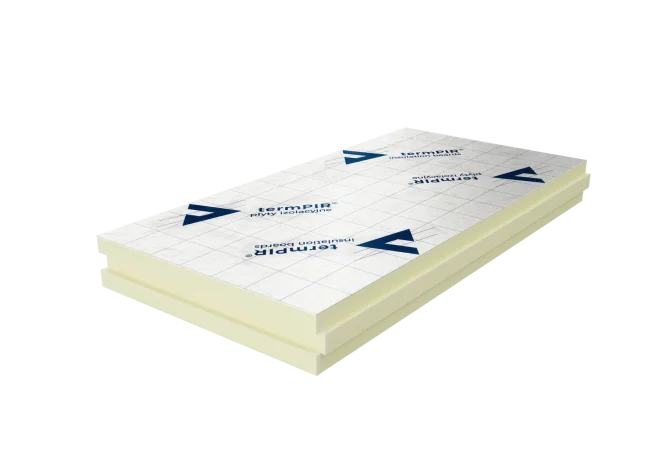
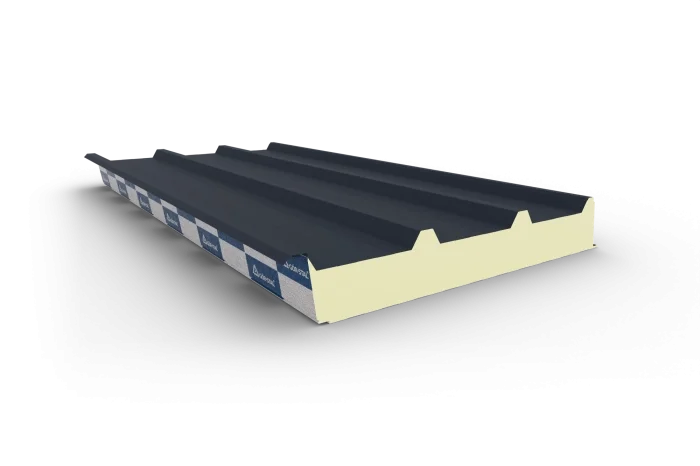
The rule is simple: the calculated U must be lower than or equal to the limit value. If it comes out higher — you have to increase the insulation thickness, reach for a lower-λ material or add a layer. The roof is the most demanding here (0.15), which with roof sandwich panels insPIRe D or termPIR AL insulation means selecting a suitably thick core. For walls a thinner section is usually enough to drop below 0.20.
The most common mistakes in U calculations
- Thickness in cm instead of metres in R = d/λ — it overstates R tenfold.
- Confusing λ with U — comparing a material’s λ with the assembly’s U requirement is a category error.
- Omitting Rsi/Rse or using values for the wrong flow direction (roof ≠ wall).
- λ “from the internet” instead of the declared value — use the value from the technical data sheet of the specific product; different PIR products have different λ.
- Calculating “for the material alone” in a multi-layer assembly — you must sum the resistances of all layers.
- Ignoring thermal bridges — in a precise energy assessment the influence of fasteners and joints also counts, going beyond the basic U of the layer.
Do it without manual arithmetic
The whole flow above — surface resistances, R = d/λ for each layer, the sum and U = 1/RT — is done for you by our U-value calculator. You enter the layers and thicknesses, and the tool returns the assembly’s U and lets you compare it straight away with the WT 2021 requirement. This is the fastest way to check whether a designed sandwich-panel or PIR assembly will pass the requirement — and, if needed, to select the thickness by trial.
Summary
The U-value is the reciprocal of the sum of resistances of the assembly: U = 1/RT, where the layer R = d/λ, and the surface heat-transfer resistances Rsi and Rse are added to the balance. λ describes the material, U the whole assembly, and it is U that we compare with the WT 2021 limits (wall 0.20; roof 0.15; floor on ground 0.30). In calculations we use the λ declared in the product data sheet, and for sandwich panels we often read U directly for a given thickness. The rest is discipline of units and completeness of layers — or simply using a ready calculator.
🤝 Contact a BOKKA technical adviser — we will help you select the thickness of a sandwich panel or PIR to meet the required assembly U and confirm the parameters with the product’s declaration of performance.
Sources:
- EN ISO 6946 — Building components and building elements: thermal resistance and thermal transmittance (calculation method, Rsi/Rse resistances)
- Regulation on technical conditions (WT 2021) — limit Umax values of assemblies
- Declaration of performance / technical data sheet of the product — declared λ and U values
Frequently asked questions
How does lambda (λ) differ from the U-value?
What is the basic formula for the U-value?
What are the maximum U-values under WT 2021?
Where do I get the λ of a sandwich panel or PIR for the calculation?
Related products and systems
Read next

EPD and carbon footprint of sandwich panels and PIR — ESG in construction
Summer overheating of attics and halls — thermal phase shift and comfort

FM Approved for roofs and sandwich panels — what it means for the investor and insurer