Płyta obornicka — what it is, and why it is simply a sandwich panel
The phrase “płyta obornicka” is one of the most frequently typed search queries by people looking for material for a hall, warehouse or farm building. Yet you will search in vain for such a product in manufacturers’ catalogues and in building standards. The reason is simple: płyta obornicka is a colloquial, customary name for a sandwich panel — exactly the same product professionally referred to as a “sandwich panel” or “panel sandwich”. In this article we explain where the name comes from, what the panel is made of, where it is used and what the division into grades means.
“Płyta obornicka” = sandwich panel
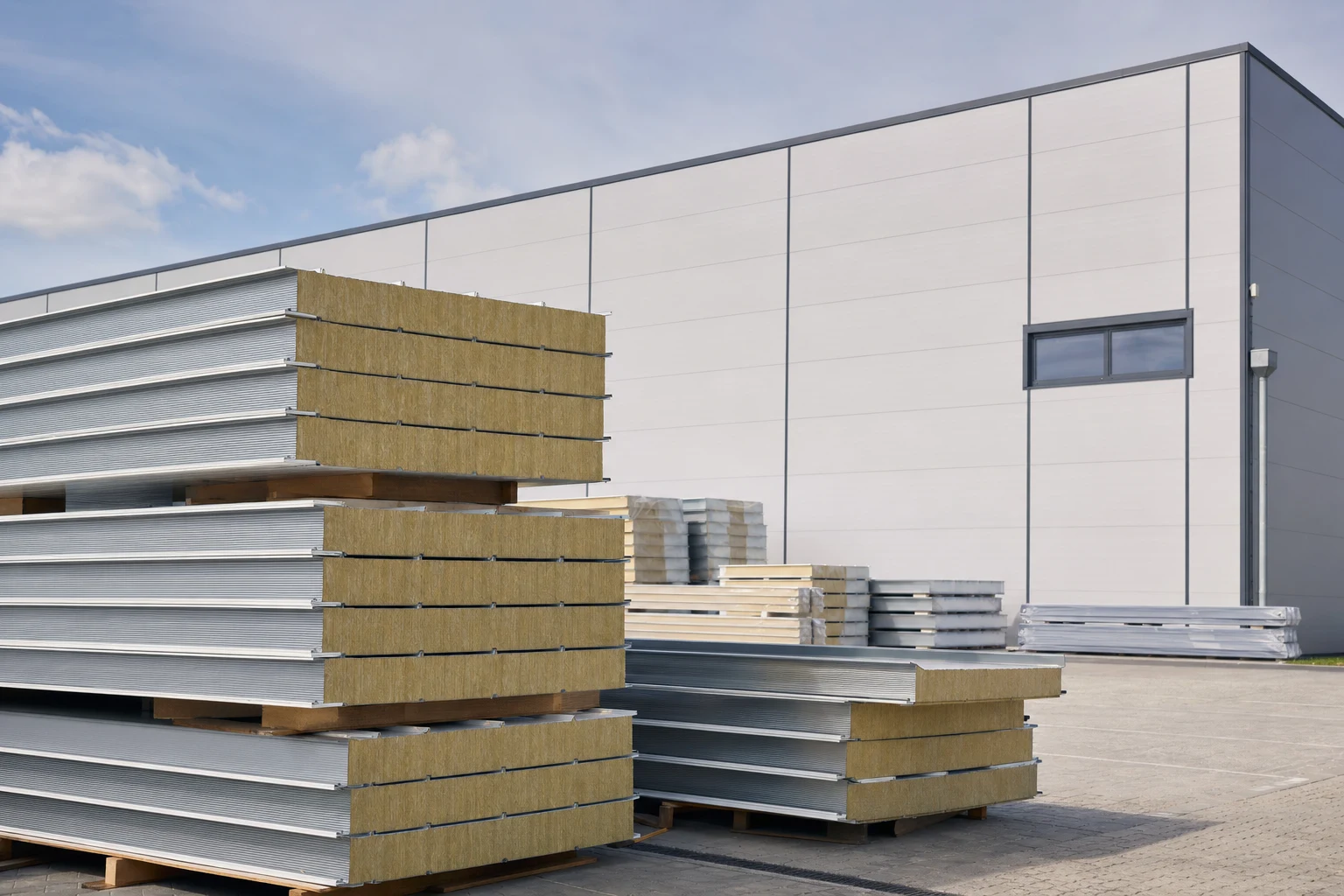
Let’s start with the most important point: this is not a separate product. When you buy a “płyta obornicka”, you are buying a sandwich panel — an envelope element made of two steel facings and an insulating core. The name “obornicka” functions in everyday speech and in classified ads, but in project documentation, quotations and standards the term sandwich panel applies.
Where does the name come from? It is a customary name — established regionally and associated mainly with agricultural and livestock construction. We do not attach ourselves to any particular story of its origin (various versions circulate), because for the choice of material only one thing matters: under the heading “płyta obornicka” what is sold is simply a sandwich panel. So if you arrived here by typing that phrase — what you are looking for is sandwich panels.
Several other colloquial terms for the same product function similarly: “panel sandwich”, “płyta kanapkowa” (sandwich board), “płyta PUR/PIR” (from the core), or simply “a panel for a hall”. They all refer to the same product family. In commercial offers and in conversation with a contractor you may come across any of them — they do not denote different materials, but different habitual names. In the rest of this article we consistently use the technical name: sandwich panel.
What a sandwich panel (obornicka) is made of
The construction is a classic “sandwich” of three layers:
- two outer steel facings — galvanised and organically coated (the coating provides colour and corrosion resistance),
- an insulating core in the middle — most often rigid PIR foam or mineral wool.
The core is responsible for thermal performance and reaction-to-fire class, and the facings for stiffness, load-bearing capacity and resistance to the environment. This distinction matters when choosing:
- PIR core — very good thermal performance at small thickness and low weight; economical, light, fast to install;
- mineral wool core — higher fire resistance and better acoustics, at the cost of greater weight and thickness.
Our range includes both variants: sandwich panels with a PIR core and sandwich panels with mineral wool (MIWO). The choice of core depends on the building’s fire, acoustic and budget requirements.
Where płyty obornickie are used
Despite the “agricultural” sound of the name, this is a versatile material for a lightweight envelope. The same panels go onto:
- agricultural and livestock buildings — cowsheds, piggeries, poultry houses, barns, stores (hence the colloquial name); more in the article on sandwich panels in agricultural construction,
- warehouse and production halls — a topic we develop in the overview of applications of the lightweight sandwich panel envelope,
- farm buildings, workshops, shelters,
- retail and service buildings,
- cold stores and freezer rooms (here in a special version for controlled temperatures).
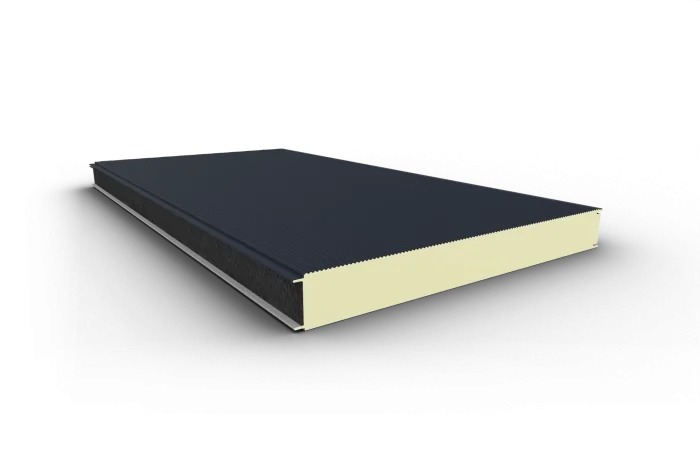
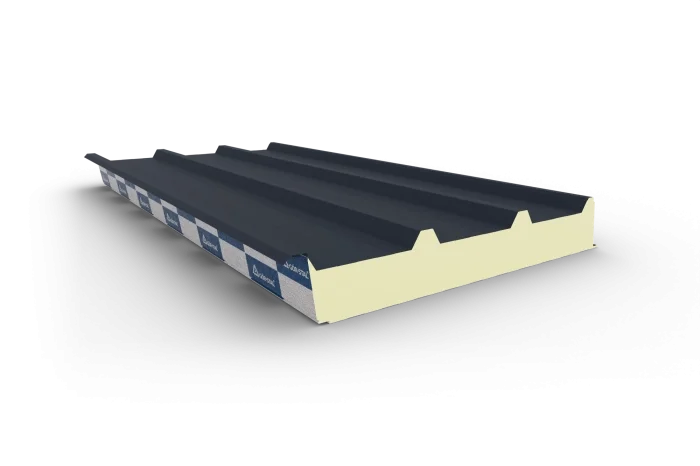
Płyta obornicka comes in two basic functions: wall (e.g. insPIRe S) and roof with a trapezoidal profile (insPIRe D). The choice depends on whether you are closing a wall or covering a roof.
Why a sandwich panel works well for a hall and an agricultural building
The popularity of “płyty obornickie” in hall and agricultural construction is no accident. It stems from several practical advantages of a lightweight envelope:
- fast installation — large-format panels are closed up on their locks, so a building goes up much faster than in masonry technology,
- insulation and sheathing in one — a single element serves as the wall/roof and the insulation, with no separate insulating layer,
- low weight — less load on the load-bearing structure and foundations,
- good thermal performance — especially with a PIR core, which lowers the building’s heating costs,
- hygiene and ease of cleaning — smooth, coated facings are important in livestock buildings and food processing.
In livestock buildings (cowsheds, piggeries, poultry houses) there is the added aspect of the internal environment — high humidity and aggressive ammonia vapours. In such buildings it is particularly important to choose the right facing and its coating, and to seal the joints carefully, so that the envelope serves for years without corrosion.
Grade I płyta obornicka vs grade II
A frequent question when buying a hall is the difference between grades. Grade concerns commercial quality, not construction — in both cases it is the same sandwich panel with the same layers.
- Grade I — a full-value panel, without defects, with full availability of colours and lengths.
- Grade II — panels with minor cosmetic facing flaws (e.g. transport marks, colour deviations) or non-standard lengths from overproduction. They are cheaper and work very well where appearance is not a priority — in farm, agricultural or warehouse buildings.
Importantly, grade II does not mean inferior technical parameters of the core or thermal performance — it is primarily a matter of aesthetics and availability. We covered the topic in detail in the article grade II sandwich panels — what they are. For an investor building a hall from “płyta obornicka”, this is often a way to make real savings.
How much does płyta obornicka cost — what affects the price
This is the most common question, and at the same time one that cannot be answered with a single figure — the price depends on the configuration. Without quoting specific rates, it is worth knowing what raises or lowers the cost of a sandwich panel:
- type of core — PIR usually gives the same U-value as thicker wool at a smaller thickness; wool in turn offers higher fire resistance,
- core thickness — the thicker the panel (better U), the higher the cost,
- facing type and coating — premium coatings for corrosive environments cost more than standard polyester,
- colour — some colours can be more expensive or made to order,
- variant and profiling — panels with concealed fixing or a special face profile cost more than basic ones,
- grade — grade II is a real saving where aesthetics are not a priority,
- quantity — the size of the order affects the terms.
That is why we always give a reliable price in an individual quotation, once the building’s purpose and dimensions are established. This avoids overpaying (e.g. for parameters the building does not need) and matches the optimal cost-to-requirement ratio.
A hall from płyta obornicka — where to start
If you are planning a hall from płyta obornicka, the order is the same as for any sandwich panel envelope: define the function and requirements (thermal performance, fire, possibly controlled temperature), select the core (PIR or wool), the thickness and the variant (wall/roof), and then the colour and the facing’s environmental class. The sandwich panel calculator helps estimate the quantity of material and the thickness for the support spacing.
Because the phrase “płyta obornicka” conceals a broad range, the simplest thing is to give us the building’s purpose and dimensions — we will select specific panels and prepare a quotation, including a grade II option if you want to lower the cost.
🤝 Contact a BOKKA technical advisor — we will help select sandwich panels (colloquially “obornickie”) for a hall, agricultural building or warehouse and prepare a quotation, including grade II.
Sources:
- PN-EN 14509 — Self-supporting double skin metal faced insulating sandwich panels with a rigid foam core — requirements and classification
- PN-EN 13501-1 — Fire classification of construction products (reaction to fire)
- Technical data sheets for GS insPIRe sandwich panels (Gór-Stal)
Frequently asked questions
Is płyta obornicka a different product from a sandwich panel?
What is płyta obornicka made of?
Is płyta obornicka only suitable for agricultural buildings?
How does grade I płyta obornicka differ from grade II?
Related products and systems
Read next
Open shelter or enclosed hall for farm machinery? After harvest, the combine deserves real walls
EPD and carbon footprint of sandwich panels and PIR — ESG in construction

How to calculate the U-value of a sandwich panel and PIR assembly (step by step)