Open shelter or enclosed hall for farm machinery? After harvest, the combine deserves real walls
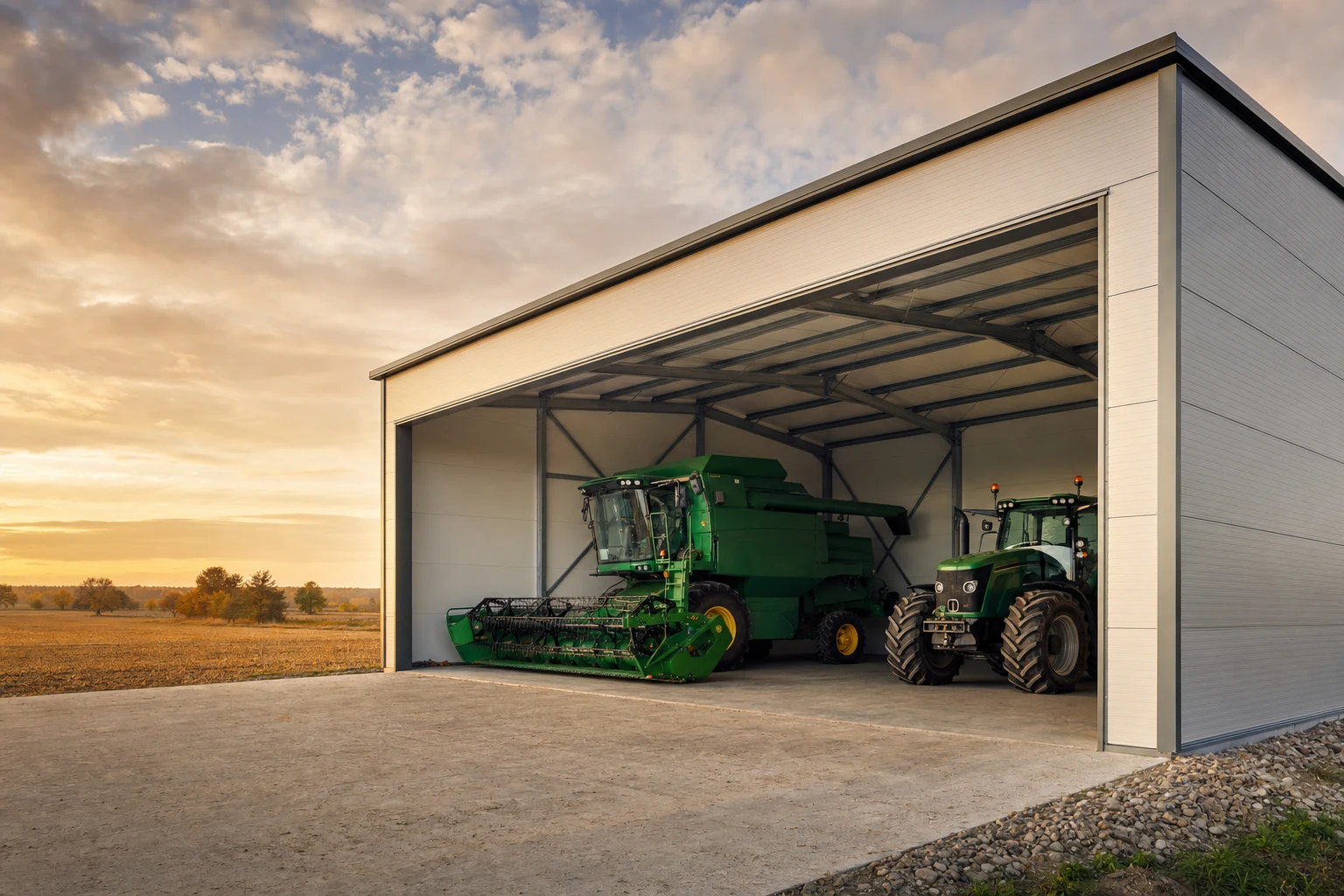
End of September. The combine stands in the yard exactly where you switched off the engine after the last pass. It has done its job. Now it will stand there — ten months, until the next harvest.
A machine worth as much as a city flat spends its nights under the open sky. Or — in the “well-kept” version — under a shelter of bare steel sheet. And here begins a story rarely considered at the time of purchase: it is not the rain that does it the most harm.
A shelter protects against rain. And that is about where it ends
An open shelter takes care of one thing: precipitation does not fall directly onto the machine. That is all. Humid air walks in freely from every side, snow drifts in under the roof with any side wind, dust and chaff settle on everything, birds treat the structure as their own, and anyone driving past can see from the road what you keep in your machine park.
That last point is not theoretical. A modern tractor or combine carries a GPS receiver on its roof and monitors and controllers in the cab — equipment that is small, expensive and easy to carry away. An open shelter by the road is a showroom catalogue with free access for a thief. An enclosed hall with a gate is an entirely different conversation — also for the insurer, who asks about storage conditions in agricultural machinery policies not out of curiosity.
And there is a third problem, the least obvious one: under the bare sheet of a shelter, a machine can end up wetter than in an open field.
Where does the water under the roof come from, if it did not rain overnight?
Condensation is to blame. The dew point is the temperature at which water vapour in the air turns into droplets — just like on a cold bathroom mirror after a shower. On a clear night, the bare roof sheet radiates its heat straight into the sky and cools below the temperature of the surrounding air. Moisture from the air then settles on its underside and starts to drip.
It drips onto whatever stands below: onto the bonnet, onto the platform, into the gaps around the console. In the morning the machine is wet, although not a single drop of rain has fallen. We break the mechanism down into its parts in the article on condensation under a hall roof and the dew point — here one thing is enough: a single sheet of steel has no way of defending itself, because nothing separates its cold surface from the humid air inside.
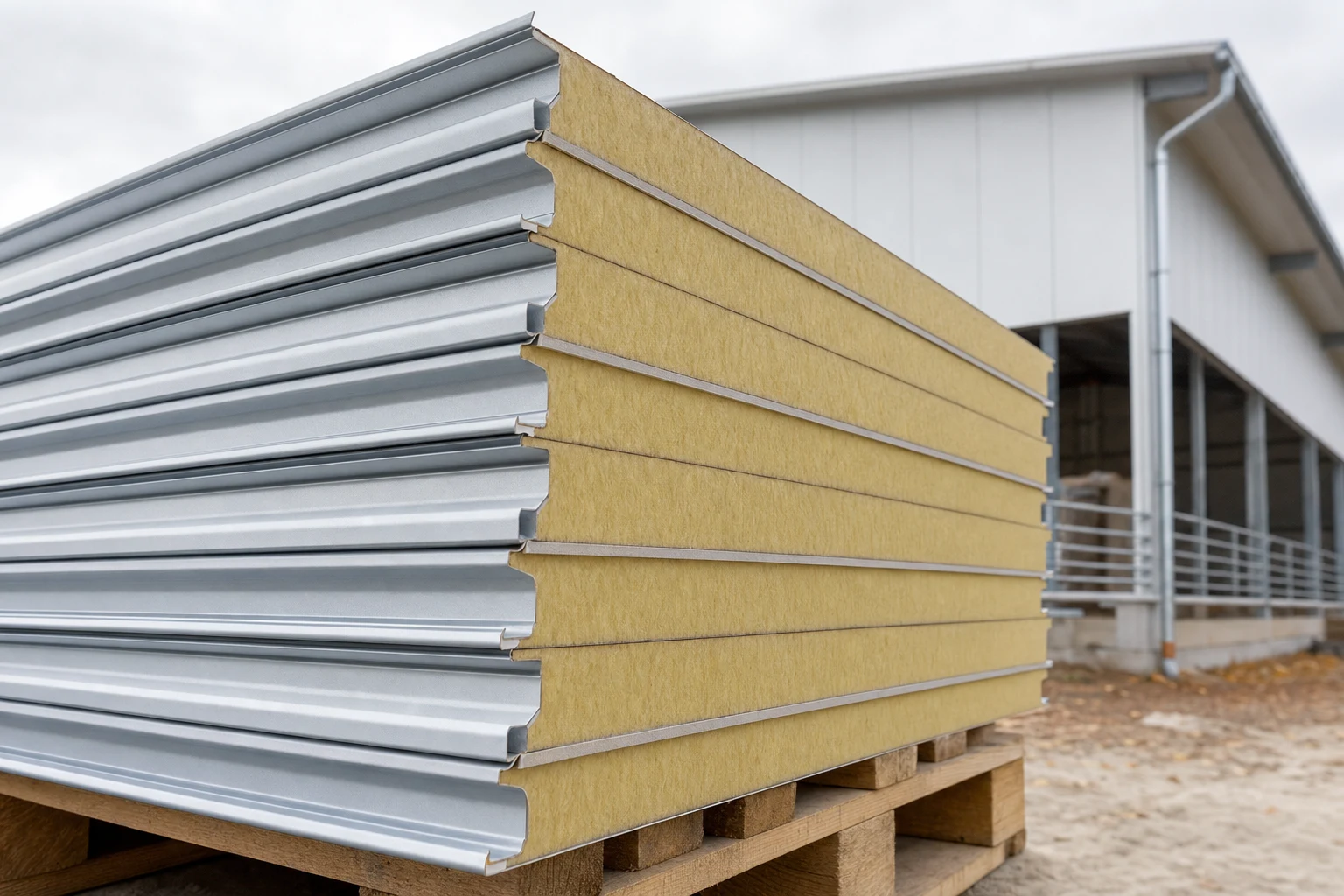
A sandwich panel solves this by design. Between the steel facings sits an insulating core — in PIR panels with a conductivity of λD = 0.022 W/(m·K) — which cuts the internal facing off from the night-time cooling. The surface on the machinery side keeps a temperature close to the air in the hall, does not fall below the dew point and simply stays dry. It is the same physics that determines the microclimate in livestock buildings — there it protects the animals, here it protects the electronics.
A modern machine is a computer on wheels
A combine from thirty years ago forgave a lot. Steel sheet, belts, bearings — after a winter under a shelter you greased what needed greasing and drove on. Today’s machine is a network of controllers, sensors and wiring harnesses, and its most expensive components dislike exactly one thing: moisture.
Condensed water works its way into connectors and does its job slowly — first a film on the contacts, then erratic sensor readings, finally fault messages at the worst possible moment, that is, on the first day of the season. Then there is the cab: moisture locked into the upholstery over winter smells of cellar in spring, and the electronics behind the dashboard go through the same dew cycles as the bonnet. Repairing a module can cost as much as a sizeable part of the envelope that would have protected it — and that is the right scale of comparison when you are working out whether “the hall pays off”.
Winter servicing — the hall works outside the season too
An enclosed, insulated hall does one more thing a shelter never will: it gives you a place to work. Winter is the natural time for maintenance — sharpening, changing fluids, overhauling components, preparing the seed drill and the sprayer for spring.
Under a shelter in January you will last an hour of that, maybe two. In an insulated hall, even without heating, the temperature stays noticeably milder than outside, and when needed you can heat it locally for the duration of the work — the insulation keeps the heat inside instead of warming the yard. On top of that, the bright internal facing of the panels reflects light and the interior is simply well lit. Servicing in your own hall instead of queueing at a workshop at the peak of the season is a saving you only appreciate once you do not have it.
The gate is taller than you think — measure the machine with its antenna
The most common mistake in designing a machinery hall concerns neither the walls nor the roof, but the gate. A combine in transport position is tall, and on the cab roof it also carries a GPS antenna and a beacon. Measuring “by eye” from the cab roof ends with a gate in front of which something has to be unbolted every year.
Do it differently: take the transport height of the tallest machine on the farm from its manual, add whatever is permanently mounted on the roof, and add a margin. Think about the future too — machines grow with every replacement, and the gate stays.
The gate opening itself in a sandwich panel wall is a structural detail, not a hole cut in sheet metal. The lintel carries the weight of the panels above the opening, the side posts stiffen the edges, and the joint between panel and reveal is closed with flashings — exactly the ones we described in the map of sandwich panel flashing details. A well-designed opening means an airtight hall; an opening “straight from the saw” is a thermal bridge and the place where corrosion begins.
What to build it from — and how not to overpay
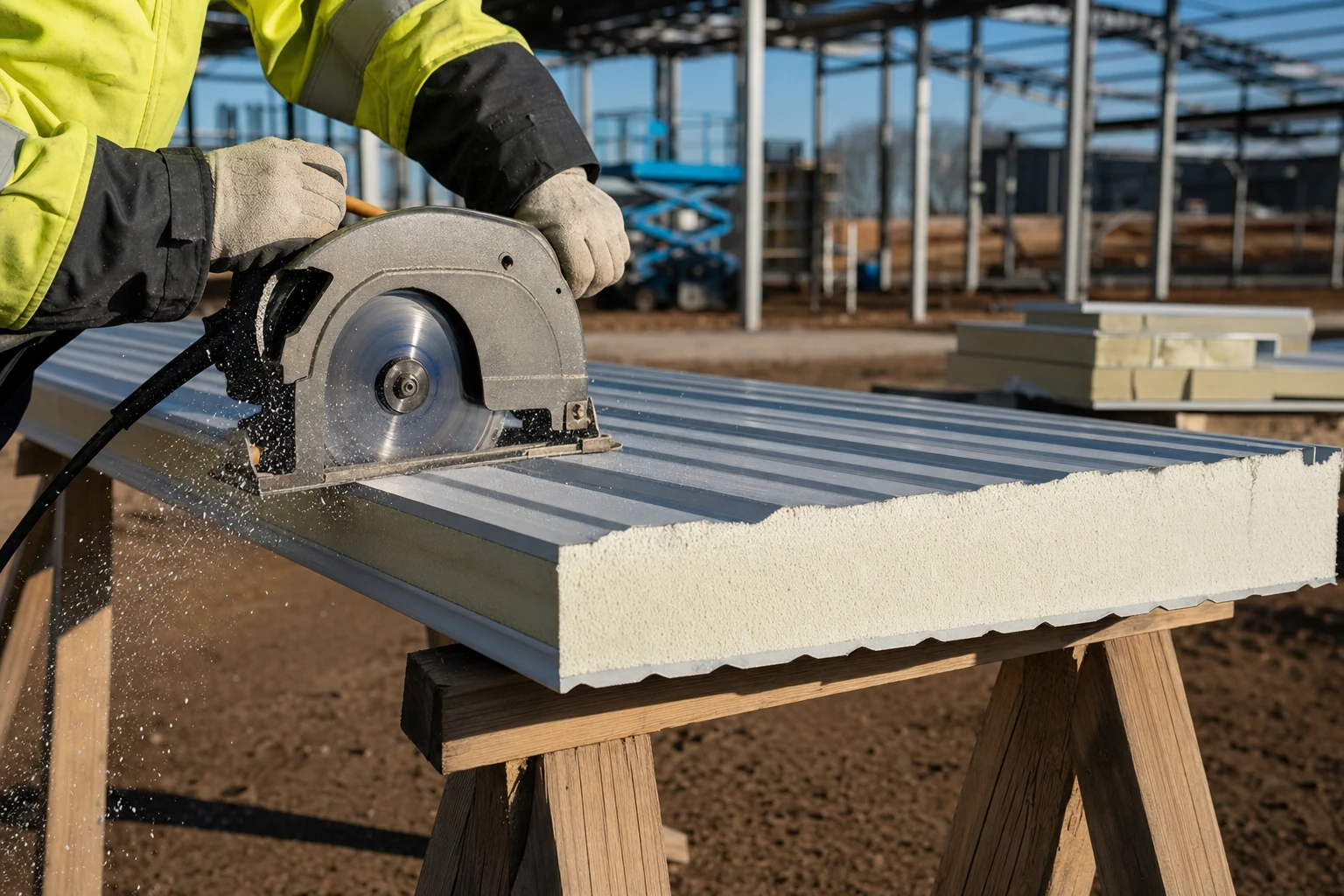
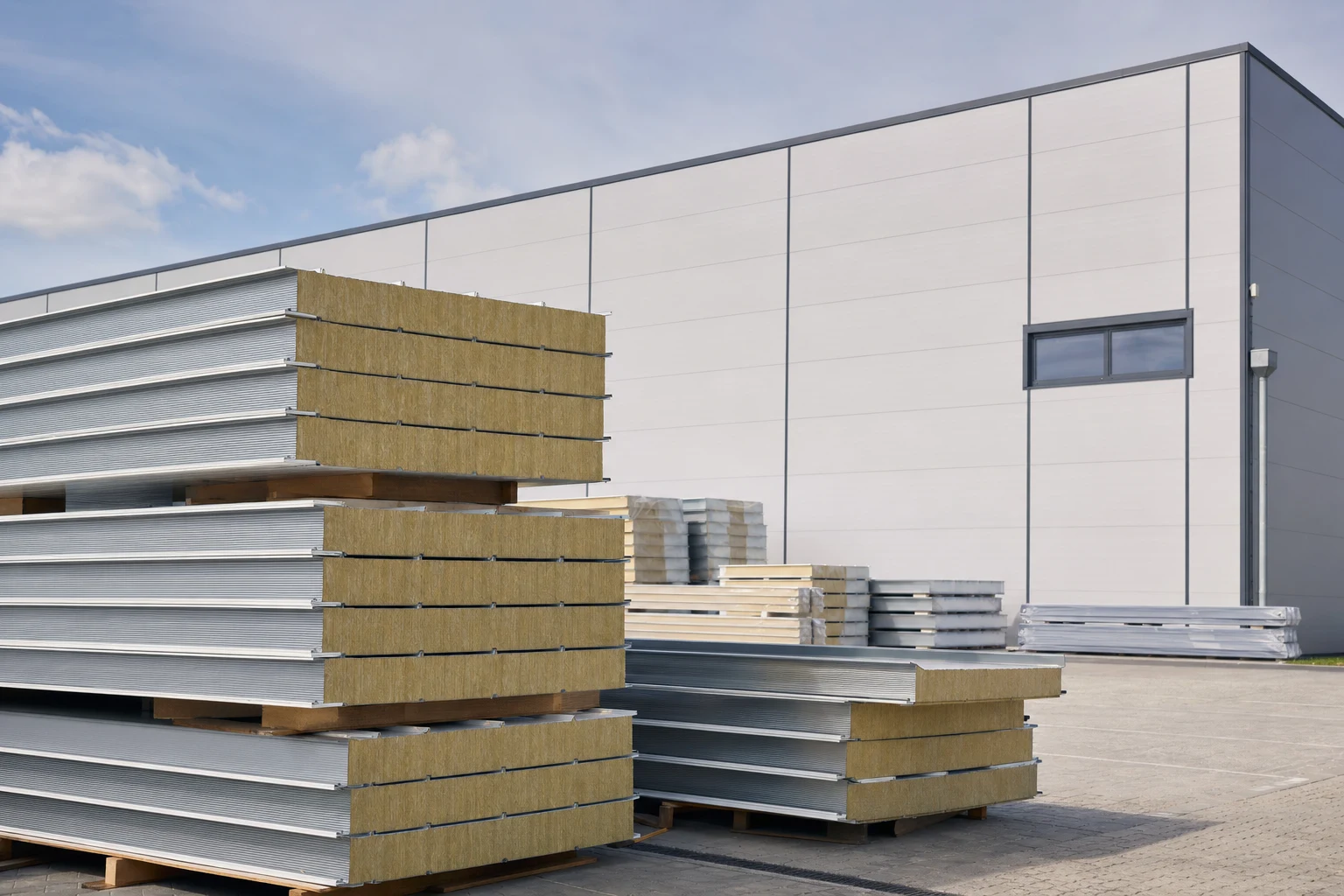
The structure is simple: a steel frame, wall sandwich panels for the envelope and roof panels with a trapezoidal profile for the covering. The same logic as for a car garage — we described it step by step — only on a larger scale and with a taller gate. In a typical machinery hall a PIR core is entirely sufficient; reaching for heavier solutions only makes sense when the fire protection design demands it. You will find a broader overview of solutions for farms in the guide to sandwich panels in agricultural construction.
And the budget? A machinery hall is a farm outbuilding — nobody is going to judge the shade of the coating on the wall facing the field. That makes it the perfect candidate for grade II sandwich panels: a full-value core and the same insulating parameters, while minor cosmetic facing flaws or non-standard lengths bring the price down. The difference you save is often enough to simply make the hall a few metres longer.
While you are at it, it is worth looking at the rest of the farm. If an asbestos-roofed barn still stands next to the future hall, it is sensible to combine both subjects into one plan — we wrote separately about the deadlines and replacements for asbestos roofing.
The final arithmetic is fairly short. A shelter costs less, but protects only against rain. An enclosed sandwich panel hall keeps the machines in a dry, bright interior, provides space for winter servicing, makes life harder for thieves and pleases the insurer. And what stands inside it is equipment whose value usually exceeds the cost of the envelope many times over.
🤝 Contact a BOKKA technical advisor — we will help select wall and roof panels for a machinery hall, design the gate opening for your combine and check whether grade II will lower the cost of your investment.
Sources:
- PN-EN 14509 — Self-supporting double skin metal faced insulating panels — Factory made products — Specifications
- PN-EN ISO 13788 — Hygrothermal performance of building components — Internal surface temperature to avoid critical surface humidity and interstitial condensation
- Technical catalogue and data sheets for GS insPIRe sandwich panels (Gór-Stal)
Frequently asked questions
Is a shelter enough for storing a combine?
How tall should the gate of a combine garage be?
Does a machinery hall have to be heated?
Are grade II sandwich panels suitable for a machinery hall?
Related products and systems
Read next
Płyta obornicka — what it is, and why it is simply a sandwich panel
Sandwich panels — thickness, dimensions and price. A buyer's guide
Car wash — building with sandwich panels and the cost of a moisture- and chemical-proof envelope