How to read DoP, ETA and AVCP certificate — a guide for designers and buyers
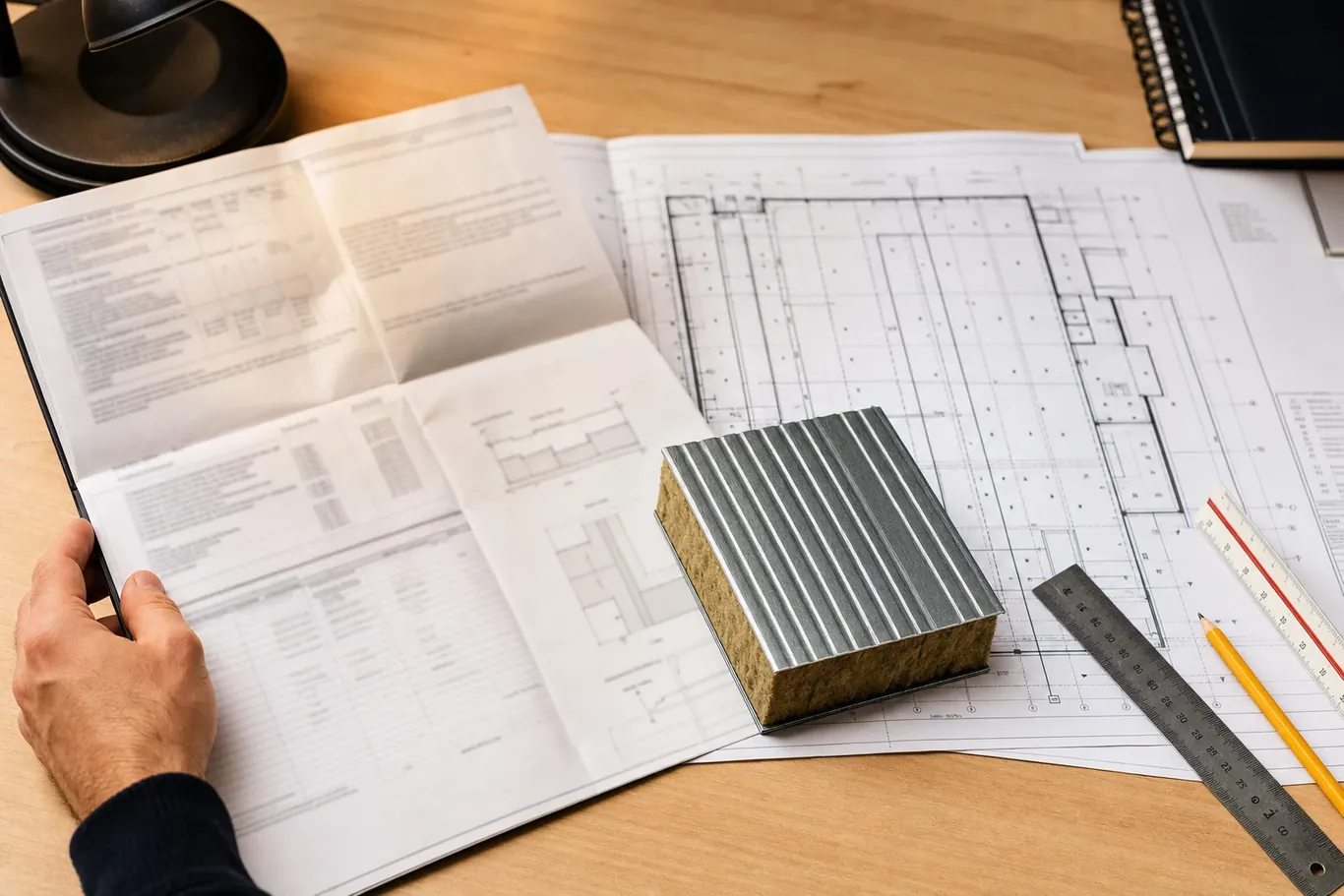
“What are all these papers?”
A designer is finishing the building design for a warehouse hall. He asks the distributor for complete technical documentation of the chosen product — termPIR® AL, 140 mm. The distributor sends a package of 8 PDFs:
- DoP no. termPIR/AL/18 (Declaration of Performance)
- Technical data sheet
- ETA-17/0066 (European Technical Assessment)
- AVCP certificate system 1 (1487-CPR-174-02)
- PZH hygiene certificate (HK/B/0123/02/2024)
- Fire classification CR-XXX (GryfitLab)
- BROOF(t1) data sheet
- REI 60 sloped roof data sheet (LBO-137-KZ/25)
What does each of these documents mean? Which is the most important? What’s missing? How to verify authenticity?
The question comes back with every delivery and with many investors. In this guide we’ll show how to read each of these documents step by step, how to verify them and when one is absolutely required, and when it’s just a bonus.
CPR 305/2011 — the foundation of the European system
It all starts with Regulation (EU) No 305/2011 of the European Parliament and of the Council of 9 March 2011, known as CPR (Construction Products Regulation). It has been in force since 1 July 2013 and replaced Directive 89/106/EEC on construction products.
What CPR introduced:
- CE marking for construction products covered by a harmonised European standard (e.g. EN 14509 for sandwich panels, EN 13165 for PIR boards)
- DoP (Declaration of Performance) — a required document accompanying every CE-marked product
- AVCP system (Assessment and Verification of Constancy of Performance) — conformity assessment procedures in 5 systems (1+, 1, 2+, 3, 4)
- ETA (European Technical Assessment) — an alternative route for products without a harmonised standard
CE is not a “quality certificate” — it’s formal information that the manufacturer has carried out the AVCP procedure in accordance with the relevant technical specification and makes the DoP available. You buy a product with CE = you have access to the DoP.
DoP — Declaration of Performance
DoP = the most important document for any construction product with CE marking. The manufacturer must make it available free of charge in electronic or paper form.
What DoP contains
The DoP template under CPR 305/2011 Annex III has 7 mandatory sections:
- Unique identification code of the product type — e.g. “termPIR/AL/18” (product code + DoP revision number)
- Type, batch or serial number or any other element identifying the product
- Intended use — e.g. “Thermal insulation in buildings” (in accordance with the harmonised standard)
- Name, registered trade name and contact address of the manufacturer
- Authorised representative (if different from the manufacturer)
- AVCP system (number 1+, 1, 2+, 3 or 4) + notified body details (e.g. “ITB 1488”, “IMBiGS 1454”, “ICiMB 1487”)
- Table of declared parameters — e.g. λD, reaction-to-fire class, strength, density, R-values per thickness
Plus two elements:
- Reference to the harmonised standard (EN 13165:2012+A2:2016 for PIR, EN 14509:2013 for sandwich panels)
- Date of issue, signature of the manufacturer’s authorised person
What you CAN read from a DoP
| DoP field | What it means in practice |
|---|---|
| Type code | Product identity — must match the packaging and delivery note |
| Harmonised standard | EN 13165 = PIR, EN 14509 = sandwich panel, EN 13164 = XPS, EN 13162 = mineral wool |
| Notified body number | 4-digit ID + acronym (e.g. “ITB 1488”) — you can verify in NANDO |
| AVCP system | 1+ / 1 = highest rigour, 3 = typical for PIR, 4 = lowest |
| λD | Thermal conductivity coefficient [W/(m·K)] — typically 0.022 for PIR with Al foil |
| Reaction-to-fire class | A1/A2-s1 d0/B-s1 d0/C/D/E/F per EN 13501-1 |
| Compressive strength | CS(10/Y)X — e.g. “CS(10/Y)120” = 120 kPa at 10% deformation |
| Diffusion coefficient µ | ”MU 100” or “Z 5-100” for gas-tight facings |
| Water absorption WL(T)X | WL(T)2 = ≤2% by volume |
| R-values | Thermal resistance per thickness — typically a table 20-250 mm |
What DoP does NOT contain (and this is important)
- REI/EI fire resistance classification — this is a separate document (classification from a notified body). DoP only has reaction-to-fire class (how the material ignites), NOT system resistance (how long a wall will withstand).
- BROOF(t1) — also a separate classification, not in DoP
- PZH hygiene certificate — a Polish hygiene document, national, voluntary
- Installation conditions — DoP tells you “WHAT the product can do”, not “HOW to install it”
- Ecological aspects (LCA, EPD) — separate Type III EPD declarations
How to verify a DoP
- Notified body number — check on the NANDO website (European Commission). Enter the number (e.g. 1488) → you’ll see the name, country, accreditations.
- DoP currency — the manufacturer regularly updates the revision number (DoP/18 → DoP/19) when something changes in the product. Check that you have the latest one.
- Consistency with packaging — type code on DoP = code on the pallet/product label = code on the delivery invoice.
- Online — the manufacturer must make the DoP available free of charge online. No DoP on the internet = a warning sign.
ETA — European Technical Assessment
ETA is an alternative route for products for which no harmonised European standard exists or the product does not fully fit within an existing standard.
For PIR boards and sandwich panels:
- EN 13165 and EN 14509 are harmonised standards — a DoP under them is sufficient
- ETA is additionally issued for applications such as ETICS (External Thermal Insulation Composite System for external walls)
- e.g. ETA-17/0066 for termPIR® ETX for the ETICS system
ETA is issued by a TAB (Technical Assessment Body) — in Poland this is the Building Research Institute (ITB).
When ETA is required
- An ETICS system requires ETA for every component in the system (board + adhesive + mesh + render)
- Non-standard constructions (e.g. a new type of fastener, non-standard dimensions)
- Special applications (e.g. industrial installations, ventilated façades with a specific profile)
An ETA for PIR is a longer document (50-150 pages) containing:
- A full description of the product
- All technical parameters (like a DoP, but broader)
- Design and calculation assumptions for the whole system (e.g. for ETICS: maximum height, anchor type, fastener density, bonding, renders)
- Installation requirements
- Declared durability (e.g. “25 years for typical climatic conditions”)
How to read an ETA
The most important sections:
- Section 1 — Product definition — what it is, for what application
- Section 2 — Technical specification — dimensions, materials, core, facings
- Section 3 — Properties (like DoP, but in more detail)
- Section 4 — Calculation and design assumptions — key for the designer
- Section 5 — Installation guidelines — what MUST be met for the ETA to apply
- Section 6 — Packaging and transport
ETA = a design document
For a designer of an ETICS system on PIR — ETA is the reference document in the project’s technical description. Write: “ETICS system on termPIR® ETX in accordance with ETA-17/0066, adhesive XYZ, mesh ABC, render DEF”.
The contractor then has a precise recipe — and classifications (thermal, fire) remain valid only if installation complies with the ETA.
AVCP — Assessment and Verification of Constancy of Performance system
AVCP = the procedure by which it is verified that the declared product parameters are stable throughout production.
CPR 305/2011 defines 5 AVCP systems with different levels of control:
| System | Who controls | For which products |
|---|---|---|
| 1+ | Notified body + production audits + tests of samples taken from the market | Most rigorous: load-bearing structures, fire doors, cement |
| 1 | Notified body + production audits (without tests of samples from the market) | Fire safety (reaction class), critical products |
| 2+ | Notified body + FPC audit (Factory Production Control), without own sample tests | Sandwich panels (EN 14509), PIR boards (EN 13165), mineral wool |
| 3 | Manufacturer (FPC) + notified body performs initial type tests | Products stable in time (some properties) |
| 4 | Only the manufacturer (own FPC) | Least restrictive: internal, acoustic insulation |
AVCP1 for sandwich panels — what exactly it certifies
For BOKKA products (sandwich panels GS insPIRe, GS MW QA) the AVCP1 certificate (e.g. 1487-CPR-174-02 from ICiMB) confirms:
- The reaction-to-fire class (Euroclass: A1, A2-s1 d0, B-s1 d0, C, D, E, F) is durable throughout production
- The manufacturer has production control (FPC) audited by a notified body (ICiMB, ITB, IMBiGS, etc.)
- Tests are performed regularly
AVCP1 does NOT certify:
- λD (this is system 3 — manufacturer + one-off type test)
- Mechanical strength (system 3)
- Dimensions (system 4 — manufacturer’s own control)
So one product can have several AVCP systems for different properties. For a typical sandwich panel:
- System 1 for reaction to fire
- System 3 for thermal and mechanical
- System 4 for dimensions
The AVCP1 certificate number has the format: {NB_NUMBER}-CPR-{CONTRACT_NUMBER} (e.g. 1487-CPR-174-02 = ICiMB no. 1487, contract 174, revision 02).
How to verify an AVCP certificate
- Notified body number — on the NANDO website (as for DoP)
- Issue date + validity — typically 3-5 years, then requires renewal (FPC re-audit)
- Consistency with DoP — the AVCP system in the DoP must match the certificate (both contain the NB number and system)
- Scope of the certificate — some certificates cover only some product variants, check whether your variant is covered
PZH hygiene certificate — a national hygiene document
PZH hygiene certificate = a Polish voluntary document issued by the National Institute of Public Health (NIZP-PZH). It confirms that the material:
- Does not introduce harmful substances into the environment
- Can be used in rooms inhabited by people
- Meets Polish standards regarding VOC emissions, formaldehydes, heavy metals
Is PZH a legal requirement?
No. CPR 305/2011 is a European act, the PZH hygiene certificate is a Polish addition. But:
- Many public tenders in PL require a PZH certificate in the specification
- Private investors often expect it (especially for single-family houses, schools, hospitals)
- Building shops and chains (Castorama, Leroy Merlin, OBI) require PZH for indoor materials
The certificate number has the format: HK/B/XXXX/MM/YYYY or similar. The validity period is typically 5 years.
REI/EI fire classification — a separate document!
This is most often confused: the designer looks at the DoP, sees “reaction class E (50-250 mm)” and thinks “I have EI 30”. No!
- Reaction to fire (EN 13501-1) → describes how the material behaves in the first phase of a fire (ignitability, smoke, flaming droplets). Classes A1, A2, B, C, D, E, F. In DoP.
- Fire resistance (EN 13501-2) → describes how long the entire structural element (wall, floor, roof) meets the R (load-bearing capacity), E (integrity), I (insulation) criteria. Classes REI 30/60/120… NOT in DoP, separate classification document.
REI/EI classification is issued as:
- Fire classification (e.g.
LBO-137-KZ/25from GryfitLab,FIRES-CR-XXXfrom FIRES,LZP01-XXXX/YY/Z00NPfrom ITB) - Specific test conditions: span, fastening, direction, joint seal
- Field of application = the scope within which the result applies
More in our article: EI 120 from a sandwich panel — under what condition?
Checklist: what MUST be there, what’s GOOD to have
Mandatory for every delivery
✅ DoP (Declaration of Performance) — without this, CE is formally empty ✅ Data sheet (technical) — product description, parameters, conditions of use ✅ PZH hygiene certificate — if required in the project (public, educational, hospitals)
Required for specific applications
✅ ETA — for the ETICS system (boards + adhesive + mesh + render) ✅ REI/EI classification — when the project requires specific fire resistance ✅ BROOF(t1) — for a roof with a specific non-fire-propagating class ✅ Hygiene certificate for water (PZH-NIZP for water) — if in contact with drinking water
Bonus / marketing
🎁 Type III EPD (Environmental Product Declaration) — LEED/BREEAM points 🎁 Keymark — European CE+ quality mark (voluntary, additional tests) 🎁 ISO 9001/14001 certificate — quality/environmental management system of the manufacturer 🎁 GreenGuard — low VOC emissions (mainly furniture + interior finishes)
Pitfalls — how to recognise suspicious documentation
Pitfall 1 — No DoP on the internet
CPR requires that the DoP be available free of charge online. If the manufacturer hides the DoP behind a login, an email to the sales department, or doesn’t make it available at all — a warning sign.
Remedy: search Google "DoP" "{product name}" filetype:pdf or "declaration of performance" "{manufacturer}".
Pitfall 2 — Notified body number doesn’t exist
Some manufacturers enter “1234” as a fictitious NB number. Check in NANDO — if it’s not there → a lie.
Remedy: verify every suspicious DoP in NANDO.
Pitfall 3 — Inconsistency between DoP and AVCP certificate
DoP says “AVCP system 2+, notified body 1488 (ITB)”. The AVCP certificate attached to the documentation has the number 1487. Doesn’t match. Either the DoP is fake, or the certificate is attached from another product (a seller’s mistake).
Remedy: NB number in DoP = NB number in AVCP certificate.
Pitfall 4 — Old DoP, new product
The manufacturer has changed the core composition (e.g. added R-eco recycling), released a new variant. The outdated DoP (from 2018) does not cover the new product. Any material change = new DoP.
Remedy: check the DoP issue date. If >3 years, ask the manufacturer for the current revision.
Pitfall 5 — No fire classification matching the project’s regime
The project requires REI 60 for a partition wall. The distributor provides a DoP (reaction class E) + PZH hygiene certificate + ISO certificate. No REI classification = no proof that the requirement is met.
Remedy: for REI/EI/BROOF requirements, demand a specific classification card issued by a notified body.
Pitfall 6 — ETA withdrawn
ETA is issued for a fixed period (5 years). The manufacturer may not renew it — then the old ETA loses validity. Check the validity date + status (UEAtc has a register of active ETAs).
Remedy: ETA-XX/YYYY → check in UEAtc whether it is active.
What BOKKA provides
We are a direct distributor of termPIR®, GS insPIRe and GS MW panels. Full documentation for each product is available on request as part of the delivery package:
- DoP + data sheet + PZH hygiene certificate — standard with every delivery
- ETA — for termPIR® ETX (ETICS system), termPIR® ETX-R-eco
- AVCP1 certificate from notified bodies ICiMB, ITB, IMBiGS — for all variants with a fire reaction class
- REI/EI/BROOF classifications — for the specific configuration of your project (on request)
In practice, if you have doubts about any document (authenticity, scope, validity) — send us a scan, we’ll verify it within 24h.
Your technical contacts:
🤝 Free technical consultation with BOKKA — we will help you select the product and complete documentation for your project.
Summary
A technical documentation package looks overwhelming, but each document has a clear purpose:
| Document | What it confirms | Requirement |
|---|---|---|
| DoP | Product parameters + AVCP system | Always (CPR 305/2011) |
| Data sheet | Description + conditions of use | Always (standard) |
| ETA | System (e.g. ETICS) | Only for systems |
| AVCP1 | Constancy of fire reaction class | For products with a fire class |
| PZH hygiene certificate | Hygiene | National PL requirement (voluntary) |
| REI/EI/BROOF classification | Resistance of the structural system | When the project requires a specific class |
| EPD | Environment (LCA) | Bonus for LEED/BREEAM |
A practical rule: DoP + data sheet = the minimum for every delivery. Fire classifications = separately for each requirement in the project. ETA = for ETICS systems.
In case of doubts about a specific document — get in touch. Free verification of authenticity and scope of documents.
Sources and legal basis:
- Regulation (EU) No 305/2011 of the European Parliament and of the Council — Construction Products Regulation (CPR)
- PN-EN 13165:2012+A2:2016 — Thermal insulation products for buildings — Polyurethane (PIR/PUR) products
- PN-EN 14509:2013 — Self-supporting double skin metal faced insulating sandwich panels
- PN-EN 13501-1:2018 — Fire classification — Reaction to fire
- PN-EN 13501-2:2023-09 — Fire classification — Fire resistance
- ETAG 004 — Guidelines for ETICS (External Thermal Insulation Composite Systems)
- NANDO database (European Commission): https://ec.europa.eu/growth/tools-databases/nando/
- EOTA (European Organisation for Technical Assessment): https://www.eota.eu/
Frequently asked questions
Does DoP have to be in Polish?
Does CE exist without DoP?
What if the manufacturer refuses to provide the DoP?
Does DoP replace technical approvals (AT)?
Can the same product have a DoP from two manufacturers?
Does a DoP have to be signed by hand?
After how long must the manufacturer issue a new DoP?
Can a manufacturer issue a DoP for a product that has not been tested?
Related products and systems
Read next
Reaction-to-Fire Euroclasses A1/A2/B/C/D/E/F — What They Mean in Design Practice
1000 m² Warehouse — termPIR® or Sandwich Panels? Cost, Time, Operation Comparison

EPD and carbon footprint of sandwich panels and PIR — ESG in construction