Details and plinths in cold stores and freezers — floor, corner and door junctions
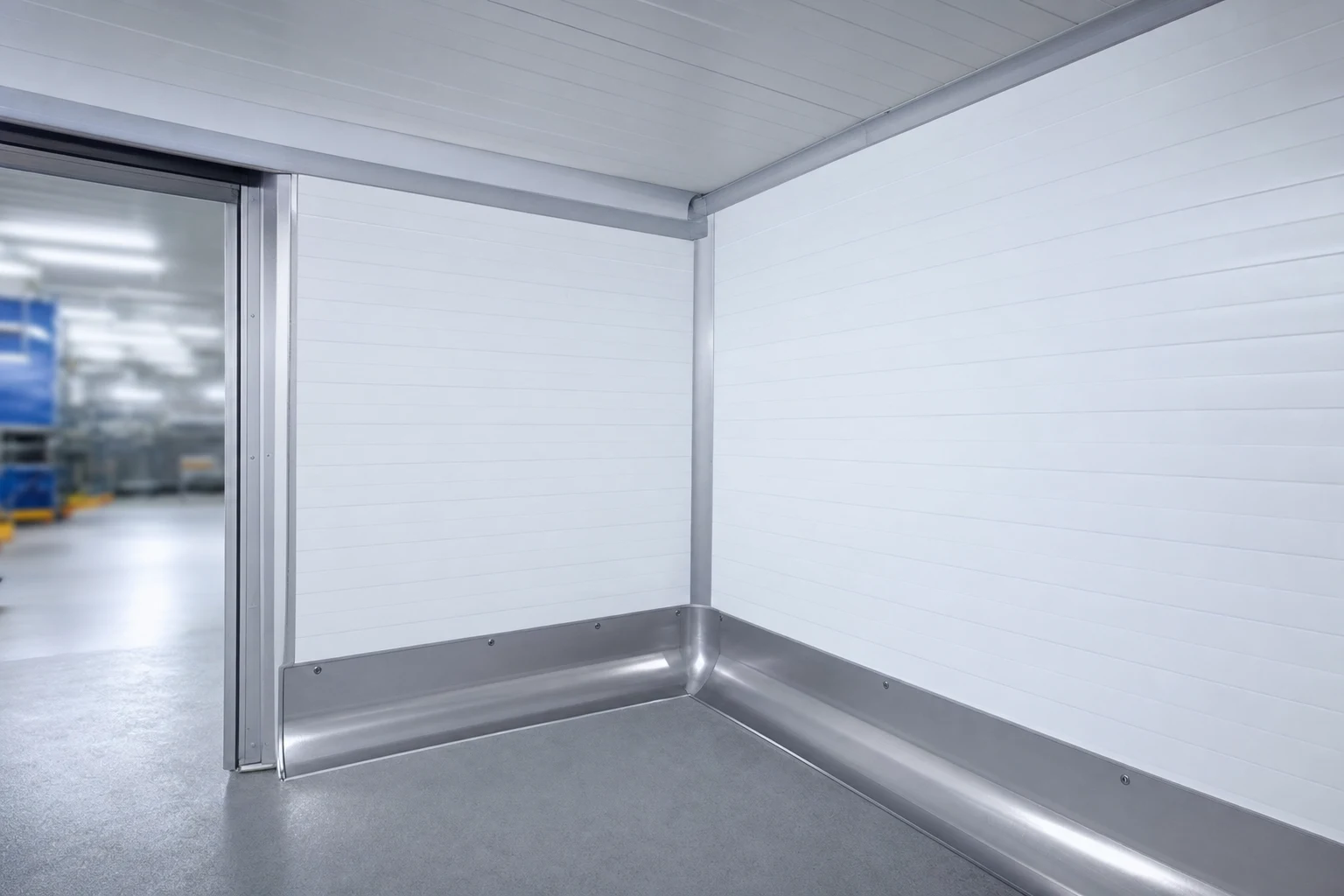
On the selection of panels for cold stores and freezers from the insPIRe CH line we have already written from the perspective of the wall layout, temperatures and core thickness. But the durability and efficiency of a cold-store chamber are decided by something that is not visible on the plan: the details and junctions. It is in the plinths, corners, wall-to-ceiling connections and door reveals that thermal bridges, condensation and places of contamination most often arise. This article is a deepening of the subject — a guide to the key details of thermal tightness and hygiene in a cold store and freezer built from sandwich panels.
Why details decide the quality of the chamber
The sandwich panel as such has excellent parameters — a continuous core insulation and smooth, non-absorbent facings. The problem is that a cold-store chamber is not made of flat panels alone. It is made of connections: wall to floor, wall to wall, wall to ceiling, door openings, service penetrations. At each of these places the continuity of insulation and vapour control can be broken.
The consequences of a poorly resolved junction in a cold store are severe: escape of cold (higher energy costs), condensation of water vapour (and in a freezer — frosting and icing), corrosion of steel elements, and places that cannot be cleaned effectively. That is why, in the design of a cold-store chamber, the details are treated as seriously as the selection of the panels themselves.
Plinth and the wall-to-floor junction
This is the hardest junction of the whole chamber. Three requirements meet here at once: continuity of thermal insulation (the cold-store floor is insulated too), transfer of mechanical loads from the movement of trucks and pallets, and full hygienic tightness.
The plinth is therefore designed as a separate, considered detail, not an ordinary closing of the wall to the floor. In practice this means:
- Continuity of insulation between the wall insulation and the floor insulation — without a gap through which cold would escape and a bridge would form.
- A durable, washable plinth protecting the lower edge of the wall panel from truck impacts and from water during washing.
- A tight, non-absorbent sealing of the junction with a fall that aids rinsing, so that water does not stand at the base of the wall.
A well-made plinth decides whether the lower band of the wall will serve for years or will begin to corrode and condense from the floor side. It is also the most frequent place of complaints in poorly designed chambers — which is why it is worth designing it together with the panel supplier.
It is also worth remembering that the chamber floor works under the movement of forklift and pallet trucks. The lower edge of the wall and the plinth must withstand impacts and edge loads, which is why reinforced and abrasion-resistant solutions are used here. Combining the thermal, mechanical and hygienic requirements in a single junction means that the plinth is a detail that cannot be resolved “on site” without prior thought.
Corners and wall-to-ceiling transitions
In a room under a sanitary regime, sharp angles are the enemy of hygiene — dirt gathers in them and they are hard to wash. That is why coved (radiused) corners are used in cold-store chambers: rounded wall-to-wall and wall-to-ceiling transitions. The benefit is twofold — easier rinsing and disinfection, and better continuity of insulation in the corner, where local weakening of the assembly is easiest.
The wall-to-ceiling connection requires separate attention, because it is often a suspended ceiling of sandwich panels of considerable span. The junction must ensure continuity of insulation and vapour control and carry the weight of the ceiling, while remaining tight. The method of suspension and the flashing of this junction are matched to the span and loads of the chamber.
Reveals of cold-store doors
A door is by nature a break in the continuous, insulated envelope — and at the same time a place of the most intensive use. The reveal of a cold-store door must:
- keep the continuity of insulation around the whole opening, so that the frame does not become a perimeter thermal bridge,
- transfer the loads from the heavy, often sliding leaves of freezer doors,
- remain tight — with correctly selected gaskets, and in a freezer also with protection against frosting in the threshold zone (e.g. a heated edge).
The threshold is often underestimated: in a freezer it is the place where cold meets the warmer floor of the adjacent room, which favours condensation and icing. The resolution of the threshold and any of its heating is designed together with the rest of the floor junction.
Thermal bridges and vapour control
Two concepts tie together all the details above: continuity of insulation (no thermal bridges) and continuity of the vapour barrier (vapour control).
A thermal bridge is any place of locally poorer insulation — a steel element passing through, a gap in the core, a careless junction. In a cold store a bridge means an escape of cold and a point of condensation; in a freezer additionally frosting, icing and the risk of corrosion. Designing the junctions consists, to a large extent, precisely of leading the insulation without interruption through corners, plinths and reveals.
Vapour control is crucial in a cold-store chamber, because water vapour always travels from the warmer side (outside) to the cooler interior. If on this path it meets a cold surface inside the assembly, it will condense — and in a freezer it will freeze inside the structure. That is why the vapour barrier must be continuous and tight on the warmer side, and all joints, penetrations and panel connections carefully sealed. This is one of the main reasons why smooth, non-absorbent facings and tight panel locks are preferred in cold-store chambers.
Service penetrations and fixings
A cold-store chamber is not a box without openings. Refrigerant pipelines, condensate drains, electrical and control installations pass through the assemblies, and evaporators and fittings are fixed inside. Every penetration and every fixing is a potential weakening of the insulation and a place of condensation.
That is why service penetrations are planned and flashed just as carefully as the structural junctions: keeping continuity of insulation and vapour control around the pipe, and with a tight, non-absorbent seal. Heavier elements (evaporators, ducts) should not be fixed at random — the loads are transferred to the load-bearing structure, not to the panel core itself, so as not to deform and unseal the assembly. The fewer the random penetrations and the better flashed the necessary ones, the more efficiently and longer the chamber works.
Under-slab heating and ground protection
In freezers at sub-zero temperatures a problem appears that does not exist in above-zero cold stores: freezing of the ground beneath the floor. Freezing water in the ground increases in volume and can heave the floor, damaging the structure of the chamber. That is why protection against freezing is used beneath a freezer floor — most often under-slab heating or a ventilated void cutting off the cold from the ground.
This is a purely design solution: the scope, type and power of the protection are set by the designer on the basis of the chamber temperature, the ground conditions and the foundation method. From the point of view of the sandwich-panel envelope, it is important that this system is consistent with the plinth junction — the floor insulation, the ground protection and the wall plinth must form one continuous whole.
Panel selection and design support
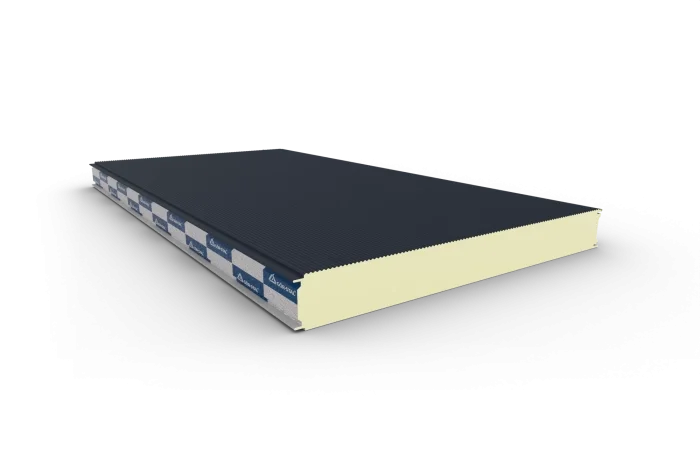
Details are only as good as the panels they join. For cold-store chambers and freezers, dedicated variants from the controlled-temperature line are used — insPIRe CH, and for larger spans and thicknesses the reinforced variants. The full range of PIR sandwich panels is available in the product catalogue. The selection of core thickness, variant and the way the junctions are resolved depends on the chamber temperature, its geometry and loads — which is why cold-store chambers are designed individually.
It is also worth remembering that in some cold stores and freezers the atmosphere is additionally aggressive (moisture, chemicals), which translates into selecting the facing for corrosivity — we described this in the post on a facing for a C5 environment.
Summary
In a cold store and freezer the quality of the envelope is decided by the details: the plinth and the wall-to-floor junction, the coved corners, the wall-to-ceiling connection and the door reveals. All are subordinated to two principles — continuity of insulation (no thermal bridges) and continuity of the vapour barrier (vapour control on the warmer side) — supplemented by hygiene and, in a freezer, protection of the ground against freezing. Well-resolved junctions mean lower energy costs, no condensation or icing, and a chamber that can be effectively washed and that will serve for years.
🤝 Contact a BOKKA technical adviser — we will help select panels for a cold-store chamber and indicate the correct resolutions of the junctions, plinths and reveals.
Sources:
- Technical data sheets and installation guidelines of GS insPIRe CH sandwich panels (manufactured by Gór-Stal, distributed by BOKKA)
- Principles of designing cold-store assemblies: continuity of insulation and vapour control (general guidelines)
- EN ISO 12944-2 — Corrosivity categories of atmospheres (selection of facing in an aggressive environment)
Frequently asked questions
Why is the plinth in a cold store so important?
Why are coved (radiused) corners used in cold-store chambers?
What does a thermal bridge threaten in a freezer?
Is under-slab heating needed in a freezer?
Related products and systems
Read next

Cold Store / Freezer with GS insPIRe CH — Wall Build-Up for -30°C
Sandwich panels second grade — what it exactly means and when it makes sense

Fruit and vegetable storage — how to build the envelope from cold store sandwich panels