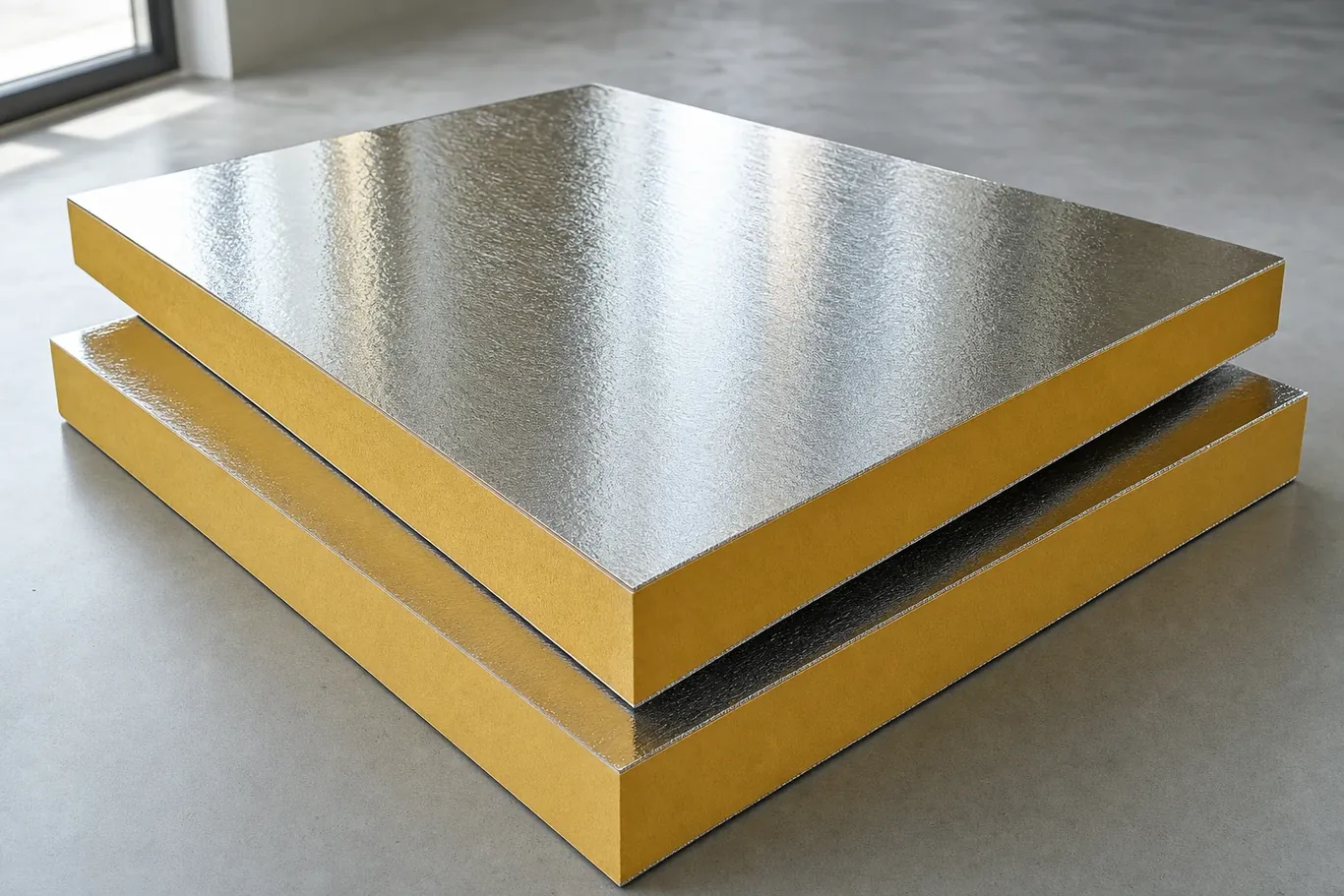
Passive house — termPIR over-rafter system for EUco 15 kWh/m²/year
What “passive house” means
In short: a house that consumes a maximum of 15 kWh/m²/year of energy for heating. The standard was set by the Passive House Institute (PHI) in Darmstadt in 1990. For comparison:
- Typical house per WT 2021: 60–80 kWh/m²/year
- NF40 (energy-efficient): 40 kWh/m²/year
- NF15 / passive: ≤15 kWh/m²/year
- Plus-energy: ≤0 kWh/m²/year (produces more than it consumes)
15 kWh is roughly the energy of 1.5 litres of heating oil per m² per year. For a 150 m² house = 225 l of oil/year. In reality, a passive house barely needs heating — the sun heats it + heat recovery from the ventilation unit + body heat.
To achieve this standard, every building envelope element (roof, wall, floor, window) must meet rigorous U-value requirements. Here we show how to do it in the roof using termPIR®.
Roof requirements for the passive standard
PHI Darmstadt recommends:
| Building element | U max (passive) |
|---|---|
| Roof | 0.10 W/(m²·K) |
| External wall | 0.12 W/(m²·K) |
| Floor on ground | 0.12 W/(m²·K) |
| Window (full assembly with frame) | 0.80 W/(m²·K) |
| External doors | 0.80 W/(m²·K) |
For comparison, WT 2021 for the roof = 0.15 W/(m²·K) — the passive standard is 33% stricter.
What does that mean in terms of insulation thickness?
U = 1 / (R + R_other_layers) ≈ 1 / R (the insulation layer dominates). Hence for U = 0.10 → R ≥ 10 m²·K/W.
Insulation thickness for R = 10:
- Mineral wool (λD 0.036): 360 mm = 36 cm
- EPS (λD 0.038): 380 mm = 38 cm
- PIR with Al foil (λD 0.022): 220 mm
- PIR MAX 19 (λD 0.019): 190 mm
So PIR saves ~15 cm of thickness for the same R standard. That’s a lot when you’re designing a rafter structure — the difference between 24 cm and 36 cm rafters means significant money and structural weight.
Why over-rafter = king for a passive house
In a typical pitched roof you have 3 insulation systems:
- Between-rafter — insulation inside the structure. Plus: doesn’t increase roof height. Minus: thermal bridges across the rafters (wood has λD 0.16 — 7× worse than PIR). The roof U drops by 10–15% due to the rafters.
- Under-rafter — insulation under the rafters on the interior side. Plus: an additional layer that eliminates bridges. Minus: reduces room height, vapour permeability requires attention.
- Over-rafter — insulation above the rafters (outside the structure), under the roof covering. Plus: zero thermal bridges (entire envelope homogeneous), anchor counter-battens can be fixed through the insulation. Minus: roof covering sits higher (+ insulation thickness), requires long screws.
For the passive standard, over-rafter is almost essential — without it, it’s hard to achieve U = 0.10 without internal additions that reduce room height.
A concrete system for EUco 15 kWh
Variant A — full over-rafter (simplest)
[roof tile / metal sheet]
[batten]
[counter-batten 80×40 mm]
[wind-tight membrane]
[termPIR® AL 220 mm  — over-rafter]        ← R 10.0
[wooden rafter 60×120 mm — not loaded with insulation]
[vapour-permeable foil]
[steel grid CD60 + 1× plasterboard 12.5 mm]
- Roof U-value: 0.10 W/(m²·K) ✓ passive
- Rafter height: 120 mm (small, as it doesn’t carry insulation)
- Total envelope height: ~400 mm (220 insul + 120 rafter + ~60 rest)
- Thermal bridges: zero (rafters below insulation)
Variant B — MAX 19 for a thinner envelope
[roof tile]
[batten + counter-batten 80×40]
[wind-tight membrane]
[termPIR® MAX 19 AL 190 mm  — over-rafter]    ← R 10.0
[rafter 60×120 mm]
[vapour-permeable foil]
[CD60 + plasterboard 12.5 mm]
- Roof U-value: 0.10 W/(m²·K) ✓ passive
- Thickness saving: 30 mm vs Variant A
- Cost: +25–35% for insulation (MAX 19 is more expensive than AL)
- When it makes sense: when the designer has limited ridge height or wants to preserve aesthetic roof proportions
Variant C — hybrid (between-rafter + over-rafter)
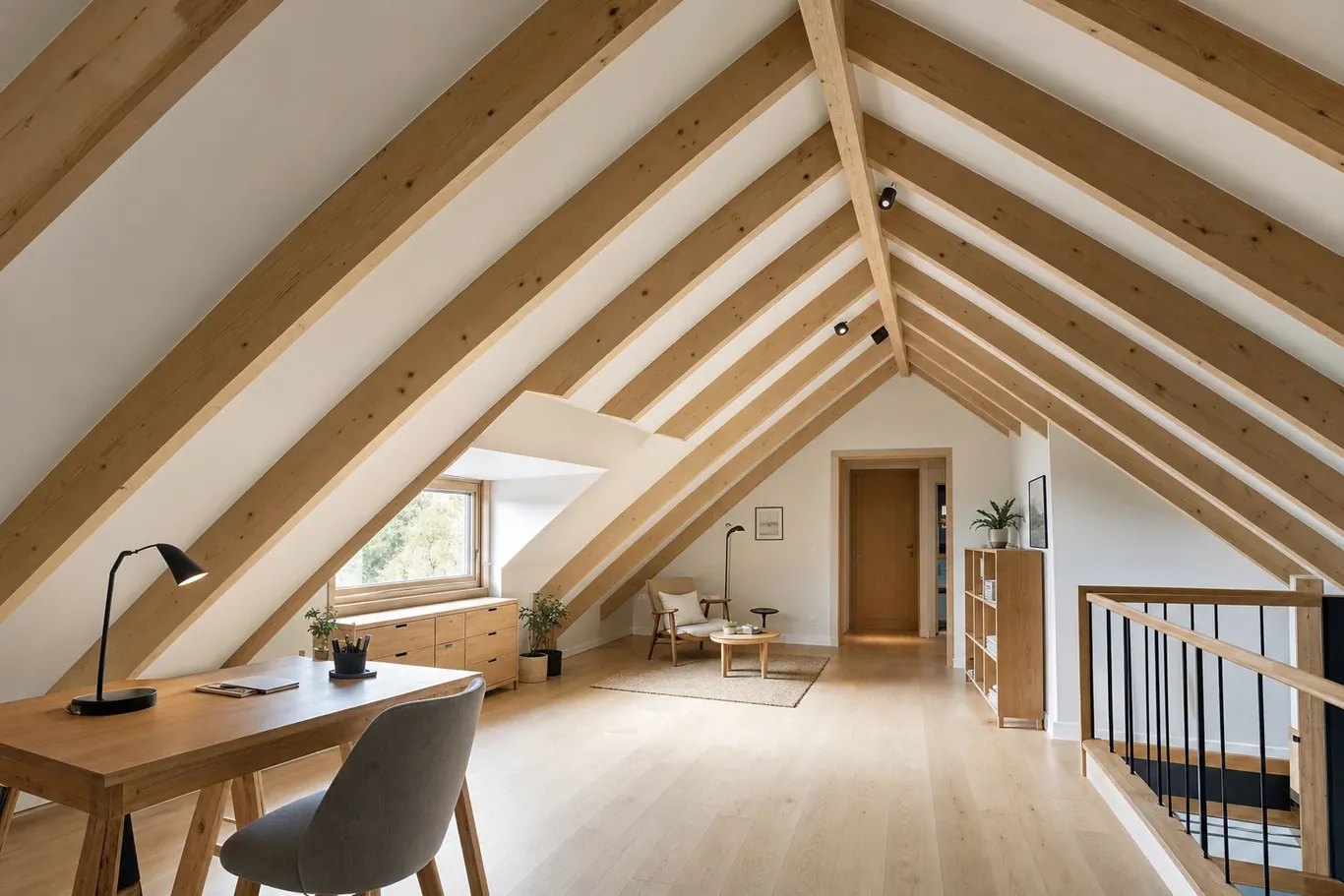
Sometimes the designer wants to keep rafters visible inside (highlander or loft aesthetic):
[roof tile]
[batten + counter-batten 80×40]
[wind-tight membrane]
[termPIR® AL 140 mm  — over-rafter]        ← R 6.4
[rafter 60×220 mm visible inside]
[termPIR® AL 200 mm  — between rafters]   ← R 9.1 (with addition)
[vapour-permeable foil]
[visible pine boarding]
- Roof U-value: ~0.09 W/(m²·K) ✓ with margin
- Aesthetics: rafters visible inside (loft, highlander)
- Thermal bridges: minimised (most insulation above the rafters)
- Cost: higher (more PIR + thicker rafters), but visual effect
Cost example — house 150 m² floor area, pitched roof 220 m²
Variant A (classic passive, AL 220 mm over-rafter):
| Item | Quantity | Price (indicative) | Total |
|---|---|---|---|
| termPIR® AL 220 mm | 220 m² | PLN 130/m² | PLN 28,600 |
| Wind-tight membrane | 220 m² | PLN 18/m² | PLN 3,960 |
| Vapour-permeable foil | 220 m² | PLN 12/m² | PLN 2,640 |
| Counter-battens 80×40 (wood) | 220 m² | PLN 25/m² | PLN 5,500 |
| Telescopic screws 12×340 | 220 m² | PLN 18/m² | PLN 3,960 |
| Aluminium tapes (joint sealing) | set | — | PLN 850 |
| Materials total | ~PLN 45,500 | ||
| Labour (complex layout) | 220 m² | PLN 65/m² | PLN 14,300 |
| Total | ~PLN 59,800 |
The investor has a passive requirement in the design. A one-off investment of ~PLN 60k means:
- Annual heating energy use: for 150 m² × 15 kWh = 2,250 kWh/year
- Annual heating cost (electricity for a heat pump COP 4, price ~PLN 0.80/kWh): ~PLN 450/year
Compared with a WT 2021 house (60 kWh/m²/year) = annual use of 9,000 kWh, cost ~PLN 1,800/year. Savings of ~PLN 1,350/year.
Plus the thermal modernisation tax relief: up to PLN 53,000 × 2 people = PLN 106,000 of deductions. Real tax savings of ~PLN 12–34k. The investment pays back in 7–10 years, the roof lasts 30+ years.
Pitfalls when designing a passive roof
Pitfall 1 — Thermal bridges at the eaves
If the over-rafter insulation doesn’t extend beyond the rafters to the eaves, you get a thermal bridge (rafters sticking out through the insulation). Solution: a thermally insulating eaves beam or extending the PIR beyond the lower roof outline by min. 200 mm.
Pitfall 2 — Counter-batten fixings too short
The counter-batten must be fixed with a screw through the insulation into the rafter. For 220 mm PIR you need a screw of min. 240 mm (e.g. telescopic 12×260). Shorter = the roof covering will come off in the first storm.
Pitfall 3 — No joint sealing
Every joint between PIR boards = potential 5% loss of U-value. All joints must be sealed with BOKKA® aluminium tape. Also in corners, around roof windows, chimneys.
Pitfall 4 — Wrong membrane
For an over-rafter system you need a wind-tight + waterproof membrane (SD ≤ 0.3 m), not an ordinary roofing foil. A bad membrane = moisture in the insulation, performance drop.
Pitfall 5 — Sub-covering ventilation
Between the insulation (PIR) and the roof covering (tile) there must be a ventilation gap of 30–60 mm (maintained by counter-battens). Without it — condensation, wet insulation, durability problems.
What BOKKA provides for passive roofs
We have all the key termPIR® thicknesses for the passive standard in stock: 140, 160, 180, 200, 220, 250 mm. Plus all the accessories:
- Telescopic screws SX 12×220–340 mm
- Aluminium and butyl tapes for sealing joints
- Wind-tight and vapour-permeable membranes
- Technical advice: we calculate R for your passive envelope + select thickness for a specific U-value
🤝 Free BOKKA technical consultation — we’ll help select the product and complete documentation for your project.
Summary
A passive house in Poland is realistic and cost-effective — it requires a good design, a competent contractor and the right materials. The roof is the key envelope element (60–70% of heat loss in a typical house).
For the passive standard U = 0.10 W/(m²·K) you need:
- 220 mm termPIR® AL or 190 mm termPIR® MAX 19 over-rafter
- Rafters 120–140 mm (not loaded with insulation)
- Wind-tight membrane + sub-covering ventilation 30–60 mm
- Telescopic screws min. 240 mm
- Sealing of all joints with aluminium tape
An investment of ~PLN 60k for 220 m² of roof, payback through thermal modernisation relief + heating savings in 7–10 years. After that, pure savings for 30–50 years.
🤝 Free BOKKA technical consultation — we’ll help select the product and complete documentation for your project.
Sources:
- Passive House Institute (PHI Darmstadt) — technical requirements for the passive house
- Polish Institute of Passive Building and Renewable Energy (PIBP) — national certifications
- Regulation of the Minister of Infrastructure — Technical Conditions 2021 (standard comparison)
👉 Full range and technical specs: termPIR® PIR insulation boards.
Frequently asked questions
Is every termPIR® board suitable for a passive roof?
What if I have a mansard roof with dormers?
What PIR thickness for NF40 (energy-efficient, not passive)?
Can I achieve the passive standard with mineral wool?
Can a passive house design be certified?
Does building a passive house really pay back within the investor's lifetime?
Related products and systems
Read next
Over-rafter PIR Roof Insulation — Technical Guide
150 mm PIR board — what U-value it gives and where it really makes sense
PIR vs XPS — foundations, inverted roofs and ground floors