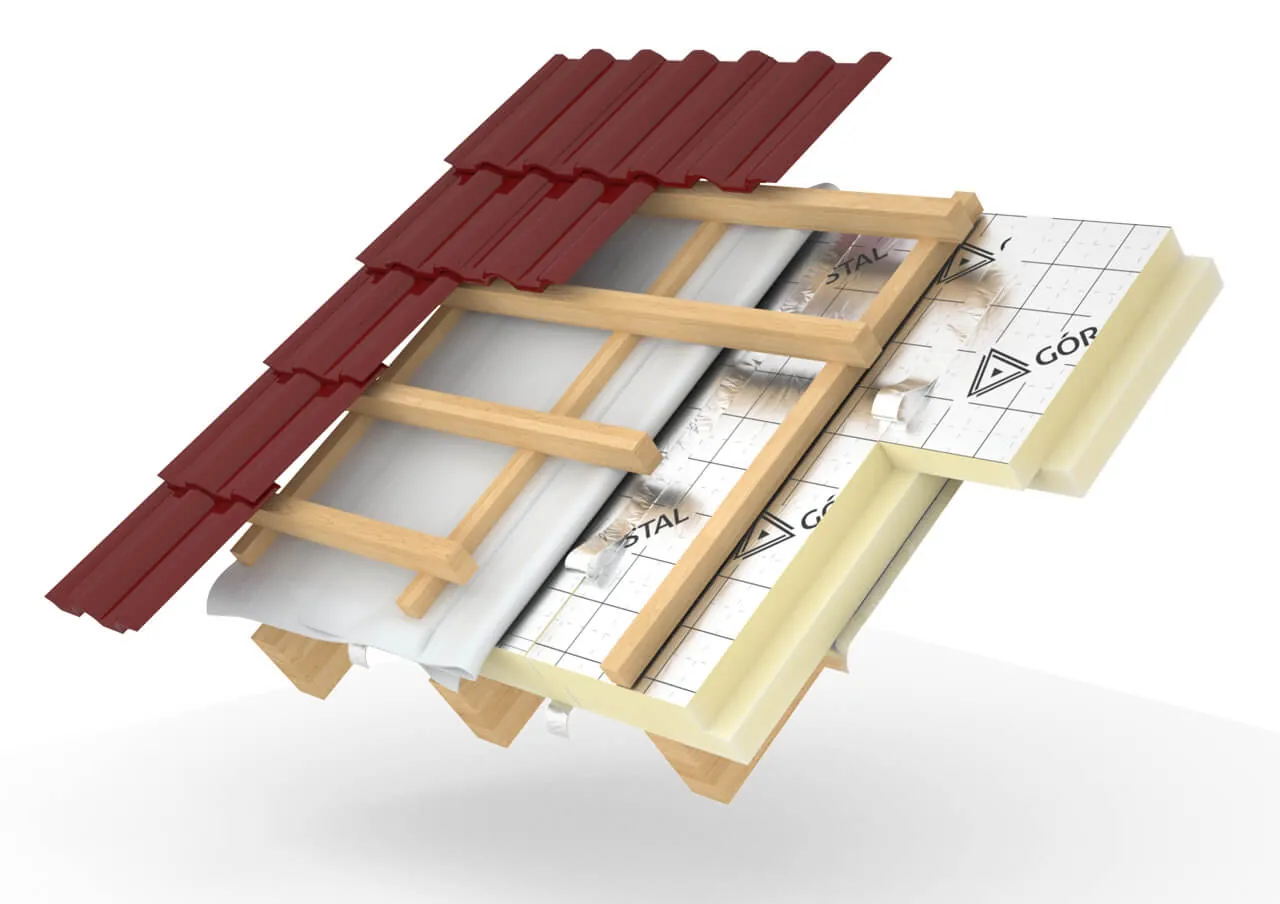
BROOF(t1) for PIR Roofs — 8 Proven Coverage Configurations + Test Conditions
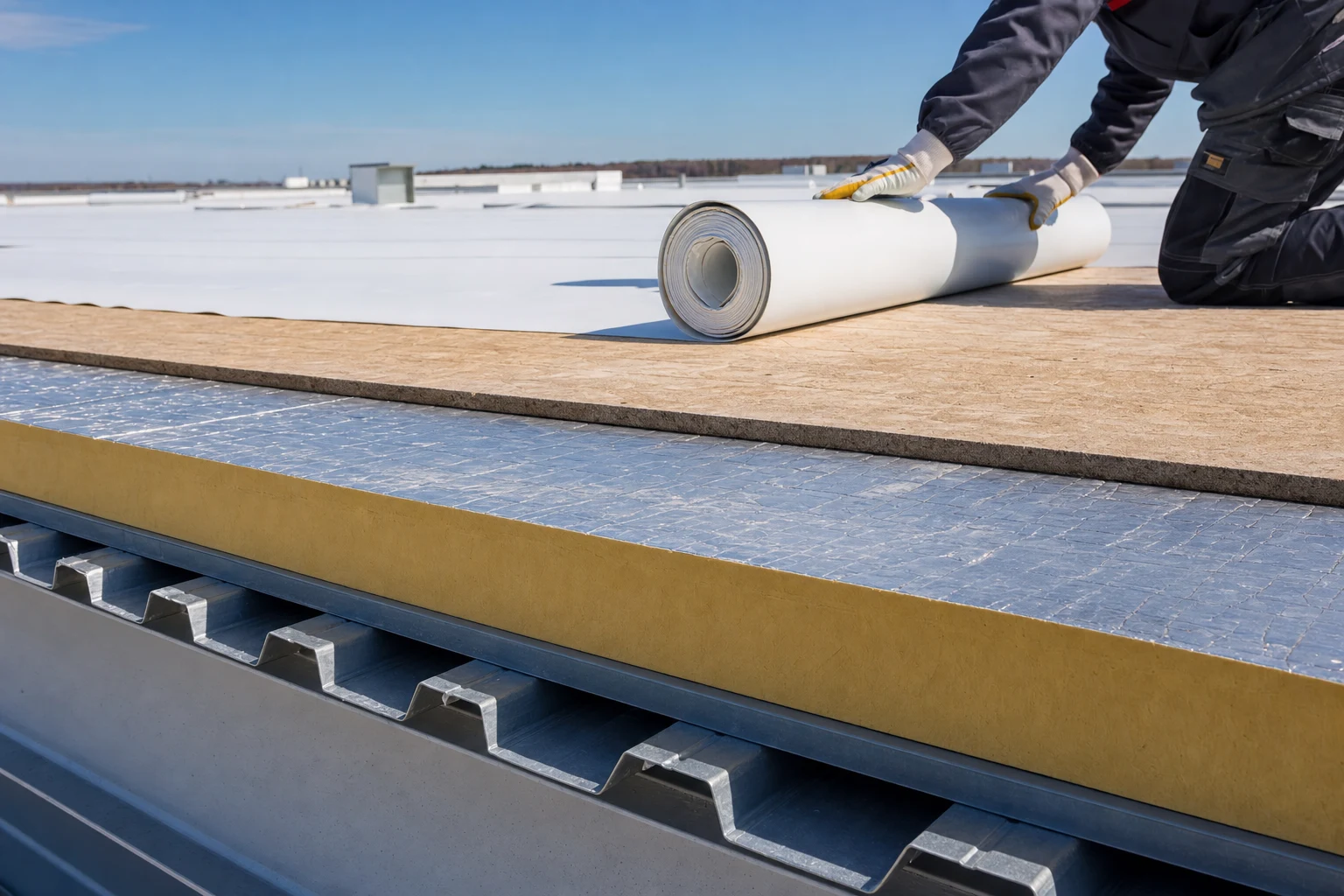
“Roof ready for BROOF(t1)” — what does it actually mean?
An investor orders a warehouse, the designer writes a BROOF(t1) requirement for the roof covering into the technical specification. The roofer receives termPIR boards from the distributor, buys a PVC membrane from the nearest builders’ merchant (because “that’s how I’ve always done it”), and installs it. During acceptance, the inspector asks about the BROOF classification for this combination — and it turns out the manufacturer’s test concerned a membrane from a different producer with a different chemical composition. The classification is formally invalid.
This is a typical scenario: BROOF(t1) from a PIR product data sheet is declared “for the system”, but on site the roofer swaps the covering or substrate and the external fire resistance class loses validity.
The good news: the PIR board manufacturer carries out tests for several specific combinations. You just need to know them and stick to the documentation. In this guide we show 8 proven configurations for termPIR + 4 typical coverings (PVC, TPO, EPDM, bitumen felt) with precise test conditions.
What is BROOF(t1) and when do we need it
BROOF = classification of roof resistance to external fire according to PN-EN 13501-5 (part 5 of the European fire classification). The whole roof system is tested for its reaction to a burning brand falling from above or carried by wind — simulating ignition from a neighbouring building or a spark from a chimney.
The classification has four test variants per CEN/TS 1187:
- t1 (method 1) — test with a burning wooden brand + 11 m/s wind, most commonly used in PL
- t2 (method 2) — brand + radiant heat + wind
- t3 (method 3) — brand + heat + wind + simulated rain
- t4 (method 4) — full two-sided laboratory test
In Poland the most commonly required minimum is BROOF(t1) — it covers most buildings with roof coverings.
When WT 2021 requires BROOF(t1)
The Ministry of Infrastructure regulation (Technical Conditions) §218 requires the roof fire resistance class NRO (non-fire spreading) for many types of buildings. For a roof, NRO compliance is documented through:
- BROOF(t1) or higher — per the European classification
- Or PN-B-02867 tests (national method, older, being withdrawn)
BROOF(t1) is required, among others, for:
- PM buildings (production and warehouse) fire resistance classes “B” and “C”
- Multi-storey ZL (collective residential) buildings
- Some agricultural IN buildings with combustible interiors
- Roofs less than 8 m from the boundary of a plot adjacent to a built-up area
The investor usually receives the requirement from the construction design. Check yours.
8 proven termPIR + covering configurations
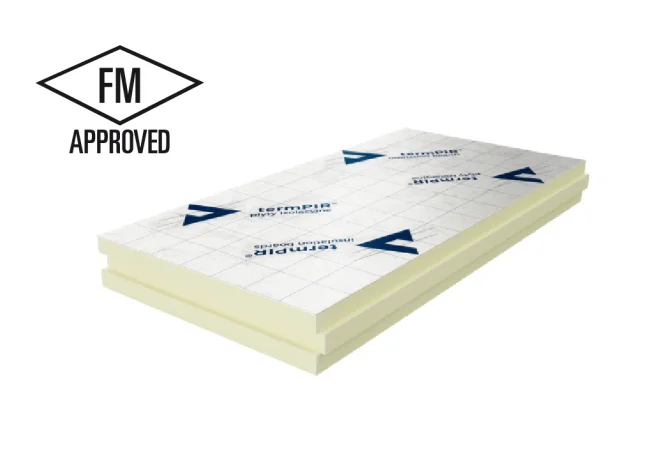
All configurations below are laboratory tested and have a BROOF(t1) classification issued by an accredited notified body. The data is based on the manufacturer’s classification reports for termPIR® AL, ETX, WS, BT, Pro-F and Agro AL boards.
Configurations with a PVC membrane
| # | Covering | Fixing | Substrate | PIR thickness | Class |
|---|---|---|---|---|---|
| 1 | 1.2 mm PVC membrane | Bonded (PU adhesive 350 g/m²) | 16 mm chipboard + 0.125 mm PE film | ≥100 mm | BROOF(t1) |
| 2 | 1.2 mm PVC membrane | Mechanically fixed (screws + washers) | Glass fleece 110 g/m² | ≥100 mm | BROOF(t1) |
Critical: PVC coatings for BROOF(t1) must have a top-layer thickness ≤ 0.200 mm and a heat of combustion ≤ 8.0 MJ/m² (a parameter on the membrane’s data sheet). A membrane with a thicker pigmented coating loses the classification.
Configurations with a TPO membrane
| # | Covering | Fixing | Substrate | PIR thickness | Class |
|---|---|---|---|---|---|
| 3 | 1.2 mm TPO membrane | Bonded (PU adhesive) | 16 mm chipboard + 0.125 mm PE film | ≥100 mm | BROOF(t1) |
| 4 | 1.5 mm TPO membrane | Mechanically fixed | Directly on PIR (no substrate) | ≥100 mm | BROOF(t1) |
Note: TPO has a lower chemical density than PVC (no chlorine) and behaves differently in a fire. A configuration without a chipboard substrate is permitted only in variant 4 (with mechanical fixing).
Configuration with EPDM
| # | Covering | Fixing | Substrate | PIR thickness | Class |
|---|---|---|---|---|---|
| 5 | 1.1 mm EPDM membrane | Bonded (PU adhesive 350 g/m²) | 16 mm chipboard + 0.125 mm PE film | ≥100 mm | BROOF(t1) |
EPDM (synthetic rubber) is the most elastic of the three membranes — it performs well at extreme temperatures (-40°C to +120°C). However, it requires bonding to achieve BROOF(t1); mechanically fixed EPDM without adhesive is a different classification and requires a separate test.
Configuration with bitumen felt
| # | Covering | Fixing | Substrate | PIR thickness | Class |
|---|---|---|---|---|---|
| 6 | 4.0 mm underlayer felt + 5.3 mm cap sheet (polyester carrier, PN-EN 13707) | Mechanically fixed | 16 mm chipboard | ≥100 mm | BROOF(t1) |
| 7 | 5.2 mm torch-on felt (SBS modified) | Torched (to the underlayer) | Separating bitumen film | ≥100 mm | BROOF(t1) |
| 8 | Felt under trapezoidal sheeting (multi-layer system) | — | Trapezoidal sheet T-45 | ≥80 mm | BROOF(t1) as a system |
Torch-on felt pitfall: torching directly onto PIR IS NOT ALLOWED (welding temperature ~250-300°C deforms the PIR core). A separating layer is required: bitumen film, mineral mat, or a mechanically fixed underlayer felt.
Critical conditions for all tests
Every BROOF(t1) classification has a “field of application” — the range of conditions under which the result is valid. The most important ones:
1. PIR core density
A minimum of 35 kg/m³ to maintain the class. All termPIR® products have a declared density of ~30-32 kg/m³, in practice 35-40 kg/m³ for the core used in BROOF tests. Check the declaration for the specific thickness — some thinner ones (20-40 mm) may have lower density.
2. PIR thickness
Most tests were carried out for ≥100 mm. If you use a thinner board (e.g. 60-80 mm), the classification may not apply — check whether the test covers thin thicknesses or ask the manufacturer for an expert opinion.
3. Roof slope
CEN/TS 1187 method 1 tests are performed at a 15° slope (typical pitched roof or flat roof fall). For roofs steeper than 30° or very flat (<3°), the classification may require additional assessment.
4. Ambient temperature during testing
Tests are conducted at 17-22°C, 40-60% humidity. These are test conditions, not service conditions — the roof can operate across the full weather range (BROOF does not change with temperature).
5. Substrate (chipboard)
If the test covers a 16 mm chipboard at 680 kg/m³ density, then exactly this parameter must be on site. OSB has a different density, MDF is a different substrate. The BROOF class for 16 mm chipboard does not apply to 18 mm OSB without a separate test.
6. Adhesive (if a bonded system)
Bonding the membrane to the substrate was tested with PU adhesive at 350 g/m². Adhesives with a different chemical composition (acrylic, contact) change the fire parameters — they require separate verification.
7. PE separating film
Most tests include a 0.125 mm polyethylene film between PIR and the chipboard substrate. It is only omitted when the manufacturer explicitly allows its absence — by default it must be used.
On-site pitfalls
Pitfall 1 — “PVC membrane = PVC membrane”
The roofer has a PVC membrane from manufacturer X in stock. The designer planned BROOF with a PVC membrane from manufacturer Y (tested with termPIR). Despite identical thickness and colour — the chemistry may differ. The BROOF(t1) class is issued for a specific product, not a generic “PVC” category.
Remedy: in the design, specify the manufacturer and model of the membrane in line with the BROOF document. No negotiation on site.
Pitfall 2 — Mechanical fixing instead of bonding
A bonded system and a mechanical one are two different classifications. The roofer changes method “because it’s faster” — the class is invalid. A mechanically fixed membrane has more gaps (at the screws) and behaves differently under external fire.
Remedy: the fixing method is part of the classification. If the test was “PU bonding at 350 g/m²”, then bonding is required.
Pitfall 3 — Omitting the chipboard substrate
The roofer saves a day of work: he lays the membrane directly on PIR (without chipboard). Some tests allow this (configuration 4 above), but most require a substrate — in a fire it acts as a thermal barrier between the flame and the PIR core.
Remedy: check the specific configuration on the BROOF certificate. No substrate = often no BROOF(t1).
Pitfall 4 — A different membrane colour
A PVC membrane in a different colour has different pigmentation = different top-layer thickness. The BROOF classification is often issued for a standard grey membrane; dark colours (black, anthracite) may require a separate test.
Remedy: confirm the membrane colour with the PIR manufacturer before ordering.
Pitfall 5 — Torching felt directly onto PIR
The most common mistake during refurbishment. A propane torch at ~300°C melts the PIR facing and reduces its insulating (and fire) properties.
Remedy: always use a separating layer between termPIR and torch-on felt. Bitumen film, mineral mat, or mechanical fixing of the underlayer felt.
Compatibility: which termPIR for which covering
| termPIR variant | Bonded PVC | Bonded TPO | Bonded EPDM | Mechanically fixed felt |
|---|---|---|---|---|
| termPIR® AL | ✓ | ✓ | ✓ | ✓ |
| termPIR® AL R-eco | ✓ | ✓ | ✓ | ✓ |
| termPIR® Pro-F | ✓ | ✓ | ✓ | ✓ |
| termPIR® PRIME | ✓ | ✓ | ✓ | ✓ |
| termPIR® WS (glass fleece) | — | — | — | ✓ (preferred) |
| termPIR® BT (bitumen fleece) | — | — | — | ✓ (preferred) |
| termPIR® ETX | ✓ | ✓ | — | ✓ |
WS and BT are boards with a glass/bitumen fleece — intended mainly for felt roofs (the fleece improves bitumen adhesion). For PVC/TPO/EPDM membranes, AL, AL R-eco, Pro-F or PRIME are better.
What BOKKA provides
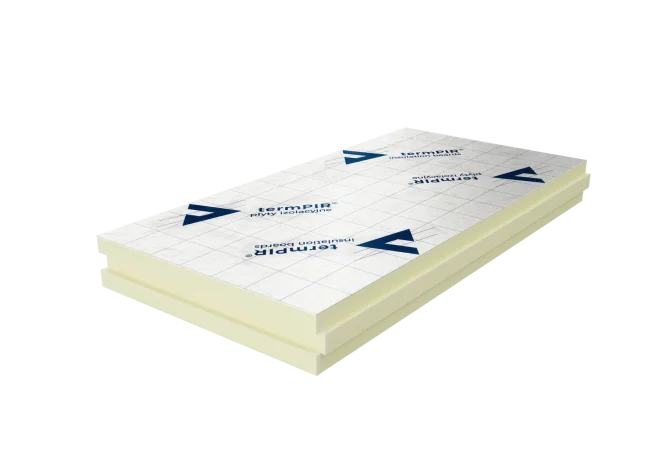
We are a direct distributor of termPIR® boards across the full range of roof variants. We have complete BROOF certificates for each of the 8 configurations above + additional ones (special coverings, green roofs, etc.).
In practice for your project:
- Pre-order consultation — we verify whether the planned covering + PIR thickness + substrate forms a tested combination with BROOF(t1)
- Product selection by covering — if you have a chosen membrane manufacturer, we identify the termPIR variant with a matching classification
- BROOF certificate with delivery — the classification document in the delivery package, evidence for the fire service at acceptance
- Roofer support — installation instructions with exact parameters (adhesive, fixing, separating film, density, slope)
🤝 Free technical consultation with BOKKA — we will help you select the product and complete documentation for your project.
Summary
BROOF(t1) on a termPIR data sheet is a system declaration, not the material alone. The choice of specific covering (PVC vs TPO vs EPDM vs felt), fixing method (bonded vs mechanical), substrate (16 mm chipboard vs OSB vs nothing) and PIR thickness — all together determine the validity of the classification.
The 8 configurations above are proven, tested combinations. By sticking to them, you can be sure the roof will meet the BROOF(t1) requirement without needing an individual expert opinion.
If in doubt about a specific covering, membrane manufacturer or non-standard PIR thickness — get in touch before ordering. A free technical consultation saves weeks of expert assessments at acceptance.
Sources and legal basis:
- Regulation of the Minister of Infrastructure on Technical Conditions — Chapter 2, § 217–218 (roof resistance)
- PN-EN 13501-5:2016 — Fire classification of construction products — Classification using data from external fire exposure tests on roofs
- CEN/TS 1187:2014 — Test methods for external fire exposure to roofs
- PN-EN 13707:2013 — Flexible sheets for waterproofing — Reinforced bitumen sheets for roof waterproofing
- PN-B-02867:2013 — Fire protection of buildings — Test method for the degree of fire spread through walls (national standard, being withdrawn in favour of EN 13501)
Frequently asked questions
Is BROOF(t1) enough for any roof in Poland?
Does a bitumen felt roof without a substrate also have BROOF(t1)?
Which matters more: BROOF(t1) or the core's reaction to fire (E/F class)?
Can I swap the PVC membrane for TPO during construction?
What about green roofs (extensive/intensive)?
Does a BROOF classification have an expiry date?
Related products and systems
Read next
How to Get Rid of Martens in the Attic? PIR as a Barrier
Inverted Roof Insulation with PIR Boards — Layers, U-value, WT 2021
Basement Ceiling Insulation with PIR Boards — Selection & Installation