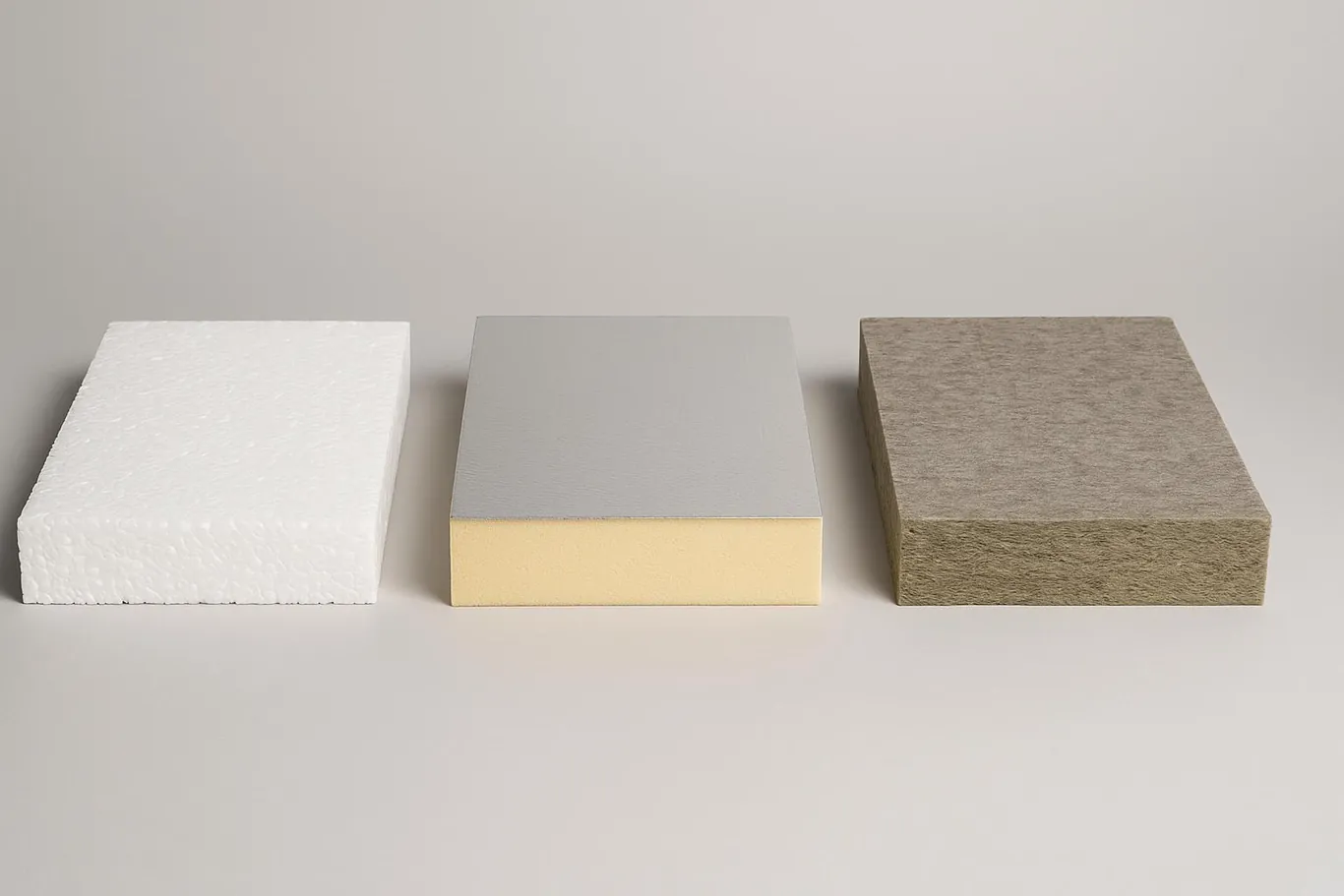
PIR Boards vs Mineral Wool — Total Cost of Ownership Comparison (30 Years)
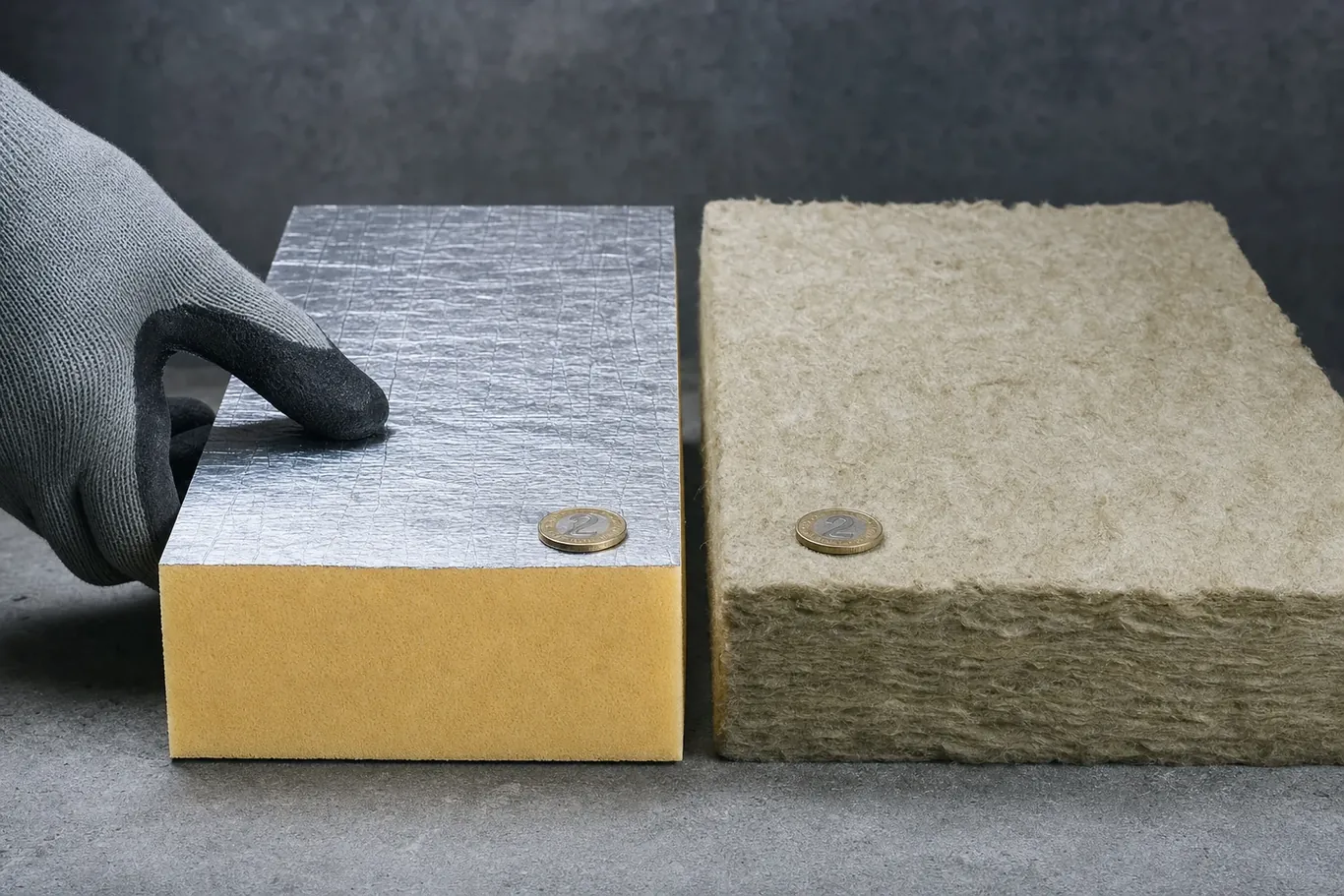
“Which is cheaper — PIR or wool?”
A question asked every single day. The answer: it depends on the time horizon.
- For the purchase of the insulation alone: mineral wool is 2× cheaper than PIR
- After the first year of operation: PIR already starts catching up thanks to lower heating bills
- After 7–10 years: PIR and wool run neck and neck
- After 20–30 years: PIR usually wins (fewer repairs, no moisture, retains its λD)
In this article we present hard numbers — the TCO (Total Cost of Ownership) for a 200 m² house with a roof building element, over a 30-year horizon.
Context: how the two materials differ
| Parameter | termPIR® AL | Mineral wool (board) |
|---|---|---|
| λD | 0.022 W/(m·K) | 0.034–0.040 W/(m·K) |
| Density | 30 kg/m³ | 80–160 kg/m³ |
| Reaction-to-fire class | E (50+ mm) | A1 (non-combustible) |
| Vapour permeability (µ) | 5–100 (gas-tight) | 1–2 (vapour-permeable) |
| Water absorption | <2% by vol. | 1–5% by vol. (more over long-term service) |
| Compressive strength CS | 120 kPa (rigid PIR) | 4–25 kPa (depending on density) |
| λD durability | Constant for 50+ years | Drops by 5–15% over 20–30 years (moisture) |
| Price per m² (100 mm) | ~85 PLN | ~45 PLN |
In one sentence: PIR = less thickness, no susceptibility to moisture; wool = non-combustibility, vapour permeability, cheaper to buy.
TCO comparison — the assumptions
A single-family house with 200 m² of usable floor area, a pitched roof of 250 m² (after the slope). We need to choose the roof insulation.
Goal: meet WT 2021 → roof U = 0.15 W/(m²·K) → R = 6.67 m²·K/W
Variant A — termPIR® AL over the rafters:
- PIR thickness: 150 mm (R = 6.82) → 250 m² × 85 PLN = 21,250 PLN material
- Adhesive, tapes, accessories: ~3,200 PLN
- SX 12×240 telescopic screws: 3,100 PLN
- Windproof + vapour-permeable membrane: 5,800 PLN
- Labour (over-rafter layout, simple): 8,500 PLN
- Total investment: ~41,850 PLN
Variant B — mineral wool 200 mm between the rafters:
- Wool 200 mm: 250 × 45 = 11,250 PLN material
- Vapour-barrier film (critical for wool): 2,400 PLN
- Windproof film on the other side: 2,800 PLN
- Timber (thicker 60×200 mm rafters): 6,800 PLN
- Labour (between-rafter layout + film protection): 9,200 PLN
- Total investment: ~32,450 PLN
Investment difference: 9,400 PLN (PIR more expensive).
That is a 17% premium. Sounds like a lot? Let’s see what happens next.
Operating cost year by year
Energy (heating)
A 200 m² house, heating energy demand:
| Variant | Roof U | R | Annual EU (kWh/m²·year) | Annual energy cost (0.80 PLN/kWh) |
|---|---|---|---|---|
| A — PIR 150 mm | 0.15 | 6.82 | 65 kWh/m² | 200×65×0.80 = 10,400 PLN/year |
| B — Wool 200 mm (with 12% degradation from rafter bridges) | 0.17 | 5.88 | 72 kWh/m² | 200×72×0.80 = 11,520 PLN/year |
Annual energy difference: 1,120 PLN against wool (because of thermal bridges at the rafters in the between-rafter layout).
After 10 years: a difference of 11,200 PLN. After 20 years: 22,400 PLN. After 30 years: 33,600 PLN.
PIR pays back the 9,400 PLN premium in 8 years thanks to lower heating bills.
Insulation degradation over time
Mineral wool loses its λD over time:
- Year 0: λD 0.036
- Year 10: λD 0.038 (+5%, moisture)
- Year 20: λD 0.041 (+14%)
- Year 30: λD 0.043 (+19%)
PIR keeps its λD constant for 50+ years (gas-tight facing, no moisture inside the core).
Energy-cost chart factoring in degradation:
| Year | Variant A (PIR) | Variant B (wool) | Annual difference |
|---|---|---|---|
| 1 | 10,400 | 11,520 | +1,120 |
| 10 | 10,400 | 12,100 | +1,700 |
| 20 | 10,400 | 13,050 | +2,650 |
| 30 | 10,400 | 13,800 | +3,400 |
Maintenance and repairs
| Item | PIR | Mineral wool |
|---|---|---|
| Inspection every 5 years (visual check) | free | free |
| Repair of vapour-barrier leaks | rarely (not required) | every 10–15 years ~3,000 PLN |
| Replacement of insulation damaged by moisture | rarely | every 15–20 years ~5,000 PLN |
| General roof overhaul (covering replacement + possibly insulation) | year 30: ~25,000 PLN | year 25: ~30,000 PLN (wool less durable) |
PIR: ~25,000 PLN of repairs over 30 years. Wool: ~38,000 PLN of repairs over 30 years.
PIR saves 13,000 PLN on repairs.
30-year TCO — summary
| Variant | Investment | Energy 30 years | Maintenance 30 years | TCO 30 years |
|---|---|---|---|---|
| A — PIR 150 mm | 41,850 PLN | 312,000 PLN | 25,000 PLN | 378,850 PLN |
| B — Wool 200 mm | 32,450 PLN | 376,500 PLN | 38,000 PLN | 446,950 PLN |
Difference: 68,100 PLN in PIR’s favour over 30 years.
In other words, a 17% premium in the investment saves 17% of the TCO after 30 years. PIR is cheaper, not more expensive, over the life of the building.
When wool wins
The example above is for a typical single-family house with a well-built pitched roof. Wool wins in specific situations:
1. Class A1 non-combustible required
Some projects (close to the plot boundary, a class “A”–“B” fire-resistance production hall, a heritage neighbourhood) require a class A1 material. PIR is class E. Wool is the only choice.
2. Acoustics as a priority
Wool has Rw 35–45 dB for 100 mm. PIR ~25 dB. For production halls or flats above commercial units, wool dampens better.
3. A short-term investment (sale within 5 years)
If you plan to sell the house in 3–5 years, an investment in PIR will not pay back within that time. The buyer looks at the purchase price + the annual bill, not at the 30-year TCO. Wool is cheaper to buy → a quicker sale for the same amount.
4. Heritage renovation
Old masonry buildings (especially listed ones) require vapour-permeable insulation — so that water vapour can escape through the wall. Mineral wool (µ 1–2) works; PIR (µ 5–100, gas-tight) forms a barrier → condensation in the masonry → destruction of historic brickwork.
When PIR wins
1. Passive standard or WT 2030
R ≥ 10 requires 300+ mm thickness of wool — often physically unworkable. PIR delivers it in 220 mm.
2. Limited thickness (renovations, balconies, terraces)
PIR is 2× thinner for the same R. Wherever every centimetre counts.
3. A home for the long haul (10+ years in your own ownership)
PIR pays back the premium in 7–10 years + saves a further 60,000 PLN over 30 years.
4. The structure must be lightweight
PIR ~7 kg/m². Wool 80–160 kg/m². For extensions on existing structures, for flat roofs on a lightweight steel structure — PIR saves hundreds of kilograms per m².
5. A damp building / close to water
Wool in a damp environment (e.g. basements, roofs over cold stores) loses its λD faster. PIR is insensitive to moisture (gas-tight facing + low water absorption).
A decision in 5 questions
| Question | Your answer | Recommendation |
|---|---|---|
| 1. Do you plan to live there 10+ years? | YES | PIR |
| NO (sale) | Wool | |
| 2. Class A1 non-combustible required? | YES | Wool |
| NO | PIR or Wool | |
| 3. Limited element thickness? | YES | PIR |
| NO | Wool or PIR | |
| 4. Is acoustics crucial? | YES | Wool |
| NO | PIR | |
| 5. Passive standard / NF15? | YES | PIR (MAX 19) |
| NO | Both OK |
What BOKKA offers
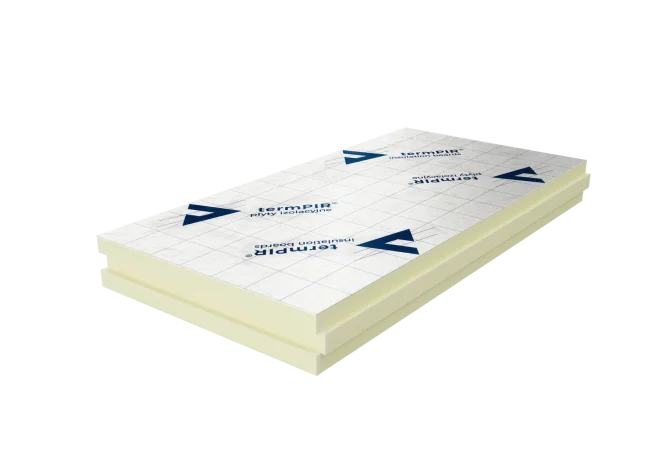
We sell PIR (termPIR® AL, ETX, WS, Pro-F, PRIME, MAX 19, AGRO AL, etc.) + mineral wool in sandwich panels (GS MW QA — with a steel facing for halls).
We do NOT sell loose mineral wool (outside our range) — if you decide on wool, the best manufacturers are Rockwool, Knauf Insulation, Isover, Paroc. We can advise but not supply.
For PIR: full DoP documentation + PZH approval; in Poland, nationwide delivery within 7 days of ordering and a VAT invoice that can be claimed only in Poland under the Polish thermal-modernisation tax relief (ulga termomodernizacyjna).
🤝 Free BOKKA technical consultation — we’ll help you select the product and complete documentation for your project.
Summary
30-year TCO for 250 m² of roof insulation:
- PIR 150 mm: ~379,000 PLN
- Wool 200 mm: ~447,000 PLN
- Difference: ~68,000 PLN in PIR’s favour
Verdict:
- A home owned for 10+ years → PIR (payback in 7–10 years)
- Sale within 3–5 years → wool (lower purchase cost, the buyer looks at price)
- Class A1 non-combustible requirement or acoustics → wool (the only option in some projects)
- Passive standard or limited thickness → PIR (the only physically sensible option)
🤝 Free BOKKA technical consultation — we’ll help you select the product and complete documentation for your project.
Sources:
- EN 13165 (PIR) and EN 13162 (mineral wool) — harmonised standards
- DAFA industry reports on the durability of insulation materials
- Manufacturer data: Gór-Stal (PIR), Rockwool/Isover/Paroc (wool)
Frequently asked questions
Does PIR really retain its λD for 50 years?
Why does mineral wool degrade?
Can I combine PIR and wool in a single building element?
Is PIR environmentally friendly?
Is mineral wool safe for health?
What about polystyrene (EPS) as a third option?
Related products and systems
Read next
1000 m² Warehouse — termPIR® or Sandwich Panels? Cost, Time, Operation Comparison
Reaction-to-Fire Euroclasses A1/A2/B/C/D/E/F — What They Mean in Design Practice
How to read DoP, ETA and AVCP certificate — a guide for designers and buyers