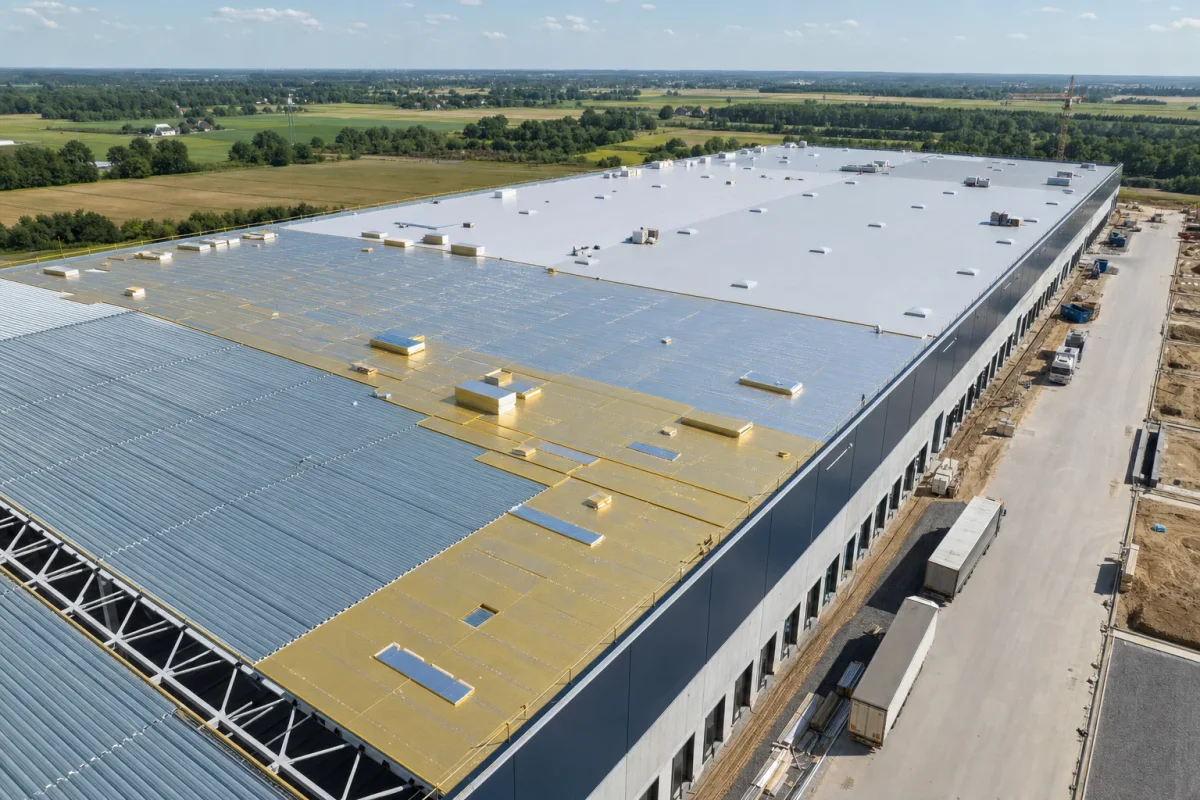
When to use this system
Market standard for large-format warehouse and logistics facilities — warehouse property developers have been building roofs in this configuration for decades. The reason: combination of light weight and fast installation.
Choose this system when:
- Hall structure is steel — truss or beam girders spanning 12-24 m, steel columns every 12-24 m.
- Large roof area (>5000 m²) — sandwich panel D would be too expensive per m² at this scale; bonded termPIR AL with bitumen felt is more economical.
- Standard fire requirements — no FM Approval requirement (use the FM Approved system for that).
- Speed of construction — trapezoidal sheet laid in 1 day (1000+ m²/day), roof layers built up layer-by-layer.
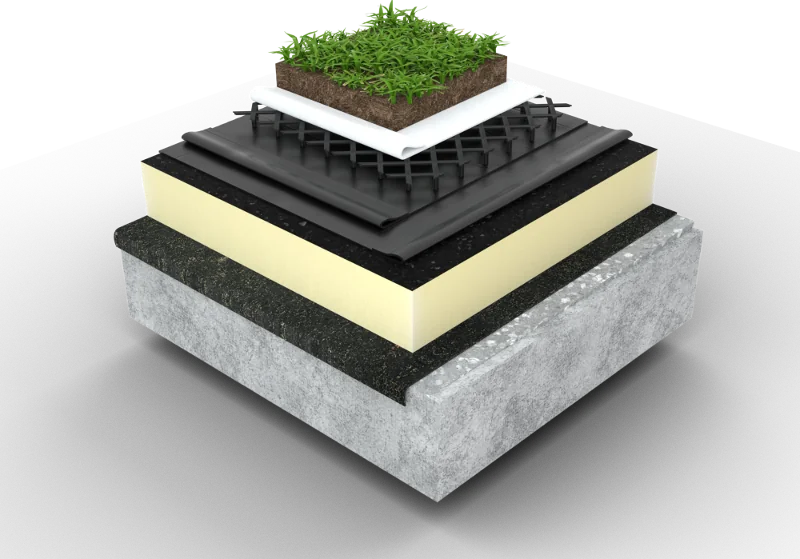
Layer configuration (from top)
- Waterproofing — 2-layer SBS bitumen felt (classic) or synthetic membrane (PVC/EPDM/FPO/TPO) per design.
- termPIR® AL 150-220 mm (typical) — main insulation, λD 0.022 W/(m·K). Bonded or mechanically fastened to the sheet.
- Vapour barrier — PE foil SD ≥ 100 m or vapour-tight bitumen felt with polyester carrier.
- Structural trapezoidal sheet T130-T200 — fulfils two functions: load-bearing roof structure + layer distributing loads to the girders.
- Steel structure — truss / beam girders on columns.
Fastening termPIR® AL to the trapezoidal sheet
Two variants in line with industry standards:
| Variant | Characteristics | Typical scope |
|---|---|---|
| Bonded | PU adhesive or bitumen adhesive applied in strips to the sheet + along edges of the board. No perforation of the vapour barrier. | Halls with high vapour-tightness requirements (refrigeration, food). |
| Mechanical fastening | Telescopic (plate) fasteners through termPIR + vapour barrier to the sheet. 4-6 pcs/m² in the internal zone, 6-10 pcs/m² in edge and corner zones. | Market standard — most commonly used. |
| Ballasted (rarely) | Loose-laid on EPDM membrane, weighted with gravel 50-100 kg/m² or concrete pavers. | Exceptional projects, ballasted roofs (rooftop park). |
System fire resistance — REI class (ITB 01120.4/20/R97NZP)
A roof system with thermal insulation made of termPIR® AL on trapezoidal sheet holds an ITB fire resistance classification issued by the Building Research Institute (ITB Classification No. 01120.4/20/R97NZP, Warsaw, 2020-04-08):
| Variant | Thermal insulation configuration | Required class of supporting structure | Roof fire resistance class |
|---|---|---|---|
| 1 | 1 layer termPIR® AL ≥ 70 mm | R 20 | REI 20 |
| 1 | 1 layer termPIR® AL ≥ 100 mm | R 30 | RE 30 |
| 2 | 2 layers termPIR® AL totalling ≥ 100 mm (each ≥ 40 mm) | R 30 | REI 30 |
Scope of classification:
- Roof pitch angle: 0°-15° per PN-EN 1365-2.
- Support (purlin) spacing: ≤ 750 cm.
- Permissible utilisation level of trapezoidal sheet load capacity αq1: 71%.
- Waterproofing: PVC/EPDM/TPO membrane ≥ 1.2 mm, or 1-2 layers of bitumen felt, or sheet metal (steel/aluminium/titanium-zinc).
- Thermal insulation: termPIR® AL (or IzoProof), core density min. 30 kg/m³, tongue-and-groove profile min. 12 mm deep, AL / Agro AL / WS / PK facing.
- Vapour barrier: bitumen or PE foil ≥ 0.2 mm (bonded to the sheet), or none.
- Maximum load suspended from the sheet: 0.40 kN/m² (e.g. installations).
What the REI class means:
- R = load-bearing capacity (Resistance) — the roof does not collapse for X minutes.
- E = fire integrity (Etanchéité) — does not let through flames / hot gases.
- I = fire insulation — temperature on the cold side does not rise by more than 140°C on average.
For facilities with FM Global policies or premium industry insurers — switch to the FM Approved system with certified termPIR® Pro-F.
Roof slope
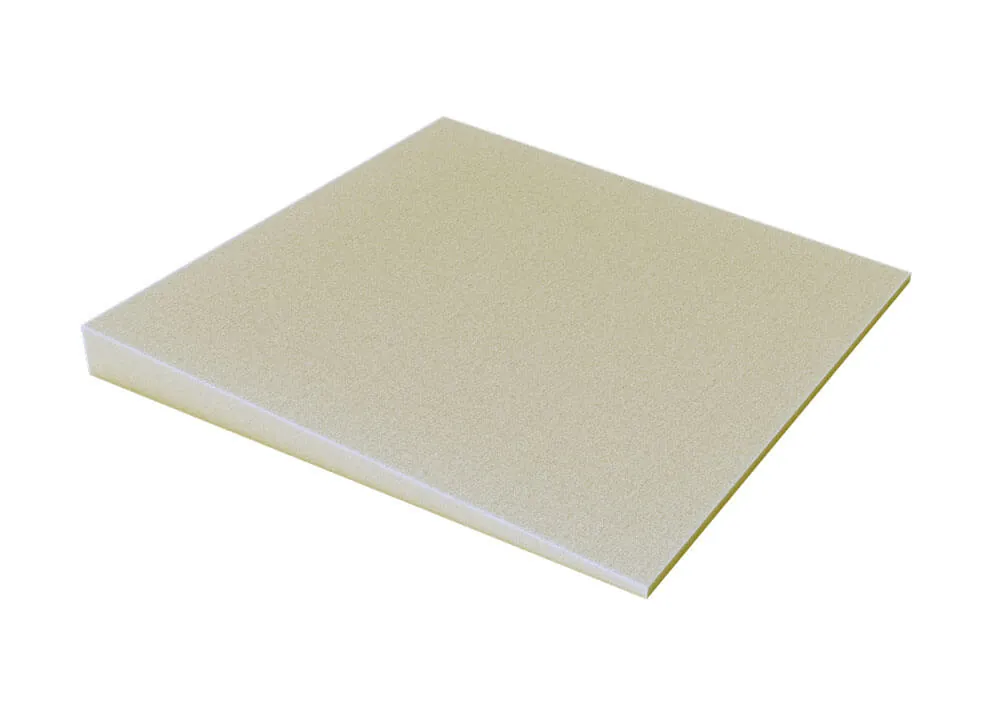
Steel halls typically have a structural slope of 1.5-2% achieved by variable girder profile (roof “suspended” — higher in the middle, lower towards the eaves). If the structure does not provide a slope, we add izoGRASS® tapered wedges on top of termPIR® AL (see reinforced concrete flat roof section “Roof slope”).
Comparison with other BOKKA roof systems
| System | Load-bearing structure | Fire class | Price per m² | Typical facility |
|---|---|---|---|---|
| This (trap. sheet + termPIR AL) | steel + sheet | B_ROOF(t1), PIR class E | baseline | standard warehouse |
| RC slab + termPIR AL | reinforced concrete | B_ROOF(t1), PIR class E | higher structure, same insulation | residential, public utility |
| FM Approved + termPIR Pro-F | steel or reinforced concrete | FM Approval Class 1 | +15-25% per m² | premium logistics (FM Global insurer requirement) |
| Sandwich panel D | steel, self-supporting panel | B-s1,d0 + B_ROOF | higher per panel, lower for installation | standard halls with sloped roof |
| MAX19 terrace | any | B_ROOF | higher (premium MAX19) | usable roofs above apartments |
Technical documentation
termPIR® AL board — termPIR® 2025 Folder (Gór-Stal, 2025-04-23, p. 13). The layered system on trapezoidal sheet is the industry standard configuration used for decades — it does not require a dedicated manufacturer’s datasheet; every steel-hall roof design includes this build-up.
Selection of waterproofing + structure is the responsibility of the designer and contractor. BOKKA supplies termPIR® AL boards + optionally izoGRASS® tapered wedges for the slope. The remaining components (bitumen felt / membrane, trapezoidal sheet, girders) — from industry suppliers specialising in steel structures.
Layer composition
| # | Layer | Thickness | λ | Role |
|---|---|---|---|---|
| 1 | Waterproofing — SBS torch-on bitumen felt (base + cap) OR synthetic PVC / EPDM / FPO / TPO membrane | — | — | external waterproofing |
| 2 | termPIR® AL — 50 µm aluminium facing on both sides | 80–250 mm | 0,022 W/(m·K) | main insulation (gas-tight) |
| 3 | Vapour barrier — PE foil class SD ≥ 100 m or vapour-tight bitumen felt | — | — | vapour barrier on the interior side of the hall |
| 4 | Structural trapezoidal sheet (T130 / T153 / T160 / T180 / T200 — per structural engineer's design) | — | — | load-bearing roof structure + load distribution layer |
| 5 | Steel structure — truss or beam girders (IPE / HEB / trusses) | — | — | main load-bearing structure of the hall |
U-value by insulation thickness
| termPIR® thickness | U [W/m²·K] | Meets WT 2021 (roof U ≤ 0.15) |
|---|---|---|
| 80 mm | 0,26 | — no |
| 100 mm | 0,21 | — no |
| 120 mm | 0,18 | — no |
| 150 mm | 0,14 | ✓ yes |
| 180 mm | 0,12 | ✓ yes |
| 200 mm | 0,11 | ✓ yes |
| 220 mm | 0,10 | ✓ yes |
| 250 mm | 0,08 | ✓ yes |