When to use this system
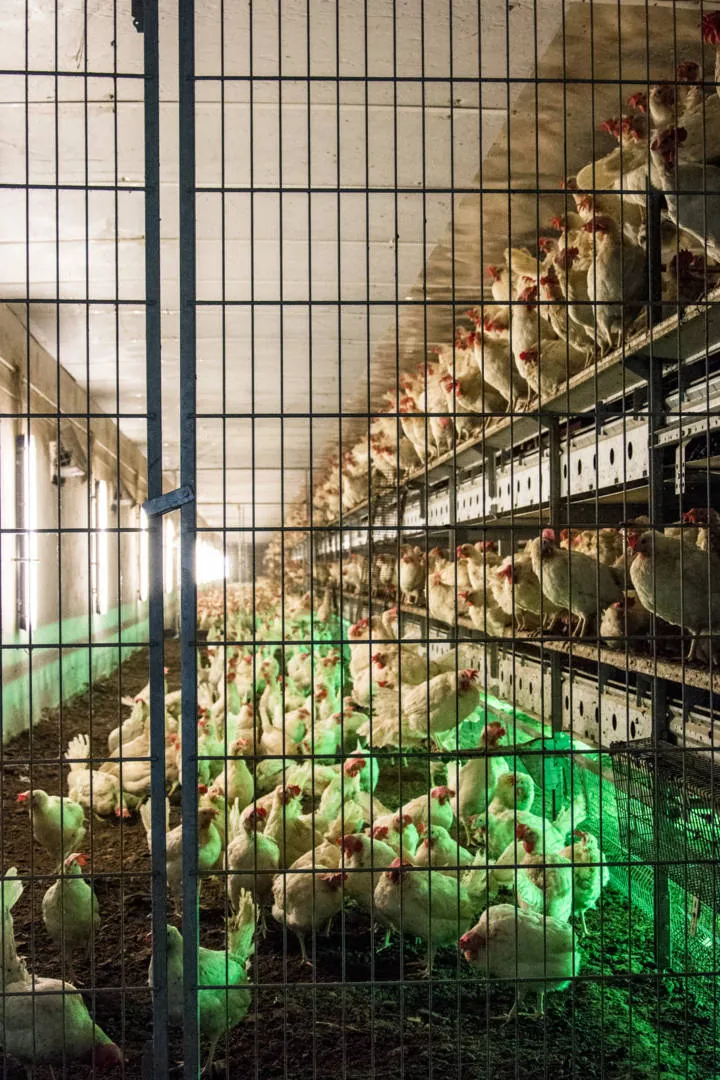
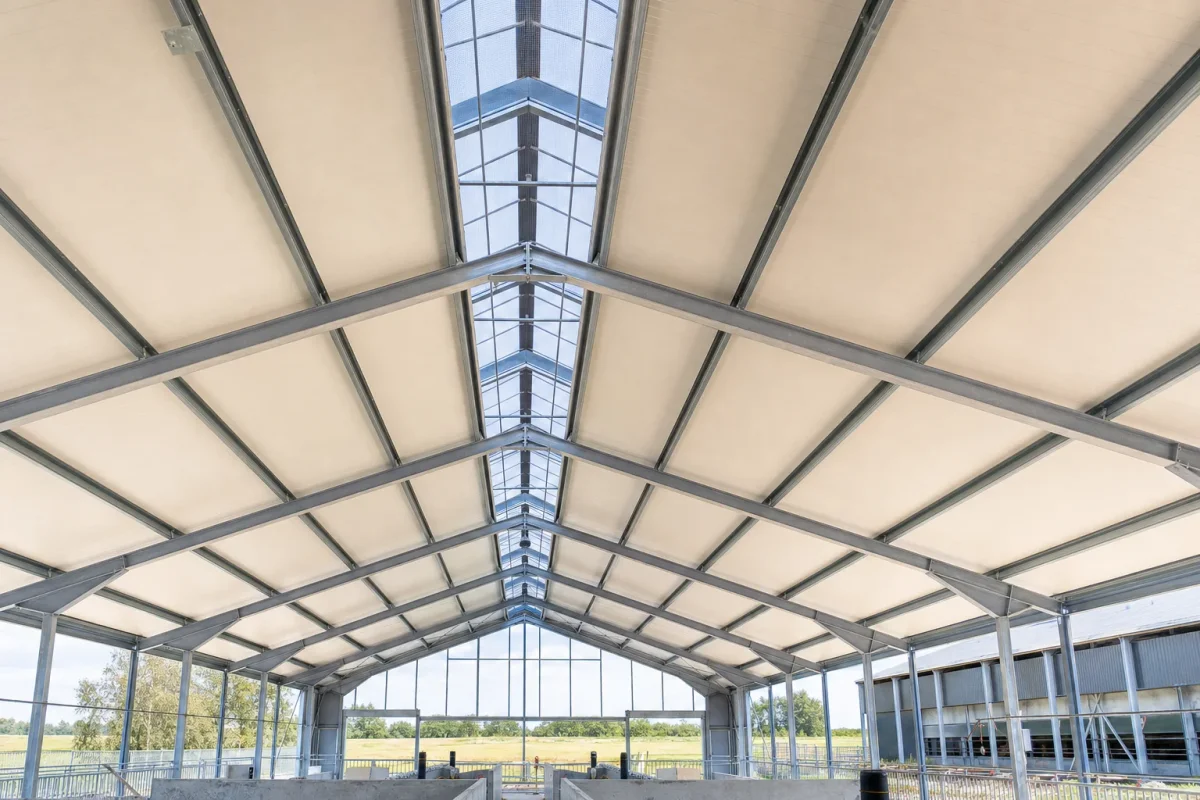
Standard roof for livestock buildings — poultry houses, cattle barns, pig houses, stables and feed storage almost always use a pitched roof for two reasons:
- Gravity ventilation — natural air exchange requires a 7-15° slope for effective airflow draft (ridge chimney + eaves inlets).
- Snow load — in continental/mountain climates, flat roofs cannot withstand the snow load zones (>1.5 kN/m² typically) and would require a much more expensive structure.
That is why: BOKKA does not offer flat roofs for livestock buildings — only insPIRe® D sandwich panel with appropriate slope.
Layer configuration
- Upper facing — standard trapezoidal sheet with RAL paint (colour per design, typically dark green or grey).
- PIR core 100-150 mm — selected according to climate and livestock type:
- poultry house → 100-120 mm (strong internal heating offsets losses),
- free-stall cattle barn → 120-150 mm (warmer rooms + condensation reduction),
- pig house → 120-150 mm (high climate requirements).
- Lower facing — the key difference vs warehouse hall — special coating Granite® Farm or Granite® HDX, resistant to NH₃ and pressure washing from below (building sanitisation procedures).
Inner liner selection
| Building type | Recommendation |
|---|---|
| Broiler poultry house | Granite® Farm (price/quality) |
| Layer poultry house with cage systems | Granite® HDX (higher NH3 concentration) |
| Free-stall cattle barn | Granite® Farm |
| Pig fattening house | Granite® HDX (highest NH3 concentration from slurry) |
| Stable | Granite® Farm (moderate NH3) |
| Feed / silage storage | Granite® Farm (VOC from silage) |
| Dairy with production line | HPS200 Ultra or Prisma (premium, long depreciation) |
Installation requirements
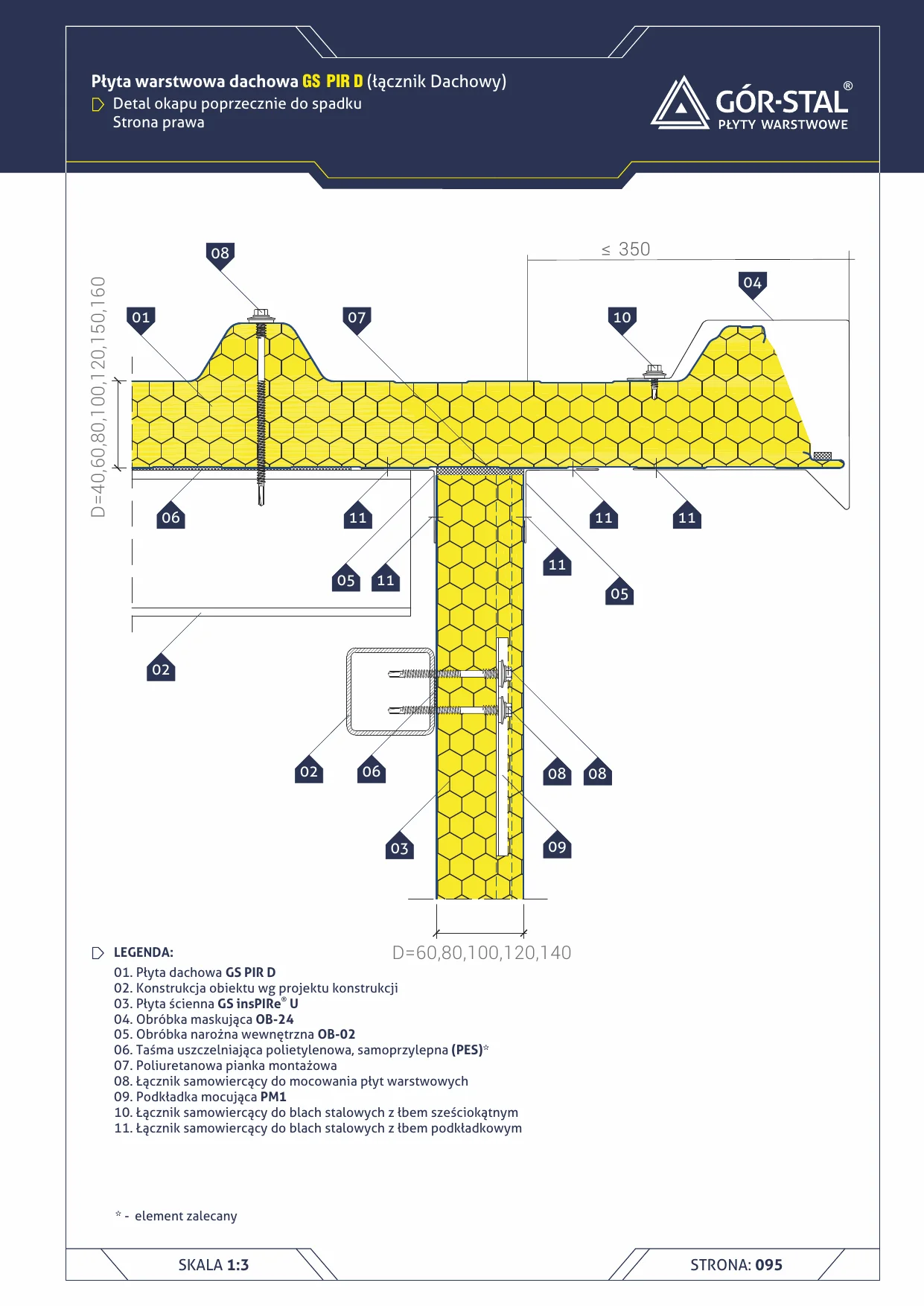
- Roof slope — minimum 7° (12% pitch) for effective water drainage and gravity ventilation operation; 15° for snow regions (snow self-sheds at pitches >12%).
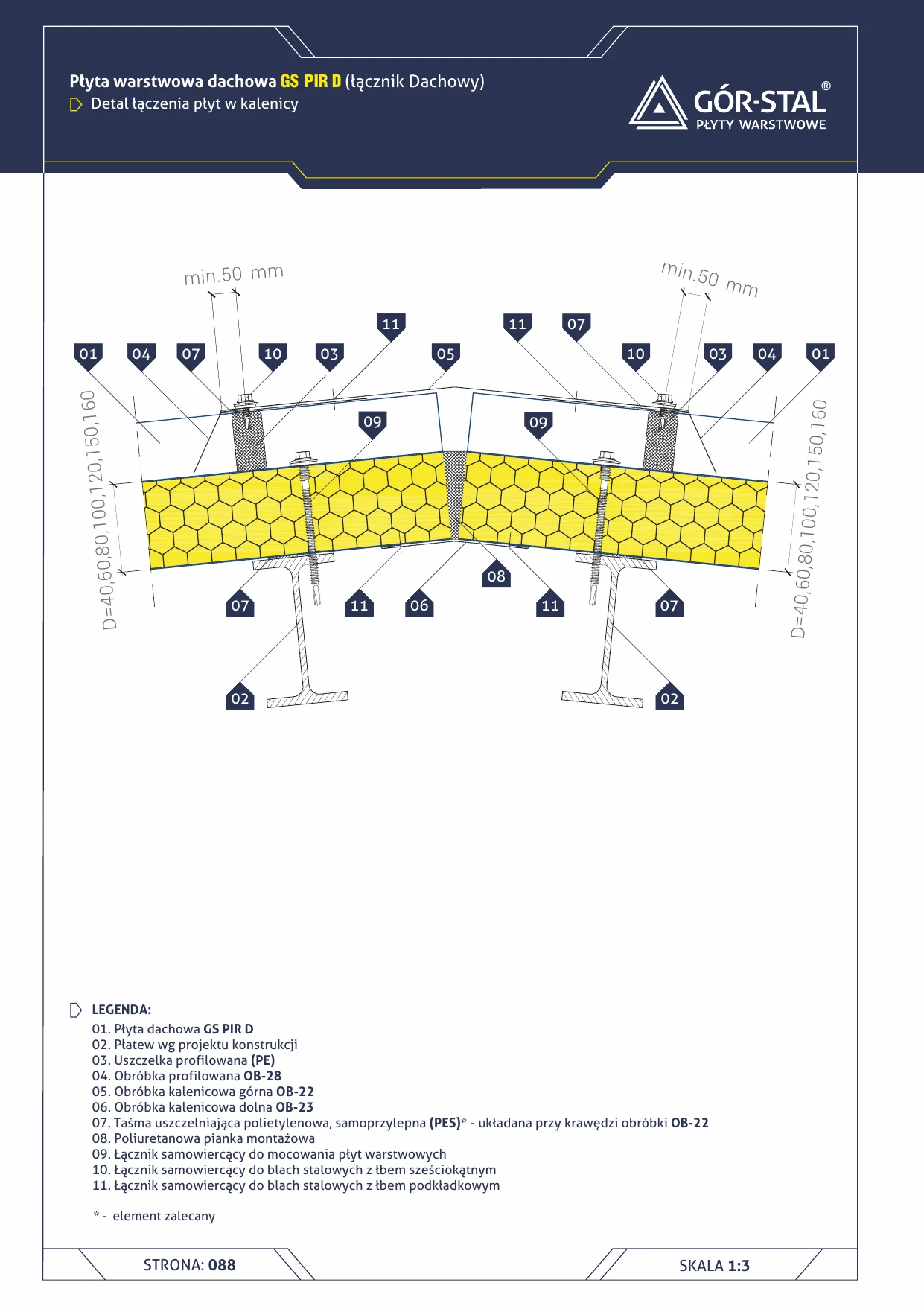
- Ridge chimney — mandatory in poultry houses and cattle barns, OB-22 ridge profile with special coating (visible from the interior side).
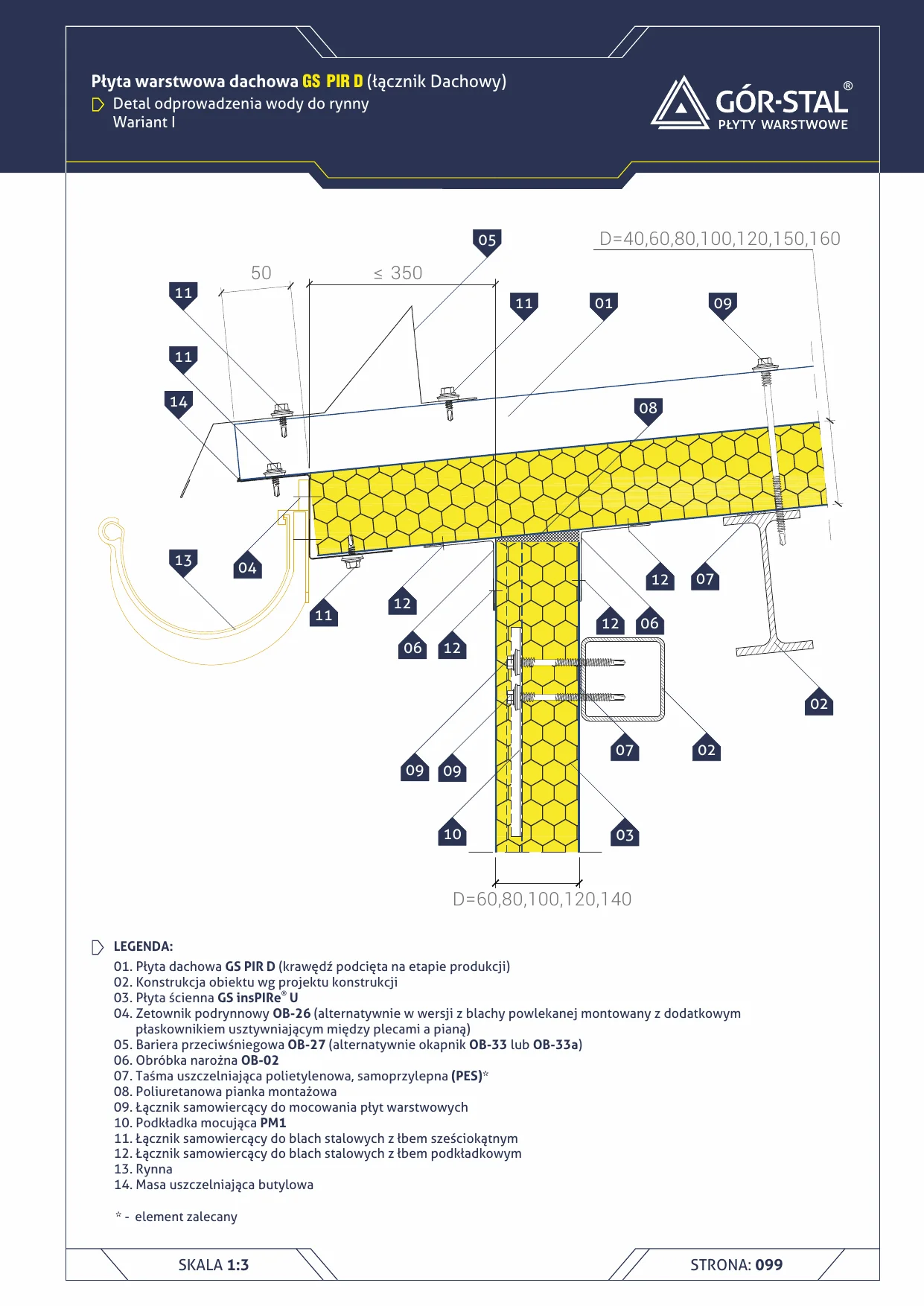
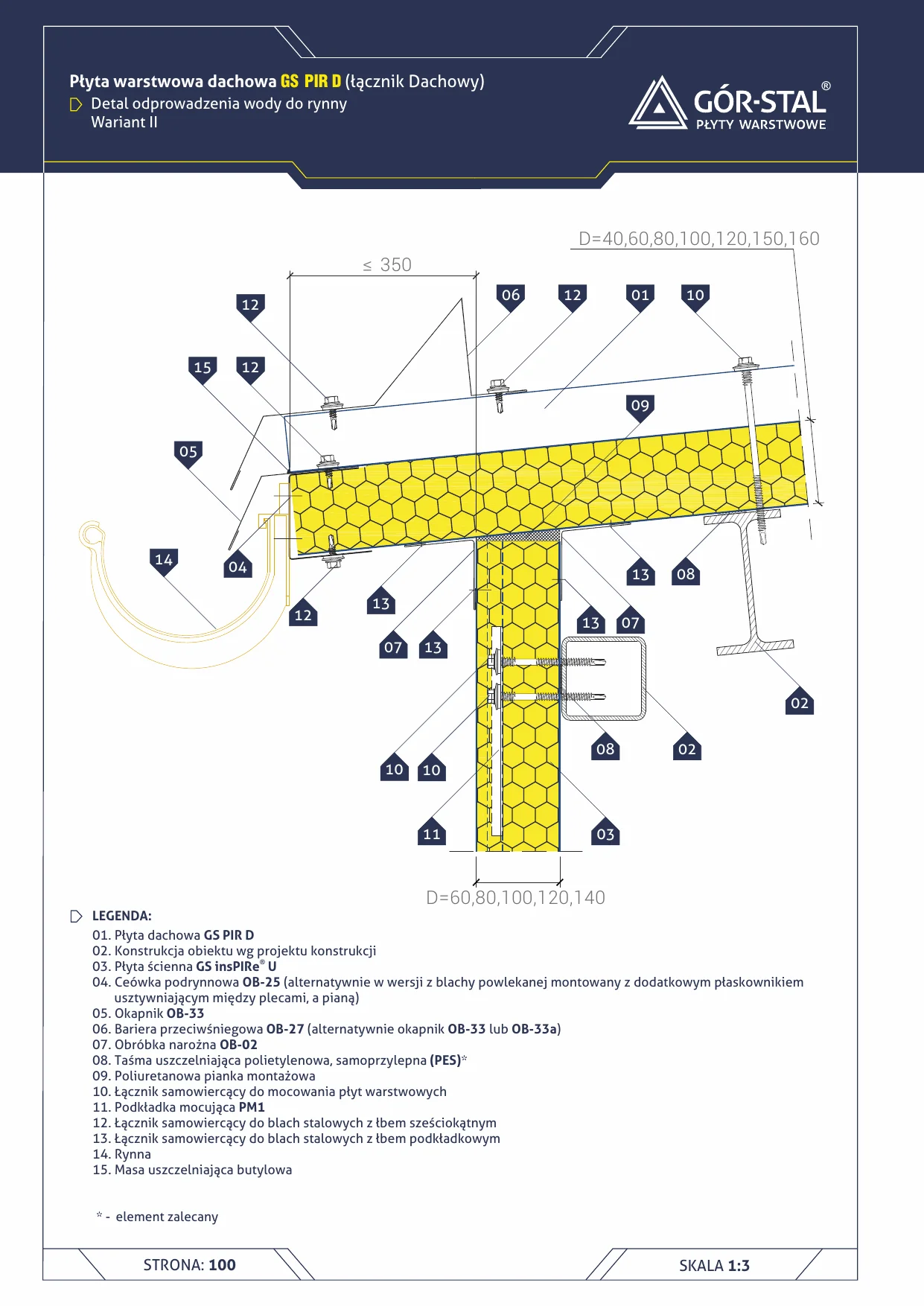
- Roof eaves — OB-12 drip edge + OB-13 end profile with drainage to the external gutter (wash water + rainwater).
- Fasteners — double density in the edge zone (50 cm from the roof edge) — wind suction forces at the eaves are higher than in the central part.
Load-bearing structure
The D sandwich panel is self-supporting with appropriate thickness and span selection:
- Span 4-6 m → 100 mm thickness is sufficient for typical loads.
- Span 6-8 m → 120 mm thickness recommended.
- Span 8-10 m → 150 mm thickness required; above 10 m → intermediate support.
- Steel purlins spaced at 1.2-2.0 m (depending on panel thickness).
Order fulfilment
- Granite® Farm / Granite® HDX lower facing — lead time 4-6 weeks from order.
- HPS200 Ultra / Prisma — 6-8 weeks.
- INOX lower facing — 8-10 weeks (rare in roofs, more common in dairies with direct milk contact).
Technical documentation
The system is described in the Gór-Stal Technical Catalogue 2025 (p. 7 — D roof panel, p. 16 — inner coating variants). NRO + B-s1,d0 classification, PZH hygienic certificate for the standard panel.
Layer composition
| # | Layer | Thickness | λ | Role |
|---|---|---|---|---|
| 1 | Upper facing — trapezoidal galvanised steel sheet + 25 µm RAL paint | 0.5–0.6 mm | — | roof external facing layer |
| 2 | PIR core (density 40 kg/m³) | 100–150 mm | 0,022 W/(m·K) | roof thermal insulation |
| 3 | Lower facing — galvanised steel sheet + special coating (Granite® Farm / HDX) | 0.4–0.5 mm | — | visible facing from below — on the animal side, resistant to NH3 and washing |
U-value by insulation thickness
| termPIR® thickness | U [W/m²·K] | Meets WT 2021 (roof U ≤ 0.15) |
|---|---|---|
| 100 mm | 0,22 | — no |
| 120 mm | 0,18 | — no |
| 150 mm | 0,15 | ✓ yes |
Related catalogue items
Applications
Recommended variants
Installation accessories