Over-Rafter Roof Insulation with PIR Boards — Complete Guide
Over-rafter roof insulation — why PIR boards are the first choice
Under the tightened WT 2021 (Polish Technical Conditions 2021), achieving U ≤ 0.15 W/m²K for a pitched roof using the classic between-rafter method requires a mineral wool layer of 28–32 cm — and even then it does not eliminate thermal bridges along the rafters themselves. The over-rafter method using rigid termPIR® PIR insulation boards solves both problems: it provides a continuous, uniform insulation layer above the truss structure at a thickness up to 40% smaller. This is a systemic solution that designers increasingly specify as a standard in new developments and comprehensive energy retrofits.
What over-rafter insulation involves
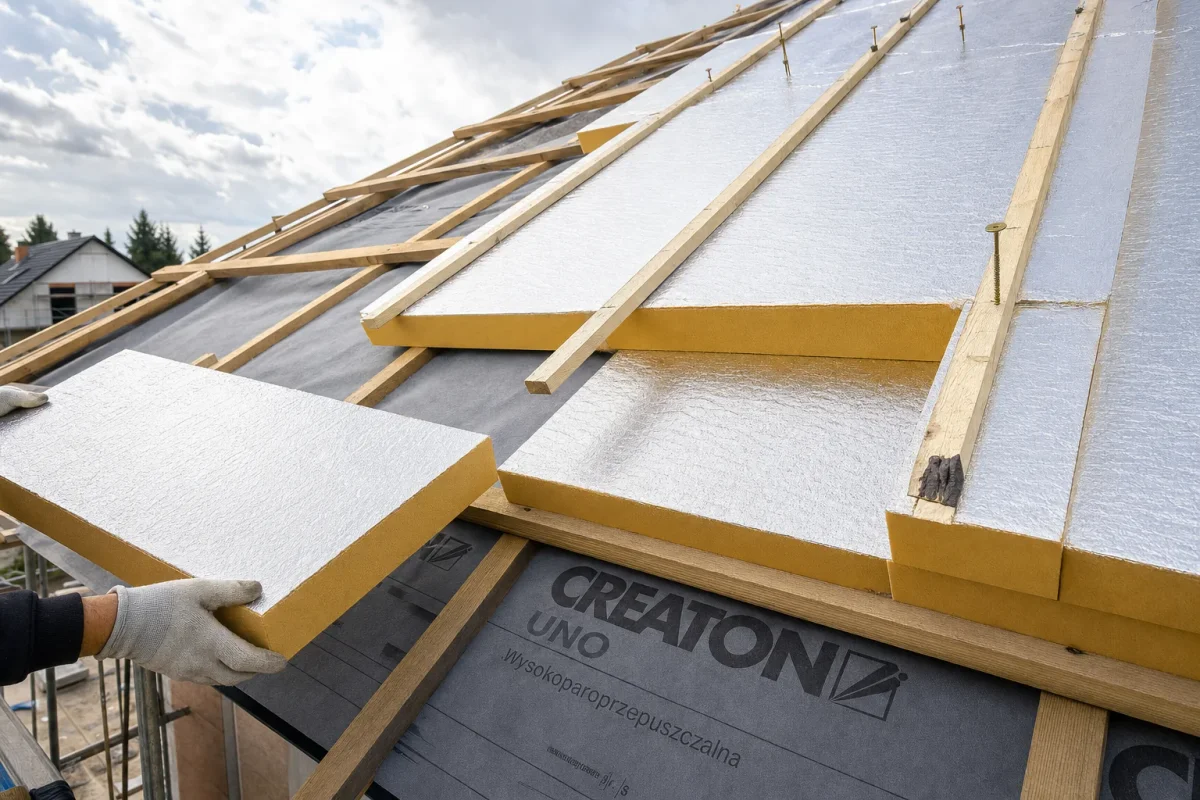
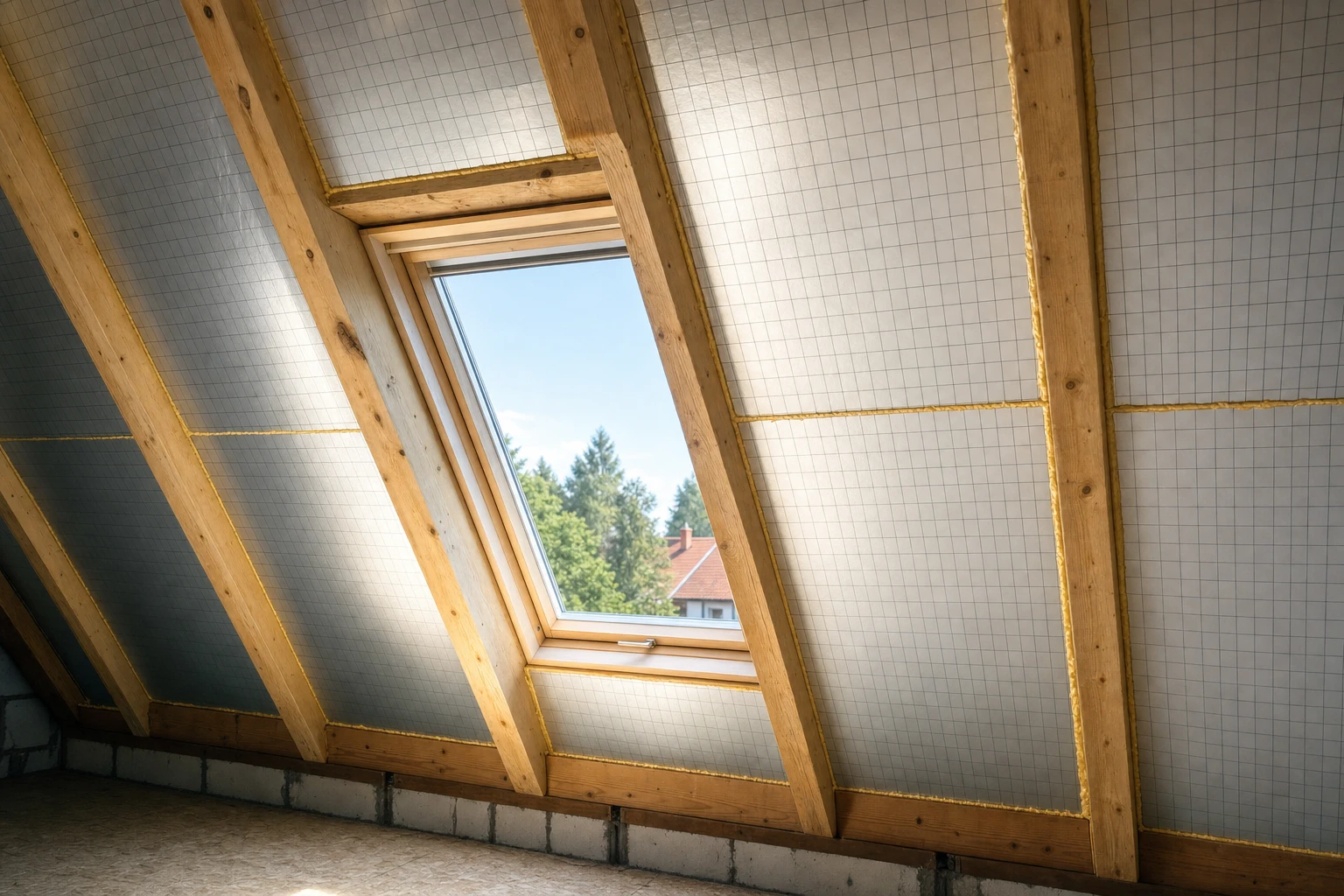
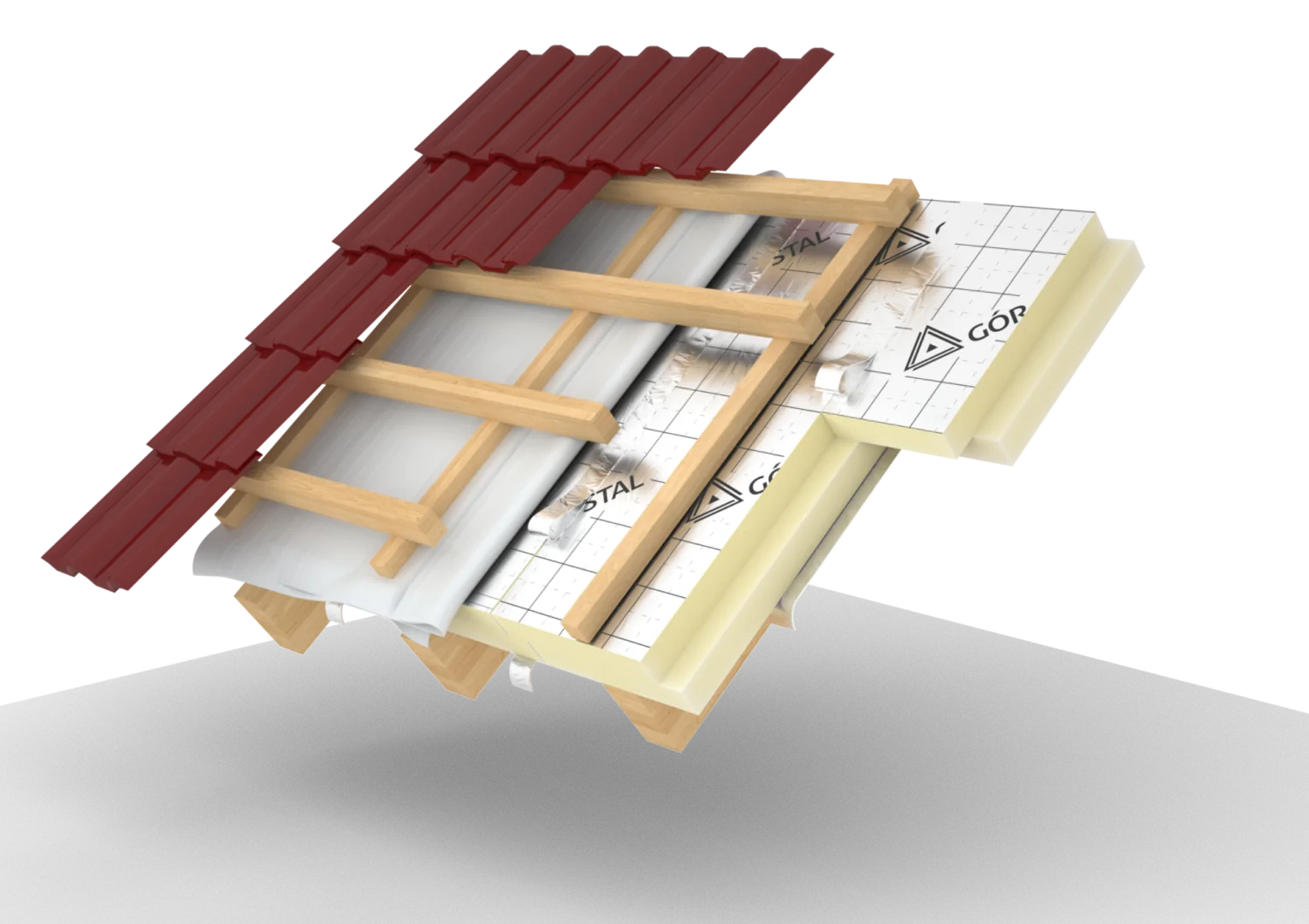
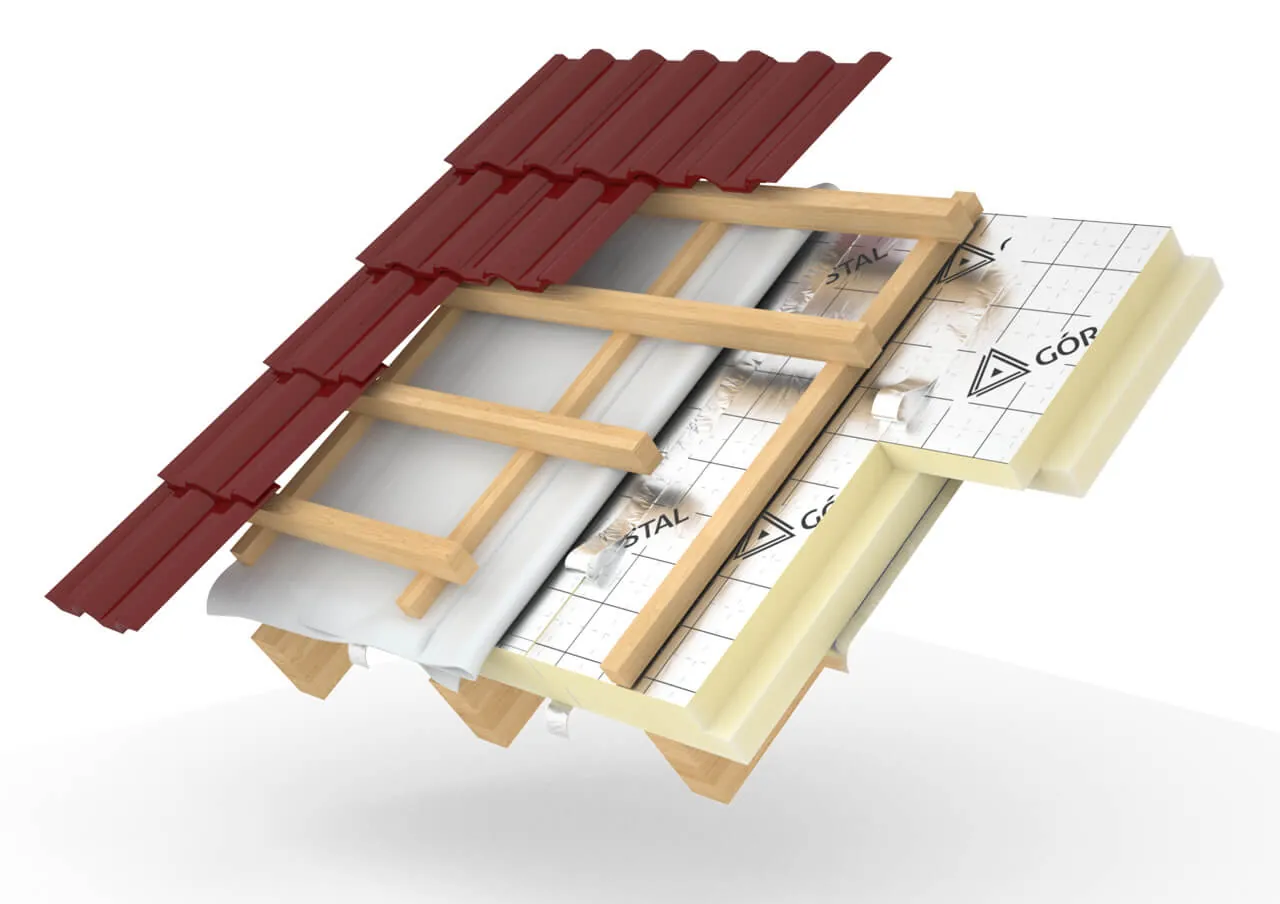
In the over-rafter method (German: Aufdachdämmung), the thermal insulation layer is laid above the rafters, on rigid board sheathing or directly on the load-bearing structure, beneath counter-battens and roof covering battens. The insulation layer forms a continuous thermal envelope in which the rafters remain on the warm side of the partition — they can be exposed as a feature element of the attic interior.
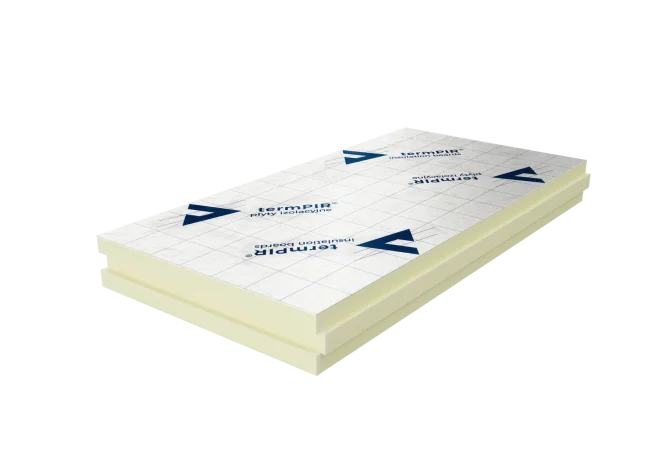
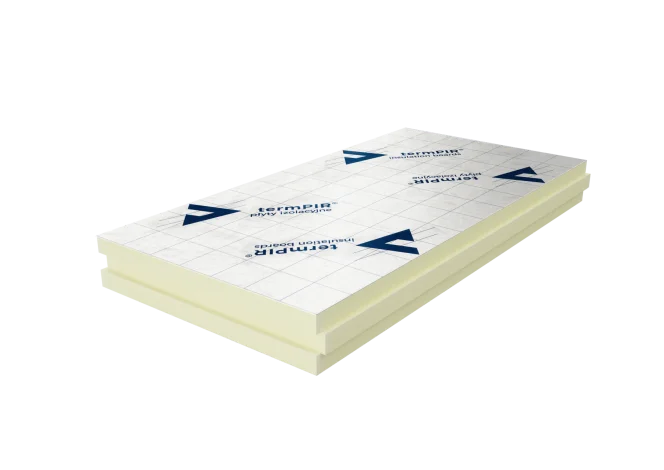
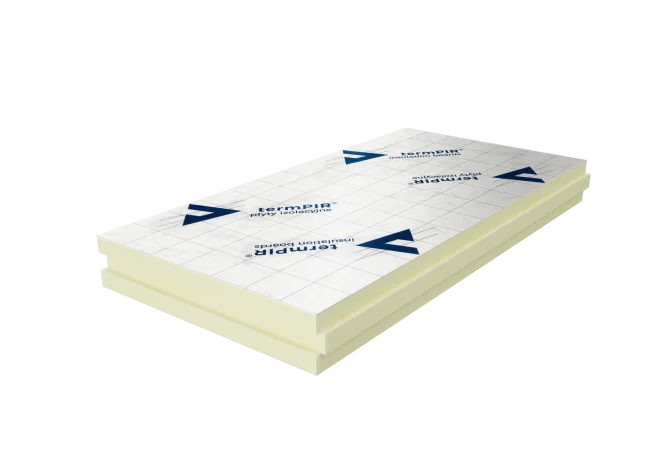
The material used in this technology must meet three criteria: stiffness sufficient to transfer loads from the counter-battens and roof covering, low water absorption, and dimensional stability. termPIR® AL boards with a gas-tight aluminium facing fully meet these criteria — short-term water absorption below 2%, compressive strength ≥ 120 kPa at 10% deformation, and dimensional stability across a temperature range from −50 to +110°C.
Technical parameters — thickness and U-value comparison
The decisive advantage of PIR boards is their low thermal conductivity. For termPIR® AL, λD equals 0.022 W/(m·K), and for the premium variant termPIR® MAX 19 AL — 0.019 W/(m·K). By comparison, mineral wool lambda reaches 0.035–0.040 W/(m·K), and EPS polystyrene 0.031–0.038 W/(m·K).
The table below shows the over-rafter insulation thickness required to meet the WT 2021 requirement (U ≤ 0.15 W/m²K), assuming it serves as the main thermal layer:
| Material | λD [W/(m·K)] | Thickness for U ≈ 0.15 |
|---|---|---|
| termPIR® MAX 19 AL | 0.019 | 13 cm |
| termPIR® AL | 0.022 | 15 cm |
| Mineral wool | 0.038 | 26 cm |
| EPS 038 | 0.038 | 26 cm |
For a combined over-rafter + between-rafter setup (W I), the over-rafter layer thickness can be reduced to 8–10 cm of termPIR®, supplementing the structure with mineral wool between the rafters. This logic is described in detail in the over-rafter termPIR® pitched roof system.
Thermal bridge elimination and water vapour control
With between-rafter insulation alone, timber rafters with λ ≈ 0.16 W/(m·K) form linear thermal bridges across 10–15% of the roof area. The energy loss is significant, and during the winter season point condensation may occur on the rafters from the room side, with a risk of mould growth over time.
An over-rafter layer of termPIR® AL shifts the dew point outside the timber structure. The gas-tight aluminium facing simultaneously acts as a vapour barrier — provided the board joints are properly sealed with aluminium tape, and the TAG profile (tongue-and-groove) ensures mechanical alignment of the edges. The BOKKA standard also includes FIT (flat) and LAP (stepped) profiles — the choice depends on the project and contractor preferences.
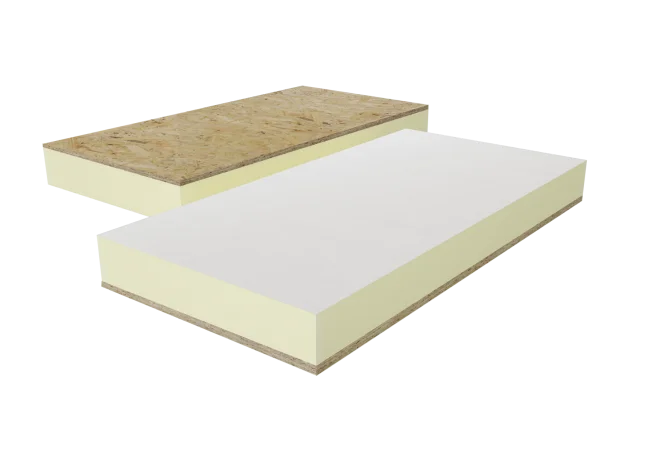
For projects requiring an integrated working substrate beneath the membrane and tile covering, the termPIR® AL/OSB composite is particularly suitable — a PIR board factory-bonded to an OSB 3 panel, ready for direct counter-batten fixing.
Step-by-step installation technology
- Substrate preparation — full plank sheathing or 22 mm OSB boards on the rafters. With the termPIR® AL/OSB variant, sheathing is not required.
- Vapour barrier — a vapour-tight film or variable vapour barrier beneath the PIR layer; in the case of termPIR® AL, the aluminium facing from below performs this function on its own.
- Board laying — with staggered joints (brick-bond pattern), with the TAG profile pressed tightly together. Boards are laid from the eaves towards the ridge.
- Joint sealing — BOKKA aluminium tape on all edges, with additional low-expansion foam sealing at chimneys and skylights.
- Mechanical fixing — roof screws with washers through the PIR board into the rafters; spacing according to structural calculations (typically 4–6 pcs/m²).
- High-vapour-permeability membrane — laid over the PIR boards beneath the counter-batten.
- Counter-battens and battens — serve as the ventilation gap and substructure for the roof covering.
When to choose the over-rafter method
Over-rafter insulation is the optimal solution in three scenarios. First — new energy-efficient and passive construction, where the requirement of U ≤ 0.10–0.12 W/m²K forces thicknesses that are impossible to achieve between rafters. Second — energy retrofits of roofs with preserved interior finishes (suspended ceilings, lining boards), where dismantling from the inside is uneconomical. Third — attics with exposed timber trusses, where the rafters are part of the interior design.
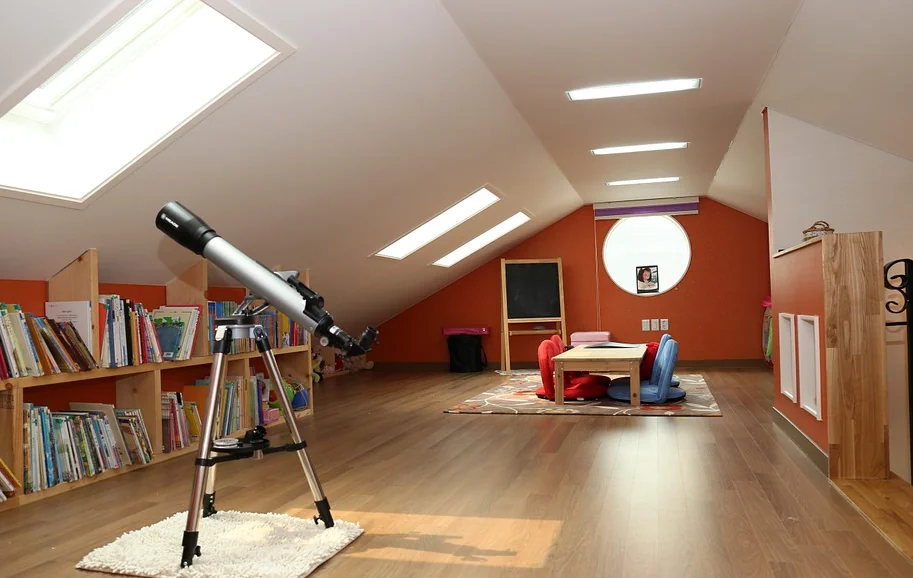
In projects with height restrictions (converted attics, low soffits), it is worth considering termPIR® MAX 19 AL — a premium board with λD 0.019 W/(m·K), allowing partition thickness to be reduced by a further ~15% versus the standard.
Environmental and certification aspects
For investments seeking BREEAM/LEED certification or funding from grant programmes, the dedicated variant is termPIR® AL R-eco — with internal glass fleece and a reduced carbon footprint. All termPIR® boards meet the EN 13165 standard (factory-made PIR products for the thermal insulation of buildings), and the roof system achieves a fire reaction class of B-s2,d0 to EN 13501-1.