How much does a PIR board cost — the price per m² and what really moves it
— Good morning, how much does a PIR board cost?
That sentence opens a great many of the calls to our office. And it almost always ends with a question back: what thickness, what facing, how many square metres, where is it going. At the other end you can hear the impatience, because it sounds like a dodge.
It is not. The question “how much does a PIR board cost” is exactly as precise as “how much does a plank cost”. This article will not give you a single figure — it will give you something more durable: the price broken down into its parts, and a method for building a budget that you can feed the current price list into.
Why “the price of a PIR board” is a question with no unit of measure
A PIR board 50 mm thick and a PIR board 200 mm thick are, in the catalogue, the same product: the same core, the same facing, the same name. On the invoice — a completely different world, because you are buying several times the volume of foam.
So the first thing to settle before comparing quotes is thickness. Without it, a price per m² means nothing, and setting two prices at two different thicknesses side by side is an arithmetic error dressed up as analysis.
The second thing is subtler. You are not buying millimetres of foam, you are buying the thermal resistance of a building element. The genuinely comparable unit is the cost of achieving your target U-value over a square metre of roof. How to work that figure out for a specific build-up of layers we showed in the piece on calculating the U-value of an assembly.
Thickness governs everything — but not in a straight line
The first surprise: doubling the thickness of a board does not double the price per m². It raises it noticeably less than twofold.
The reason is mundane. The facing, the edge machining, the cutting and the packing cost the same in a 20 mm board as in a 200 mm one. In a thin board that fixed component is spread over a dozen or so millimetres of foam; in a thick one, over two hundred.
The conclusion is counter-intuitive: the most expensive millimetre of insulation is the one you buy in the thinnest boards. Above roughly 80–100 mm the cost per millimetre settles down. That is why on an over-rafter roof it is worth aiming for 150 mm rather than stopping at 140 — the extra charge for the missing centimetre is small, and the margin against thermal bridging from the fixings is real.
Thickness has one more consequence: the thicker the board, the fewer square metres in a factory pack.
| Thickness | R [m²·K/W] at λD 0.022 | Boards per pack | m² per pack (2400×1200) |
|---|---|---|---|
| 50 mm | 2.30 | 10 | 28.80 |
| 80 mm | 3.70 | 6 | 17.28 |
| 100 mm | 4.65 | 5 | 14.40 |
| 140 mm | 6.50 | 4 | 11.52 |
| 200 mm | 9.30 | 3 | 8.64 |
Facing, edge profile and format — what really moves the price
The facing moves it, and noticeably. The cheapest variant is an aluminium–paper–polyethylene laminate, the thing commonly called “aluminium foil” — in reality aluminised paper about 0.1 mm thick, not sheet metal. That is how termPIR® AL is built.
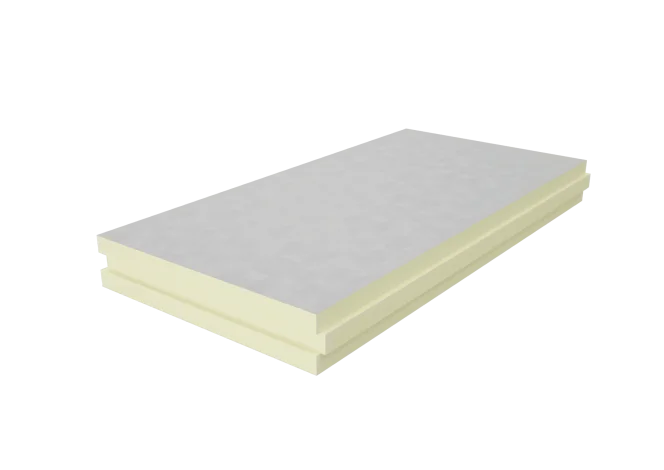
Boards with a glass veil come out dearer: ETX for ETICS systems and WS in vapour-permeable build-ups. Top of the price list stands AL+GK — a PIR board with a 12.5 mm plasterboard sheet bonded on at the factory. That is logical: you are buying two products in one and saving yourself a separate labour stage.
And the edge profile and the format? Here the popular belief tends to mislead. Within a single line the type of edge does not change the price per m² — flat FIT, rebated LAP and tongue-and-groove TAG all cost the same. Format works the same way: a square metre in a 600×1200 mm board costs what it costs in a 2400×1200 mm one.
The choice changes the arithmetic anyway: TAG and LAP close the joints without a gap, so you will use less foam and tape, while a large format speeds installation up at the price of more waste on a complicated roof slope.
Work it out properly — six steps and one unknown
We price PIR boards per gross square metre and issue them in full factory packs (AL, ETX, WS; the exception is AL+GK, sold by the board). So the requirement is rounded up to a whole pack — and that is exactly where the money usually leaks away. Not on the unit price. On one pack too many.
An example: a flat roof of 120 m², termPIR® AL 100 mm, format 2400×1200 mm. Let us call the price per m² X.
1. Net area. Here, 120 m². On a pitched roof remember that the plan projection is not the slope — we described the measuring method in the piece on how many PIR boards a roof takes.
2. Allowance for offcuts. On a plain slope 5% is enough; with chimneys and access hatches, 8–10% is realistic. Let us take 7%: 120 × 1.07 = 128.4 m².
3. Rounding up to whole packs. 128.4 ÷ 14.4 = 8.92, which means 9 packs and 129.6 m². The actual allowance came out at 8%.
4. Material cost. 129.6 × X per m². That is the only number you have to go to the price list for.
5. Accessories. The item people forget most often: insulation or timber fixings of the right length, sleeves, aluminium tape for the joints, foam, PIR foam plugs. They are selected to suit the board thickness and the substrate — one set goes into concrete, another into timber.
6. Delivery or collection. Domestic delivery, on pallets — or collection in person from the warehouse in Wola Batorska, which zeroes that item out. A practical note: we do not run lorries with a loading crane, so plan the unloading on your side.
And now the counter-example. Instead of working it out, you go with the popular “let us take 10% more”: 120 × 1.10 = 132 m², divided by 14.4 gives 9.17 packs, which means 10 packs and 144 m². Two percentage points of difference in an assumption turned into a whole extra pack that will end up sitting under a lean-to.
Why PIR can be dearer per m² and cheaper across the project
Put two quotes for the same thickness side by side and PIR will lose to every cheaper material. Except that nobody buys thickness — what you buy is a building element with a target U-value.
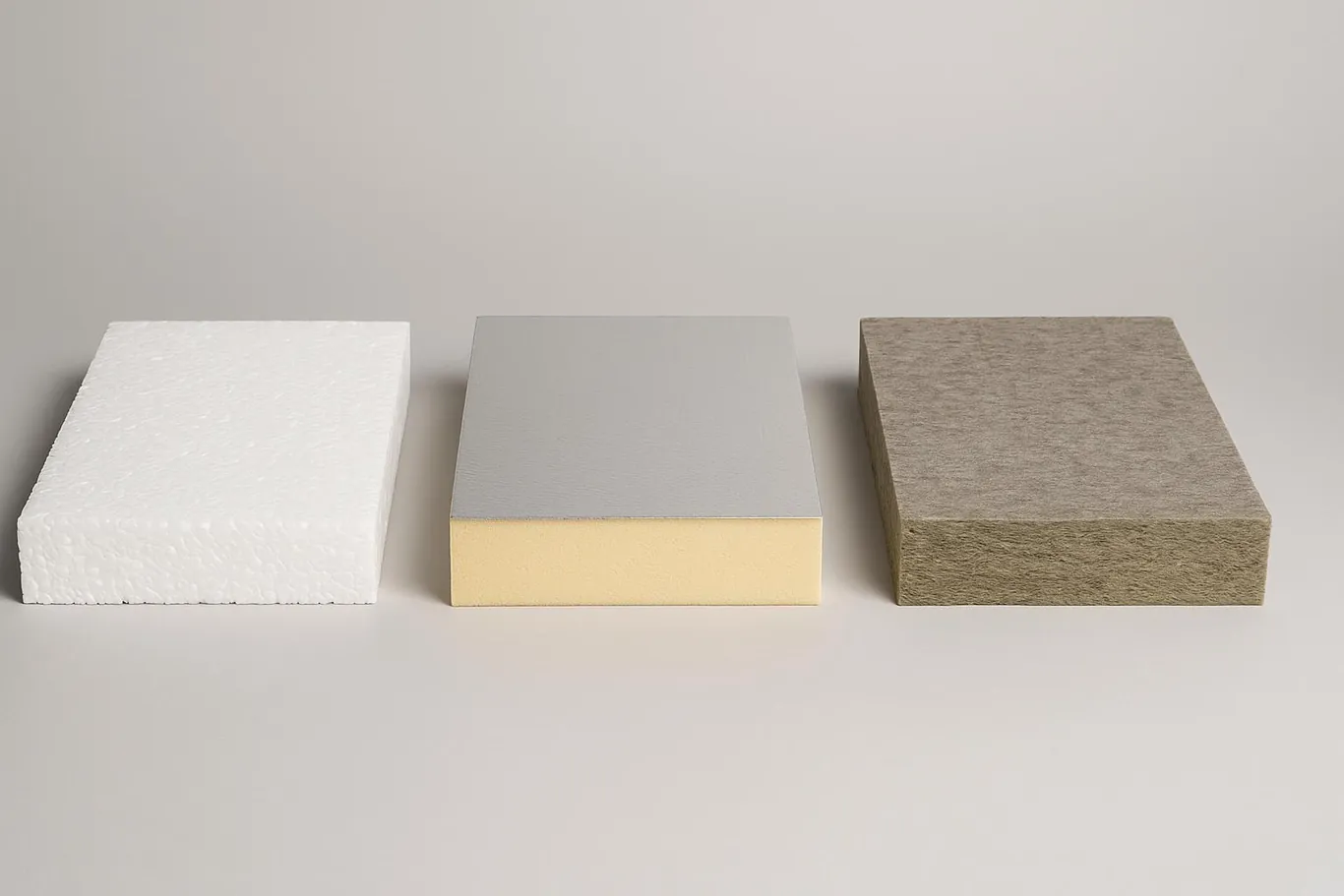
A PIR core has λD = 0.022 W/(m·K). Mineral wool in typical applications is up around 0.035, EPS around 0.038. At the same thermal resistance the PIR layer is roughly a third thinner: where PIR settles the matter at about 150 mm, wool needs well over 200 mm.
And that is when the things that never appear on an insulation price list start to count. Shorter fixings. Less timber in the counter-battens. Less lost headroom — in a loft conversion those few centimetres can be the difference between meeting a requirement and rebuilding.
We did the sums separately: in the ROI analysis of PIR versus EPS and in the comparison of PIR against mineral wool over 30 years. The short version of both: compared at the level of U-value, the difference in price per m² shrinks sharply.
Where you can genuinely save
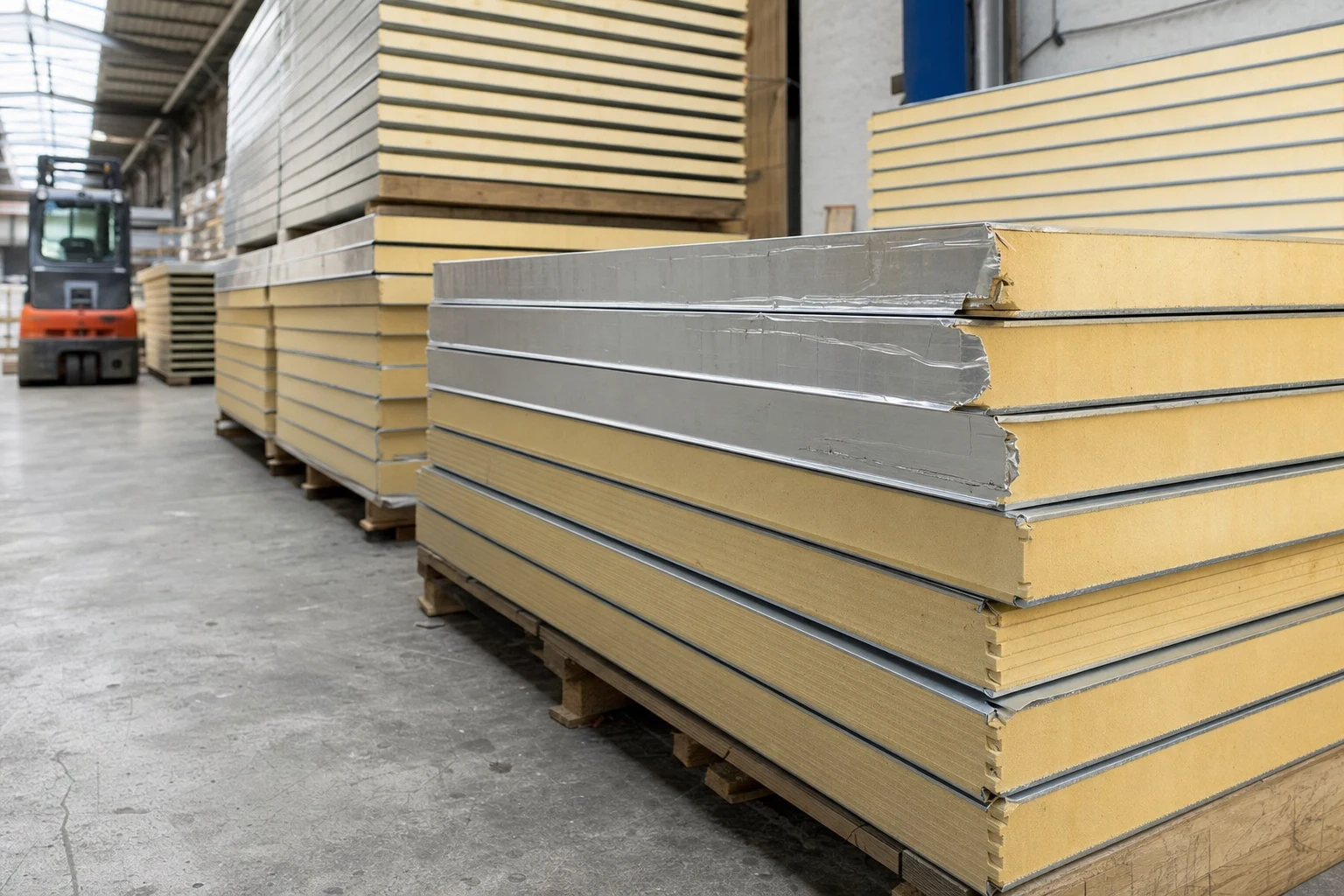
Full packs instead of broken-up sets. The boards travel in their original wrapping, nobody splits the bundle, and the film protects the facing until the day of installation. Less damage in transport means fewer boards thrown away.
Collection in person from Wola Batorska. If you have something to come with, delivery disappears from the budget.
Second grade where nobody will ever see it. Boards with visual or dimensional defects have the same core and the same λ, and under a screed or in a floor slab over a cellar they behave identically. Where the line of common sense runs we set out in the piece on when second-grade PIR boards pay off. You will find the offer in the Outlet category — we only sell what is physically in the warehouse, so zero stock means “sold out”. The shop itself runs in Polish.
A properly calculated allowance. The cheapest of these four — it costs a quarter of an hour with a tape measure and a calculator.
Where to check the current price of PIR boards — and in what order to count
Since 10 September 2026 prices have been open in the BOKKA shop. On the product page you will see the gross price per m² for the chosen thickness, format and edge profile, the stock level and the size of the factory pack — precisely the numbers you need for the arithmetic in this article. For larger quantities and made-to-order formats, write to an advisor.
Because the price of a PIR board is not a property of the product but the result of your design decisions — thickness, facing, unit of sale, allowance and method of collection shift the final figure more than the differences between price lists do.
Which is why the order is the opposite of what instinct suggests. First the U-value and the thickness, then the board variant, and only at the very end the price per m². Done that way it takes a quarter of an hour and gives you a number you can trust. Done the other way round, it gives you a quote that will come apart on site.
🤝 Contact a BOKKA technical advisor — we will help you choose the thickness and variant of rigid PIR insulation boards for your building element and work out the real requirement in full packs.
Sources:
- Technical data sheets and Declarations of Performance for termPIR® AL, ETX, WS and AL+GK boards — λD, thicknesses, formats, edge profiles, facings
- PN-EN 13165+A2 — Thermal insulation products for buildings. Factory made rigid polyurethane foam (PU) products. Specification
- Regulation of the Polish Minister of Infrastructure on the technical conditions to be met by buildings and their siting (WT 2021)
Frequently asked questions
How much does a 100 mm PIR board cost?
Why is a PIR board more expensive than EPS?
Do I buy cheaper by taking a full pack rather than single boards?
Do PIR board prices change through the season?
Related products and systems
Read next
Second-grade PIR boards — when they pay off and when they are a trap
PIR vs EPS/XPS vs Mineral Wool: ROI Analysis for Designers | BOKKA

Energy Retrofit with PIR Boards and WT 2021 in Practice | BOKKA