Second-grade PIR boards — when they pay off and when they are a trap
A phone call on Monday morning. — I have seen you have second-grade PIR board. Just tell me straight: it insulates worse, right?
No. Not worse. And that is exactly why the conversation then runs for another ten minutes — because if the core is the same, then where is the catch.
There is a catch. Just not where most people look for it.
Where second-grade PIR board comes from in the first place
Nobody makes second grade on purpose. It makes itself, along the way — on the line, in the warehouse, on the trailer.
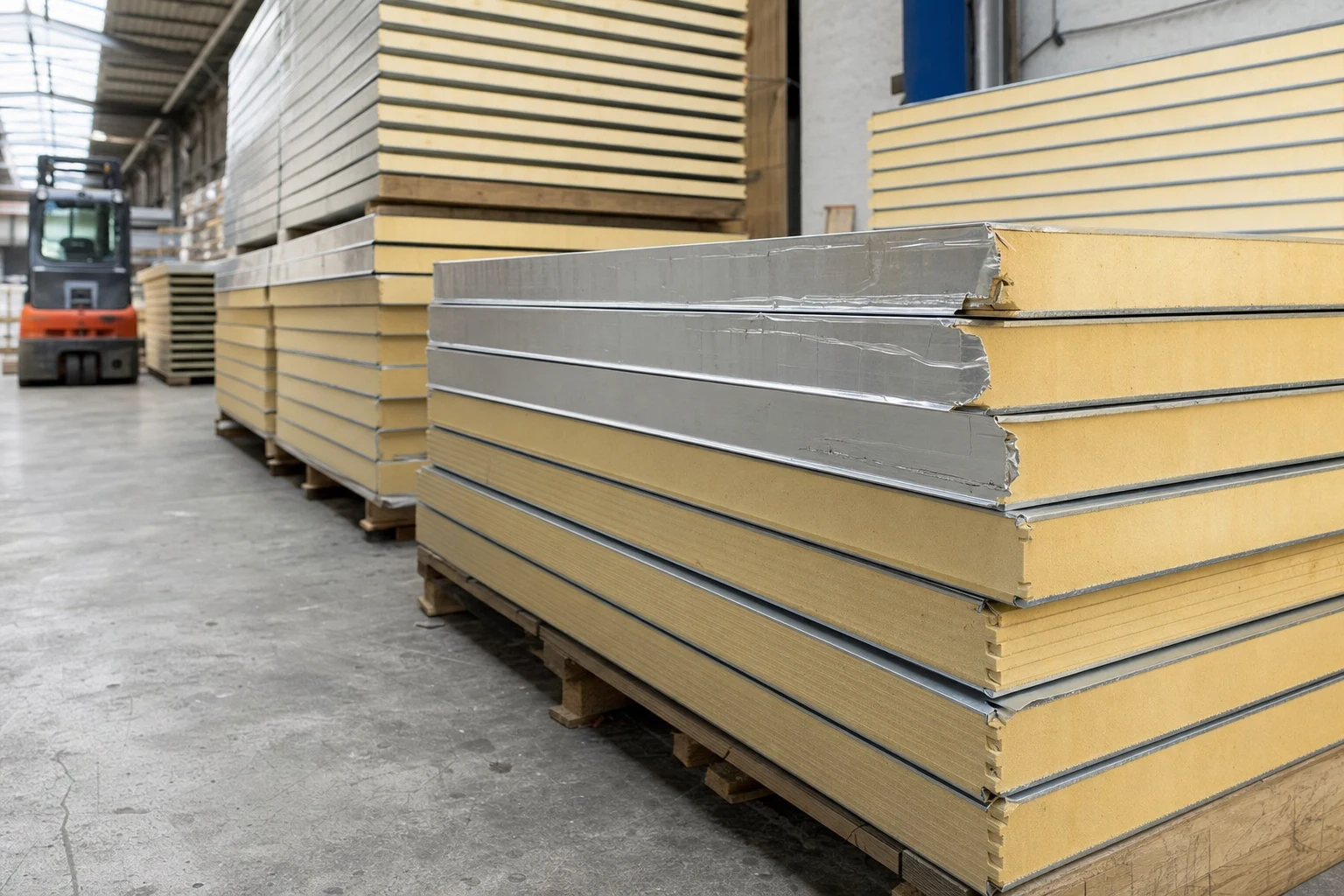
The most common source is end-of-run material: the plant finishes a large batch in one thickness and is left with boards nobody ordered. Then there are non-standard lengths and formats — boards outside the standard 1200 × 600 mm, which cannot be slotted into the regular range. There are also dimensional deviations: thickness or squareness stay well within the bounds of common sense, but outside the tolerance the manufacturer holds for a catalogue product.
The second group of reasons is more mundane. Damage to the facing or the edges in transport and storage — scuffed foil, a dented corner of the pallet, a torn strip of aluminised paper. And finally batches with a colour deviation in the facing: two deliveries of the same board can differ in shade, which is disqualifying for a catalogue and completely irrelevant for a floor slab under a screed.
Notice what is not on that list. There is no “worse core”. No cheaper foam, no shortened process. Second grade is board that dropped out of the main stream because of looks, dimension or logistics.
Do second-grade PIR boards insulate worse?
Short answer: no, as long as the board is dry and not crushed.
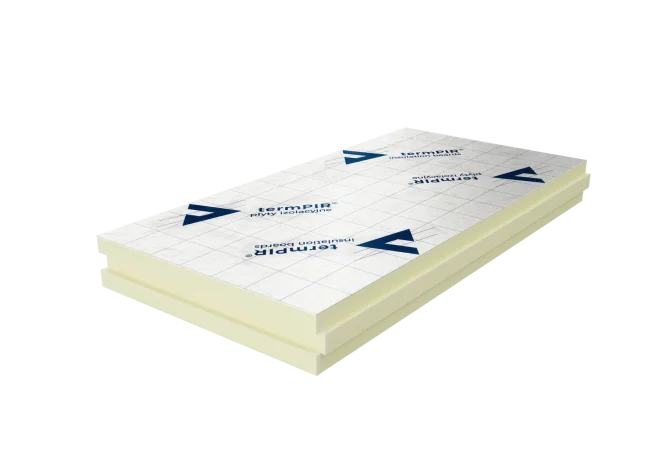
The declared thermal conductivity is a property of the core and the facing, not of whether the board has a scratch on its surface. termPIR® AL with an aluminised facing has λD = 0.022 W/(m·K), and the glass-veil variants — ETX and WS — 0.025–0.027 W/(m·K). The same numbers apply to a board from that very same production run which ended up in the outlet because somebody clipped the corner of the pallet with a forklift.
Two caveats are real, though, and worth understanding.
First: water. A PIR core absorbs very little water, but a board that has spent the winter in a puddle, or under a tight sheet collecting condensate, stops being a cheap bargain. Moisture in a building element is not “a few per cent off” — it is different physics.
Second: a crushed core. Rigid foam takes compressive load very well, right up until somebody crushes it at a point. A board with a visibly compressed band is not second grade but material to be rejected — and that is how we treat it.
And one thing hardly anyone remembers: the “aluminium” facing on termPIR is aluminised paper about 0.1 mm thick, not sheet metal. Minor scuffs do not change the thermal figure. But if the board is meant to work in the build-up as a gas-tight layer, large tears in the facing become a design decision rather than cosmetics — what that facing actually does in an assembly we describe on the termPIR AL product page.
What you give up along with the lower price
This is where the honest part of the conversation begins.
Buying second grade, you do not get the complaints and documentation route you get with first grade. The defects are described and visible before purchase — you accept them by buying. There is no guarantee of replacement with an identical product either: if in three months you are two boards short, nobody will top them up from the same batch, because that batch no longer exists.
The second loss is logistic, and it is the one that catches people out most often. The outlet sells from current stock. What lies in the warehouse today may not exist tomorrow — and then the item is simply sold out, not “available to order”. Second grade cannot be back-ordered, because nobody makes it on request.
The third thing is about planning. With first grade you are buying repeatability: the same thickness, the same format, the same shade in the next delivery. With the outlet you are buying one specific stack. If your project is going to split into two phases six months apart — that is an argument for first grade, price aside.
Where second grade is simply a good buy
Everywhere that thermal resistance is what counts, and looks and paperwork are not.
Outbuildings, a garage, a carport, a workshop — the classics of the genre. Nobody inspects the colour of a facing in a garage, and insulating a metal garage with PIR board works exactly the same whether the board has a scratch or not.
Insulating a floor slab over an unheated space — a cellar, a drive-through, a garage under the building. The board goes up under the ceiling and stays there for twenty years, viewed exclusively by spiders.
A ground-bearing floor under a screed is probably the best scenario there is for the outlet: the boards disappear under a layer of concrete and only the thickness and the stiffness of the core matter. How to build up those layers we set out in the guide to insulating a ground floor.
And finally self-funded retrofits with no grant — when the owner does the job at home, out of their own pocket, and nobody is going to settle it or sign it off.
Where not to buy second grade — and we will say it plainly
There are places where the saving turns into trouble, and there is no point dressing that up.
Grants and support programmes. If the cost is to be settled from funding, the material has to be a documented product — the outlet does not provide that route.
The thermal retrofit tax relief. The rules for claiming it, and what has to end up in the file, we go through in the piece on the thermal retrofit relief and invoices. If you are planning to get part of the money back from tax, do not risk material without full documentation in order to save less than the refund is worth.
Sign-offs, and works run on a building notification or on a permit with a design. The designer writes a specific product with specific parameters into the documentation; the inspector checks whether that is what is lying on site.
ETICS. An external wall insulation system is a set: board, adhesives, mesh, render — tested and approved as a whole. For ETICS the suitable product is termPIR® ETX with the appropriate European assessment, as an element of a system, not “some PIR board from the outlet”. The typical mistakes at this stage we collected in the article on the ETICS system with termPIR ETX.
The rule is simple: if anybody other than you is going to look at the paperwork — take first grade.
Do the maths on the whole set, not per square metre
The most common mistake with the outlet is comparing the price per square metre of two different boards. That makes no sense, because a square metre does not insulate — thickness insulates.
Count it like this:
- Establish the required thickness for your building element (not the one that happens to be on offer).
- Work out the net area of that element.
- Add the offcut waste — usually small with catalogue formats, but noticeably larger with non-standard outlet lengths, because the board does not lay out “to module”.
- Multiply the gross area by the price from the product page and add the accessories — fixings, tapes, foams. They cost the same with either grade.
- Compare two final totals, not two unit rates.
The method for working out what you need, including the allowance for offcuts, we wrote up in the guide to how many PIR boards a roof takes.
| What you compare | First grade | Second grade (outlet) |
|---|---|---|
| Core and λD | catalogue values | the same, if the board is dry and uncrushed |
| Documents and complaints | full route | none — you buy the condition described on the product page |
| Batch repeatability | you can buy the same again | one batch only, no repeat run |
| Dimensions | catalogue formats | can be non-standard, allow for more waste |
| Availability | made to order | only what is lying in the warehouse today |
What to look at before you sign for the delivery
The outlet is bought with your eyes. Five minutes at the pallet saves a lot of later conversations:
- A dry facing — no streaks, no stains, no marks from standing water.
- Edges without crushing — especially the tongue-and-groove and rebated locks. They are what decides whether the boards will close up tightly.
- No delamination — the facing must not be coming away from the core, not even at one corner.
- The stack stored flat, on level ground. Boards stored “in a bow” can keep that bow for good.
- Consistent thickness within the batch — if you are taking 100 mm, every board has to be 100 mm. Mixed thicknesses in one layer are guaranteed trouble during laying.
If anything on that list raises a doubt, better to ask before you sign for the delivery than after the screed has been poured.
Stock changes from one day to the next — and who really gains
In the shop, the outlet product pages show the real stock in square metres, refreshed automatically from warehouse levels. This is not a catalogue saying “we carry it”, but a list of what is physically lying in Wola Batorska. So availability is checked live, on the page of the specific board: Outlet — second grade, and within it second-grade rigid PIR insulation boards — the shop itself runs in Polish. Sandwich panels have their own separate shelf in the outlet — different transport, different market; if those are what you are after, take a look at the piece on second-grade sandwich panels.
The summary fits into one sentence. If you are insulating a garage, a workshop, a floor slab over a cellar or a ground-bearing floor, and nobody is going to look at the paperwork — second grade is one of the most sensible purchases you can make. If a grant, a tax relief, a design, a sign-off or an ETICS system is in play — buy first-grade rigid PIR insulation boards and sleep soundly. The rest is arithmetic: thickness, area, waste, total.
🤝 Contact a BOKKA technical advisor — we will check whether an outlet batch is enough for your building element, or whether it is better to take first-grade rigid PIR insulation boards with the full set of documents.
Sources:
- PN-EN 13165+A2 — Thermal insulation products for buildings. Factory made rigid polyurethane foam (PUR/PIR) products. Specification
- PN-EN 13172 — Thermal insulating products. Evaluation of conformity
- Technical data sheets for termPIR® boards (AL, ETX, WS, AL+GK) — declared λD values, thicknesses, formats and edge profiles
- Polish Personal Income Tax Act of 26 July 1991 (Art. 26h — the thermal retrofit tax relief), together with the regulation listing the building materials covered by the relief
- ETA 17/0066 — European Technical Assessment for the ETICS external wall insulation system with PIR boards (termPIR® ETX)
Frequently asked questions
Do second-grade PIR boards insulate worse?
Do I get the documents with second-grade PIR boards, and can I claim the thermal retrofit tax relief?
How much can you save on second-grade PIR boards?
How do I know how many second-grade PIR boards are in stock?
Related products and systems
Read next
PIR vs EPS/XPS vs Mineral Wool: ROI Analysis for Designers | BOKKA

Energy Retrofit with PIR Boards and WT 2021 in Practice | BOKKA

Retrofitting Old Houses with PIR Boards — Energy Upgrade Guide