Polyurethane boards: PUR or PIR? How they differ and what you are really buying
— Good morning, I’m looking for polyurethane boards for a roof.
— PIR, you mean?
— I don’t know. The design says “polyurethane boards”, my neighbour says “PUR”, and in the shops all I see is “PIR”. Are those three different things?
Two, and closely related ones at that. The trouble is that the names circulate interchangeably on the market, while you have to order a specific product and not get it wrong by one letter. Let us untangle it in order: first the chemistry in a single picture, then what you can see on the label and in the documents.
PUR and PIR are one family. So why two names?
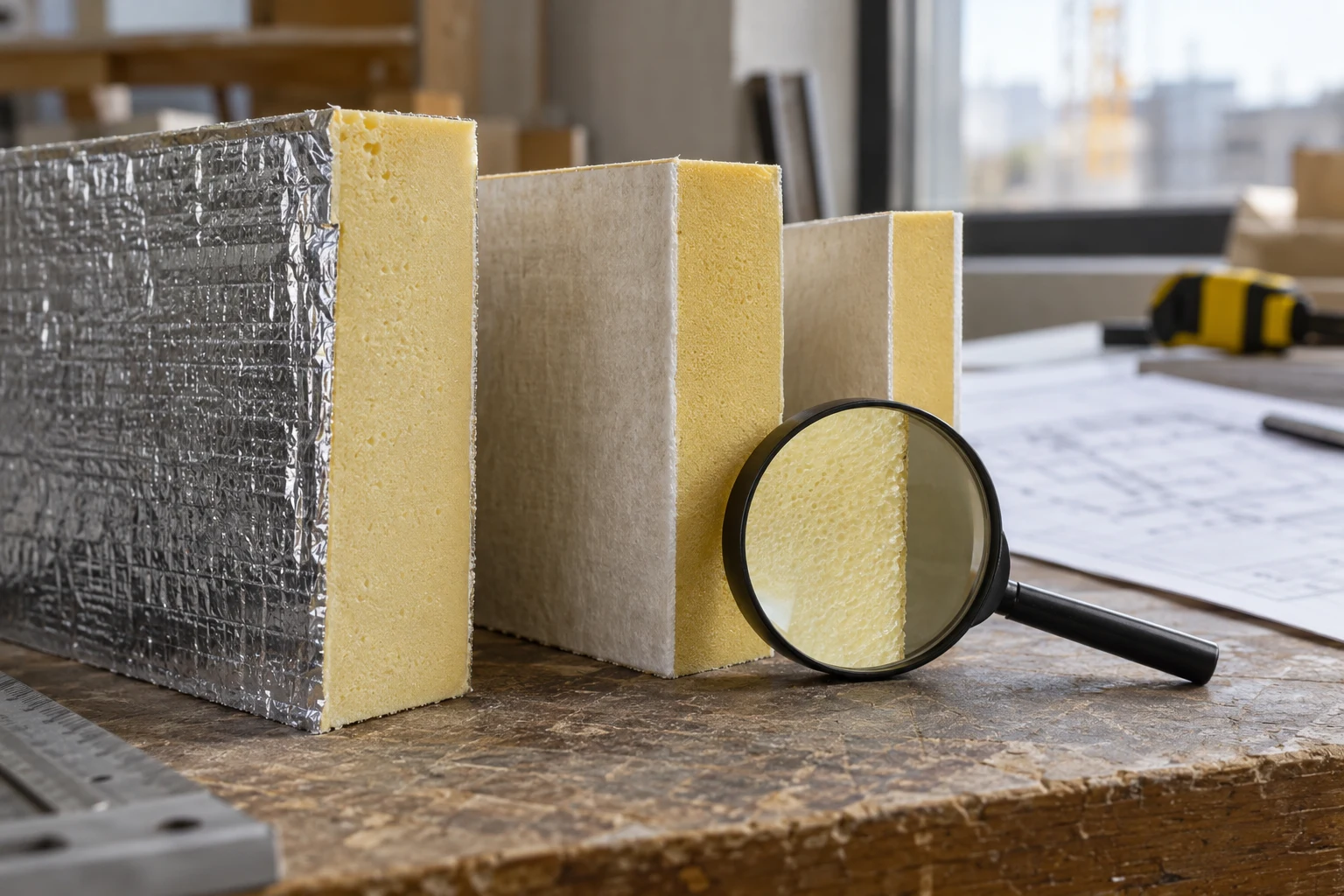
Both abbreviations describe rigid polyurethane foam: a plastic foamed so that it consists of millions of closed cells filled with gas. It is that gas, trapped in the cells, that accounts for the very low thermal conductivity.
PUR is polyurethane to the classic recipe. PIR, or polyisocyanurate, is made from the same ingredients but in different proportions, so that some of the molecules close up into stable isocyanurate rings.
Picture a scaffold: in PUR the tubes are held by single couplers; in PIR, every few nodes there is a rigid ring that holds the whole thing together when it gets hot.
So to the question “PUR or PIR” the answer is: both are polyurethane boards, except that PIR is the variety with a more densely cross-linked, more resistant structure.
What do those rings change when it gets hot?
The difference shows in two situations: in fire and in ordinary summer heat under the roof covering.
The bonds in classic PUR give way to temperature sooner, so the foam softens faster and breaks down faster. Isocyanurate rings are more durable. The manufacturer of termPIR® boards states that these structures only break down above 300°C, and that in contact with flame the foam chars and forms a layer on the surface that shields the deeper parts of the core.
That does not mean PIR is non-combustible. It is still an organic plastic: an unenclosed termPIR® AL board has reaction-to-fire class E in thicknesses of 50–250 mm and F in thinner ones. Higher classes appear only once the board is built in — termPIR® AL in a build-up with trapezoidal sheet achieves B-s2,d0, and termPIR® ETX in the façade insulation system assessed in ETA 17/0066 — B-s1,d0. What those letters and indices mean, we set out in the piece on Euroclasses of reaction to fire.
The second matter is dimensional stability. A board that shrinks or bows under a dark covering opens the joints, and every gap is a heat loss. In the termPIR® AL declaration for thicknesses from 50 mm you will find the entries DS(70,90)3 and DS(-20,-)2: the product was tested at 70°C and 90% humidity and at −20°C.
Why is an insulation board today almost always PIR?
Because a building makes exactly those two demands of its insulation: it has to behave predictably in a fire and hold its dimensions for decades. Factory-made polyurethane boards for insulating roofs, floors, walls and foundations are therefore produced today mainly in the PIR variety.
PUR has not disappeared, it has just changed address. You will meet it in canned expanding foam, in spray foams, in adhesives and seals. When someone says “PUR boards” or “polyurethane foam boards” and means a rigid faced board for insulating a house, in practice they almost always mean PIR.
There is one more misunderstanding worth defusing. “Polyurethane board” — or “polyurethane panel” — is also the everyday name for a sandwich panel: two profiled steel sheets with a foam core between them. That is a different product — for cladding halls, warehouses, cold stores and garages, not for insulating a house. If that is what you are after, have a look at PIR sandwich panels; from here on we are talking solely about insulation boards.
How to check on the label and in the DoP what you are really buying?
A trade name settles nothing, so reach for two documents: the technical data sheet and the Declaration of Performance, DoP for short. That is where the manufacturer declares the product’s parameters and takes responsibility for them.
Start with the standard. Boards of this type come under PN-EN 13165, whose title speaks of “factory made rigid polyurethane foam (PU) products”. One standard covers both varieties, which is why its number on the label will not, on its own, tell you whether you are holding PUR or PIR. That information is in the description of the core: on termPIR® data sheets it reads rigid polyisocyanurate foam, i.e. PIR.
Then read four items from the declaration table. Taking termPIR® AL as the example, they look like this:
- λD = 0.022 W/(m·K) — declared thermal conductivity; the lower it is, the thinner the layer that gives the same effect.
- Reaction to fire: E (50–250 mm), F (20–49 mm) — always with a thickness range and always for the unenclosed product.
- CS(10/Y)120 — compressive stress of at least 120 kPa at 10% deformation; important under a screed and on a flat roof.
- WL(T)2 — long-term water absorption of no more than 2%.
Finally, compare the product-type code with the quote and check that the table covers your thickness. The code is a short identifier from the declaration, for example termPIR/AL/18 — the same one should appear in the quote and on the label. We go through the whole anatomy of these documents in the guide to the DoP, ETA and AVCP certificate.
Facing, thickness, format — three choices that matter more than the name of the foam
In the four boards in the table below the core is the same: PIR foam with a density of 30 kg/m³. Where a board may be laid is decided by what it is faced with.
| Product | Facing | λD [W/(m·K)] | Thicknesses in the shop | Format [mm] |
|---|---|---|---|---|
| termPIR® AL | paper–aluminium laminate, gas-tight | 0.022 | 20–250 mm | 600 × 1200 and 2400 × 1200 |
| termPIR® ETX | glass veil, vapour-permeable | 0.025–0.027 | 50–200 mm | 600 × 1200 |
| termPIR® WS | glass veil, vapour-permeable | 0.025–0.027 | 20–200 mm | 600 × 1200 and 2400 × 1200 |
| termPIR® AL GK | paper–aluminium and 12.5 mm plasterboard | 0.022 (core) | 20–120 mm (PIR layer) | 1200 × 2600 |
In the glass-veil boards λD depends on thickness: 0.027 below 80 mm, 0.026 in the 80–119 mm range and 0.025 from 120 mm.
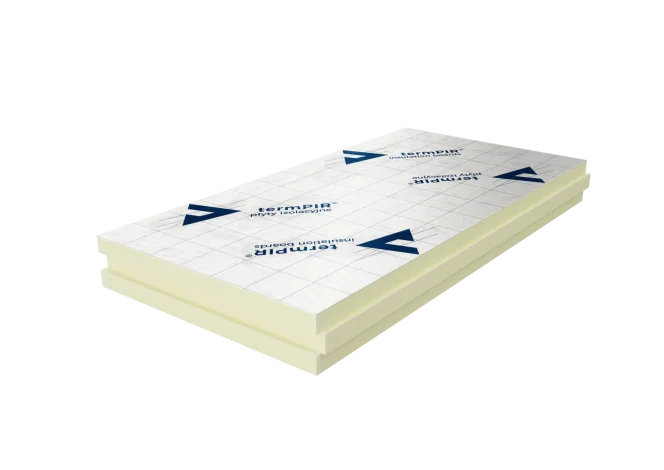
termPIR® AL (the shop runs in Polish) is the all-round variant: roof, floor, ceiling slab, foundation and three-layer cavity wall, i.e. masonry with the insulation in the middle. Its “aluminium” facing is a thin laminate of paper and aluminium about 0.1 mm thick, not sheet metal. It does not let water vapour through, so this board is not laid under render.
For insulating a façade in the ETICS system, i.e. under thin-coat render, only termPIR® ETX will do, installed with the system adhesive and mesh per ETA 17/0066. termPIR® WS has a similar veil and goes on flat roofs, terraces, and basement and foundation walls.
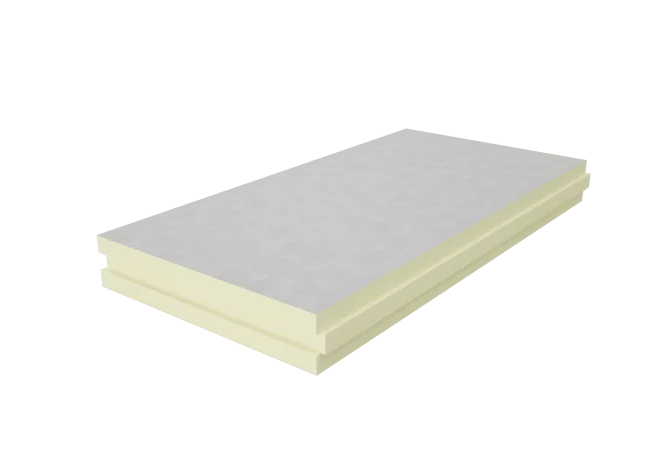
termPIR® AL GK is a product designed for work from the inside: a loft under the rafters, a wall from the room side. Insulating from the inside does, however, require a moisture analysis and a continuous vapour barrier, i.e. a layer that stops water vapour — take advice on this build-up before you buy.
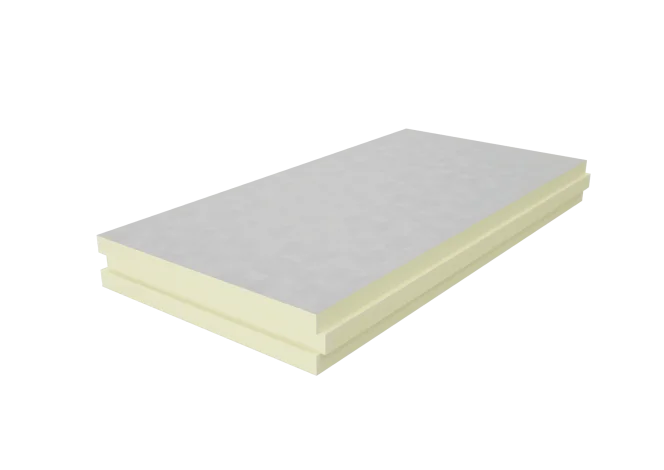
That leaves format, edges and packs. A large format means fewer joints on the slope; a small one is easier to carry up to the loft and to cut around a chimney. FIT is a flat edge, LAP — rebated, TAG — tongue-and-groove, which locks the joint shut.
Boards are bought in full packs: termPIR® AL at 100 mm is 5 boards per pack, i.e. 3.60 m² in the small format or 14.40 m² in the large one. We have gathered all the variants in the category PIR insulation boards.
Insulating a roof with polyurethane boards — where to start?
With the build-up. The best result comes from over-rafter installation: the boards lie as a continuous layer on top of the rafters, so the timber does not interrupt the insulation. The order of layers is shown in our system pitched roof with termPIR® over the rafters.
Then thickness. Thermal resistance is calculated with the formula R = d / λ. For 150 mm of termPIR® AL:
R = 0.150 / 0.022 = 6.82 m²·K/W
After adding the surface resistances on both sides of the element (0.14 m²·K/W together) you get U ≈ 1 / 6.96 ≈ 0.14 W/(m²·K), against the requirement of the Polish WT 2021 building regulations for a roof of U ≤ 0.15. That is an estimate for the insulation layer alone; the design is what binds.
Why 150, when 140 mm also gets to 0.15? Because it only just gets there, and the screws fixing the counter-battens — the timber strips that press the boards down onto the rafters — pass through the insulation and worsen the result. You can check your own build-up in the U-value calculator.
And a detail that is easy to overlook: the joints of boards with an aluminium facing are sealed with aluminium tape. Only a taped facing works as a continuous, sealed layer rather than a collection of sealed pieces.
The roof is not the only place. The same boards work in a ground floor, on a ceiling slab, in a cavity wall and at a foundation — you will find an overview broken down by building type in the piece on applications of PIR boards.
Who makes polyurethane boards, and what does the price depend on?
Asking about the manufacturer makes practical sense: it is the manufacturer who issues the DoP and answers for the declared parameters. termPIR® boards are produced by Gór-Stal. BOKKA is a distributor: we have been in business for ten years, we sell this manufacturer’s boards, keep them in stock at our warehouse in Wola Batorska near Kraków and run an online shop. How buying from a manufacturer, a distributor and an intermediary differs in practice, we described in the guide on how to choose a PIR board supplier.
Price is much like the name: one word, several variables. The price of polyurethane boards per square metre depends first on thickness, then on the facing, and in an order there is also the rounding up to full packs. We give no figures here, because they change more often than the article does. Current thicknesses, availability and prices can be seen in the BOKKA shop, and we showed the method for working out a budget in the piece on how much a PIR board costs.
You are buying PIR. The question is: which one
Polyurethane boards is the name of a family. PUR and PIR are relatives within it, and a factory-made board for insulating a building is today, in practice, PIR, because it copes better with temperature and holds its dimensions. You can confirm that in a minute: the PN-EN 13165 standard on the label, PIR in the description of the core, the parameters in the DoP.
The real choice begins further on. The facing decides the application, the thickness decides the U-value, and the format and edge decide how easy installation is. So start from the building element you are insulating, not from the abbreviation on the packaging.
🤝 Contact a BOKKA technical advisor — tell us what you are insulating and we will select the variant and thickness of termPIR® insulation boards and send you the full set of documents.
Sources:
- PN-EN 13165+A2 — Thermal insulation products for buildings — Factory made rigid polyurethane foam (PU) products — Specification
- PN-EN 13501-1 — Fire classification of construction products — reaction to fire
- Declaration of Performance for termPIR® AL (DoP no. termPIR/AL/18) — λD, reaction-to-fire classes, CS(10/Y)120, WL(T)2, dimensional stability
- Brochure “termPIR® insulation boards” (Gór-Stal, 2025) — core type, facings, dimensions, λD of glass-veil boards
- Technical data sheets for termPIR® AL, ETX, WS and AL GK
- ETA 17/0066 — European Technical Assessment of the ETICS system on termPIR® ETX boards
- EN ISO 6946 — Building components and building elements: thermal resistance and thermal transmittance (Rsi/Rse surface resistances)
- Regulation on the technical conditions to be met by buildings and their siting (WT 2021)
Frequently asked questions
What is the difference between a PUR board and a PIR board?
Are polyurethane boards suitable for insulating a roof?
Who makes termPIR® polyurethane boards?
How much do polyurethane boards cost?
Related products and systems
Read next
Second-grade PIR boards — when they pay off and when they are a trap
PIR vs EPS/XPS vs Mineral Wool: ROI Analysis for Designers | BOKKA

Energy Retrofit with PIR Boards and WT 2021 in Practice | BOKKA