Choosing a PIR board supplier — manufacturer, DoP, ETA, lead times
Three quotes in the inbox. The same thickness, the same brand on the facing, and prices that diverge by a good ten per cent or more. One firm replied within two hours, the second after two days, the third sent a scan of a price list with no date on it.
The question looks simple: which one to take. In practice it is three questions, because behind those quotes stand three models — a factory, a distributor with a warehouse, and somebody who will pass the order on and add a margin.
Below are the questions worth asking each of them — including when you end up buying somewhere else.
Who issues the invoice, and who answers for a complaint
The manufacturer makes the board and is the one who issues the Declaration of Performance — it takes legal responsibility for the parameters. It sells in whole batches and plans dispatches around the production cycle, not around your programme.
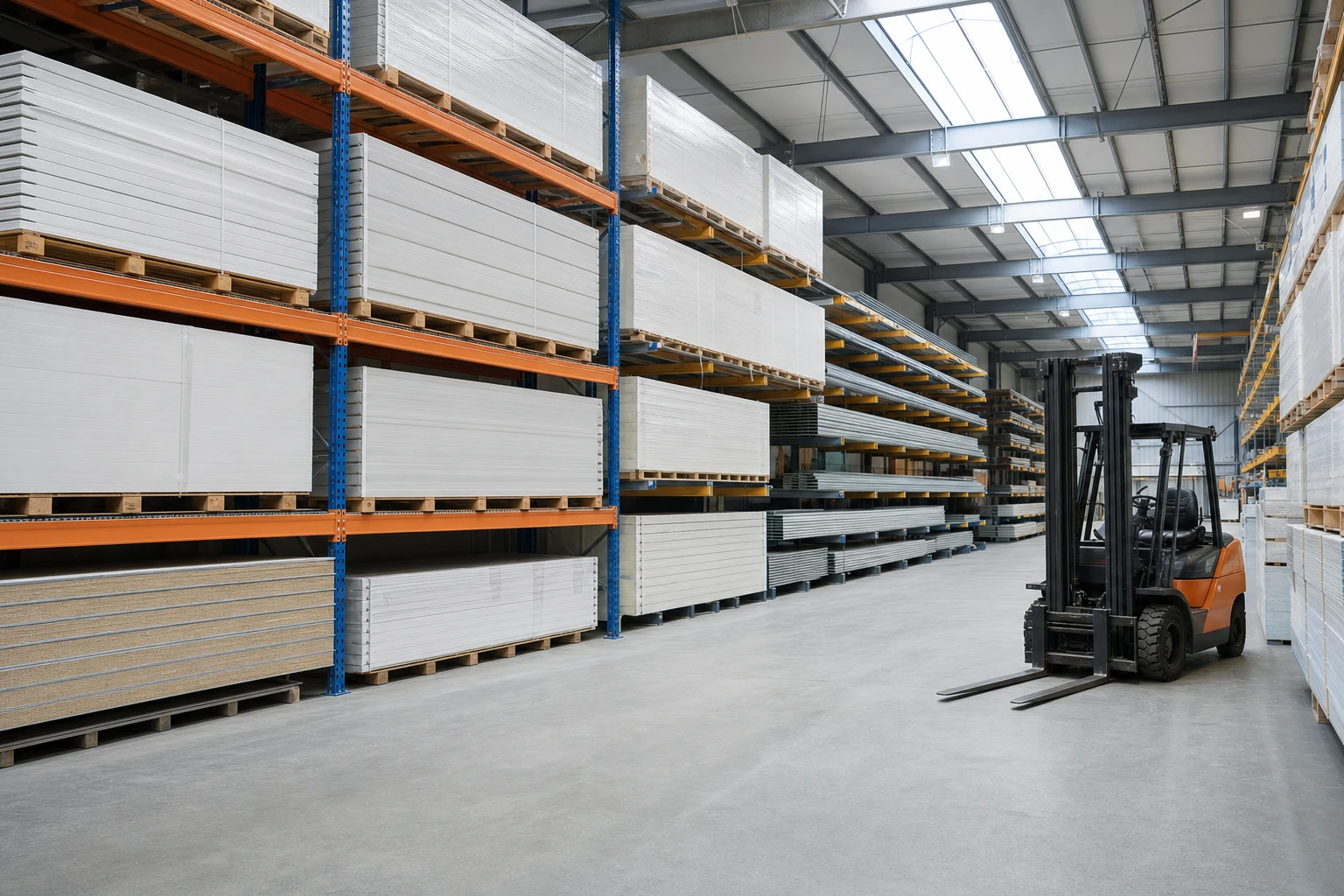
A distributor with its own warehouse buys the goods on its own account and keeps them on site. They can be inspected, counted and issued the same day, and for a complaint you have one window instead of a factory.
A middleman with no warehouse sells goods it has never seen. Part of the market works that way and it can be cheaper — but every problem travels through two links: the lead time, damage in transport, a missing pack, the documents.
| Manufacturer | Distributor with a warehouse | Middleman with no warehouse | |
|---|---|---|---|
| Where the goods are | at the factory or in the cycle | in its own warehouse | at a third party |
| Who handles a complaint | directly | with the manufacturer on your behalf | depends on the contract — ask |
| What the lead time depends on | the production plan | stock, then production | two links at once |
BOKKA is a distributor: the goods sit in the warehouse in Wola Batorska, the company has been on the market for ten years, and the office and Customer Service department work in Kraków. We write that not to award ourselves a medal — it is the fact worth asking every supplier about: where does the stock you are selling me physically lie?
Documents: what must be there and how to check it applies to your board
The minimum set is short: the Declaration of Performance (DoP), CE marking and the technical data sheet. In the DoP the manufacturer declares the parameters of a specific product type and is legally answerable for them — and is obliged to make it available free of charge. If somebody drags their feet over that, it is a message in itself.
A European Technical Assessment (ETA) comes in where a product or a system has no harmonised standard. Rigid PIR insulation boards have a standard (EN 13165), sandwich panels have one too (EN 14509) — but a complete ETICS system does not, so it is assessed by the ETA route. Hence termPIR® ETX and its ETA 17/0066: not an ornament in a quotation, but the basis on which the build-up is approved.
What to do with the paperwork? Three checks, a minute each:
- The type code in the DoP has to match the code in the quotation. The numbers differ by one element — “termPIR/AL/18” and “termPIR/ETX/17” are two different products.
- The range of thicknesses. The declaration gives parameters for a defined range. You are buying 40 mm and the table starts at 50 mm? Then the document does not describe your board.
- The intended use. The same board behaves differently in different build-ups — and the documents reflect that.
The best example is the reaction-to-fire class. termPIR® ETX unenclosed has class E in thicknesses of 50–250 mm and F at 20–49 mm, while the declared B-s1,d0 is reached only as part of an ETICS system and from 50 mm upwards. A bare “B-s1,d0” in a schedule, with no build-up and no thickness, is a classic error. What those letters mean we take apart in the piece on reaction-to-fire euroclasses, and the anatomy of the documents in the guide to the DoP, the ETA and the AVCP certificate.
And a warning that can otherwise set off a needless alarm: tests and approvals are often extended by separate documents. A date in the header of a fire classification does not mean the document has expired — the extension is often a separate letter in the set. Do not accuse a supplier on the strength of a date alone; ask for the current, complete set.
“We have it in the warehouse” means something different from “we have it in the range”
This is the commonest misunderstanding in a sales conversation and the most expensive in its consequences — it hits the construction programme.
The question “do you have termPIR?” will almost always get a “yes”. The question “do you have 140 mm with an aluminised facing, twenty pallets, for Thursday?” is a different conversation. Popular thicknesses sit in stock. An unusual thickness, a made-to-order format or a rarer facing go into the production cycle — and the cycle is measured in weeks, and will not speed up because the roofer happens to have a free slot.
So ask about a specific item, not about a product: thickness, facing, format, quantity, date. And ask for confirmation in writing — “we will confirm tomorrow” and “confirmed, I am reserving it” are two different sentences. With us, availability is shown on the product pages in the BOKKA shop, which runs in Polish, where stock levels update automatically.
Who will unload the pallet? Settle it before the lorry sets off
Transport is the part of an order people think about last — and the part that takes its revenge on the day of delivery.
Rigid PIR insulation boards travel on pallets, by ordinary road transport; a forklift or a telehandler will lift them off. Sandwich panels are a different league: the insPIRe® module is produced in lengths of up to 16.5 m, travels on a trailer and needs room to manoeuvre.
And the crucial point, said plainly: we do not have lorries with a loading crane. Unloading is arranged by the buyer, and it has to be settled before delivery — so that on the day of arrival somebody is waiting with equipment rather than with a phone. Ask every supplier about it; be wary of the answer “we will think of something”. The third option is often the simplest: collection in person from the warehouse.
Does the person on the other side understand what they are selling
A good supplier can do three things a price list cannot do for them.
Match the thickness to the required U-value, rather than sell you the one they have most of. In an ETICS system on termPIR® ETX, reaching U ≤ 0.20 W/(m²·K) takes about 130 mm; on an over-rafter roof you aim at 150 mm, because 140 meets the condition in theory but the thermal bridges from the screws eat the margin. The calculation step by step is in the piece on calculating the U-value of an assembly.
Point to the right product for the application. This is where a costly mistake is easiest. ETICS takes termPIR® ETX with a glass veil and ETA 17/0066, and not a board with an aluminised facing: termPIR® AL is gas-tight and does not work with thin-coat render, nor is it suitable for washable ceilings or as an internal lining — each of those applications has its own dedicated variant. We set the differences out in the comparison of termPIR AL and MAX 19, and the installation mistakes in the piece on fitting ETICS on termPIR ETX.
Show you the detail from the manufacturer’s catalogue. Not describe it in words — send the junction drawing: plinth, eaves, junction with an opening. Somebody who has those to hand saves you a week of correspondence with the designer.
Five red flags
None of them disqualifies a quotation automatically, but each should prompt a further question.
- “A DoP? It’s a well-known manufacturer.” The declaration is not a favour granted to fussy customers, it is an obligation.
- A price with no unit and no thickness. “89 PLN a board” means nothing: per m² or per board, and at what thickness?
- “We will bring it in within a week” with no confirmation. Such a declaration is worth exactly as much as it is worth in writing.
- No warehouse address. Anyone who cannot say where the goods lie probably does not have them.
- A document for a different product or thickness. Sometimes a slip in an email, sometimes something more.
Eight questions to copy and send
Paste this into an email to a supplier. The answers — or their absence — will tell you more than a phone call.
- Are you a manufacturer, a distributor or a middleman? Where do the goods physically lie?
- Please send the DoP and the technical data sheet for exactly the product and thickness in the quotation.
- Have any validity extensions been issued for those documents? Please send the current, complete set.
- Is that thickness and facing in the warehouse today, or in the production cycle?
- What is the lead time for release of the goods, and can I have it in writing?
- What vehicle will the delivery come on, who is responsible for unloading, and is collection in person possible?
- Is the price per m² or per board, net or gross, and at what order size?
- Who handles the complaint if the goods arrive damaged or the parameters differ from the declaration?
A few minutes of typing. In return you get something that is not in any price list: a picture of whether this firm will hold up at the moment something goes wrong.
🤝 Contact a BOKKA technical advisor — we will select rigid PIR insulation boards for your building element, send you the full set of documents and tell you plainly what is in the warehouse and what is in the production cycle.
Sources:
- Regulation (EU) No 305/2011 (CPR) — declaration of performance, CE marking, manufacturer’s obligations
- PN-EN 13165 — Thermal insulation products for buildings: factory made rigid polyurethane foam (PU)
- PN-EN 14509 — Self-supporting double skin metal faced insulating panels — Specifications
- ETA 17/0066 — European Technical Assessment for the ETICS system on termPIR® ETX boards
- Technical data sheets and DoPs for termPIR® (no. termPIR/AL/18, termPIR/ETX/17)
Frequently asked questions
What is the difference between a distributor and a manufacturer of PIR boards?
Which documents should I demand when buying PIR boards?
Will the supplier unload the boards on site?
How long is the wait for PIR boards?
Related products and systems
Read next
How to read DoP, ETA and AVCP certificate — a guide for designers and buyers

EPD and carbon footprint of sandwich panels and PIR — ESG in construction
Reaction-to-Fire Euroclasses A1/A2/B/C/D/E/F — What They Mean in Design Practice