termPIR® ETX — PIR Boards with Glass Fleece for ETICS | BOKKA
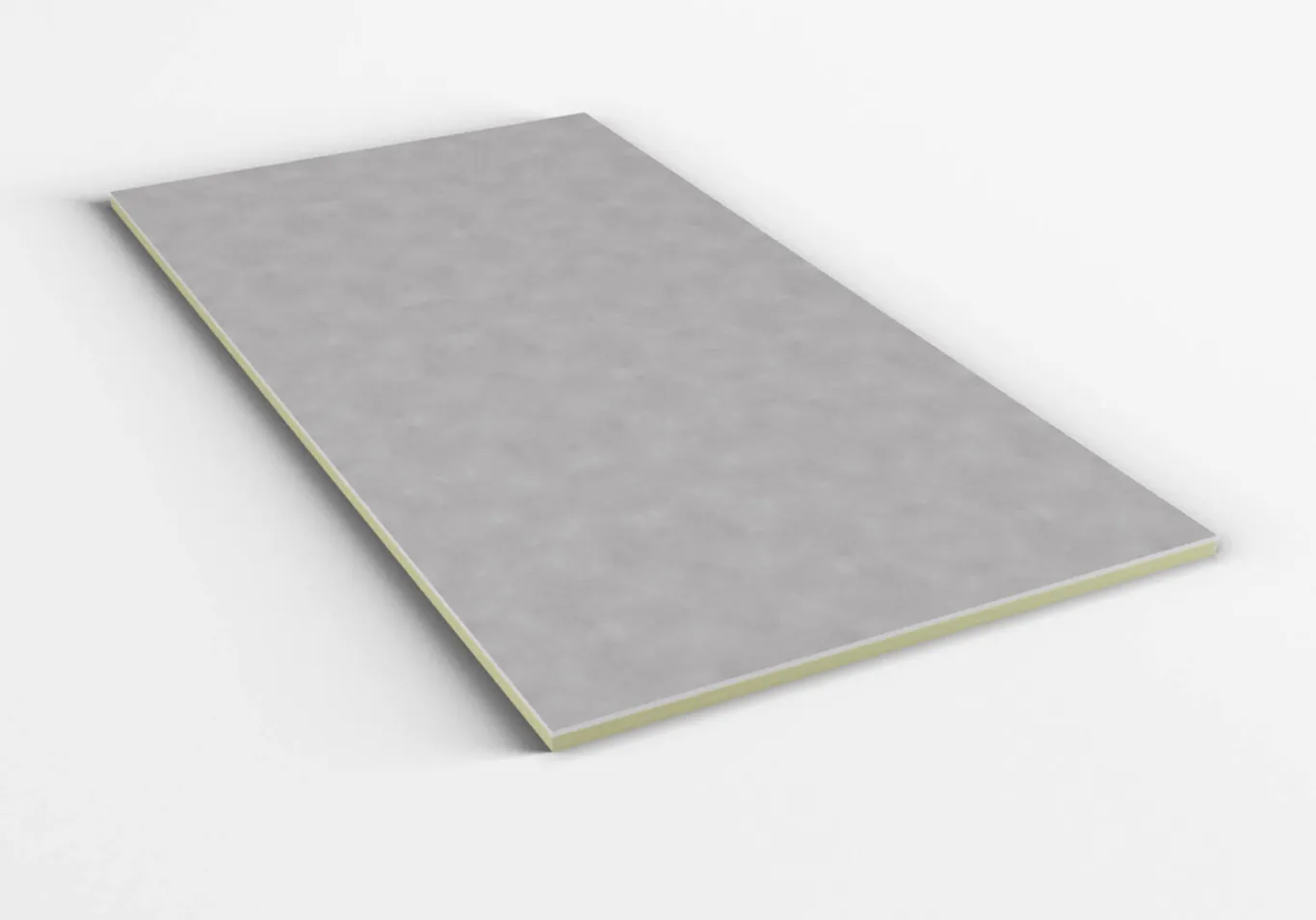
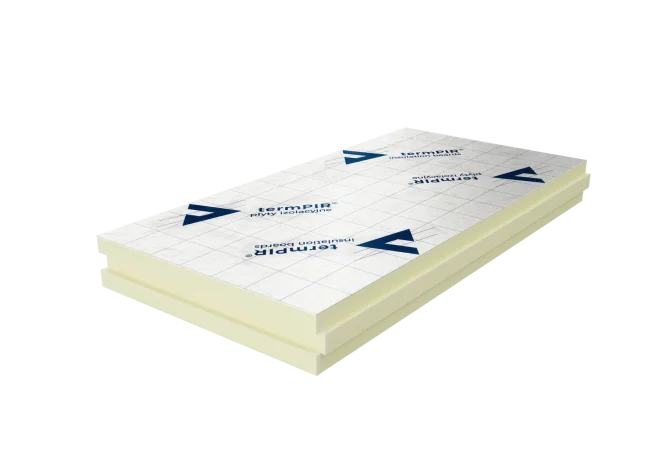
termPIR® ETX — PIR Insulation Board with Glass Fleece for ETICS
The choice of facing on a PIR board determines its application. For external insulation in ETICS technology, the standard aluminium foil is a disqualifying factor — the assembly requires a vapour-permeable facing compatible with cementitious adhesives and thin-coat renders. A board with Al foil cannot meet this requirement; termPIR® ETX can — the variant with glass fleece on both sides, holding European Technical Assessment ETA 17/0066. This article covers the technical parameters, thickness selection against WT 2021 (Polish Technical Conditions 2021) requirements, and the correct installation technology.
Board structure and technical parameters
The core is a rigid polyisocyanurate (PIR) foam with a density of approximately 32 kg/m³, manufactured in accordance with EN 13165. Both sides are faced with glass fleece — a vapour-permeable, mineral material compatible with cementitious adhesives and mortars. This is the fundamental difference compared with termPIR® AL, whose gas-tight Al/paper/PE foil prevents its use in ETICS.
Key termPIR® ETX parameters:
| Parameter | Value |
|---|---|
| Thermal conductivity λD | 0.025–0.027 W/(m·K) |
| Core density | approx. 32 kg/m³ |
| Fire reaction class (board) | E |
| Fire reaction class (ETICS system with render) | B-s2,d0 |
| Compressive strength (10% deformation) | ≥ 120 kPa |
| Dimensional stability | ≤ 2% |
| Long-term water absorption | ≤ 3% |
| Approval | ETA 17/0066 |
| Product standard | EN 13165 |
The higher λD value compared with termPIR® AL (0.022) is due to the diffusion-open structure of the fleece — a deliberate trade-off for compatibility with the ETICS system. Despite this, termPIR® ETX remains markedly more efficient as an insulator than EPS (λD ≈ 0.031–0.038) and mineral wool (0.035–0.040).
For projects focused on carbon footprint, the termPIR® ETX R-eco variant is available — with reduced CO₂ across the product life cycle.
Dimensions, thicknesses and edge profiling
Standard board formats:
- 1200 × 600 mm — recommended format for ETICS, easy to handle on scaffolding
- 1200 × 2400 mm — large format, reduces the number of joints
Available thicknesses: 30, 40, 50, 60, 80, 100, 120, 140, 150, 180, 200 mm.
Edge profiling:
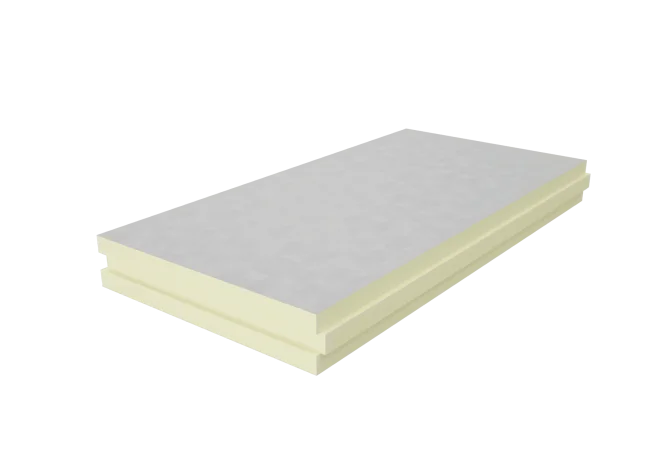
- FIT — flat edge (standard for ETICS, straightforward adhesive + mechanical fixing)
- TAG — tongue and groove (eliminates linear thermal bridges at joints)
Thickness selection for WT 2021
The current WT 2021 (Polish Technical Conditions 2021) require an external wall U-value of U ≤ 0.20 W/m²K. Below are indicative termPIR® ETX thicknesses (λD = 0.025) achieving the target U-value on a typical masonry wall built from 25 cm ceramic blocks (substrate U ≈ 0.90 W/m²K):
| termPIR® ETX thickness | R of insulation layer [m²K/W] | Assembly U [W/m²K] |
|---|---|---|
| 100 mm | 4.00 | ~0.22 |
| 120 mm | 4.80 | ~0.19 |
| 140 mm | 5.60 | ~0.16 |
| 150 mm | 6.00 | ~0.15 |
| 180 mm | 7.20 | ~0.13 |
| 200 mm | 8.00 | ~0.12 |
For walls with a low substrate U-value (concrete, calcium silicate), required thicknesses will be close to the upper end of the table. With EPS, achieving U = 0.20 W/m²K typically requires 180–200 mm — the PIR advantage is tangible particularly where every centimetre counts (renovations, narrow passages, balconies, window reveals).
Application — when termPIR® ETX and when a different board
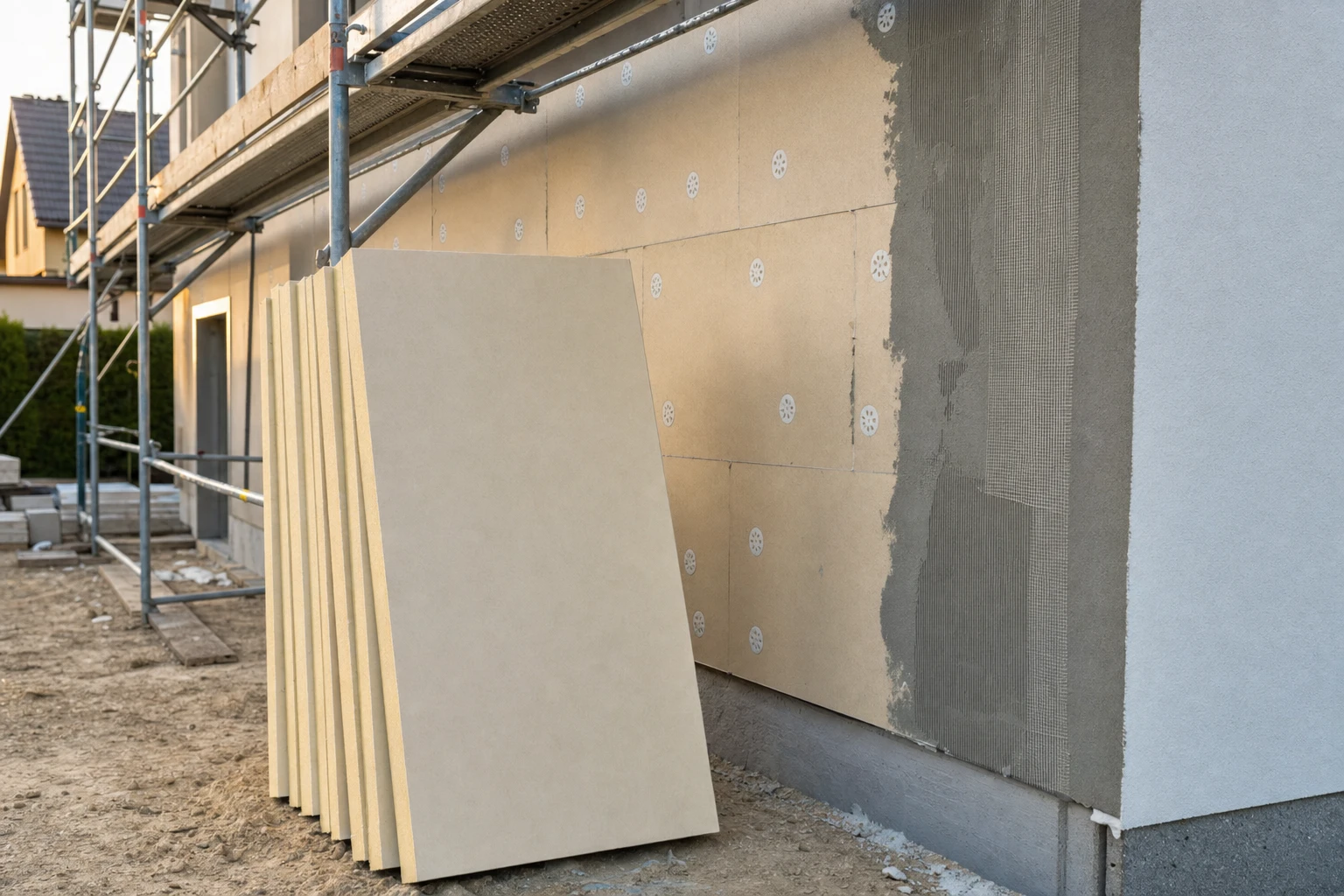
The main application is the external wall in an ETICS system — residential, office, commercial and warehouse buildings finished with thin-coat render. The glass fleece ensures proper bonding of the adhesive mortar, reinforced base coat with mesh, and acrylic, silicone or silicate render.
Key limitations:
- For ventilated walls with siding cladding, termPIR® AL can be considered — a different scenario (cavity-open assembly).
- For flat roofs under membranes, termPIR® Pro-F with FM Approved certification is dedicated.
- For foundations and plinths — termPIR® WS with enhanced moisture resistance.
- For interior insulation (e.g. heritage walls) — the termPIR® AL/GK composite.
Cross-applying products (e.g. termPIR® AL in ETICS) results in blisters under the render and detachment of the base coat — the gas-tight Al foil prevents technological moisture from the adhesive evaporating.
Installation in an ETICS system — key stages
Substrate preparation
The substrate must be load-bearing, dry, and cleaned of dust and anti-adhesion substances. Absorbent surfaces are primed with an agent specified in the system datasheet of the adhesive mortar manufacturer. Unevenness greater than 10 mm over 2 m requires levelling.
Starter rail and bonding
Installation begins from the bottom, on a starter rail sized to the board thickness. The rail sets the level, protects the lower edge and ensures correct finishing with the plinth. The adhesive is applied using the perimeter-and-dab method (a strip around the perimeter + 3–6 dabs) — minimum 40% of the board surface after pressing. Boards are laid in a staggered pattern, with corner interlocking on building corners. Vertical joints of adjacent rows must not align.
Gaps wider than 2 mm are filled with low-expansion PIR/PUR polyurethane foam (not cementitious adhesive — it cracks). Once hardened, excess foam is trimmed flush with the board face.
Mechanical fixing and reinforced base coat
Mechanical fixing is carried out no earlier than 48 hours after bonding. The number and layout of fasteners follow the project design (wind zone, building height) — typically 4–8 pcs/m², with densification in corner zones.
The reinforced base coat with glass-fibre mesh (min. 145 g/m²) is embedded in the adhesive mortar, with mesh overlaps of min. 10 cm. Corners and reveals are reinforced with mesh corner profiles and diagonal mesh strips at windows.
Priming and rendering
After a minimum of 3 days of base coat drying, a render primer is applied. The thin-coat render is applied after the primer has dried (min. 24 h). The temperature of the substrate, material and surroundings during work and for the following 48–72 h must be +5°C to +25°C — without direct sunlight or precipitation.
Façade painting (optional) — between 3 and 28 days after rendering, depending on the type of render (acrylic, silicone, silicate).
We’ll select the board and system for your project
Need to size the termPIR® ETX thickness for a specific façade project, calculate U-values, or get a quote for a production batch? Contact the BOKKA team — we’ll prepare a technical specification, product datasheet, ETA 17/0066, and a quotation with delivery to site across Poland. Also see the full line of termPIR® PIR insulation boards.
Frequently asked questions
What is the difference between termPIR® ETX and termPIR® AL?
What thickness of termPIR® ETX for a single-family house?
Are termPIR® ETX boards combustible?
Can termPIR® ETX be applied over EPS or mineral wool?
Which renders work with termPIR® ETX?
Related products and systems
Products
Building systems
Read next
Energy Audit of a Building — Thermal Retrofit with PIR

Energy Retrofit with PIR Boards and WT 2021 in Practice | BOKKA
Smog and Allergies — How PIR Thermal Upgrades Cut Emissions | BOKKA