Window Replacement and Warm Installation with PIR Insulation | BOKKA
Window replacement and energy retrofit — where heat is lost most often
Window replacement is one of the most cost-effective stages of a building energy retrofit — it can reduce energy demand by as much as 10–15%, and when combined with properly executed wall insulation, it opens the way to upgrading the heat source (heat pump, condensing gas boiler). The catch is that even a window with Uw = 0.9 W/m²K will not deliver its potential if a thermal bridge at the junction between the window frame and the wall undoes the effect. The key is warm installation within the PIR insulation layer — and this very detail is the focus of this article.
Why window reveals are a critical point of the wall
The window opening breaks the continuity of the insulation layer and introduces into the wall an element with significantly worse thermal parameters than the surrounding masonry. In a typical ETICS façade with 200 mm of insulation, the wall is characterised by U ≈ 0.17 W/m²K, while even a triple-glazed window has Uw = 0.9–1.1 W/m²K — i.e. 5–6 times worse. On top of that, there is a linear thermal bridge Ψ (psi) along the perimeter of the frame, which in standard installations reaches 0.10–0.15 W/(m·K), and with a poorly executed detail even 0.25 W/(m·K).
WT 2021 (Polish Technical Conditions 2021) require for window joinery in external partitions Uw ≤ 0.9 W/m²K (vertical) and Uw ≤ 1.1 W/m²K (roof slope). To translate this parameter into real savings, the reveal must be insulated with a material of low λD — and here the PIR boards in our offering have the advantage over traditional EPS or mineral wool solutions.
Window location within the wall thickness — general principles
The Polish National Energy Conservation Agency recommends the following window positioning within the wall cross-section:
| Wall type | Optimal window position |
|---|---|
| Single-layer (no insulation) | At mid-thickness of the masonry |
| Double-layer (ETICS, external insulation) | Flush with the masonry face or extended into the insulation layer |
| Triple-layer (cavity wall) | Within the thermal insulation layer |
| Wall with internal insulation (e.g. heritage building) | Within the internal insulation layer |
The greatest energy benefit comes from extending the window into the insulation layer (installation flush with or in front of the masonry face on consoles) — Ψ then drops to 0.02–0.05 W/(m·K), several times lower than when the window is seated within the masonry.
Warm installation in the PIR layer — step by step
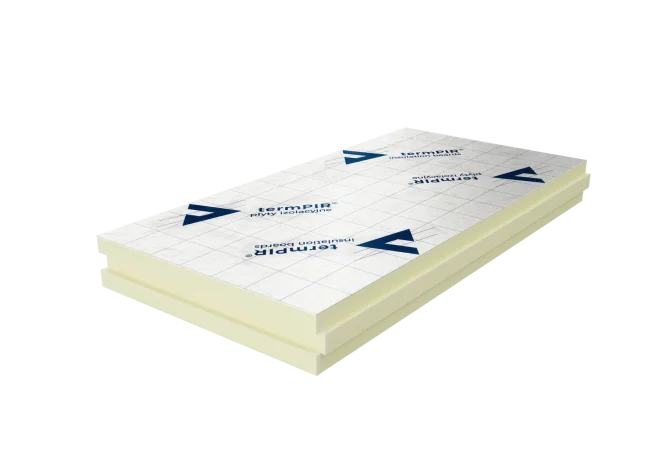
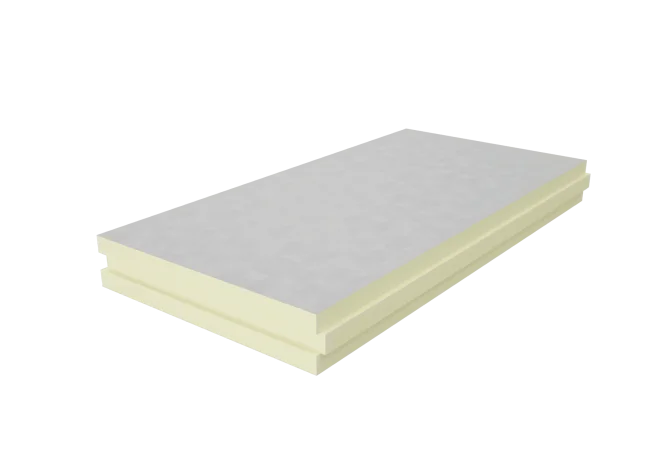
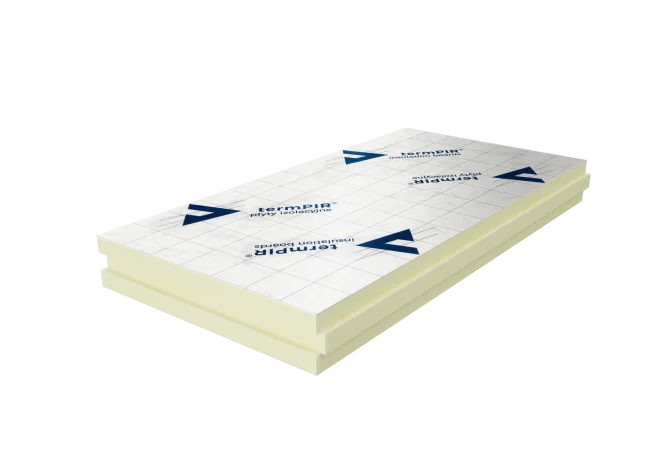
In an ETICS wall, where the primary insulation is the vapour-permeable termPIR® ETX with a glass fleece facing (ETA 17/0066, λD 0.025–0.027 W/(m·K)), the reveal is best finished with PIR strips 20–30 mm thick cut from the same board or from termPIR® AL (λD 0.022 W/(m·K)). The procedure is as follows:
- Preparation of the opening — straightening edges, cleaning and priming the substrate for installation tapes.
- Expanding or vapour-barrier tape on the inside — ensures airtightness (water-vapour barrier layer).
- Seating the frame on anchors or system consoles — for installation in front of the masonry face, load-bearing consoles (e.g. JB-D, Compacfoam) are mandatory.
- Filling the gap with low-expansion foam — without excess, so as not to deform the frame.
- Vapour-permeable tape on the outside — protects the foam from moisture and UV.
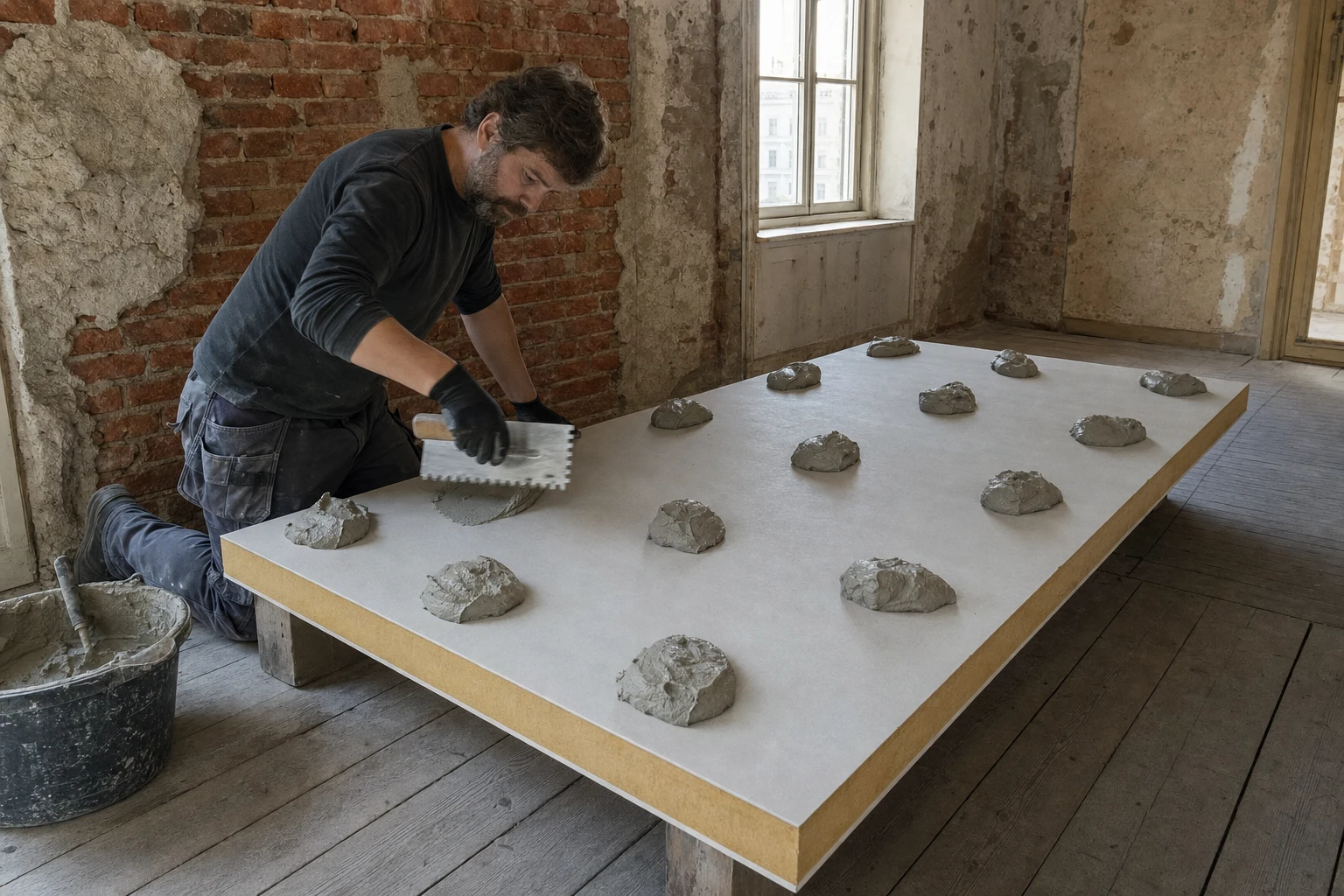
- Bonding PIR strips to the reveal with PU adhesive or telescopic fasteners, overlapping the frame by 20–30 mm.
- Finishing with a thin-coat render with reinforcing mesh and corner beads.
The key rule: PU foam without the protection of tapes and render disintegrates under UV exposure within 4–8 weeks, losing up to 50% of its insulating value. Every unprotected joint is a future thermal bridge.
Why PIR rather than EPS for window reveals
Reveal strips have to fit into the narrow space between the window frame and the façade face. With a typical 200 mm ETICS and a frame projection of 30 mm, only 20–30 mm remains for reveal insulation. Comparison of effectiveness:
| Material | λD [W/(m·K)] | R-value at 30 mm [m²K/W] |
|---|---|---|
| termPIR® AL | 0.022 | 1.36 |
| termPIR® MAX 19 AL | 0.019 | 1.58 |
| EPS 031 | 0.031 | 0.97 |
| Mineral wool 035 | 0.035 | 0.86 |
PIR at the same thickness provides 40–60% better insulation performance than EPS or mineral wool. In practice, this means the difference between a thermal bridge of Ψ = 0.08 and Ψ = 0.03 W/(m·K) along the frame perimeter. For a 1.5 × 1.5 m window this is a saving of 6 m × 0.05 W/(m·K) × 3000 Kh/year ≈ 0.9 kWh/year less — multiplied by 15 windows in a single-family house, the cumulative saving is measurable.
For heritage walls, where insulation is applied from the inside, the termPIR® AL/GK composite performs well — ready for direct bonding from the room side, with an aluminium vapour barrier on the cold side. The installation detail is shown in the system heritage wall termPIR® AL/GK.
Most common installation errors
- Foam as the sole seal — this skips the fundamental principle “airtight on the inside, vapour-permeable on the outside”. Without tapes, water vapour condenses in the foam, and ice cracks the joint.
- Window recessed deep into the masonry in an ETICS wall — Ψ increases by 100–150% compared to installation within the insulation layer.
- No corner beads or mesh at the reveal corner — render cracks within 2–3 years.
- Using EPS 040 in reveals — at 20 mm thickness, this material does not perform an insulating function and provides only a visual finish.
The full range of boards for window reveals and ETICS is available in the PIR insulation board catalogue.
Frequently asked questions
Does warm installation require special consoles?
What thickness of PIR strips should be used in the reveal?
Can I use an unfaced PIR board in the reveal?
Will replacing windows change the EP indicator of the building?
Can warm installation be carried out when replacing windows in an existing ETICS?
Related products and systems
Products
Read next

Energy Retrofit with PIR Boards and WT 2021 in Practice | BOKKA
Silesia Anti-Smog Resolution and PIR Thermal Upgrades | BOKKA
Smog in Kraków 2024 — AGH study and the role of thermal upgrades | BOKKA