Sandwich panel screws — how to match the length to panel thickness and substrate
Saturday, seven in the morning. The panels have been lying by the hall since Thursday, the crew is all there, the first panel is already standing against the column. The fitter offers up a screw and pulls the trigger.
The screw squeals, heats up and stops halfway through the steel. The second one does the same. They are “for a hundred-mil panel” — the same as on the last job. Except that there the wall rails were made of thin section, and here the column has a flange ten millimetres thick.
Nobody will be screwing anything down before Monday.
Screws for a sandwich panel are chosen from two sides at once: from the side of the panel and from the side of whatever they have to go into. Panel thickness is half the answer. The other half is the substrate, and a few small things only come to mind once you are up on the roof. Below are three questions worth asking yourself before you order — and the manufacturer’s table, copied from the shop’s product pages.
Question one: what does this screw have to go into?
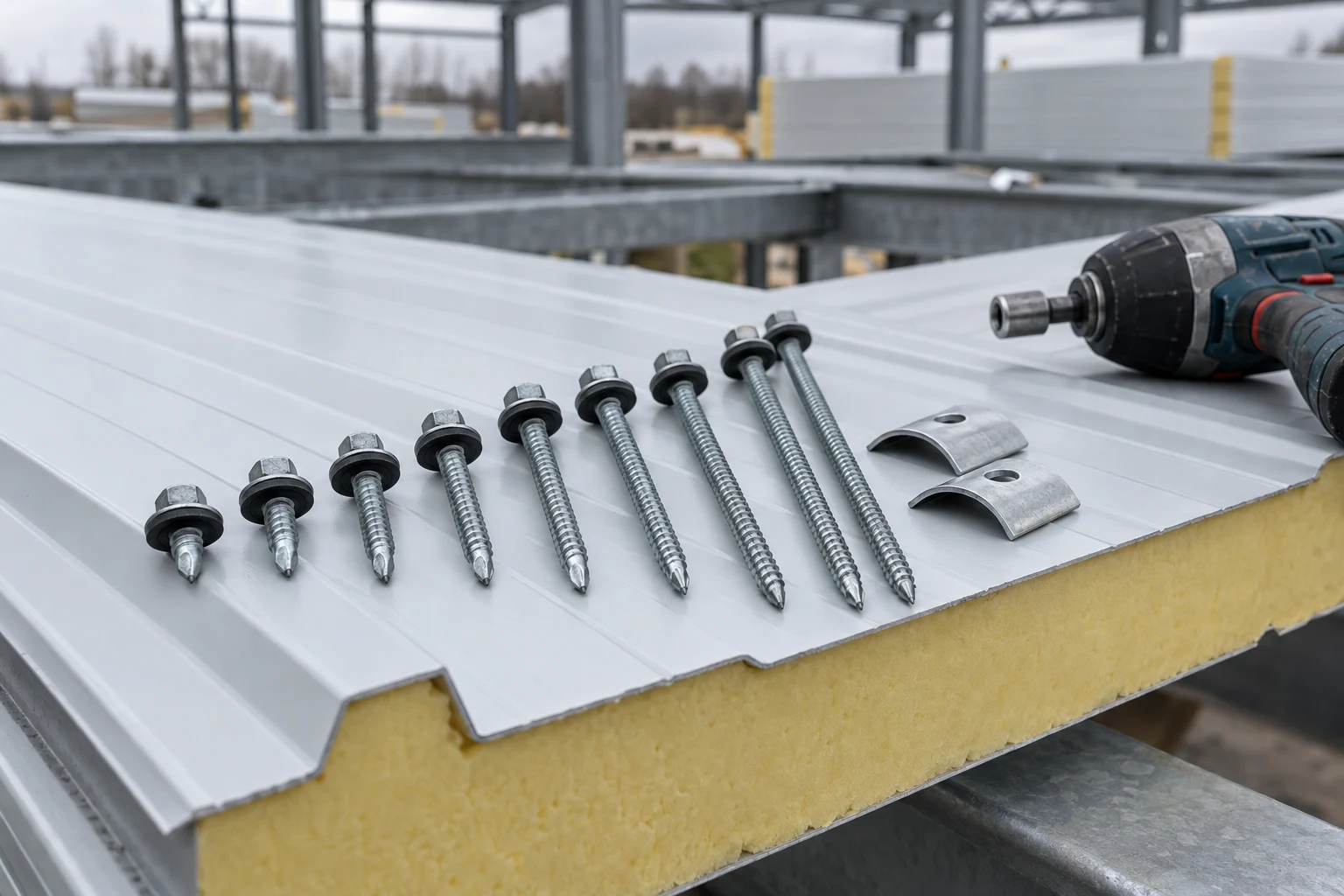
A sandwich panel is fixed with a self-drilling fastener. Its tip is a drill bit: it makes the hole in the structure itself, and the thread right behind it anchors in it straight away. You do not pre-drill and you do not tap. People talk loosely about “bolts for sandwich panels”, but this is a screw — it works without a nut.
The drill point has its limit, though. It is called drilling capacity and means the greatest thickness of steel a given screw will get through. Hence three screws for steel in the shop (which runs in Polish), not one:
- GTR6 screws — steel up to 6 mm thick, diameter 5.5 mm;
- GTR12 screws — steel up to 12 mm, diameter 5.5 mm;
- GTR16 screws — steel up to 16 mm, diameter 6.3 mm.
What counts is the thickness of the wall the screw goes into: the wall of a rail made of hollow section, or the flange of an I-section. Read it from the structural design or measure it before you open the basket. The light framing a sandwich panel garage stands on and the columns of a large hall are two different steel thicknesses — and so, often, two different screws.
Otherwise the three are alike: an 8 mm hex head (one socket for everything), a washer 19 mm in diameter with a vulcanised EPDM seal, and two threads — a working one at the tip and a second one under the head, which supports the panel’s outer facing.
Sandwich panel screws for timber, concrete and brick — the fourth type
A shelter on timber posts, an outbuilding on a frame of squared timber, a hall with reinforced-concrete columns. Here a drill point for steel has nothing to do.
For substrates like these there are GTRW screws: diameter 6.4 mm, a timber point and a Hi-Lo thread. The product page describes them as fasteners for solid materials — timber, concrete, aerated concrete and brick — but they are installed differently in each.
Into timber the screw goes directly. Into concrete too, except that a 5 mm pilot hole has to be drilled first. In brick and aerated concrete you also need the ULTRA expansion sleeve, which spreads the fastener’s load where the thread alone would have nothing to grip.
Question two: which panel and what core thickness?
This is where a slip is easiest, because a “hundred-mil panel” means one thing on a wall and another on a roof. The insPIRe® line has four variants — we set out the differences between S, U, D and CH separately — and each is read in the table in its own way.
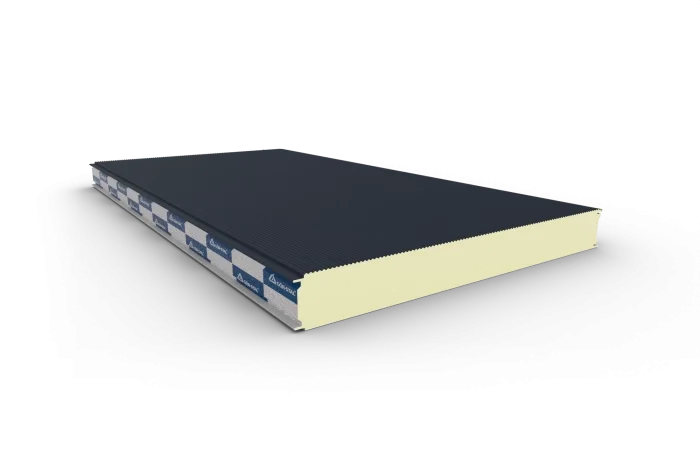
insPIRe® S wall panel, standard joint. The screw passes through the full thickness of the panel and stays visible on the façade. One thickness, one length.
insPIRe® U wall panel, concealed fixing. The screw sits in the joint, with a PM1 fixing washer, and disappears under the neighbouring panel. For each thickness the product page gives two lengths here: a shorter one “in the joint” and a longer one “at the corner” — the same as for an S panel of that thickness. So there are two items on your shopping list, not one.
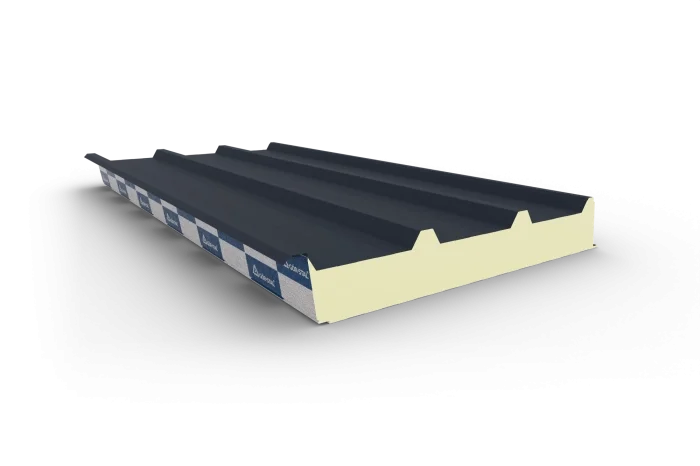
insPIRe® D roof panel. The thickness is written as a pair of numbers, for example 100/140: the first is the core in the trough of the trapezoid, the second — at the crest of the rib. A roof panel is fixed through the crest, so it is the second number that decides the length. The table confirms it: a 40/80 roof panel gets the same screw as an 80 mm wall panel.
insPIRe® CH cold-store panel. The core is from 100 to 200 mm, so the screws are among the longest in the table.
What length? The screw selection table for sandwich panels
The figures come from the table “selection of installation screws for sandwich panels” on the screw product pages in the shop. The first column gives the panel variant and core thickness, the others — screw diameter × length; everything in millimetres.
| Panel and core [mm] | Steel up to 6 mm (GTR6) | Steel up to 12 mm (GTR12) | Steel up to 16 mm (GTR16) | Timber, concrete (GTRW) |
|---|---|---|---|---|
| S 40 | 5.5×65 | 5.5×70 | 6.3×85 | 6.4×100 |
| S 60 | 5.5×90 | 5.5×90 | 6.3×10⁵ | 6.4×120 |
| S 80 | 5.5×110 | 5.5×110 | 6.3×125 | 6.4×140 |
| S 100 | 5.5×125 | 5.5×130 | 6.3×155 | 6.4×140 |
| S 120 | 5.5×150 | 5.5×150 | 6.3×190 | 6.4×160 |
| U 60 (corner) | 5.5×90 | 5.5×90 | 6.3×10⁵ | 6.4×120 |
| U 60 (joint) | 5.5×65 | 5.5×70 | 6.3×85 | 6.4×100 |
| U 80 (corner) | 5.5×110 | 5.5×110 | 6.3×125 | 6.4×140 |
| U 80 (joint) | 5.5×90 | 5.5×90 | 6.3×10⁵ | 6.4×120 |
| U 100 (corner) | 5.5×125 | 5.5×130 | 6.3×155 | 6.4×140 |
| U 100 (joint) | 5.5×110 | 5.5×110 | 6.3×125 | 6.4×120 |
| U 120 (corner) | 5.5×150 | 5.5×150 | 6.3×190 | 6.4×160 |
| U 120 (joint) | 5.5×125 | 5.5×130 | 6.3×155 | 6.4×140 |
| D 40/80 | 5.5×110 | 5.5×110 | 6.3×125 | 6.4×140 |
| D 60/100 | 5.5×125 | 5.5×130 | 6.3×155 | 6.4×140 |
| D 80/120 | 5.5×150 | 5.5×175 | 6.3×190 | 6.4×160 |
| D 100/140 | 5.5×175 | 5.5×185 | 6.3×190 | 6.4×190 |
| D 120/160 | 5.5×200 | 5.5×200 | 6.3×215 | 6.4×210 |
| D 160/200 | 5.5×230 | 5.5×230 | 6.3×250 | 6.4×260 |
| CH 100 | 5.5×125 | 5.5×130 | 6.3×155 | 6.4×140 |
| CH 120 | 5.5×150 | 5.5×150 | 6.3×190 | 6.4×160 |
| CH 160 | 5.5×200 | 5.5×200 | 6.3×215 | 6.4×210 |
| CH 200 | 5.5×230 | 5.5×230 | 6.3×250 | 6.4×260 |
Brick and aerated concrete: lengths as in the last column — only the ULTRA sleeve is added.
Two remarks. First: the table does not climb evenly — the same GTRW 6.4 × 140 screw serves both the S 80 and the S 100 panel, and the GTR16 6.3 × 190 fits both the 80/120 and the 100/140 roof panel. Do not interpolate — find your row.
Second: the table does not cover every thickness in the panel range. It has neither the 140 mm U wall panel nor the 150/190 roof panel. For those thicknesses, confirm the length with an advisor.
Screws for a 100 mm sandwich panel — why there are four answers
Of all the thicknesses, the hundred is the one searched for most — and it is good proof that thickness alone is not enough. For a 100 mm S wall panel the table gives:
- steel up to 6 mm — 5.5 × 125,
- steel up to 12 mm — 5.5 × 130,
- steel up to 16 mm — 6.3 × 155,
- timber or concrete — 6.4 × 140.
Thirty millimetres of difference between the extremes, for the same panel. If the “hundred” has concealed fixing, a second, shorter screw for the joint is added — on steel up to 6 mm that is 5.5 × 110. And if it is a roof and a 100/140 panel, the lengths start at 5.5 × 175.
That is why in the shop you choose the length only on the page of the specific type. You will find all four, together with saddle washers and sleeves, in the category installation screws.
The saddle washer — the third question, the one the roof reminds you of
On a wall the screw’s washer lies on the sheet over its whole surface. On a roof the screw lands on the crest of the trapezoid, i.e. on a narrow, convex strip of sheet. The washer alone would have little to bear on there.
This is where the saddle washer comes in — kalota on the Polish product page, more often kalotka on site: a profiled aluminium cap with a vulcanised EPDM seal that sits on the rib like a saddle. The 36 mm roof saddle washer has an inclination angle of 40° and — as its product page states — increases the load capacity of the connection thanks to the larger contact area with the facing. It seals the penetration while it is at it.
You need as many saddle washers as there are screws fixing the roof panels to the purlins. A screw with a saddle washer is tightened with feel: the seal has to bed down, and the rib must not deflect. It is one of the eight slip-ups described in the piece on the most common sandwich panel installation mistakes.
At the eaves, in turn, the open end of the trapezoid is closed by a trapezoidal end plug, pressed into every rib.
Head colour, and screws that are easy to mix up
GTR screws and saddle washers are ordered in a colour. The product pages offer ten RAL shades to choose from, among them 9002, 9006, 9007, 9010 and 7016. With a standard joint the heads stay on the façade, so you match the colour to the facing. A pack is 100 pieces.
In the same shop category there are three more groups of screws — similar in name, different on the job. Flashing screws 4.2 × 16 fix flashings to the panels. Sheet-stitching screws 4.8 × 20 join sheets and facings at laps. Insulation fasteners (GTS-S, GTS-B, GTH-D) are a different family: together with a plastic sleeve they hold insulation boards down on flat roofs, and they are not used for sandwich panels.
Which flashings go where on a hall is shown in the map of details from plinth to ridge. The full list of things to order besides the panels is gathered in the guide to accessories and fixings.
Three questions settled. Leave the fourth to the design
The table answers the question “how long”. It does not answer “how many” or “how closely spaced”. The number of screws, their spacing and the load capacity of the connection follow from the design — from wind and snow loads, the spacing of the supports and the manufacturer’s load tables. That is why you will not find any “per square metre” figure here: it would be true for one hall and false for the one next door.
The background is described in the piece on the load capacity and span of sandwich panels. An indicative schedule of panels, flashings and fasteners can be prepared with the sandwich panel calculator, an advisor will help settle the quantities to order — and the design remains what binds.
The second limit is the environment. On their product pages GTR screws carry atmospheric corrosivity categories C1–C4. For cold rooms the manufacturer’s catalogue provides for stainless-steel fasteners, and for freezer rooms — thermally insulating ones, with plastic components. If you are building a cold store from CH panels, agree the choice of fasteners with an advisor before you reach for the table.
The rest is simple: the substrate picks the screw type — GTR6, GTR12, GTR16 or GTRW. The panel and its thickness pick the row of the table — remembering the two lengths with concealed fixing and the thickness at the crest on a roof. Finally add the saddle washers, the sleeves for masonry and the colour. Availability and current prices of all lengths can be seen in the BOKKA shop.
🤝 Contact a BOKKA technical advisor — give us the panel variant and thickness and the type of structure, and we will select the type and length of screws, the saddle washers and the sleeves for your insPIRe® sandwich panels.
Sources:
- Product pages for GTR6, GTR12, GTR16 and GTRW screws in the BOKKA shop — the manufacturer’s table “selection of installation screws for sandwich panels”
- Product pages in the BOKKA shop: 36 mm roof saddle washer, ULTRA expansion sleeve for GTR W screws
- Gór-Stal technical catalogue 2025 — fixing details for S, U and D panels (PM1 fixing washer, saddle washer)
- Gór-Stal cold-store catalogue 2025 — selection of fasteners for insPIRe® CH panels
- PN-EN ISO 12944-2 — atmospheric corrosivity categories
Frequently asked questions
Which screws for a 100 mm sandwich panel?
Which screws fix a sandwich panel to timber?
What is a saddle washer for on a sandwich panel?
How many screws are needed per square metre of sandwich panel?
Related products and systems
Read next
Gór-Stal sandwich panels and a facing for a C5 environment
insPIRe S, U, D and CH — which sandwich panel variant to choose
Sandwich panels second grade — what it exactly means and when it makes sense