Tent hall or sandwich panel hall — which pays off year-round
Six in the morning, February. The heater has been running all night, and you still walk into the hall wearing a jacket. Drops hang from the inner side of the tarpaulin — one more hour and they will start dripping onto the pallets of goods. The gas meter shows a figure you would rather not see.
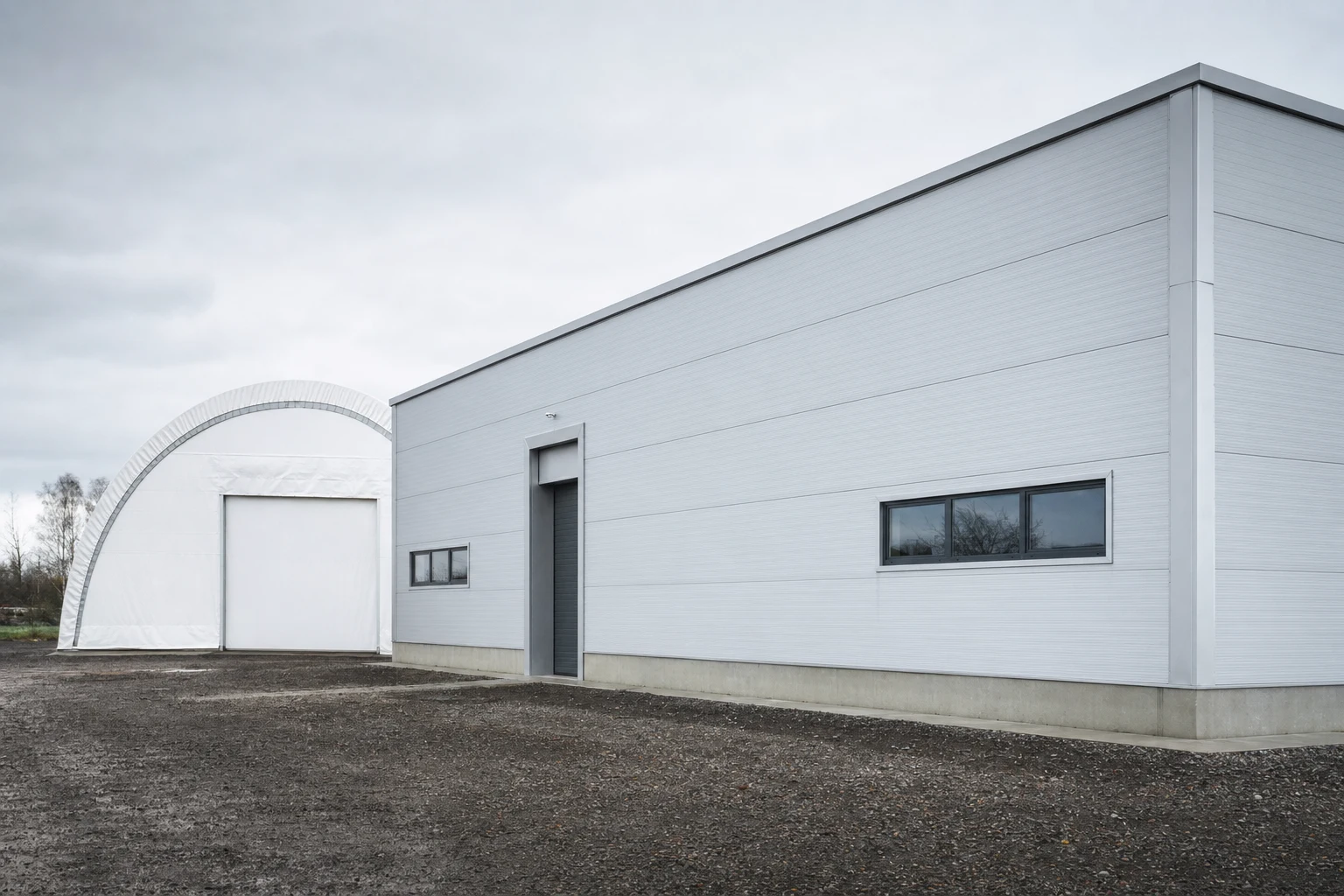
This is not a heater failure. This is physics. And that is exactly what this article is about — because the choice between a tent hall and a sandwich panel hall is, at its heart, a choice between two completely different ideas of what a building is. Tent halls are on a good run in Poland, and partly deservedly so. You just need to know what they are really for — and at what point you start paying extra for someone else’s definition of a “hall”.
What a tent hall honestly deserves credit for
We are not going to bash tents, because there is no reason to. A tent hall does three things genuinely well.
First: speed. A structure bolted together on site, a tarpaulin tensioned in a few days — from decision to a working roof takes weeks, not months. When the seasonal peak is approaching faster than any construction project, that argument is hard to beat.
Second: a low entry cost. You pay mainly for the frame and the membrane, without heavy foundations or a full envelope. A smaller initial outlay means the decision can be made without a multi-year investment plan.
Third: mobility. A tent hall can be dismantled and put up somewhere else. If you operate on leased land or do not know where the company will be in three years, “a building you can take with you” has real value.
The problem starts when a structure bought for seasonal duties stays with you all year round. And for every winter.
Tarpaulin versus core — why the winter difference is brutal
The U-value tells you how much heat escapes through a square metre of the envelope at a given temperature difference — the lower it is, the warmer inside for the same money. We show how to calculate it for a specific partition in our article on calculating the U-value.
The tarpaulin of a tent hall is a coated fabric — a membrane not much thicker than a credit card. It has no core and no insulating layer, so its thermal resistance is practically zero. In winter it gives heat away almost as fast as you supply it. Heating such a structure is like heating a patio: it can be done, but the meter knows no mercy.
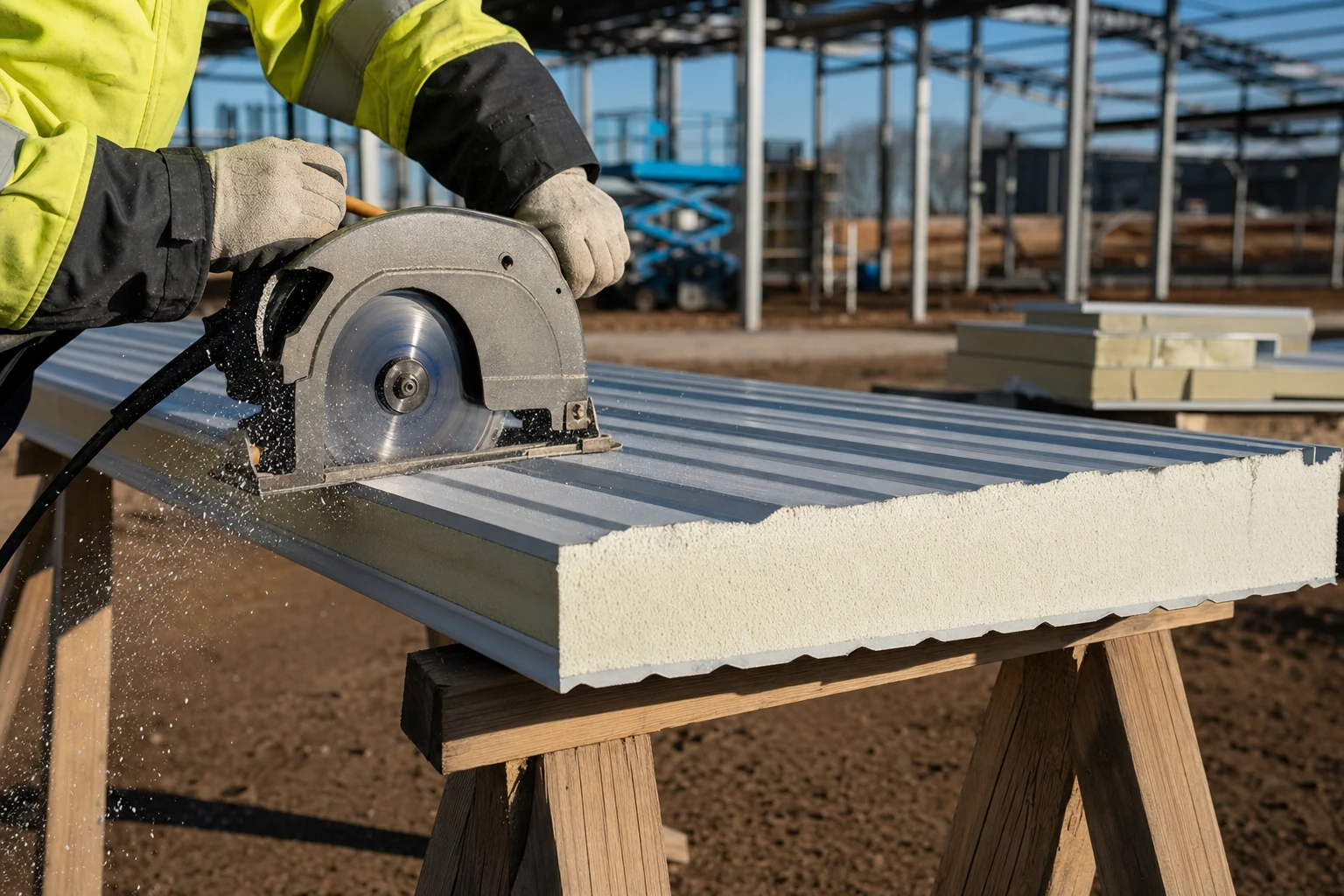
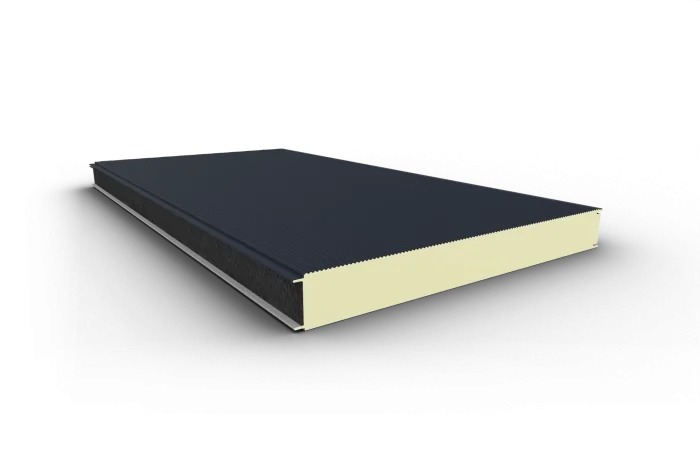
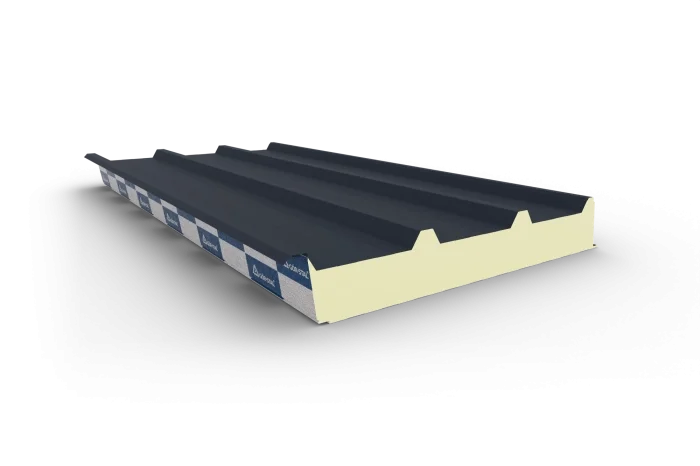
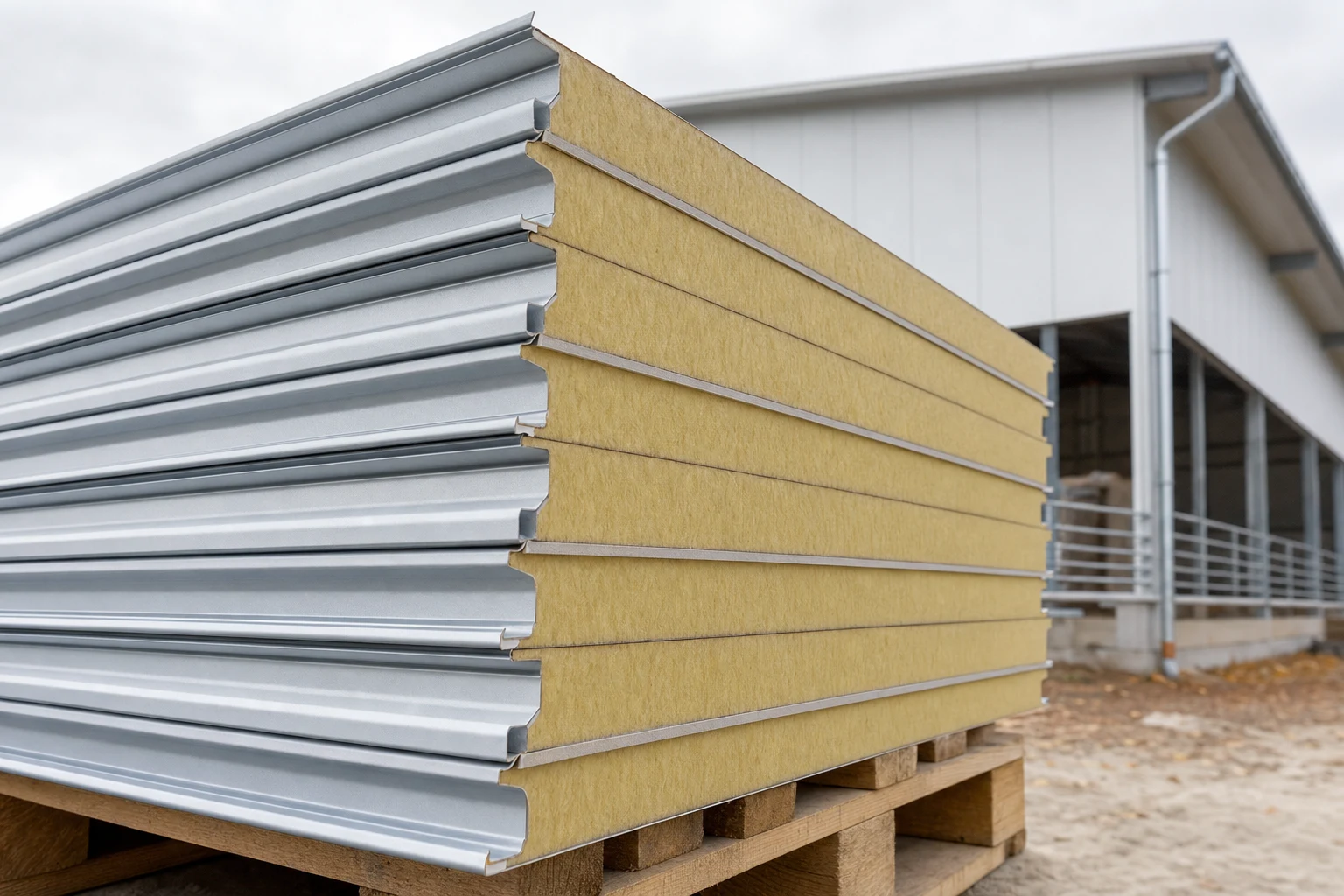
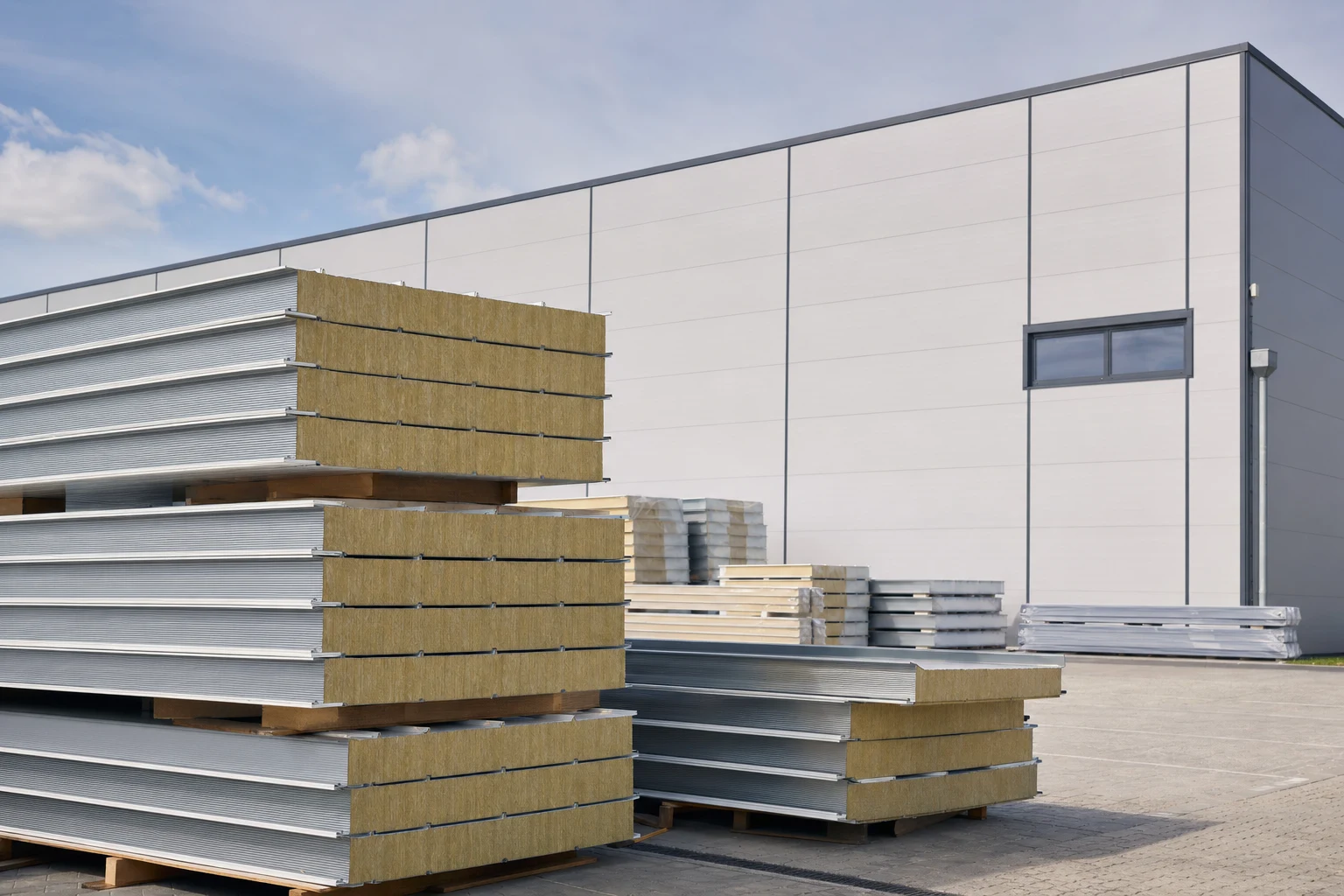
A sandwich panel is a different league. Two steel facings and from a few to a dozen or so centimetres of insulating core — PIR foam or mineral wool. The core thickness is selected for the required U-value, so the heat stays inside and the bills stop being a lottery.
There is a second winter problem too: the dew point — the temperature at which water vapour in the air turns into droplets, like on a cold bathroom mirror. The inner side of a tarpaulin in winter is almost as cold as the air outside, so moisture from the heated interior condenses on it and drips down. Onto goods, onto machines, onto bedding. In a sandwich panel hall, with a correctly selected core thickness, the inner facing stays on the warm side of the dew point — condensate has nowhere to form.
In summer the roles do not reverse at all — the tent merely swaps one problem for another. The thin membrane heats up in the sun and it turns into a greenhouse under the tarpaulin. An insulating core works both ways: in winter it keeps the heat in, in summer it keeps the heat out.
Snow and wind — the night that tests the roof
A rigid sandwich panel roof is designed for snow and wind loads according to the Eurocodes (PN-EN 1991-1-3 and PN-EN 1991-1-4), and the load capacity of the panels themselves is read from the manufacturer’s tables. We wrote about how support spacing and panel thickness play together in our article on the load capacity and spans of sandwich panels.
A decent tent hall is also calculated for the snow zone — that has to be honestly acknowledged. But the tarpaulin remains a flexible membrane: it sags between the arches of the structure, and snow and water can collect in the depressions. Winter operation of a tent therefore means duties — checking for build-up, snow removal, sometimes heating an empty hall just so the snow does not settle. Wind, in turn, works on the tarpaulin non-stop: flapping is cyclical bending of the material, which accelerates its fatigue.
On a rigid, insulated roof the snow simply lies there — exactly as the designer intended. Nobody gets up at night to check deflections.
Durability and value: a balance you only see after years
A tarpaulin is a consumable. Sun, frost and wind take their toll — over time the membrane loses elasticity and tightness, until it finally has to be replaced. The structure stays, but you buy the covering all over again. Sandwich panel facings are galvanised steel with an organic coating, selected for the working environment and designed for decades — the same building you erect once and lock up for twenty years.
There is also a difference that rarely comes up in the first sales conversation: asset value. A sandwich panel hall on foundations is a building — an item in the company’s assets that raises the value of the property and can be presented to a bank as collateral. A tent hall is usually treated as something closer to equipment: easy to buy, harder to build balance-sheet credibility on. Confirm the details with your bank and your accountant, but that is the direction.
Warehouse, production, livestock — three different calculations
Warehouse
A tent warehouse holds its own wherever the goods do not fear temperature or moisture and the need is seasonal: a buffer before the peak, packaging, equipment wintering under a roof. An unheated tent is a cheap square metre of covered space — and that is exactly what it is meant to be.
The calculation reverses when the warehouse has to run year-round with controlled temperature: electronics, chemicals, food, anything that dislikes condensation. Then every degree maintained under a tarpaulin costs several times more than in an insulated hall, and dripping condensate can be more expensive than the heating itself. We described how to plan such a building, from structure to envelope, in our guide to sandwich panel halls.
Production
Production means people at permanent workstations, machines and processes that tolerate neither frost nor heat. Conditions have to be stable all year round — and it is hard to imagine a worse environment for a textile membrane than a heated, humid interior working around the clock. In practice, a tent hall tends to be a bridging solution for production: it works until the target building with a lightweight envelope is ready.
Cattle and horses
A tent hall for cattle tempts with its price — and indeed, cattle cope well with cold. They cope far worse with damp, draughts and condensate dripping onto the bedding. Under a tarpaulin it is almost as cold as outdoors in winter and like a greenhouse in summer; the animals pay for those swings with their health and their results — weight gain, milk yield, appetite.
A tent hall for horses has an extra catch: equine airways are sensitive to moisture and ammonia, so the microclimate and ventilation matter more than the volume itself. An insulated envelope keeps the temperature stable — no fridge in winter, no greenhouse in summer — and well-designed ventilation removes fumes before they do harm. You can read about how the aggressive atmosphere of livestock buildings affects the choice of facing and coating in our article on piggeries and cowsheds built with sandwich panels.
When a tent hall really makes sense
To be clear: there are scenarios where the tent is the smarter choice. A seasonal warehouse that stands empty in winter. A building for the duration of a contract or a rebuild. Leased land, or a situation where the location decision has not yet been made. A sudden need for a roof “right now”, before the target building is ready.
The common denominator is one: temporariness. A tent is an excellent answer to the question “what now” and a poor one to the question “what for the next twenty years”. The trouble starts at exactly the moment the temporary solution quietly becomes permanent.
Entry cost versus the cost of every winter
Specific rates depend on the project, so it is more honest to show the structure than the numbers. The tent hall wins at the start: fewer foundations, less material, shorter installation. A sandwich panel hall requires a bigger outlay — foundations, steel structure, envelope — but from the first winter it starts paying the difference back: in heating bills, in tarpaulins you never replace, in goods that condensate never soaked.
The longer the horizon and the warmer the building, the more the calculation tips towards the sandwich panel. For an unheated shelter for three seasons, the tent will win. For a year-round heated tent hall — count the running costs before you sign, because the difference in purchase price has a way of coming back to you in instalments added to every gas bill. We showed the same mechanism, a lower entry cost versus running costs, on a small scale in our article on a sandwich panel garage.
🤝 Contact a BOKKA technical advisor — if you are considering a year-round hall, we will help you select the sandwich panels and the core thickness for your building before the first winter verifies the choice for you.
Sources:
- PN-EN 14509 — Self-supporting double skin metal faced insulating panels — Factory made products — Specifications
- PN-EN 1991-1-3 — Eurocode 1: Actions on structures — Snow loads
- PN-EN 1991-1-4 — Eurocode 1: Actions on structures — Wind actions
- Technical data sheets and catalogue of GS insPIRe / GS MW sandwich panels (Gór-Stal)
Frequently asked questions
Is a tent hall suitable as a year-round, heated warehouse?
How does the insulation of a tent hall differ from a sandwich panel hall?
Will a tent hall work for cattle or horses?
When is a tent hall the better choice?
Does a sandwich panel hall take much longer to build than a tent hall?
Related products and systems
Read next
Sandwich panels — thickness, dimensions and price. A buyer's guide
Płyta obornicka — what it is, and why it is simply a sandwich panel
Open shelter or enclosed hall for farm machinery? After harvest, the combine deserves real walls