Mineral wool sandwich panels — when to choose them instead of a PIR core
The hall design is done. The structure calculated, the colours chosen, the offer for PIR-core panels practically agreed. And then the fire protection consultant adds a single note to the plan: “fire compartment wall — EI 120, non-combustible core”. One sentence — and half the bill of materials goes in the bin.
That is how the conversation about mineral wool sandwich panels usually begins. Not with fashion and not with a catalogue. With requirements that cannot be worked around.
Two cores, the same “sandwich”
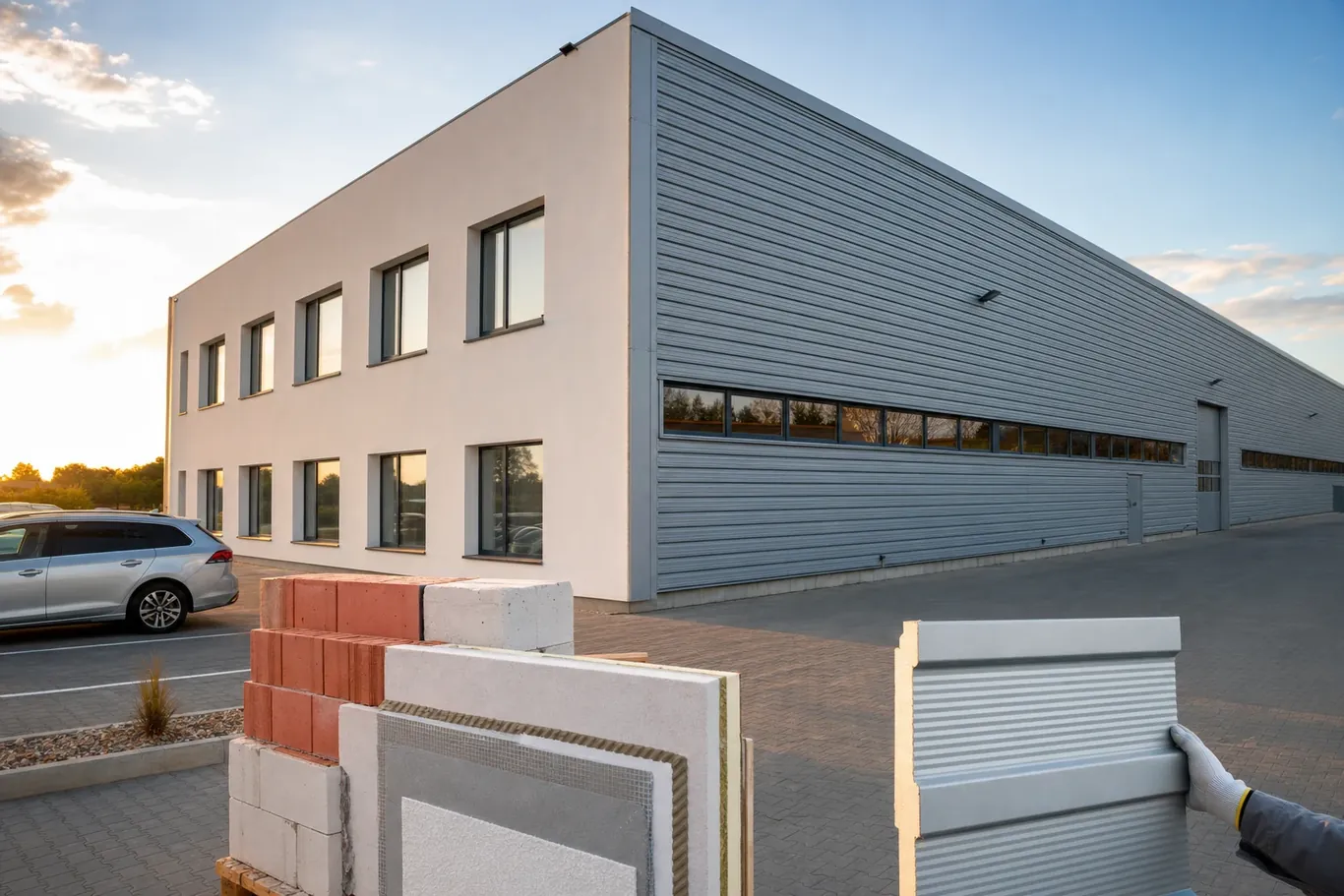
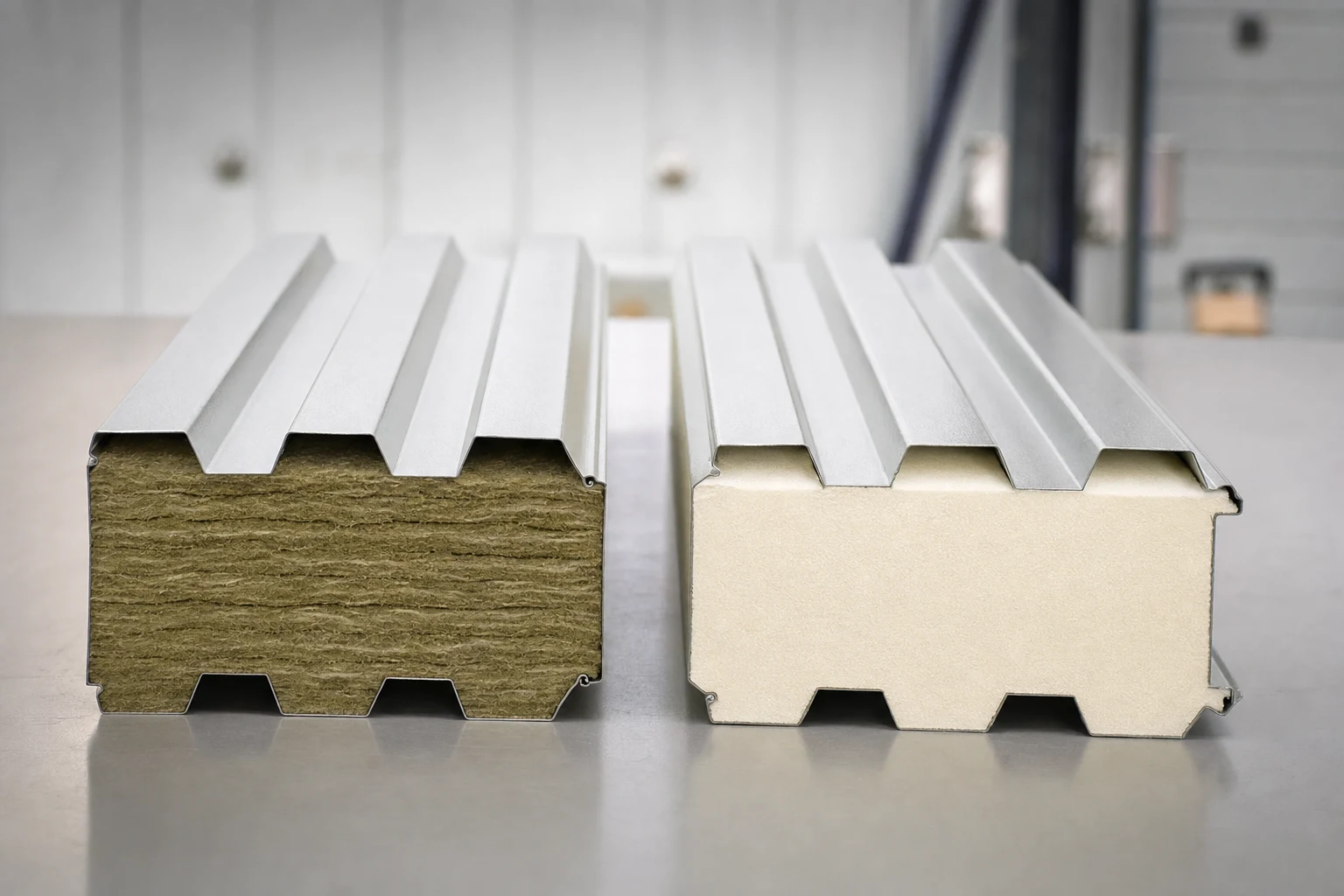
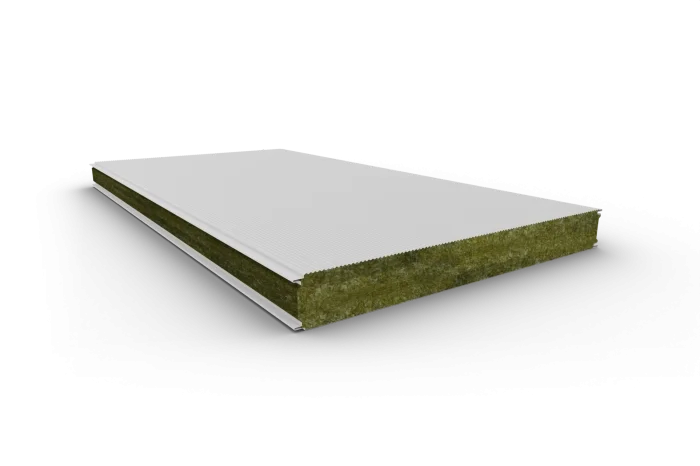
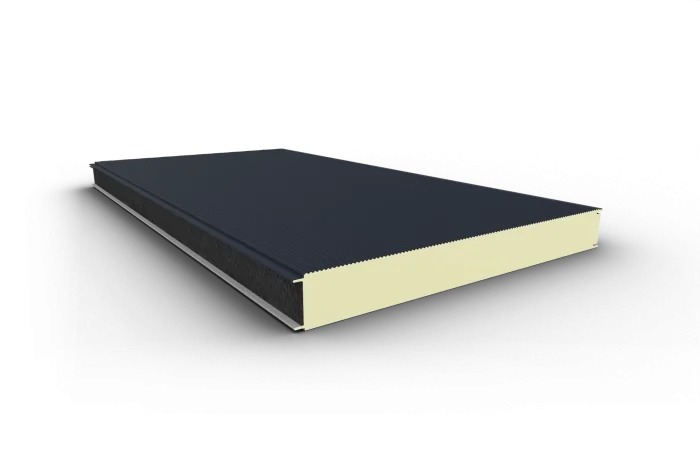
A sandwich panel is always the same idea: two steel facings and an insulating core between them — if you are just getting into the subject, we covered the basics in our article on the “płyta obornicka” (the colloquial Polish name for a sandwich panel). The difference happens on the inside. In GS insPIRe panels the core is rigid PIR foam; in the GS MW line — stone mineral wool.
One housekeeping note: we are talking about sandwich panels, with steel facings, for walls and hall envelopes. termPIR insulation boards for thermal upgrades are a different product and an entirely different conversation.
And the thesis of this whole article fits in one sentence: the core is chosen by the building’s requirements, not by preferences. Let’s see who wins in which category.
When the designer orders wool — and there is nothing to discuss
Stone wool is a mineral material — molten, fiberised rock. In the reaction-to-fire euroclass classification, GS MW panels carry class A2-s1,d0: a practically non-combustible product with negligible smoke emission, no flaming droplets, and the NRO attribute (non-fire-spreading, a Polish classification). PIR foam in sandwich panels is rated B-s1,d0 — very decent for a plastic, but still an organic material that takes part in a fire.
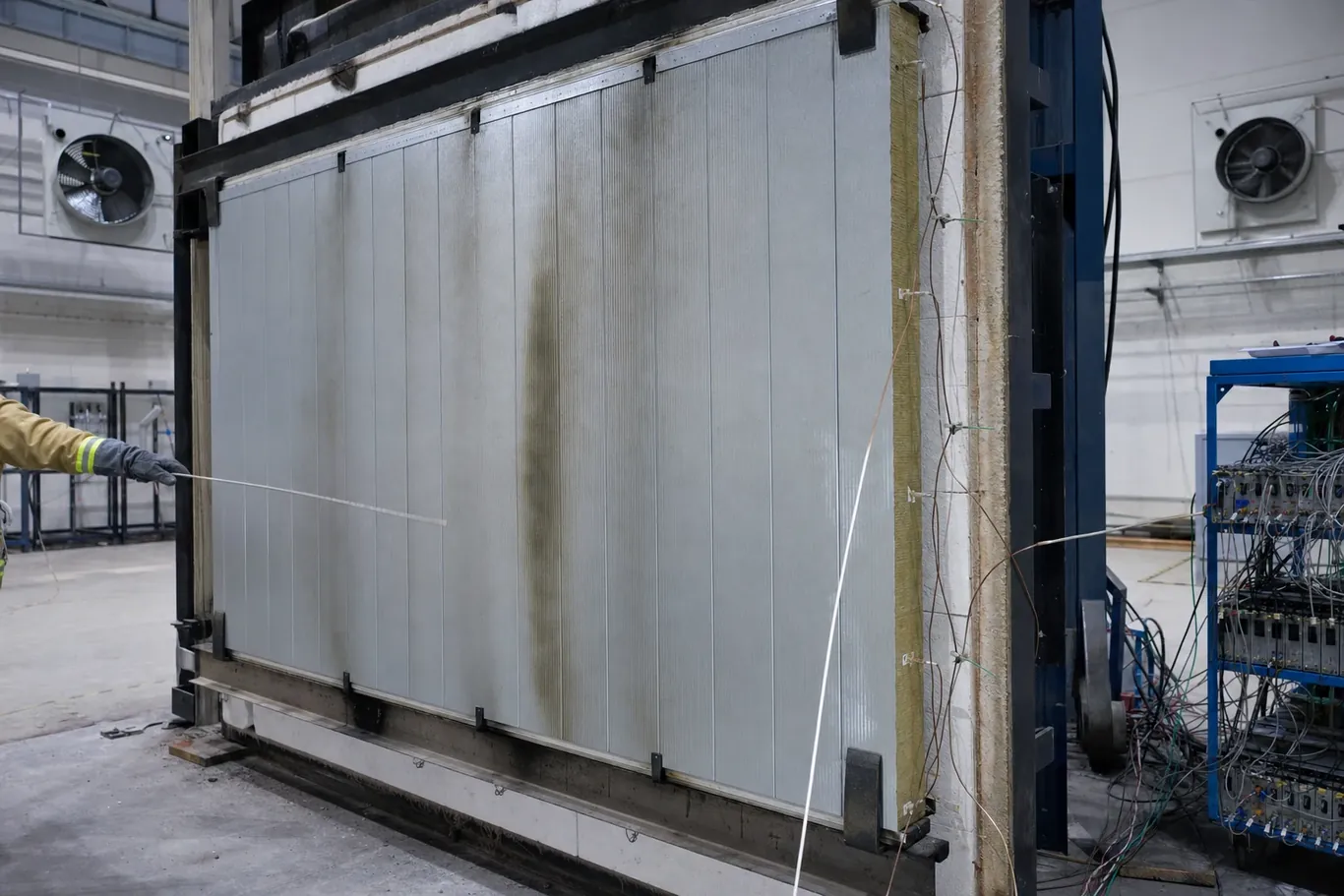
The real gulf, however, opens up at fire resistance — at the question: how long will the wall keep the fire on its own side. The GS MW catalogue answers precisely: 80 mm gives EI 60, 100 and 120 mm — EI 120, 160 mm — EI 180, and 200 and 250 mm — EI 240. Four hours. PIR-core sandwich panels achieve EI 15–30 in comparable tests.
That is why, when the design includes a fire compartment wall, a wall at the plot boundary or the enclosure of a zone with a required class of EI 60 or higher — wool stops being “an option to consider”. It is the only item on the list. The designer does not “prefer” wool; he simply has nothing else with which to meet the regulation.
One caveat that will save you nerves at handover: the EI class applies under test conditions — a specific support span, fixing method, joint sealing. The “EI 120” from a data sheet is the beginning of the checking, not the end. We dissect the traps in the guide EI 120 with a sandwich panel — on what condition.
Eight decibels you can really hear
Wool’s second speciality is noise. GS MW panels declare a sound insulation of Rw = 31 dB (the concealed-fix variant GS MW U 120: 32 dB). insPIRe panels — 23 dB. On paper that is “only” eight or nine decibels, but the decibel scale is logarithmic: the ear perceives a difference of about 10 dB as a sound roughly twice as quiet behind the wall.
Physics is on wool’s side twice over here. The dense core (105 kg/m³) provides mass, and the fibrous structure converts acoustic energy into heat — exactly the way a heavy curtain does compared with a pane of glass. A light, closed-cell foam has neither the one nor the other.
If your hall houses machinery or a compressor room, or stands close to residential buildings, start from the acoustic requirements, not the thermal ones. How to translate laboratory Rw into the real R′w on site, and what values to demand for different types of halls — we cover that in a separate article on the acoustics of sandwich panels.
Where wool loses: centimetres and kilograms
Now the other side of the coin. A stone wool core has a declared lambda of λD = 0.044 W/(m·K). A PIR core: λD = 0.022 W/(m·K). Exactly half — which means you need roughly twice the thickness of a wool panel for the same U-value.
In catalogue numbers: to get down to U = 0.22 W/(m²·K), you reach for a GS MW panel 200 mm thick. PIR delivers similar insulation at roughly half that thickness. A thicker panel means deeper reveals, longer fasteners, more space taken out of the floor plan and fewer panels per transport package.
On top of the centimetres come the kilograms. A 120 mm GS MW panel weighs 23.0 kg/m² (0.6/0.6 mm facings); an insPIRe S of the same thickness — 13.4 kg/m² (0.5/0.5 mm). Almost ten kilograms of difference on every square metre of the envelope. On a hall with several thousand square metres of wall, that is real tonnes the structure has to carry — and which have to be delivered and lifted on site.
Price-wise — no rates, because those depend on configuration — the direction is predictable: since the same thermal effect takes about twice as much of a core that is more expensive to produce, and every metre weighs more, at the same U-value wool usually comes out more expensive in material and logistics. That is why nobody builds an entire hall from wool “just in case” — it goes where its incombustibility and acoustics do the work.
Moisture, or why a car wash is not wool territory
Mineral wool is absorbent. Damp fibres insulate noticeably worse — water conducts heat far better than the air trapped between the fibres — and a wet core inside a tightly closed steel “sandwich” has no way to dry out. In the long run, moisture also affects the durability of the insulation performance, which we show in the 30-year comparison of PIR and mineral wool.
The practical conclusion: wherever the facings and joints are regularly exposed to water — car washes, wet processing zones, intensive pressure washing — the safer choice is closed-cell PIR, whose structure moisture simply cannot enter. In cold stores and freezer rooms a very low U-value additionally rules, so a PIR core is the standard. If, however, fire regulations force wool there too, the GS MW catalogue provides thicknesses up to 250 mm (U = 0.17 W/(m²·K)) — it can be done, only the wall becomes really massive.
And once the wool is up on the building: watch the tightness of the joints and flashings. Dry wool does exactly what the data sheet promises; the problems start with water, not with the material.
What a lamella core looks like — books on a shelf
Cut a GS MW panel across and you will see that the core is not a single block of wool but an arrangement of lamellas — strips of stone wool rotated by 90 degrees so that the fibres run perpendicular to the facings. A bit like a row of books standing spines up.
This trick is not cosmetic. Fibres set across the panel work like thousands of micro-columns: the core gains compressive and tensile strength, and the facings get stable support across the whole surface. Heat, in turn, has to travel across the fibres — the hardest route it can take. The density of such a core in GS MW panels is 105 kg/m³ (±10%) — and it is precisely what accounts at once for the panel’s weight and for its acoustics.
Six criteria, zero sentiment
| Criterion | Mineral wool (GS MW) | PIR (GS insPIRe) |
|---|---|---|
| Fire | wins: A2-s1,d0, EI 60–240 | B-s1,d0, EI 15–30 |
| Insulation / thickness | ~2× thicker panel for the same U | wins: λD = 0.022 W/(m·K) |
| Weight | heavier (18.8–36.6 kg/m²) | wins: about 40% lighter |
| Acoustics | wins: Rw 31–32 dB | Rw 23 dB |
| Moisture | absorbent, needs tight joints | wins: closed cells |
| Cost (directionally) | more expensive at the same U | usually cheaper at the same U |
On paper PIR wins more categories — except that the two in which wool wins cannot be made up with a thicker panel or a lower price. And that is the real punchline — there is no better core, there is a better core for a specific requirement.
You do not have to choose once for the whole building
The most interesting part is that you do not have to settle this dispute for the entire hall at once. The locks of GS MW panels are compatible with GS insPIRe locks — when joining the two types, a strip of glass mineral wool is laid in the groove as additional sealing, and the envelope simply carries on. In practice it looks like this: the fire compartment wall and the inter-storey fire strips in wool, the rest of the envelope in lighter, warmer PIR. According to the manufacturer’s catalogue, such mixed systems make it possible to keep the high fire resistance class where it is required and, at the same time, to get the U-value down to as low as 0.15 W/(m²·K) on the remaining partitions.
Before you call for a quotation, answer four questions. Does the design require an EI class for any partition? Does the building generate noise or stand close to housing? Is any zone wet? What U-value do you have to achieve, and how much wall thickness can you sacrifice for it? From the answers, the map follows almost automatically: where wool, where PIR. Choosing the panel variant — wall with visible or concealed fixing, cold-store — works the same way as in the insPIRe family, which we described in the guide to the S, U, D and CH variants.
🤝 Contact a BOKKA technical advisor — tell us what fire, acoustic and thermal requirements your building has, and we will map out on which walls you need GS MW wool and where lighter PIR is enough.
Sources:
- GS MW S, CH / GS MW U Technical Catalogue — Gór-Stal Sandwich Panels (2025)
- GS insPIRe Sandwich Panels Technical Catalogue — Gór-Stal (2025)
- PN-EN 13501-1 — Fire classification of construction products — reaction to fire
- PN-EN 13501-2 — Fire classification — resistance to fire of building elements
- PN-EN 14509 — Self-supporting double skin metal faced insulating panels — Factory made products — Specifications
Frequently asked questions
When do you have to choose a mineral wool sandwich panel instead of PIR?
Does a wool-core sandwich panel insulate worse than a PIR panel?
How much does a sandwich panel with a mineral wool core weigh?
Can wool panels and PIR panels be combined in one building?
Is the wool in a sandwich panel sensitive to moisture?
Related products and systems
Read next
Sandwich panels second grade — what it exactly means and when it makes sense
Acoustics R'w 30/35/40 dB in Sandwich Panel Halls
EI 120 for sandwich panels — under what conditions? 10 pitfalls of fire classification